

Signal-based marketing automation has revolutionised how marketers reach and engage with customers. By leveraging customer signals such as website visits, email opens, and content downloads, businesses can ensure that content is always timely, relevant, and personalised. Unlike traditional static scheduling, signal-based workflows are dynamic and react in real-time to customer actions. This article delves into 10 actionable signal-based marketing workflows that optimise marketing efficiency, engagement, and conversions by using tools like Clay, HubSpot, and SmartLead.
Learn more about GTM Engineering at Intelligent Resourcing
What Are Signal-Based Workflows?
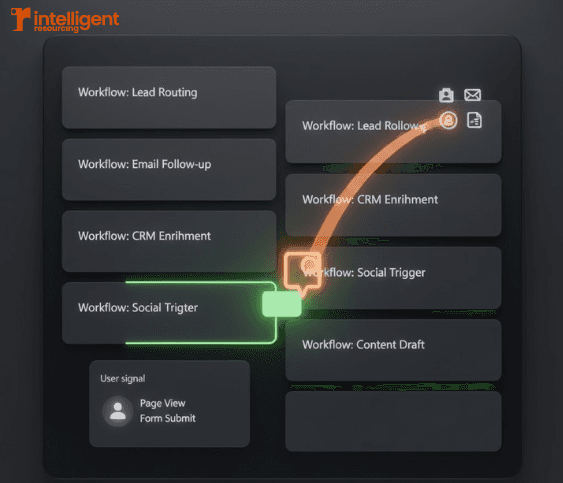
Signal-based workflows are automated processes triggered by specific customer behaviours, such as opening an email or interacting with content on a website. These behaviours send signals that initiate various actions like sending personalised emails, updating CRM profiles, or routing leads to the appropriate sales rep. The primary goal is to improve marketing efficiency and increase personalisation by automating actions based on real-time data.
According to recent research,76% of marketers using marketing automation generate a positive ROI within a year, with71% of customers expecting real-time communication from brands. Signal-based workflows enable this level of responsiveness that modern buyers demand.
10 Signal-Based Marketing Automation Workflows
In this section, we explore 10 practical examples of signal-based marketing workflows and how integrating Clay, HubSpot, and SmartLead can automate and optimise these processes.
Lead Routing Workflows
Lead routing automates the assignment of leads to the appropriate sales representative based on predefined criteria like lead score, geography, or behaviour. Research shows that if you contact a lead within five minutes, you're 21 times more likely to convert them into an opportunity, with 78% of leads buying from the first company that reaches out to them.
Key Statistics
90% of leads who interact with specific content, such as visiting the pricing page, can be routed automatically to senior sales reps
80% of leads interacting with product features are routed to junior reps to ensure more tailored follow-up
Companies using CRM automation see lead conversion rates increase by up to 30%
Workflow Example
Lead Action: A lead visits the pricing page.
Trigger: HubSpot tracks the behaviour and sends a signal to Clay to update the lead's profile.
Action: A senior sales rep is assigned to the lead, and an automated follow-up is scheduled.
Discover more about signal-based lead prioritisation
Outbound Email Triggers
Signal-based workflows ensure that outbound emails are timely and relevant, triggered by specific customer behaviours. Personalised emails triggered by automation drive 320% more revenue than non-automated campaigns, with automated cart abandonment emails recovering up to 25% of sales.
Key Statistics
75% of personalised email sequences triggered by customer actions such as website visits or content downloads result in higher engagement rates.
60% of abandoned cart reminders via automated email campaigns lead to a completed purchase.
Automated emails generate 15.2% higher open rates and 34% higher click-through rates compared to non-automated campaigns
Workflow Example
Lead Action: A lead abandons their shopping cart.
Trigger: SmartLead analyses the behaviour and triggers an email through HubSpot, reminding the lead about the abandoned cart.
Action: The lead receives a personalised email with a discount code, encouraging them to complete the purchase.
CRM Enrichment Flows
By enriching CRM profiles with third-party data or signals from other tools, businesses can improve segmentation and targeting for marketing campaigns. Clay's data enrichment platform provides access to over 100 premium data sources, enabling teams to enrich CRM data at scale and improve lead quality by up to 90%.
Key Statistics
85% of CRM profiles enriched with social media data or job title changes result in more targeted and relevant outreach
70% of enriched profiles trigger more personalised and successful email sequences
Data enrichment can improve campaign personalisation by 50% and enhance customer insights by 70%
Workflow Example
Lead Action: A lead’s LinkedIn profile is updated to reflect a new job title.
Trigger: Clay automatically enriches the CRM with this data.
Action: HubSpot triggers a personalised email outreach, acknowledging the lead’s new role and offering tailored content based on their position.
Learn about Clay's enrichment capabilities
Other Signal-Based Marketing Automation Workflows
In addition to lead routing, outbound emails, and CRM enrichment, signal-based automation can be used in a variety of other workflows. Here are more examples:
Social Media Interaction Triggers
Key Statistics: 50% of leads who engage with a brand’s social media post receive a follow-up email or webinar invitation, increasing engagement.
Customer Behaviour-Based Upsell Triggers
Key Statistics: 40% of customers who make a basic purchase automatically receive upsell offers based on their past purchasing behaviour.
Nurture Campaigns
Key Statistics: 65% of leads who interact with educational content, such as webinars or ebooks, automatically enter a nurturing sequence, moving them through the buyer’s journey.
Companies that nurture leads make 50% more sales at a cost 33% less than non-nurtured prospects, demonstrating the power of systematic lead nurturing.
Explore workflow strategies for B2B teams
How to Optimise Marketing Efficiency with Signal-Based Automation Using Clay, HubSpot, and SmartLead
Signal-based marketing automation workflows are essential tools for improving engagement, personalisation, and efficiency. By leveraging tools like Clay, HubSpot, and SmartLead, businesses can automate critical tasks such as lead routing, email outreach, and CRM enrichment, ensuring that marketing and sales teams respond to customer signals in real-time.
Research shows that companies using marketing automation experience a 451% increase in qualified leads and 53% higher conversion rates. Additionally, 79% of top-performing companies have been using marketing automation for more than two years, demonstrating the long-term value of these systems.
Learn which tools you need for signal-based marketing
Next Steps
Start building your own signal-based workflows today using Clay, HubSpot, and SmartLead. For personalised guidance, schedule a consultation with GTM engineers to optimise your automation stack and enhance your marketing operations.
Learn more about GTM Engineering services
Frequently Asked Questions (FAQs)
1. What are signal-based marketing automation workflows?
Signal-based workflows are triggered by specific customer behaviours (e.g., email opens, website visits, or form submissions) that initiate actions such as email sends, lead routing, or CRM updates.
2. How can I use signal-based automation for lead routing?
By integrating Clay and HubSpot, you can route leads based on their interactions with your content. For example, leads visiting your pricing page can be assigned to senior sales reps, while those viewing product features can be routed to junior reps.
3. Can signal-based automation help with email personalisation?
Yes, by tracking customer interactions (e.g., website visits or content downloads), you can trigger personalised email sequences that align with the customer’s interests and behaviour, ensuring relevant and timely outreach.
4. How does AI fit into signal-based marketing automation?
AI enhances data analysis and decision-making by analysing customer behaviour in real time. AI tools like SmartLead can evaluate lead quality, predict future actions, and automate tasks like lead scoring, CRM enrichment, and content recommendations.
5. How can I start building my own signal-based automation workflows?
You can begin by integrating tools like Clay, HubSpot, and SmartLead into your marketing stack. From there, define the customer behaviours (signals) you want to track, and design workflows that respond to those signals to automate key marketing tasks.
Explore essential tools for your signal-based marketing stack
Related Resources
Account-Based Marketing (ABM) Without the Overhead: GTM Framework – Learn how to build signal detection systems and automated workflows for scalable, personalized ABM campaigns without traditional overhead
Best Ways To Build A GTM Strategy With A Small Marketing Team – Discover how small teams can leverage signal-based automation to compete with larger competitors through efficient workflow design