Account-Based Marketing: The Signal-Led Playbook (2026)
Static ABM contacts accounts too early or too late. Signal-led targeting flags which accounts are ready to buy right now.
By Ronan Leonard, Founder, Intelligent Resourcing

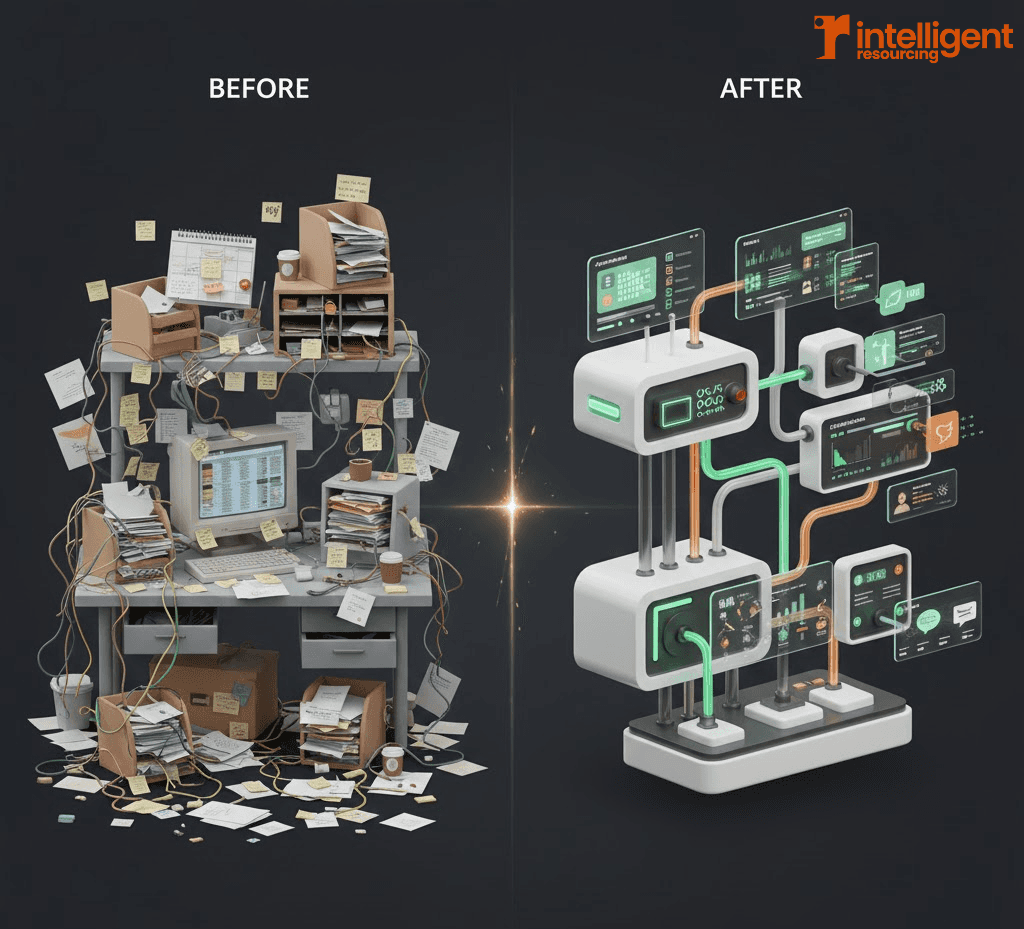
Account-based marketing coordinates sales and marketing around a defined list of high-value accounts. Most B2B programs build that list from firmographic fit and treat it as the strategy. Most never scale past the pilot stage. Missed Timing is the bottleneck, not list quality.
The account list defines who qualifies. Based on industry, headcount, revenue band, tech stack and geography. Most programs stop there and run every account at the same intensity regardless of what that account is doing right now.
Firmographic fit tells you who matches your profile. It does not tell you who is looking right now. That is where most ABM programs stall, contacting accounts too early, too late or after a competitor already engaged them.
A hire, a funding round, a competitor migration are revenue signals. They show which accounts are actively evaluating a purchase. Signal-Led Growth layers these on top of the list so outreach routes to accounts inside a Verified Buying Window™.
The signal layer does not replace the list. It determines who on the list is worth working this month and routes the rest into low-touch nurture until they show a signal of their own.
Factor | Static-List ABM | Signal-Led Growth |
Primary filter | Firmographic fit | Firmographic fit + live revenue signals |
Prioritisation | Same intensity across the list | Ranked by signal recency and volume |
Timing | Campaign calendar | Account behaviour |
Best used for | Small lists, early pilots | Lists past a few hundred accounts |
Setup | Lower upfront cost | Higher upfront, built to hold at scale |
Static-list ABM tells you who fits. Signal-Led Growth tells you who is ready. For teams with a list that has outgrown manual prioritisation, the gap between those two questions is where sales hours disappear. The signal layer closes that gap by routing outreach to accounts with a dated, specific reason to be in-market.
Account-Based Marketing Model
Account-based marketing treats a specific account, not an individual lead, as the unit of targeting. A team builds a defined list of companies matching its ideal customer profile. Sales and marketing coordinate activity around each account on that list.
The list usually comes from firmographic data: industry, headcount, revenue band, tech stack, geography. A B2B SaaS company selling to mid-market logistics firms might list every Australian logistics business with 50 to 500 staff running a competing platform.
Marketing budget growth slowed to 3.3% in 2025, with digital spend growth down to 7.3%, per Duke's Fuqua School of Business CMO Survey. That leaves little room to fix a targeting problem by spending more. The list defines who fits, but it says nothing about who is ready. Without a signal layer, every account on the list receives the same outreach on the same schedule regardless of where they are in a buying cycle.
ABM in Four Stages
A standard ABM motion runs in four stages.
Build the account list. Define who qualifies using firmographic data: industry, headcount, revenue band, tech stack and geography. This defines the universe every downstream activity runs against.
Align sales and marketing. Agree on which accounts are priority, who owns each touchpoint and what a conversion looks like at the account level.
Run coordinated campaigns. Deliver account-specific outreach across channels: paid, email, content and direct sales activity.
Track engagement and pipeline movement. Measure account-level engagement, not lead volume. An account moving from silence to multiple touchpoints in 30 days is worth escalating.
Most teams execute all four stages but apply the same intensity to every account on the list. A company evaluating vendors this week gets the same cadence as one that will not open a budget conversation for eight months.
Why Do Most ABM Programs Stall on Missed Timing?
Firmographic fit answers one question: does this account match our ideal customer profile. It does not answer the revenue question: is this account looking for a solution right now.
Missed Timing is the villain. A team contacts accounts too early, too late, or after a competitor already engaged them, because the targeting logic cannot detect where an account sits in its buying cycle. Foundry's ABM and intent data research found 91% of marketers use intent data to prioritise ABM accounts, yet most still run the same sequence regardless of signal timing.
That failure costs a team in three specific ways.
Reps spend hours on accounts that will not convert for months.
Follow-up cadences run out before a real buying window opens.
Accounts genuinely in-market get the same generic sequence as everyone else.
A national waste-management company's previous vendor delivered leads where 80 to 90% fell outside the ideal customer profile. A signal engine replaced it and brought in 150 net-new accounts in phase one, 250 over four months, each checked against the existing base. At $150,000 to $250,000 in annualised value per account, that gap is not marginal.
Revenue Signals Change the Outreach Motion
Revenue signals are actions showing an account is actively evaluating a purchase. A hire tied to the product category, a funding round, a competitor tool migration, a market expansion. Each shows something changed inside that account that firmographic data cannot detect.
Signal-Led Growth layers these signals on top of the firmographic list. Outreach no longer runs on a campaign calendar. It triggers when an account moves.
A competitor contract expiry 60 days out is a hard deadline.
A relevant job posting indicates an evaluation is starting.
A funding round opens budget that did not exist last quarter.
An account enters active outreach only once it shows a signal, inside a Verified Buying Window™. A mid-tier account showing three signals this month moves to active outreach before a top-tier account showing none. That sequencing is what static-list ABM cannot replicate.
Signal-Led ABM on a Live List
A logistics software vendor carries 400 accounts on its ABM list, all matching the ideal customer profile on paper. In one month, six post a job listing for a logistics systems manager, four renew a competitor contract within 60 days and three close a funding round.
Under a static-list model, all 400 get the same quarterly campaign. Under Signal-Led Growth, those 13 accounts move into active outreach with messaging built around the specific signal.
Signal | Outreach Angle |
Contract renewal | Competitive displacement conversation |
Funding round | Capacity and scale conversation |
Relevant hire | Systems evaluation conversation |
The remaining 387 stay in low-touch nurture until they show a signal. The result is not a larger outreach volume. It is a smaller one with a specific reason behind every contact.
Why Signal Timing Outperforms Account Rank?
The accounts that convert fastest in signal-led programs are rarely the largest names on the list. They are the accounts that just showed a signal, regardless of where they sit in the account ranking.
A static list ranks accounts by size and fit. That ranking reflects who should eventually convert, not who is ready now. A 500-person company with no recent signals is a lower priority than a 100-person company that just posted a relevant hire and opened a funding round.
The failure mode of ranking without signals is consistent. Reps spend the most time on the accounts that look the most impressive and convert at the slowest rate. The signal layer separates who qualifies from who is in motion.
Does ABM Work Differently for B2B SaaS?
SaaS sales cycles involve multiple stakeholders, a technical evaluation and a renewal or expansion motion layered on new-logo acquisition. A static list cannot distinguish a current customer showing expansion signals from a net-new account beginning its first vendor search.
SaaS buying signals leave a specific trail. Job postings, review-site activity, competitor renewal dates, integration marketplace activity and funding events. A signal-led SaaS program routes accounts based on which motion applies: new-logo, expansion or competitive displacement.
The expansion motion is where static-list ABM loses most ground. Existing customers approaching a renewal show signals weeks before the conversation starts. A program without signal detection treats them identically to a cold account.
ABM Intent Data vs. Signal-Led Routing
Most ABM platforms sell intent data: third-party signals showing an account is researching a topic. Intent data shows someone read an article. It does not show budget, timing or buying authority.
A revenue signal such as a specific hire, a funding event or a contract expiry ties directly to a decision the account is making. The Starr Conspiracy's 2025 B2B Intent Data Benchmarks found intent-prioritised accounts converted to closed opportunity at 21.3% versus 8.4% for accounts without signal prioritisation.
Signal-led routing replaces the research flag with a decision flag. The account is taking an action that only makes sense if a purchase is already in motion.
Building the Signal Layer on an Existing ABM List
Signal-Led Growth adds a layer to the existing account list, determining who is active and routing sales effort accordingly. Building it requires three things.
A defined signal set matched to your market.
Enrichment pulling live data from hiring activity, funding databases and competitor tracking.
Routing logic that connects signal scores to CRM prioritisation.
Without the routing step, the signals sit in a dashboard and do not change how the list is worked.
This is what Intelligent Resourcing builds through GTM Engineering. The work covers signal definition, enrichment architecture and the workflow connecting detection to outreach.
The same engine screens about 50,000 Australian news items a day into roughly 50 actionable signals, and narrows a universe of 115,000 companies to about 50 net-new, CRM-checked accounts a month. Applied to an existing list, the logic holds: most accounts stay quiet, and the job is finding the few that just moved.
The enrichment layer runs on Clay workflows. A rep starts each day with a ranked list of accounts showing real activity, not a static tier from last quarter's scoring run.
How Do You Measure a Signal-Led ABM Program?
Static-list ABM is usually measured on account engagement and pipeline volume. A signal-led program needs three additional metrics.
Time-to-first-touch on flagged accounts. A week-long gap between detection and action means the alert exists but nothing downstream changed.
Share of pipeline sourced from Verified Buying Window™ accounts. This isolates the layer's actual contribution instead of crediting it for pipeline the static list would have produced anyway.
Signal-to-meeting conversion rate versus static-list baseline. A program that doesn't beat the baseline needs its signal set re-weighted.
Tracking these requires no new infrastructure, just tagging which outreach originated from a signal, then reporting that separately.
Choosing ABM Tools for Signal-Led Targeting
Most ABM platforms manage the account list and run the campaign. Ad targeting, account scoring and engagement dashboards come built in. None of that detects a buying signal or routes an account in real time.
Define what signals matter for your market before evaluating any tool. A tool scoring accounts on generic intent data without a configurable signal set produces the same undifferentiated list you started with.
The ABM tools roundup covers platform selection and where each tool falls short on real-time routing. Four questions separate a signal-led platform from a relabelled intent-data tool.
Can you define and weight your own signal set, or only use the vendor's pre-built categories?
Does enrichment refresh daily, or only on a manual pull?
Does a triggered signal write back to the CRM automatically?
Can the tool distinguish a new-logo signal from an expansion signal on an existing account?
A platform that cannot answer the first two is selling intent data with an ABM interface on top.
Fit Check
Best for: B2B teams in Australia with a defined ICP and an existing follow-up motion who want to stop running every account through the same sequence regardless of buying readiness.
Not for: teams still validating their ICP, or running ABM against fewer than 50 accounts where manual prioritisation is practical.
The trade-off: a signal layer takes longer to build than a standard campaign. It removes the wasted sales hours that come from contacting accounts before they are ready.
Send your account list. We'll show you which accounts would already be inside a Verified Buying Window™ this month.
Get Your Signal Layer Scoped →
FAQs
What is account-based marketing?
Account-based marketing treats a specific company as the unit of targeting. Sales and marketing coordinate activity around a defined list of accounts.
What is the difference between ABM and lead generation?
Lead generation pursues individuals who show interest. ABM targets defined accounts regardless of inbound behaviour and coordinates every touchpoint around the account as a whole.
How many accounts do I need for ABM to work?
Static-list ABM works for lists of 50 accounts or fewer. Signal-Led Growth becomes the stronger model once the list grows past a few hundred accounts.
What is the difference between intent data and revenue signals?
Intent data shows someone consumed content on a topic. Revenue signals show a specific action tied to a buying decision. Revenue signals carry more timing precision.
How long before a signal-led ABM program shows results?
Most teams see the first flagged accounts move to active outreach within the first sweep. Pipeline impact takes a full sales cycle to show up in closed-won data.
Does signal-led ABM replace our CRM or intent data tool?
No. The signal layer sits on top of both, scoring and routing accounts based on combined signal activity rather than replacing either system.