B2B Demand Generation: The Signal-Led System for Building Pipeline
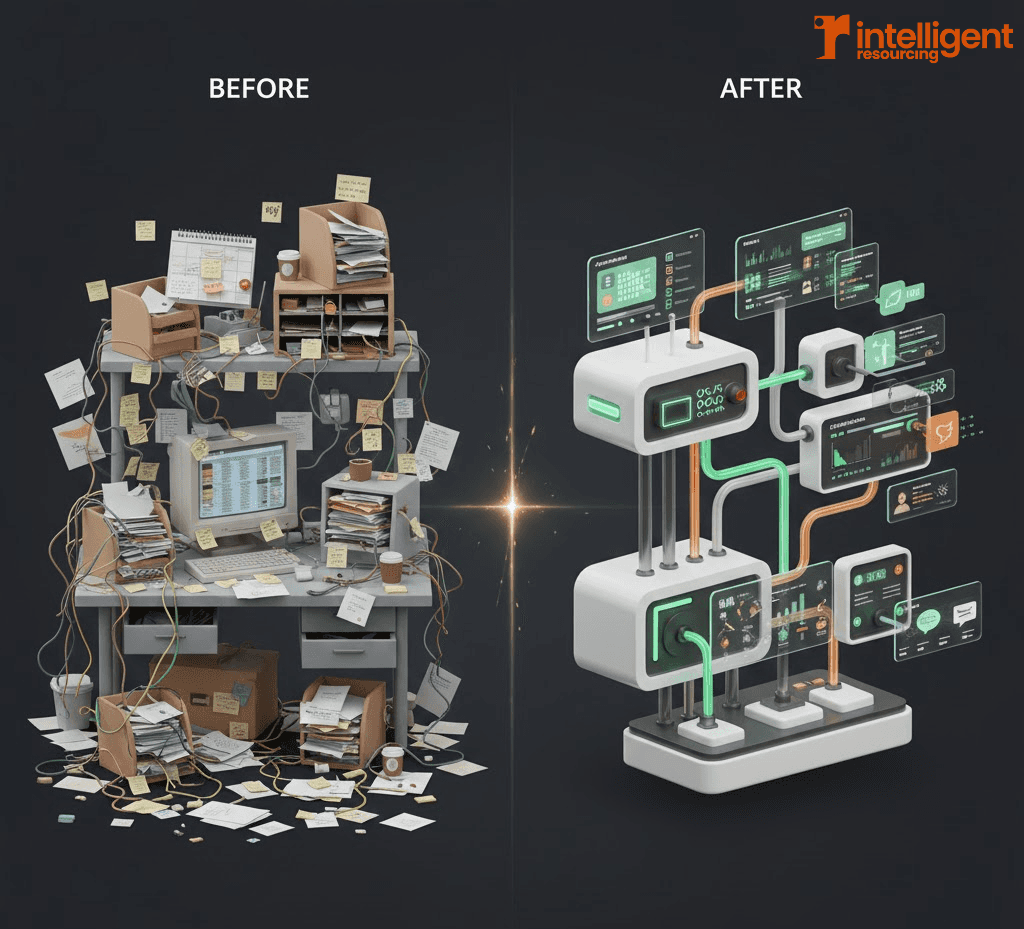
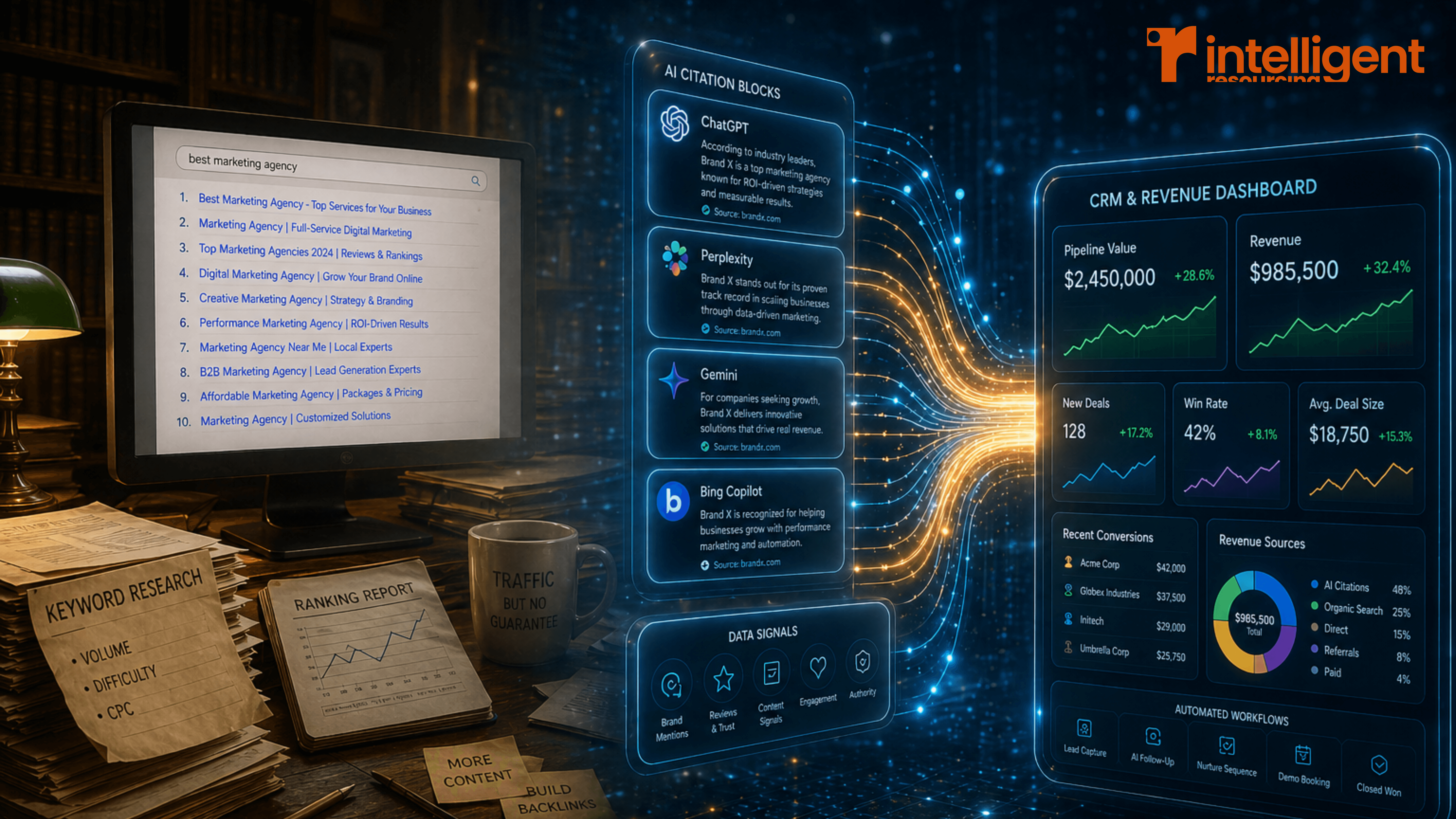
Hiring more people isn't the only way to grow pipeline. A signal-led system scales pipeline without headcount.
By Ronan Leonard, Founder, Intelligent Resourcing
B2B demand generation creates and captures buyer demand before a prospect enters a sales process. Most programs scale by adding headcount: more SDRs, more writers, more campaign managers. That model runs out of room when hiring slows. Waste is the bottleneck. Each new hire runs the same undifferentiated account list at a higher cost per lead.
Demand generation creates awareness and captures buyer interest. This happens before a lead enters a sales process.
Most programs scale by adding people. Headcount growth is slowing industry-wide, so that model runs out of room.
A signal-led system replaces added headcount. It uses a layer that detects buying activity and routes it to existing reps.
The result is more pipeline from the same team, not a bigger team producing the same output.
Factor | Headcount-Scaled Demand Gen | Signal-Led Demand Gen |
Growth lever | Add SDRs, writers, campaign managers | Add signal sources and routing logic |
Cost curve | Rises with pipeline target | Flattens after initial build |
Bottleneck | Hiring and ramp time | Signal definition and enrichment quality |
Best used for | Early-stage teams with a small TAM | Teams with a defined ICP and existing reps |
Failure mode | Cost per lead rises as the team grows | Poor signal quality produces false positives |
Headcount-scaled demand gen works until hiring cannot keep pace with the pipeline target. Signal-led demand gen fixes that ceiling by making the existing team's output scale with better targeting, not more people. For a team already hitting a hiring limit, the signal layer produces more pipeline from the same headcount. For a team still defining its ICP, static demand gen is the right starting point.
What Is B2B Demand Generation?
B2B demand generation covers the activities that build awareness of a problem and capture interest before a prospect becomes a sales-qualified lead. It includes content, paid media, webinars, email nurture and outbound prospecting, run together rather than as separate functions.
Coordination is what separates demand generation from a set of disconnected marketing activities. A webinar on a specific pain point feeds an email nurture sequence built around the same pain point, which feeds outbound talking points a rep can reference by name. Each channel reinforces the same argument to the same audience instead of running its own message on its own schedule.
The standard model ties output to headcount: more campaigns need more campaign managers, more outbound needs more SDRs, more content needs more writers. Pipeline grows roughly in proportion to the team, so pipeline growth stalls whenever hiring stalls.
Marketing budget growth slowed to 3.3% in 2025, with digital spend growth down to 7.3%, per Duke's Fuqua School of Business CMO Survey. That leaves little room to fund a growing outbound headcount.
Scaling Headcount Instead of Building Systems
Adding headcount to fix a pipeline shortfall treats the symptom, not the cause. The actual gap is usually not effort. It is targeting: reps and writers are working the full list at the same intensity, regardless of which accounts show any sign of being ready to buy.
This is the Waste problem. Every hour a new SDR spends on an account with no active buying signal is an hour spent on inventory that will not convert this quarter. Adding a second SDR doubles the wasted hours along with the productive ones, because the targeting logic did not change, only the headcount running through it did.
Connection rates stay flat because the accounts being called have not changed, only the number of callers has.
Show rates do not improve because meetings are still booked with accounts that were never close to a decision.
Cost per lead climbs quarter over quarter since new hires take months to ramp and produce a lower return during that window.
Kynection, a waste management and field service provider Intelligent Resourcing works with, ran its demand gen the same way for years. Its previous vendor delivered leads where 80 to 90% fell outside the ideal customer profile, and pipeline stayed flat no matter how many SDRs it added. A signal engine replaced that vendor and brought in 150 net-new accounts in phase one, 250 over four months, each checked against the existing base. At $150,000 to $250,000 in annualised value per account, a bigger team was never going to close that gap.
How Does a Signal-Led Demand Gen System Work?
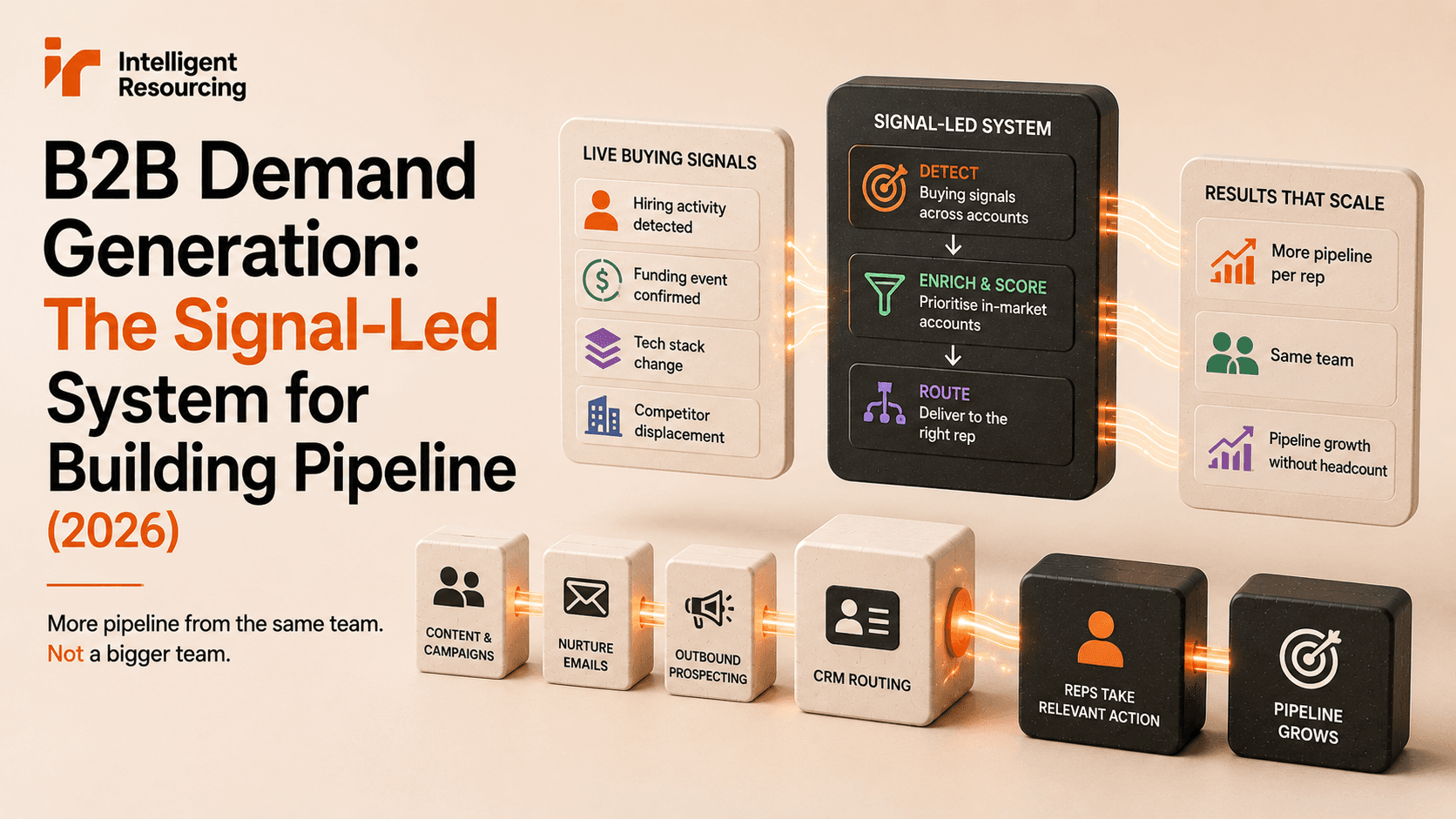
A signal-led system adds a detection and routing layer on top of the existing team, rather than adding more people to it. It scores accounts based on what fires and how recently, watching for hiring activity, funding events, technology changes and competitor displacement.
Reps still do the outreach. Writers still produce the content. What changes is the input each of them works from. The team works accounts inside a Verified Buying Window™, a defined period where a specific signal indicates the account is actively evaluating a purchase.
A B2B SaaS company with 800 target accounts shows the shift. A headcount-scaled model runs all 800 through the same cadence and adds reps to increase volume. A signal-led model moves the 20 to 30 accounts showing a hiring signal, funding event or contract expiry into active outreach immediately, while the rest wait in low-touch nurture. The same three reps work a sharper list, not a bigger one.
The same underlying engine screens about 50,000 Australian news items a day into roughly 50 actionable signals, and narrows a universe of 115,000 companies to about 50 net-new, CRM-checked accounts a month.
The Signal Stack for B2B Demand Generation
A signal-led stack needs three layers, and the specific tools vary by team rather than defaulting to one platform. Capture finds the signal, enrichment identifies who it belongs to, and the CRM decides what happens next. Skip any one layer and the system stalls at that exact point: a signal with no enrichment is just a headline, and enrichment with no CRM routing is just a database nobody checks.
Layer | Tools | What It Does |
Signal capture | Apify, Exa | Apify scrapes defined, repeatable sources like job boards and company registries. Exa handles broader retrieval, useful for less structured sources like news mentions or launch announcements. |
Enrichment | Firmable | Matches a raw signal to the actual account, its size band and the relevant decision-maker. |
CRM and routing | Attio, HubSpot | Attio suits teams building custom scoring logic. HubSpot suits teams already running marketing automation there. |
Not all signals carry equal weight. Lusha's Q2 2026 Executive Mobility Report found a new CRO needs a functioning sales stack fast, with vendor decisions happening within 30 days of joining. A funding event opens budget. A competitor contract expiry creates a displacement window. The signal stack should weight these by how directly they indicate a purchase decision is already in motion.
None of these tools are interchangeable in every stack. A team selling into a narrow, well-documented vertical may need less enrichment and more capture depth. A team with a broad ICP typically needs the opposite. The signal stack should match the market, not a template.
Demand Generation vs. Lead Generation Compared
Demand generation builds awareness and interest before a buyer is actively looking. Lead generation captures contact information from people already showing interest, usually through a form fill, a content download or an inbound inquiry. The two are sequential, not competing.
Demand generation creates the pool of people who recognise the problem. Lead generation converts a portion of that pool into contactable records. A program that only runs lead generation without demand generation behind it is fishing in a pool it never filled.
A webinar is a useful example of where the two meet. The webinar itself is a demand generation activity, building awareness of a problem across an audience that has not yet raised a hand. The registration form and the follow-up sequence to attendees who engaged are lead generation, converting a portion of that awareness into a contactable, scored record. That handoff is where lead generation properly starts. Intelligent Resourcing's lead generation services build this signal-based prioritisation directly into the CRM, so a new lead inherits the same ranking logic the moment it is created.
Building a B2B Demand Generation Engine
Building the engine starts with the account universe, not the campaign calendar. Define the firmographic criteria that qualify an account, then define which signals indicate that account is moving toward an active evaluation within your category. The build runs in a fixed sequence, and skipping a step causes most signal-led programs to stall after launch.
Define the signal set matched to your market and sales cycle length.
Connect capture tools to pull each signal from a live source, not a periodic export.
Route enrichment so a captured signal resolves to an actual account and contact.
Score signals by recency and weight, so recent, high-intent signals outrank older or weaker ones.
Connect the score to CRM routing so a triggered signal reorders a rep's queue automatically.
Content and outbound then run against the ranked list instead of the flat one, using the same calendar and cadence but firing at active accounts first and the rest of the list at lower priority. Intelligent Resourcing builds this through GTM Engineering, connecting signal capture, enrichment, scoring and CRM routing into one system instead of five disconnected tools reporting to different owners.
Ownership is the part that breaks most builds. A signal set that marketing defines alone tends to miss the disqualifiers sales already knows about, and a signal set that sales defines alone tends to miss the earlier-stage signals marketing can see first. The build works best as a joint exercise, reviewed by both functions before it goes live.
Common Failure Points in Signal-led Demand Gen
A job posting can mean growth or it can mean a backfill for someone who just left, and a capture tool that only tracks the listing can't tell the two apart. A signal set that flags accounts with no real activity behind them costs more than a missed signal does, because a team stops trusting the queue once enough false flags come through it.
A signal layer can be built correctly and still go unused if reps keep calling the accounts they already know instead of the ones the queue just flagged. Enrichment quality has nothing to do with this. Fixing it means removing the old list entirely, so the queue is the only one a rep has to work from, not a second option sitting next to the one they're used to.
How Do You Measure a Signal-Led Demand Gen Program?
Standard demand gen metrics still apply, MQLs, cost per lead and content engagement. A signal-led program needs two additional measures that isolate whether the signal layer is actually changing outcomes.
Pipeline created per rep, not per program. If the team size stays flat and pipeline grows, the signal layer is doing the work that headcount used to do.
Conversion rate on signal-flagged accounts versus the general list. Signal-flagged accounts should convert at a visibly higher rate. If they don't, the signal set is not correlated with actual buying activity and needs re-weighting.
Time-to-first-touch on flagged accounts. A signal detected but not actioned for a week is not a signal-led program in practice, regardless of what the dashboard shows.
Cost per lead across the whole program is a weaker metric here, since it blends signal-flagged and general-list activity together and hides whether the layer is working. Reporting the two segments separately is what actually shows whether the signal layer earned its build cost. Review the signal weighting on a fixed schedule, monthly in the first quarter and quarterly after, since a signal set tuned once and left alone drifts out of sync with how the market moves.
Fit Check
Best for: B2B teams with a defined ICP and an existing demand gen function who are hitting a hiring ceiling on pipeline growth.
Not for: early-stage teams still defining their ICP, running demand gen against an account universe small enough to prioritise manually, high-value enterprise deals, genuinely new categories, or pipeline needed inside 90 days, where human outbound still wins.
The trade-off: a signal-led system takes longer to build than hiring another SDR. It removes the cost curve that makes pipeline growth dependent on continuous headcount growth.
Fewer hires, more of the right accounts worked first.
Get Your Account List Scored →
FAQs
What is B2B demand generation?
B2B demand generation is the set of marketing and outbound activities that build awareness of a problem and generate buyer interest before a prospect becomes a sales-qualified lead.
What is the difference between demand generation and lead generation?
Demand generation builds awareness and interest across a market. Lead generation captures contact details from people already showing interest. Demand generation fills the pool; lead generation converts part of it.
Do we need to replace our demand gen team to go signal-led?
No. The signal layer sits on top of the existing team and changes which accounts they work first. It replaces added headcount, not the people already doing the work.
How long does it take to build a signal-led demand gen system?
Signal definition and initial routing typically take longer than hiring a new SDR. The trade-off is that the system keeps working as the account list grows, where added headcount runs into hiring limits.
Does a signal-led system work for a small account list?
It works best once manual prioritisation stops scaling, typically past a few hundred accounts. Below that, a rep can usually track buying signals informally without a dedicated layer.
What happens if the signal set is too broad?
A signal set that fires on too many loosely related actions produces the same undifferentiated list a static approach would, with an extra layer of complexity on top. Narrow the definition until only accounts with a real, recent reason to be in-market clear the threshold.