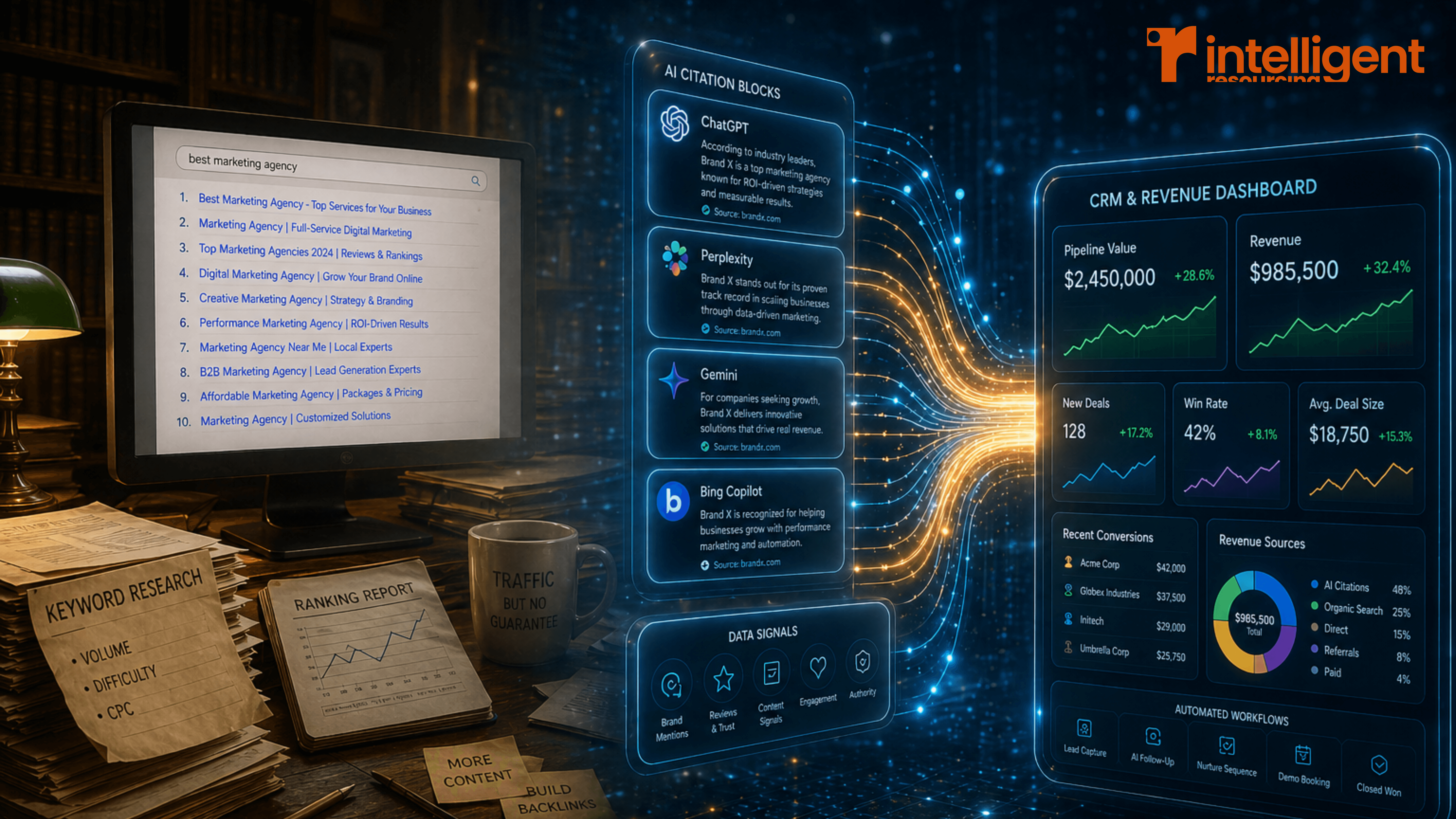
Ranking in Google vs Getting Cited in ChatGPT: How B2B Brands Win the AI Layer
You rank in Google but never appear in ChatGPT answers. Here is exactly what your pages are missing and how to fix it.
By Ronan Leonard, Founder, Intelligent Resourcing
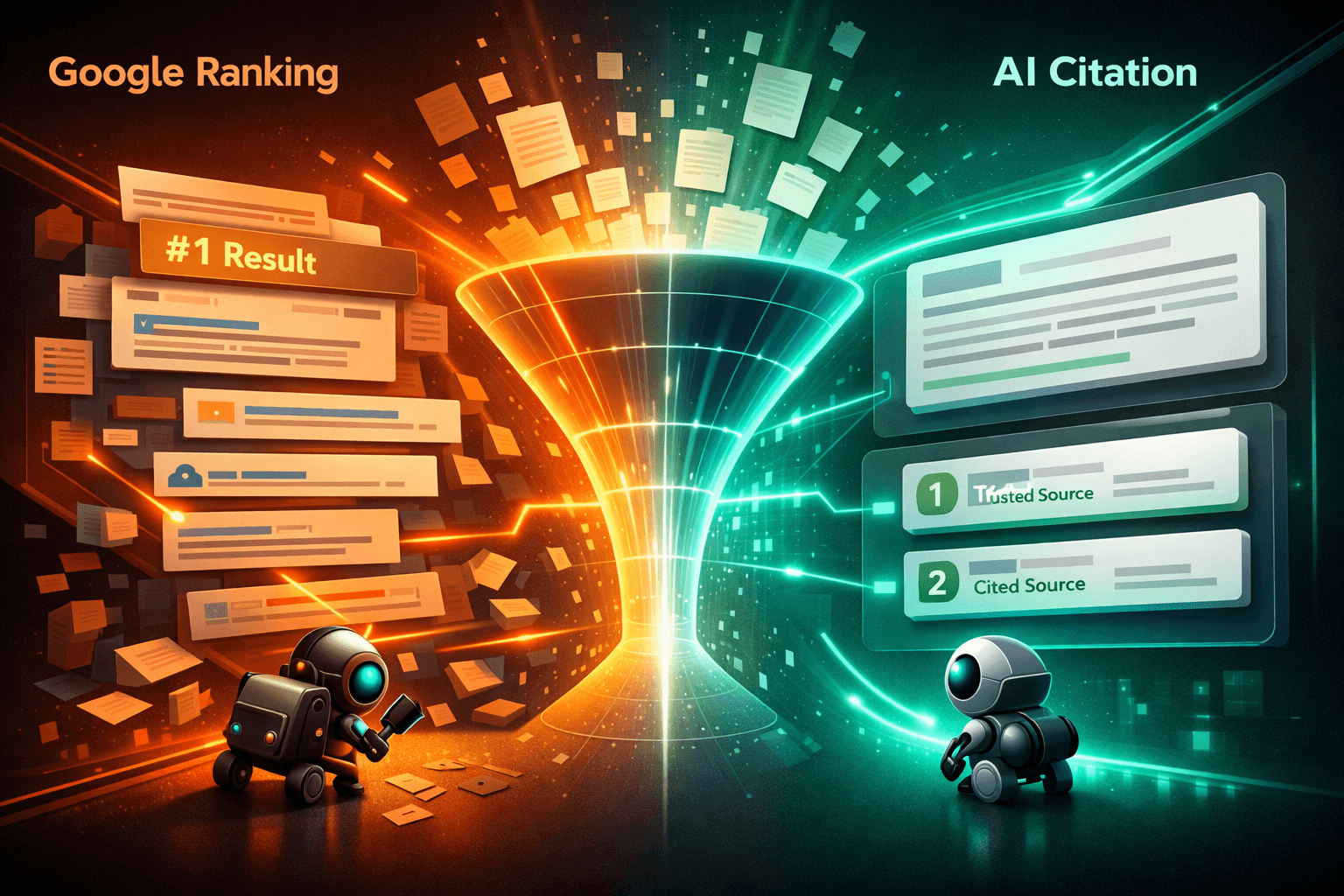
ChatGPT SEO means getting your brand cited inside AI search answers, not just ranked in Google. To appear as a cited source, your pages need OAI-SearchBot access, a clear answer structure, and content strong enough for this LLM to rely on. Block the crawler or bury the answer and the page will not be cited regardless of how well it ranks.
Allow OAI-SearchBot in your robots.txt to enable your pages to appear in search answers and capture referral traffic
Prioritise service pages, case studies and proof-led guides over blog content to increase citation probability, only 1.9% of ChatGPT's top 1,000 cited pages were blogs
Structure content with clear sections, evidence and extractable answers to become a citable source instead of just a search result
Optimise for citation logic, not ranking logic to become a source, not just a result.
Criteria | Ranking in Google | Getting cited in ChatGPT |
Main outcome | Wins a place in search results | Wins a place inside an answer |
User behaviour | Clicks a result | Reads an answer, then checks sources |
Core system | Crawling, indexing, serving | Search plus source-backed answer generation |
Access requirement | Googlebot access and indexability | OAI-SearchBot access for answer inclusion |
Winning page type | Relevant, competitive page | Clear, quotable, citation-ready page |
Measurement | Rankings, clicks, traffic | Referrals, source-page visits, assisted commercial value |
If you build pages that are accessible to OAI-SearchBot, answer clearly, and give something reliable to cite, then your brand has a real chance of appearing inside AI-generated answers where buying decisions are increasingly being made.
If you rely on Google rankings alone and assume citation will follow, then your pages may rank on page one and still never appear in a single ChatGPT answer.
What “ChatGPT SEO” actually means
This means getting your brand cited inside ChatGPT search answers. It is not about using it as a content writing tool.
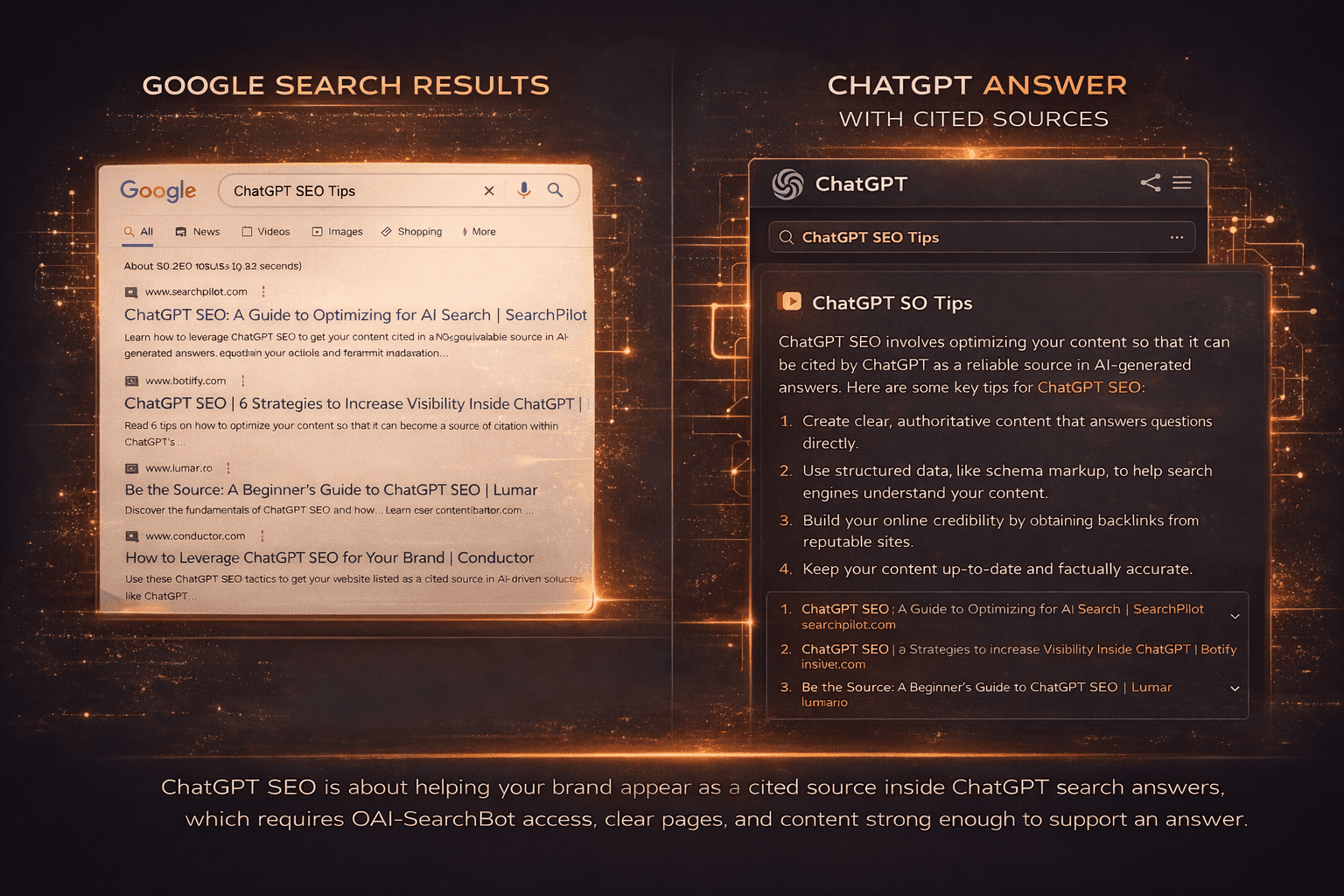
If you want your brand to get cited, you need to think about crawler access, source quality, page clarity, and whether your content gives the model something useful to rely on. OpenAI's publisher guidance makes this explicit: public websites can appear in ChatGPT search, but content must be accessible to OAI-SearchBot to be included in summaries and snippets.
This is a platform-specific optimisation problem inside the wider generative engine optimisation.(GEO) picture. The user is not choosing a blue link. They are reading an answer and deciding whether the cited source is worth following.
Ranking vs getting cited
Google ranks pages. ChatGPT cites them. These are different jobs and a page built for one does not automatically succeed at the other.
Google Search works in three stages: crawling, indexing, and serving results. But ranking does not guarantee citation. Ahrefs found that across 15,000 prompts, only 12% of links cited by ChatGPT, Gemini, and Copilot appeared in Google's top 10 results for the same query. Ranking overlap and citation selection are not the same thing.
ChatGPT search works differently. It returns fast, timely answers with links to relevant web sources. Users can open a sources button to review cited references. That means the page is not trying to win a click. It is trying to become part of the answer itself.
A page can rank on Google and still fail as a cited if it is vague, hard to summarise, or inaccessible to OAI-SearchBot. Google confirms that crawling, indexing, and serving are not guaranteed even when a page follows Search Essentials. Citation adds a fourth requirement: the page must give the model something clear and reliable enough to reuse.
What your site needs before it can earn citations
Three requirements before it can cite your content: access, inclusion-readiness, and source usefulness. Miss any one of them and the page will not be cited regardless of how well it ranks in Google.
Access comes first. OAI-SearchBot is used to surface websites in search features. Sites that block it will not appear in search answers, though they may still appear as navigational links. OAI-SearchBot and GPTBot settings are independent, which means appearing in search and allowing training are separate choices.
Inclusion-readiness comes second. Any public website can appear in search result, but for content to be included in summaries and snippets, the site must not be blocking OAI-SearchBot. Ranking is based on multiple factors designed to surface reliable, relevant information. There is no way to guarantee top placement.
Source usefulness comes third. A page that answers clearly, defines its topic quickly, and gives the user something solid to verify is a stronger candidate than a page full of soft introductions and generic claims. Sources are there to support the answer, not just to exist on the web.
This is also where LLM SEO becomes the practical next layer. The job is not merely to get crawled. It is to make the right pages usable by systems that summarise, compare, and cite.
What changes drive citation rate in ChatGPT
Three changes drive its citation rate: structure, page selection, and specificity. Generic blog volume is not the answer.
Structure
A page that leads with a direct answer is easier to use than a page that spends five paragraphs warming up. ChatGPT search rewrites queries, searches the web, and returns responses with inline citations and a Sources view. Clean, answer-first content is simply easier to support and inspect.
Page selection
Many brands still assume the best way to win AI citations is to publish more blog content. Evidence suggests a more mixed reality. Ahrefs found that in ChatGPT’s top 1,000 cited pages, Wikipedia accounted for 29.7%, homepage or landing pages for 23.8%, educational pages for 19.4%, and blog/article URLs for only 1.9%. That does not mean blog content is useless. But it does mean brands should stop assuming blog volume is the whole game.
Specificity
AI search appears to favour pages that do one clear job well. In Ahrefs' study, 28.3% of top-cited pages had zero organic search visibility, which suggests that pages can still become useful cited sources even when they are not traditional SEO winners.That is directional rather than absolute proof, but it supports a practical lesson: citation-worthiness and classic organic visibility are related, not identical.
For B2B teams, the best candidates are often not generic awareness pieces. They are service pages, pricing pages, comparison pages, case studies, and proof-led guides that answer a concrete buyer question clearly. Those page types are simply closer to the kind of decision-support content an answer engine can cite with confidence.
Why platform-specific optimisation matters
Platform-specific optimisation matters because each AI system has its own crawler rules, citation logic, and traffic signals. What works for one platform does not automatically work for another.
ChatGPT is not a generic AI search platform. It has its own source-backed search interface, its own crawler rules, and its own traffic signals. Treating it the same as every other AI system means missing the specific changes that actually drive citation rate.
OAI-SearchBot controls search inclusion independently from GPTBot. Sources and inline citations work differently from standard rank reporting. Referral traffic can be tracked via utm_source=chatgpt.com. These are platform-specific mechanics that generic AI search advice does not cover.
That is why this sits beside broader GEO content rather than replacing it. The wider service page explains the commercial offer. This article answers the specific question a B2B marketer is actually asking: what needs to change for this ai search to cite my brand?
Why this matters commercially now
AI referral traffic is growing fast and the quality is improving. For B2B teams, that makes citation a commercial priority, not a future consideration.
Similarweb estimated that AI platforms generated over 1.13 billion referral visits in June 2025, up 357% from June 2024. ChatGPT accounted for more than 80% of those referrals to the top 1,000 domains in its sample. Google still dwarfs that traffic, but the growth curve is hard to ignore.
Adobe points in the same direction from a quality angle. Web traffic from AI-driven referrals in the United States increased more than tenfold from July 2024 to February 2025. AI referrals were closing the gap with traditional channels in conversion rates and revenue per visit. In retail, AI referral bounce rates were lower than non-AI traffic by February 2025.
B2B marketing is judged by whether traffic is commercially useful, not by channel size. It does not need to match Google in scale to justify serious attention. It only needs to send enough high-intent visits to the right pages at the right point in the decision cycle.
How to measure if its actually sending value
OpenAI confirms that publishers who allow OAI-SearchBot can track referral traffic because it automatically includes utm_source=chatgpt.com in referral URLs.
A practical reporting view tracks four things:
Sessions from utm_source=chatgpt.com. This confirms its sending traffic.
Landing page distribution. This shows which pages is getting cited
Engagement on high-value pages. This reveals whether cited users view pricing, service, comparison, or proof pages.
Assisted conversions. This connects referrals to commercial outcomes.
For B2B teams, the landing page mix is more revealing than total traffic volume. It shows whether the AI is surfacing pages that contribute to the commercial journey. That is where AI visibility becomes a more useful KPI than raw impressions alone.
Common mistakes brands make with citation optimisation
Most brands fail for the same five reasons: wrong assumptions, blocked crawlers, weak pages and misallocated content budgets.
Assuming Google rankings transfer to citations. They can help but the overlap is far from perfect. Google's process is built around crawling, indexing, and serving results. ChatGPT is built around answering with sources. The two outcomes are related but not identical.
Blocking the crawler that matters. Sites opted out of OAI-SearchBot will not appear in search answers. Brands can spend months improving content and still miss the opportunity if crawler permissions are working against them.
Publishing generic pages with weak answer blocks. A page that sounds polished but never answers the question clearly is a weak source page.This is built to give users a better answer and show its sources. Vague, padded content is a worse fit than clear and tightly scoped pages.
Over-investing in blog output while under-investing in commercial and proof pages. Ahrefs citation data shows ChatGPT's top citations skew far more towards reference-style, homepage, and educational content than towards ordinary blog posts. For B2B brands, that means strengthening service pages, case studies, and comparison assets rather than relying on blog volume alone.
The practical takeaway for B2B teams
Citation-ready content is not about gaming a new platform. It is about source preparation. The pages most likely to be cited are accessible, specific, and useful enough to support an answer.
The requirements are straightforward. OAI-SearchBot must be allowed. Pages must answer clearly. Referral traffic is measurable via utm_source=chatgpt.com. The rest comes down to whether your content deserves to be used.
That is why The GEO Engine should not be framed as SEO for bots. The real job is improving how your brand is surfaced, cited, and trusted across the AI layer.
FAQs
Does ranking in Google mean you will be cited ?
No. Strong Google visibility can help, but it does not guarantee citation. Google describes Search as a crawl-index-serve system, while ChatGPT search generates answers and includes sources it chooses to support those answers. Independent overlap research also suggests the match between top rankings and AI citations is limited.
Does blocking AI crawlers protect my SEO?
No. If you block OAI-SearchBot in your robots.txt, you are opting out of AI-driven search. You might keep your "clicks" from Google, but you lose 100% of your visibility inside ChatGPT's answers.
What pages are most likely to be cited in AI search?
OpenAI does not publish a full citation formula, so there is no guaranteed page type. But current evidence suggests it cites a mix of reference pages, homepages, educational pages, and other source-rich assets, not just ordinary blog posts. For B2B brands, that makes clear service pages, pricing pages, case studies, and proof-led guides more important than generic content volume alone.
Should we double down on our blog to win in AI search?
No. To win, prioritise Service Pages, Case Studies, and Technical Guides, content that provides high-density facts over narrative.
Optimise to Become a Source
Ranking in Google still matters. But for ChatGPT, ranking is only part of the job. The platform needs source pages it can actually use.
The pages most likely to win are not just discoverable. They are accessible to OAI-SearchBot, clear enough to support an answer, and commercially useful enough to justify the effort. The mechanics are documented. The market data shows the opportunity is large enough to matter now.
Do not optimise only for the click. Optimise to become a source.