

Why Are 84% of Marketing Campaigns Still Producing Generic Output in 2026?
Salesforce's 2026 State of Marketing report found that 84% of campaigns still feel generic, despite widespread investment in automation tools. The problem is structural: most marketing automation platforms trigger content based on segment membership and calendar rules, not on what a specific account is doing right now. Generic inputs produce generic outputs regardless of the tool.
The Segment-First Problem
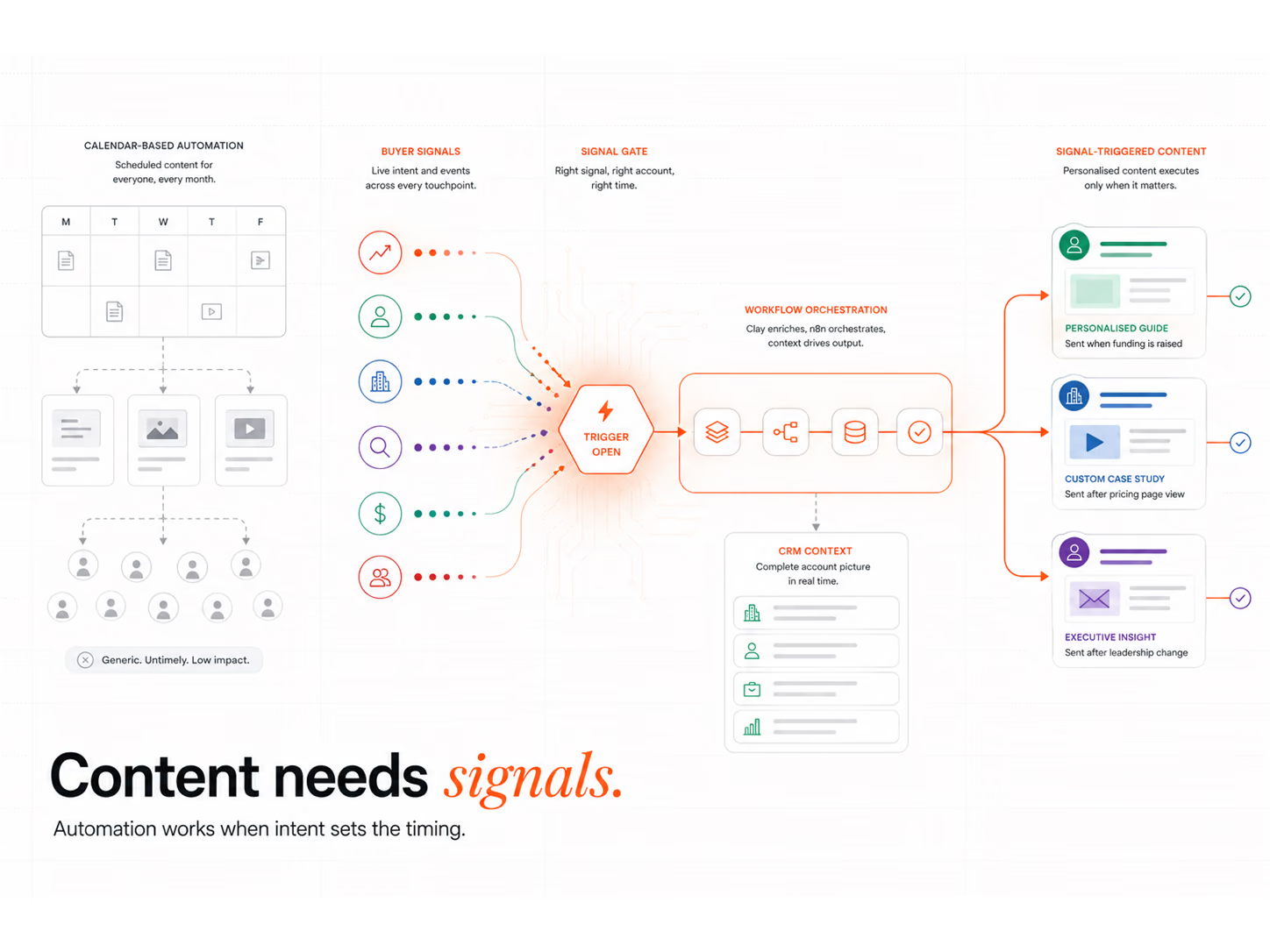
Traditional marketing automation groups contacts into segments and sends campaigns when a rule fires: "all contacts tagged Enterprise receive the Q2 nurture sequence." The segment is a proxy for intent. It tells you the contact might be relevant, not that they are actively researching right now.
The gap between segment and intent is where pipeline leaks. DemandScience's 2026 benchmark found that only 26% of intent signals convert to qualified opportunities, and 25% of marketing budget is wasted on efforts that fail to drive outcomes. Segment-based automation fires at every contact in the group. Signal-based automation fires only when a specific account crosses a real intent threshold.
Why Volume Makes It Worse
Generative AI amplified the volume problem before it solved the relevance problem. Content Marketing Institute's 2025 B2B benchmarks found that 81% of B2B marketers now use generative AI tools, yet 55% still name "creating content that prompts desired action" as their top challenge. More content, same conversion problem. Volume without precision increases noise, therefore reducing the probability that any individual piece lands at the right moment.
The fix is not better content but better triggers.
How Do AI Agents Capture and Act on Buyer Intent Signals?
AI agents monitor target accounts continuously and flag behaviour that indicates an active buying cycle. A company posting a VP of Revenue job, receiving a Series B, or visiting a competitor's pricing page is showing a signal. The AI agent captures this, scores it against the ICP, and triggers a content or outreach action. 6sense's 2025 Buyer Experience Report found that the pre-contact favourite wins the deal roughly 80% of the time, so the agent that captures the signal first determines the outcome.
What Signals AI Agents Monitor
A signal-led content automation system tracks 3 categories of signal.
Firmographic signals: funding announcements, executive hires, headcount growth, and technology stack changes. These indicate a company is building, not coasting.
Behavioural signals: website visits, content downloads, email engagement patterns, and LinkedIn activity from named accounts. These indicate active research.
Intent data signals: third-party keyword monitoring from platforms like Bombora. These indicate in-market research across the broader web.
When an account triggers signals across 2 or more categories simultaneously, the system classifies this as a Verified Buying Window and fires the first content or outreach action.
How the Agent Triggers Content
The AI agent does not write the content. It fires a pre-built workflow. A funding announcement at a target account triggers a personalised case study sequence relevant to post-funding GTM challenges. A competitor pricing page visit triggers a comparison sequence. The content existed before the signal. The agent decides when to send it, therefore ensuring the content reaches the account inside the window, not 3 weeks after it closed.
Signal-based marketing workflows map these trigger-to-content rules across every stage of the buying cycle, so the automation knows which asset to fire for which signal type.
What Does a Workflow Engineer Do That a Marketing Automation Tool Cannot?
A workflow engineer writes the logic layer between data sources, AI agents, and CRM systems. They integrate APIs, build conditional sequences, and configure the rules that decide what happens when a signal fires. A marketing automation tool executes workflows. A workflow engineer designs them. CorridorCareers reported in January 2026 that GTM Engineer hiring has doubled year over year for the last 2 years, based on ZoomInfo job posting data, because teams need someone who writes code AND understands the revenue system.
The Three Problems Workflow Engineers Solve
Integration failures: Marketing automation tools do not natively talk to enrichment databases, intent data platforms, or real-time signal feeds. A workflow engineer writes the connectors so Clay, HubSpot, and n8n operate as one system rather than 3 separate tools producing 3 separate outputs.
Logic gaps: Off-the-shelf automation applies linear rules. Workflow engineers write conditional logic: if account size is 200+ and funding event is within 30 days and no open opportunity exists, then enrol in funding-triggered sequence. This level of specificity prevents the system from firing irrelevant content at accounts that do not fit the criteria.
Data reconciliation: Signals arrive from multiple sources simultaneously. A workflow engineer builds the deduplication and scoring logic so the system does not fire 4 different sequences at the same account on the same day.
The GTM Engineer role sits between RevOps and software engineering, writing code that executes inside the revenue stack rather than inside a product codebase.
The Purdue Operations Parallel
Purdue University reported 17,000 hours saved through task automation across purchase-order reviews and background-check workflows. The saving came not from the automation tool itself, but from the workflow design that mapped each task to the right automated action. Marketing teams building signal-led content systems face the same design challenge: the tool is available; the logic layer is the bottleneck.
Workflow engineers eliminate that bottleneck. Their output is not a campaign. Their output is a system that runs campaigns autonomously, because the trigger rules are defined in advance and the integrations are built to fire without manual intervention.
How Does Signal-Led Content Automation Work in Practice?
Signal-led content automation connects 3 layers: a signal detection layer that monitors accounts, a logic layer that scores signals and fires triggers, and a content delivery layer that sends the right asset to the right contact at the right time. The Clay HubSpot integration forms the spine of this architecture: Clay enriches and scores the account, HubSpot holds the contact and sequence, and n8n automates the handoff between them.
How IR Builds the System
Intelligent Resourcing installs Signal-Led Growth systems across 4 build phases as part of its outbound lead flow built on signals.
Phase 1: ICP signal mapping. IR defines which signals indicate a Verified Buying Window for each client's specific ICP. A company selling to post-Series-A SaaS businesses monitors different signals than a company selling to enterprise manufacturing.
Phase 2: Data infrastructure. IR connects Clay enrichment waterfalls to the client's CRM, feeds intent data from third-party platforms, and configures the deduplication logic that prevents duplicate triggers.
Phase 3: Content trigger library. IR maps each signal type to a pre-built content asset: funding signals trigger growth-phase case studies, executive hire signals trigger onboarding-velocity content, competitive signals trigger comparison sequences.
Phase 4: Workflow logic build. IR's workflow engineers write the conditional logic in n8n that scores incoming signals, checks against CRM state, and fires the correct trigger. This is the layer marketing automation platforms cannot build for themselves.
What the System Produces
A running Signal-Led Growth system produces 3 outputs: higher response rates from outreach that lands inside an active buying window, shorter sales cycles because first contact happens during the research phase rather than after it, and a compounding data asset as every signal and trigger is logged to the CRM for future scoring improvement.
The service to engineer the go-to-market motion is available as a managed engagement. IR maintains the signal logic, updates trigger rules as ICP definitions evolve, and adds new data sources as coverage requirements grow.
Content Creation
Generic content automation produces volume without precision. Intelligent Resourcing installs Signal-Led Growth systems that connect intent capture, content triggers, and CRM action, so content fires on a Verified Buying Window rather than a calendar.
FAQs
What is marketing content automation?
Marketing content automation uses software to create, distribute, and optimise content based on predefined rules or triggers. Traditional automation fires based on segment membership and calendar schedules. Signal-driven automation fires based on real-time buyer behaviour, such as funding events, website visits, or executive hires at target accounts.
What is the difference between generic automation and signal-driven automation?
Generic automation sends content to all contacts who meet a segment criteria, regardless of whether they are actively researching right now. Signal-driven automation monitors specific accounts for live intent signals and sends content only when a trigger event indicates an active buying cycle. The difference is precision: signal-driven automation sends fewer messages to better-timed recipients.
What is a Verified Buying Window?
A Verified Buying Window is the period when a target account shows active intent signals across multiple data sources simultaneously. When a company posts an executive hire, receives funding, and visits a competitor's pricing page within the same 30-day window, that overlap indicates active evaluation. Outreach sent inside a Verified Buying Window reaches a buyer who is already researching, rather than a buyer who might research in the future.
What is a GTM Engineer and why do I need one for content automation?
A GTM Engineer writes the code and workflow logic that connects AI agents, data sources, enrichment tools, and CRM systems. Without this logic layer, automation tools produce outputs that require manual intervention to execute. A GTM Engineer removes the manual step entirely, so signals fire content actions without a human in the loop. They work at the intersection of RevOps, software engineering, and demand generation.
How long does it take to build a signal-driven content automation system?
A full Signal-Led Growth system build takes 3-5 weeks from ICP mapping to live workflows, depending on the number of data sources, CRM complexity, and size of the content trigger library. A simpler build covering 1-2 signal types and a single CRM integration can go live in 2 weeks. The ongoing management layer, which monitors signal quality and updates trigger logic, runs continuously after the initial build.
Can signal-driven automation work with an existing marketing automation tool like HubSpot or Marketo?
Yes. Signal-driven automation adds a logic and trigger layer on top of existing tools. Clay handles enrichment and signal detection, n8n handles workflow logic and API connections, and HubSpot or Marketo handles contact management and content delivery. The existing tool does not need to be replaced. The workflow engineer connects the signal layer to the tool the team already uses.