HubSpot AEO Review: Useful, but not the full AEO solution
An honest review of HubSpot AEO: what the $50/month standalone tool gets right, what it lacks and whether it is worth your money in 2026.
By Ronan Leonard, Founder, Intelligent Resourcing
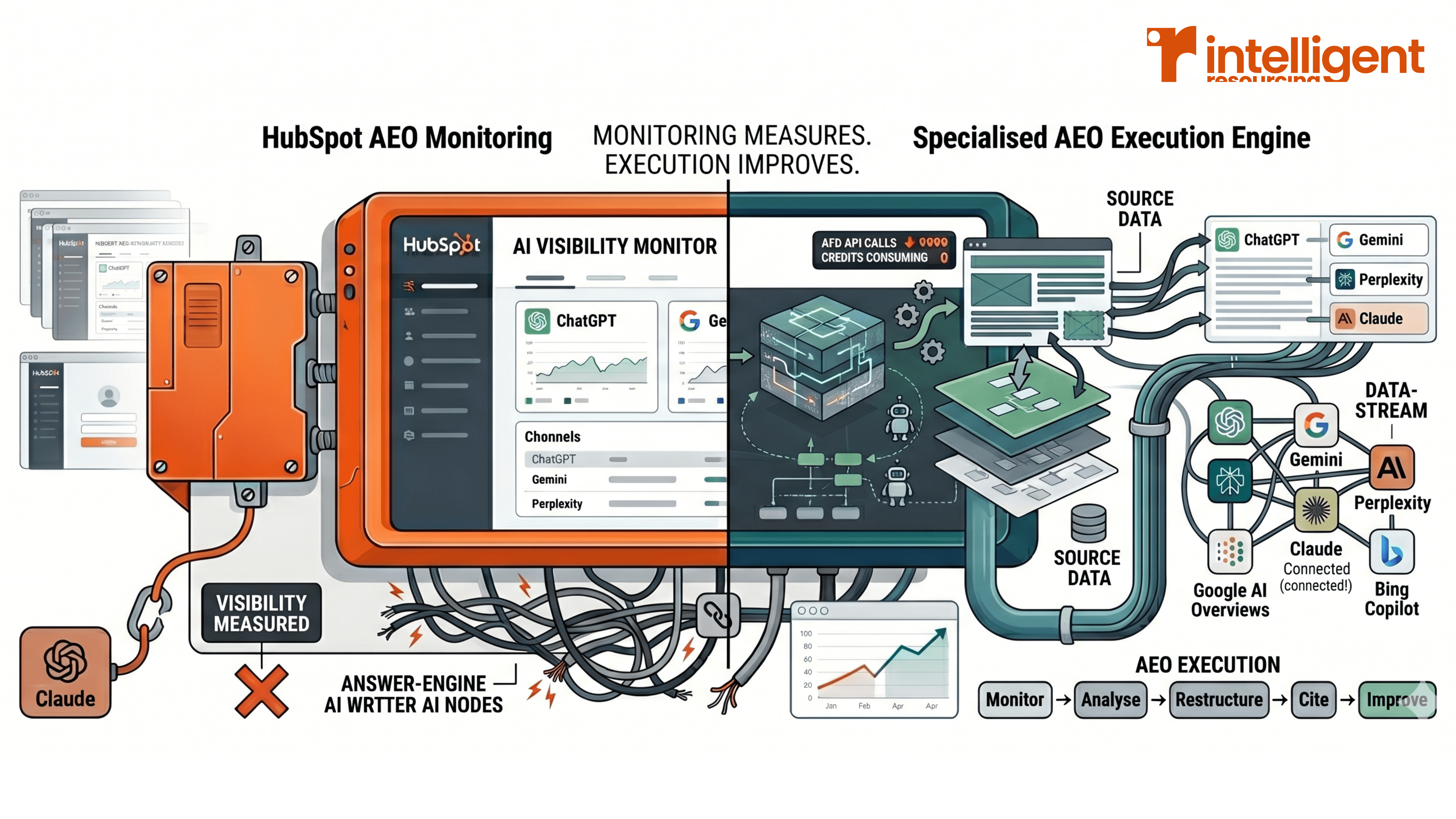
HubSpot AEO is a useful first-look AI visibility monitor for existing HubSpot customers, but it is not a full AEO execution platform. It tracks brand visibility across ChatGPT, Gemini, and Perplexity, but misses Claude, charges by prompt, and mainly tells teams where they appear rather than helping them improve citation rates.
Avoid HubSpot AEO for agency use because per-portal pricing ($50/month per client) compounds fast. 5 clients costs $250/month for fewer engines, no Claude and no consolidated multi-brand view.
Expect prompt limits to hit quickly because 25 prompts at $2 each fills up fast. Track 4 competitors across 5 queries and your plan is nearly full. Serious monitoring requires hundreds of prompts.
Use HubSpot AEO for diagnostic visibility only because it tells you where you stand but does not restructure content, improve citation rates or execute the work that moves visibility.
Choose specialist AEO when you need model-wide coverage, citation source analysis, and implementation that changes AI visibility.
Skip HubSpot AEO if you need Claude tracking because the platform omits the AI assistant accounting for 40% of enterprise LLM spend, with no public timeline for inclusion.
Understand HubSpot bought this, not built it because the xFunnel acquisition means the methodology reflects an acquired team's approach, not HubSpot's core AEO expertise.
Situation | HubSpot AEO | Specialist AEO Service |
Already on HubSpot Marketing Hub | Strong fit: no additional login, AI visibility sits next to campaign and CRM data | Requires separate platform and integration work |
Single brand, light monitoring | Adequate: 25 prompts covers basic brand tracking at $50/month across ChatGPT, Gemini, and Perplexity | Overkill for a first pass; harder to justify on cost alone |
Agency with 3+ clients | Expensive: separate subscription per brand; $150+/month minimum for 3 clients with no consolidated view | Better value: multi-brand included in base plans (e.g. Profound at $299/month covers 10+ platforms) |
Tracking Claude or full model stack | Not available as of April 2026 | Standard coverage on dedicated platforms |
AEO methodology depth | Diagnostic starting point: tells you where you stand, limited action guidance | Deeper recommendations, content gap analysis, citation source tracking, implementation |
Non-HubSpot CRM environment | Integration advantage disappears immediately | Platform-agnostic by design, works regardless of CRM |
Choose HubSpot AEO if you are already inside the HubSpot ecosystem and need a simple, low-friction way to check whether your brand appears in AI-generated answers.
Choose a specialist AEO service if you need broader model coverage, Claude tracking, multi-brand reporting, citation source analysis, and content implementation that improves visibility rather than simply measuring it.
Why Did HubSpot Buy Its AEO Capability Rather Than Build It?
HubSpot did not build this tool. That is where any honest review starts. HubSpot acquired xFunnel in 2026 and launched the capability as a beta feature in April of the same year. Acquisitions are a legitimate way to enter a category quickly. What matters for buyers is what acquisition-led development means in practice.
What Does a Bolt-On Feature Mean for AEO Methodology?
When a capability enters a platform through acquisition, the methodology embedded in the product reflects the acquired team's approach, not the acquirer's core engineering priorities. HubSpot's business is CRM and marketing automation. AEO is a bolt-on, framed as an AI visibility layer for customers already inside the HubSpot ecosystem, not a specialist product built from the ground up.
For a feature where the quality of prompt design, citation source analysis, and content gap identification depends on proprietary methodology developed over time, that distinction has consequences. Buyers are evaluating a first-generation beta product built on acquired infrastructure. HubSpot's Spring 2026 Spotlight cited a 27% year-on-year decline in organic traffic across its customer base as justification for the AEO launch. Ronan Leonard's analysis of HubSpot's share price decline over the past 12 months covers what the 65% price fall from $827 to $286 between February 2025 and March 2026 indicates at the business strategy level, alongside 3 consecutive quarters of decelerating revenue growth.
Acquiring through xFunnel under those conditions is a rational move. A platform that missed the AEO window entirely would be in a weaker position than one with an entry-level feature. The relevant question is whether a beta product acquired under financial pressure will receive the sustained roadmap investment that specialist AEO platforms are built for from the start.
What Does HubSpot AEO Actually Cost Per Prompt?
The standalone plan costs $50/month for 25 tracked prompts per day across ChatGPT, Gemini, and Perplexity. That is $2 per prompt. Additional prompts are sold in blocks of 10 at $20 per block, confirming the same $2 rate. Marketing Hub Enterprise includes 50 prompts as part of a plan that starts at $3,600/month for the full suite.
The Prompt Economics Expose the Real Problem
To put $2/prompt in practical terms: tracking 4 competitor brands across 5 core research queries uses 20 of your 25 prompts before you have asked a single industry-level or brand-adjacent question. Add 5 category queries and the base plan is full. Every additional prompt costs $2. The rate does not improve with volume.
That pricing structure might be defensible for a specialist AEO platform built around proprietary methodology, deep citation analysis, and a broad model stack. It is harder to justify for a beta feature inside a CRM platform managing significant commercial pressure while its customers' organic traffic falls.
Intelligent Resourcing's own AEO monitoring runs hundreds of prompts across a broader model set, including Claude, for a comparable budget, using a purpose-built MCP toolset rather than a CRM platform's monitoring layer. The coverage difference at the same price point is substantial.
For agencies, the economics are more damaging. HubSpot uses a per-portal model. Each client brand requires a separate HubSpot subscription. 5 clients costs $250/month minimum for 25 prompts per brand, 3 engines, no Claude, and no consolidated cross-brand reporting. Profound charges $299/month and covers multi-brand tracking across 10+ platforms in a single plan. The comparison does not favour HubSpot AEO once operational complexity appears.
Plan | Prompts | Answers/month | Engines | Cost |
Free trial | 10 | 280 | ChatGPT only | $0 for 28 days |
Standalone AEO | 25 | 2,500 | ChatGPT, Gemini, Perplexity | $50/month ($45 annual) |
Marketing Hub Professional | 25 | 2,500 | ChatGPT, Gemini, Perplexity | Included in plan |
Marketing Hub Enterprise | 50 | 5,000 | ChatGPT, Gemini, Perplexity | Included in plan (from $3,600/month) |
Limit increase add-on | +10 | +1,000 | All 3 engines | $20/month per pack |
Which AI Platforms Does HubSpot AEO Track, and Which Does It Miss?
As of April 2026, HubSpot AEO tracks 3 platforms: ChatGPT (OpenAI), Gemini (Google), and Perplexity. Claude (Anthropic) is not included and there is no public timeline for its addition.
Why Excluding Claude Is a Structural Gap, Not a Minor Omission
Menlo Ventures' 2025 State of Generative AI report found that Anthropic accounts for 40% of enterprise LLM spend, ahead of both OpenAI and Google. Claude is the dominant paid AI tool for document-heavy workflows, multi-step research, procurement evaluation, and professional research tasks. These are precisely the activities B2B buyers complete during vendor evaluation, before they contact a sales team.
A monitoring tool that excludes Claude does not track the AI assistant most used by the enterprise buyers B2B brands are trying to reach. That is a structural coverage gap, not a feature gap to add in the next update. For brands selling into enterprise accounts where Claude is the default research tool, HubSpot AEO is not tracking the environment that matters most.
One further clarification buyers need: Gemini and Google AI Overviews are not the same product. Gemini is Google's AI assistant at gemini.google.com. Google AI Overviews is a separate AI-generated layer inside Google Search. HubSpot AEO tracks Gemini. Buyers who need Google Search AI Overviews coverage should confirm which surface they are tracking before assuming broad Google AI visibility.
As of April 2026, Claude is not included. Check the live HubSpot AEO product page before acting on this: HubSpot's platform list may expand as Anthropic's API capabilities develop.
Who Should Actually Use HubSpot AEO?
Marketing teams already on Marketing Hub Professional or Enterprise who want a first view of AI search visibility without adding a platform. That is the genuine use case.
When to Use It
If your team already operates inside HubSpot, AEO data sits alongside CRM, campaign performance, and contact activity without a separate login or data import. For teams already paying for Marketing Hub who want to answer the question "are we appearing in AI answers?", this is the lowest-friction starting point. The integration advantage is real and it is the product's only clear differentiator.
When to Pause
If you are not already a HubSpot customer, the $50/month standalone tier and 28-day free trial are worth testing before committing. The trial covers ChatGPT only, not the full 3-engine view. Compare prompt limits and engine coverage against dedicated monitoring tools before making a decision. The standalone price only makes sense if HubSpot ecosystem integration is part of your value calculation.
When to Skip It
If you manage more than 1 brand or client account. If you need Claude tracking. If your goal is to improve AI visibility rather than measure it. The per-portal model makes multi-brand economics unworkable. The Claude gap means the most important enterprise research channel is unmonitored. And if the goal is to move the number, not just read it, HubSpot AEO does not do that work.
What Does Monitoring Fail to Do? The Execution Gap That Matters
HubSpot AEO reports where your brand stands in AI-generated answers. It does not identify which content blocks are failing to earn citations, why competitor content is being selected over yours, or what structural changes would improve citation rates. Knowing the score and changing the score are different problems that require different work.
What Specialist AEO Implementation Covers That a Dashboard Cannot
The 2024 ACM paper on Generative Engine Optimisation established the passage-length and citation-density principles that determine whether AI systems extract and cite a given piece of content. Specialist AEO work audits content section by section, restructures blocks to match AI extraction patterns, and expands monitoring across a model stack that includes Claude, Google AI Overviews, and Bing Copilot alongside the 3 engines HubSpot tracks.
At Intelligent Resourcing, monitoring and implementation run together. Our GEO packages at Cited-Core ($3,200/month) and Cited-Scale ($3,700/month) combine ongoing model-wide monitoring with content restructuring, passage-level optimisation, and citation source work. The monitoring component tells us where brands stand. The implementation component changes where they stand. Full details are on Intelligent Resourcing's GEO service page.
A dashboard that shows your brand appearing in 12% of AI responses tells you the gap exists. It does not tell you which pages are failing, why they are being passed over, or what to restructure. That analysis requires editorial intervention at the content level across a model stack that reflects how enterprise buyers actually research. That is what separates AEO monitoring from AEO execution, and it is where our signal-based selling framework and content implementation work operate.
What Does an AI Search Win Look Like in Practice?
HubSpot AEO can show whether your brand is appearing in AI answers. What it does not do on its own is execute the content, citation, and coverage changes that improve that visibility. The example below shows what an AI search win looks like when monitoring is paired with implementation.
A dashboard can show that visibility is weak or that a competitor is being cited more often. It cannot, by itself, rewrite the content blocks, improve extraction structure, expand model coverage, or strengthen citation pathways. That is the gap between reporting and execution, and it is where specialist AEO work tends to create measurable gains.
FAQs
Is HubSpot AEO worth $50 per month?
For a single brand already on Marketing Hub Professional or Enterprise, yes, because AI visibility is included at no extra cost inside an existing platform. As a standalone purchase for teams outside the HubSpot ecosystem, $50/month buys 25 prompts at $2 each across 3 engines with no Claude coverage. That is a first-look diagnostic, not a monitoring programme.
Does HubSpot AEO track Google AI Overviews?
No. HubSpot tracks Gemini, which is Google's AI assistant at gemini.google.com. Google AI Overviews is a separate feature inside Google Search. These are different surfaces with different coverage implications. Confirm which you need to track before selecting any AEO tool.
Can agencies use HubSpot AEO across multiple clients?
They can, but the per-portal model makes it economically inefficient at scale. Each client brand requires a separate HubSpot subscription. At 5 clients, the minimum spend is $250/month for 25 prompts per brand across 3 engines, with no consolidated multi-brand view and no Claude tracking.
What is the difference between AEO monitoring and AEO implementation?
Monitoring identifies where your brand appears in AI-generated answers and tracks competitor visibility over time. Implementation identifies which content is failing to earn citations, restructures it to match AI extraction patterns, and expands coverage across a broader model stack. HubSpot AEO is a monitoring product. Changing your AI visibility requires implementation work at the content level.
Final Take
HubSpot launched an AEO product at the right moment, and existing Marketing Hub customers now have a first view of AI visibility inside a platform they already use. That is genuinely useful and the product deserves credit for it.
The honest assessment stops there. This is a monitoring diagnostic built on acquired infrastructure, launched under commercial pressure, covering 3 engines without Claude and priced at $2 per prompt. The per-portal model means agencies pay separately per client, with no consolidated view and no volume discount.
For in-platform HubSpot teams who want to start measuring AI visibility, it does that job well. For agencies, multi-brand operators, or anyone whose goal is to improve AI visibility rather than simply measure it, the gap between monitoring and execution is where the product falls short.HubSpot AEO is purely a diagnostic tool that measures your AI citation rate. Improving that rate requires execution and is different work entirely.
If you are looking for monitoring and implementation together, across a broader model stack that includes Claude, Intelligent Resourcing's GEO service covers both.