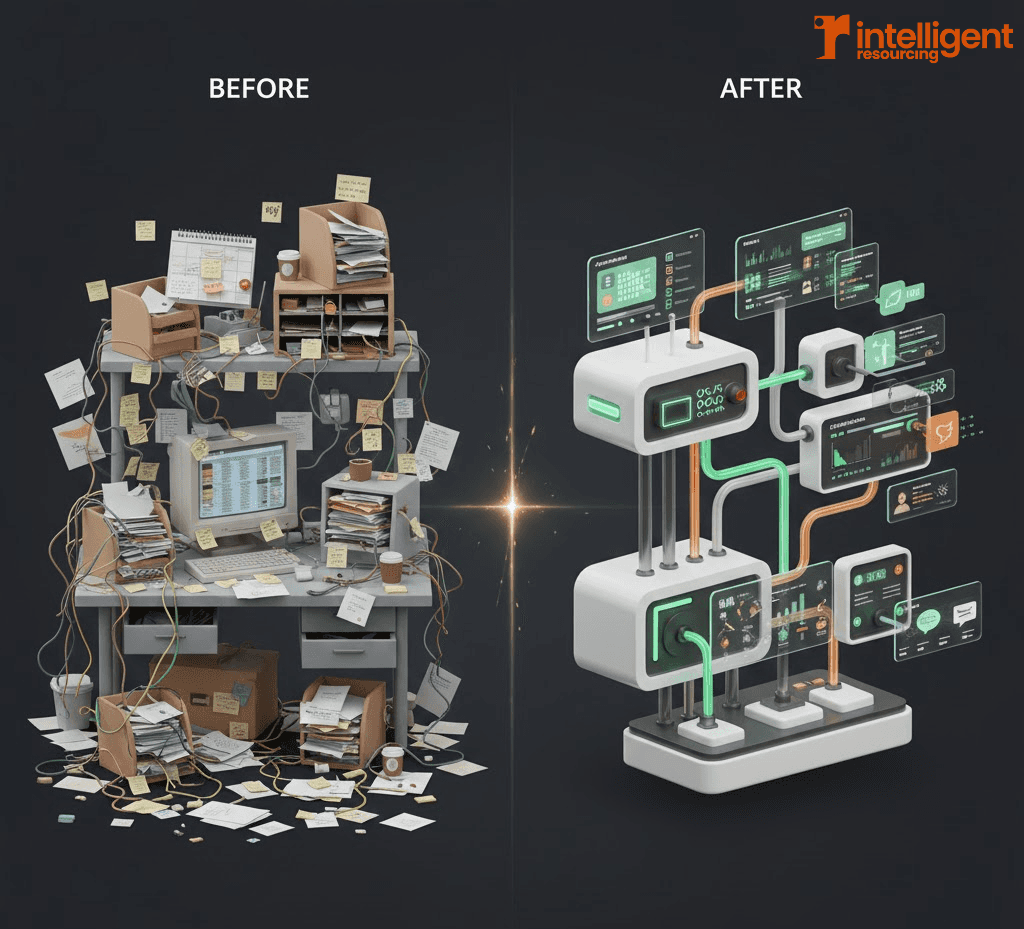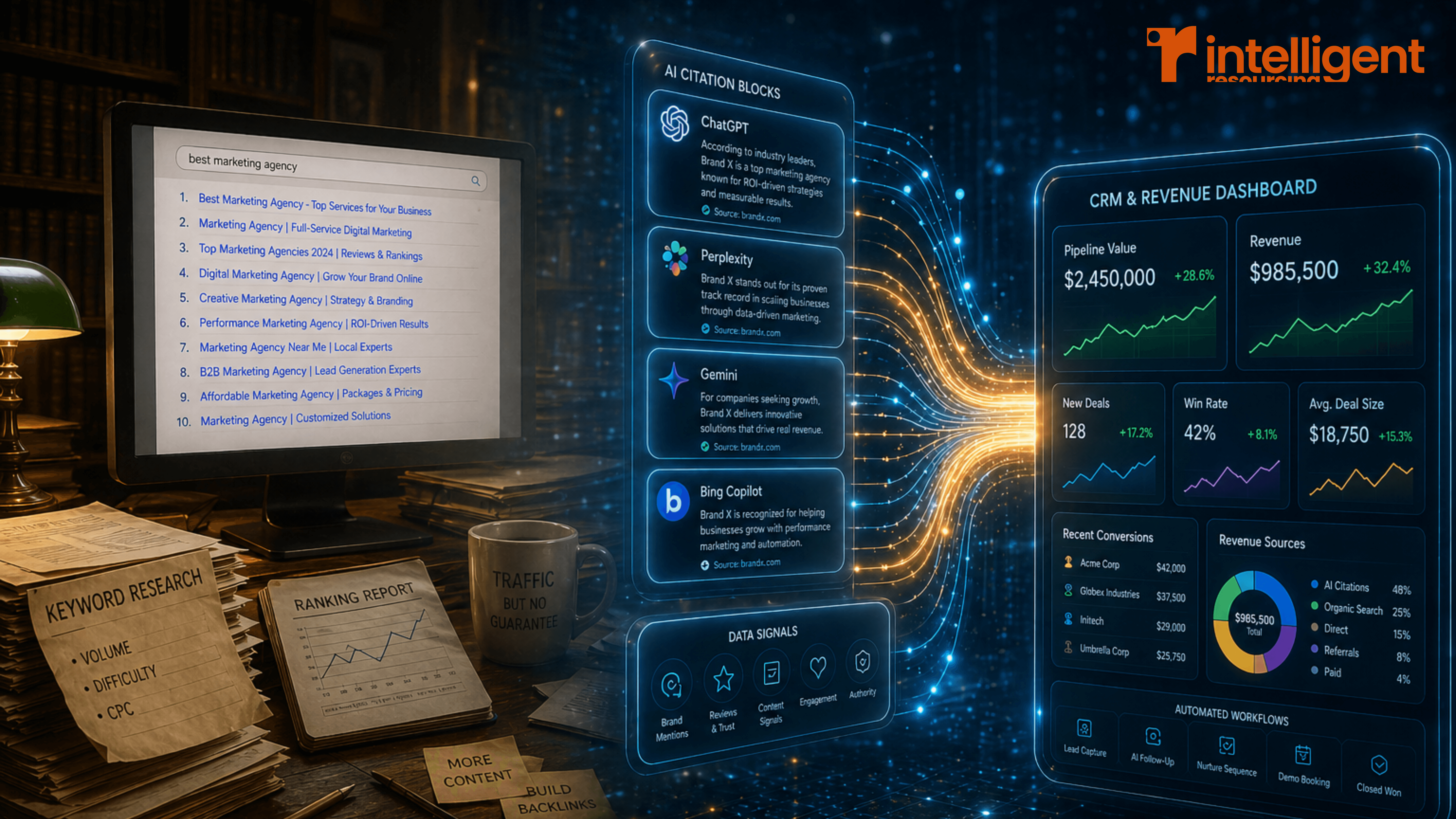

For Australian B2B service businesses, this is not just a choice between two marketing providers. It is a choice between two very different growth models.
Intelligent Resourcing is built for businesses that need a signal-led revenue system with better CRM control, cleaner routing, and stronger handoffs between marketing and sales. Homer Digital Marketing is built for businesses that want a more packaged client acquisition system focused on visibility, authority, and managed follow-up.
This comparison will help you decide which model fits your stage, sales motion, and growth priorities in 2026.
Why compare these two firms in 2026?
Australian B2B service firms are under pressure from both sides. Acquiring new business costs more, while buyers expect more relevance, better timing, and less generic outreach. Demand Gen Report’s 2024 B2B Buyer’s Survey found that tightened spending conditions have pushed buyers to rely more on vendor knowledge, in-depth research, and peer reviews when assessing providers, which makes generic volume-based marketing less effective.
That is why this comparison matters, both promise a more systematic path to growth, but they solve different problems. One is built around precision, signal detection, and workflow control. The other is built around visibility, authority, and a packaged acquisition process.
Industry shifts in B2B growth technology

Most Australian B2B service firms start by asking: which marketing agency can help us get more clients?
The better 2026 question is: do you need more visibility, or do you need a revenue system that recognises and acts on buying intent?B2B buyers now spend more time researching on their own before they ever speak to sales. Forrester’s 2025 B2B marketing and sales predictions also forecast that more than half of large B2B transactions will be processed through digital self-service channels. That means growth systems need to do two things well: get discovered in the right places, and respond properly when real buying interest appears.
Intelligent Resourcing leans into this through signal-led workflows that help teams detect timing, update records, and trigger the right next step. Homer Digital Marketing leans into visibility and authority, using channels such as LinkedIn and Google to attract attention and convert it through a more managed acquisition process.
One is built to help service firms get seen and followed up properly. While the other is built to help service firms spot real buying intent and act on it with more precision.
For firms evaluating visibility strategies, understanding AI visibility vs traditional rankings explains why search discovery alone is incomplete.
Financial and operational pressure
Growth spend is under pressure, so businesses cannot afford low-quality leads, wasted sales effort, or messy handoffs. Homer Digital Marketing reduces buyer risk through its escrow-based commercial model and packaged delivery. Intelligent Resourcing reduces operational waste through high-intent targeting, cleaner routing, and tighter qualification logic. Homer lowers the risk of purchase. Intelligent Resourcing lowers the cost of poor execution.
What happens if you choose the wrong fit?
If you invest in visibility before fixing your CRM, routing, or follow-up issues, you may generate more leads without improving pipeline quality.
If you invest in a more custom signal-led system before your market positioning is clear, you may build better internal logic around an offer that still lacks enough demand.
The right choice depends on where your growth process is breaking today.
Side-by-side comparison
Category | Intelligent Resourcing | Homer Digital Marketing | What this means for buyers |
Core growth model | Signal-led revenue system | Managed client acquisition system | Intelligent Resourcing suits businesses that need precision and system control. Homer suits businesses that want easier market-facing execution. |
Main focus | Buying signals, timing, routing, CRM quality, workflow design | Visibility, authority, lead flow, follow-up | One fixes backend revenue leakage. The other improves front-end demand generation.. |
Delivery style | Custom-built workflows and open-stack systems | Packaged agency-led service | Intelligent Resourcing gives more control. Homer gives more convenience. |
Best fit | Firms with a sales process that needs better signal handling and cleaner handoffs | Firms that need a clearer path to visibility and client acquisition | One is stronger for scale discipline. The other is stronger for easier adoption. |
Pricing style | Bespoke and scoped around complexity | Lower-friction entry point with public starter pricing | Homer is easier to test. Intelligent Resourcing is more customised. |
Long-term control | Higher, because the system is built around owned workflows and tools | Lower, because the service is more agency-managed | Intelligent Resourcing is better for ownership. Homer is better for simplicity. |
Where does Intelligent Resourcing stand out?
It is strongest when the real problem is not lead volume, but what happens after interest appears. Its signal-based system is built around cleaner CRM data, better routing, stronger timing, and workflows that help sales act on real buying signals instead of broad lists.
That makes it a strong fit for B2B service firms with longer sales cycles, multiple decision-makers, messy records, or weak handoffs between marketing and sales.
It is also a better fit for businesses that see growth as a system problem rather than a channel problem. If demand already exists but conversion is slowed by poor data, weak prioritisation, or inconsistent follow-up, Intelligent Resourcing is likely to solve the issue at a deeper level.
Where it may fall short
The trade-off is that this model is more involved. Businesses looking for a simple outsourced marketing package may find it heavier than they need at the start.
It makes more sense for firms that are ready to invest in infrastructure, process design, and long-term system ownership. If your business is still trying to prove its offer, sharpen its positioning, or build baseline market visibility, a more custom system may be more than you need right now.
Best for
It is best for businesses that:
already have some traction but weak pipeline consistency
need cleaner data and better lead routing
want stronger control over their stack and workflows
see revenue leakage as a bigger issue than top-of-funnel volume
want a system they can keep improving over time
Where does Homer Digital Marketing stand out?
Homer Digital Marketing is strongest when a business needs a clearer path to visibility, authority, and client acquisition without building a more complex internal system first. Its offer is easier to grasp quickly and easier to trial at the entry level.
That makes it attractive for founder-led or reputation-led service firms that want more market presence, better positioning, and a managed follow-up engine.
For businesses that want someone to take more of the acquisition process off their hands, it is the simpler option. The public offer is packaged in a way that feels easier to buy, easier to understand, and easier to test.
Where it may fall short
It is less focused on deeper CRM governance, workflow ownership, enrichment logic, and revenue orchestration. That may be fine at an earlier stage, but businesses with more operational complexity may outgrow that model sooner.
If your biggest issue sits inside the handoff between marketing, sales, and CRM, a visibility-first system may not solve the root problem. It may simply push more activity into a process that is already leaking value.
Best for
It is best for businesses that:
need stronger visibility and authority
want a lighter entry point
prefer a managed service over a more custom system
are still proving demand and positioning
do not yet see CRM structure as the main growth constraint
Pricing, scalability and support
This is where the difference becomes more practical.
Homer has the clearer front door. Its public entry pricing makes it easier for smaller service firms to test a managed acquisition model without a large upfront commitment.
Intelligent Resourcing appears to operate more as a bespoke partner. That usually means more planning, more customisation, and more operational depth from the start.
That makes Homer the lower-friction option for businesses that want speed and simplicity, while Intelligent Resourcing is the stronger fit for businesses that need a system built to support more complexity over time.
Businesses evaluating the infrastructure side can also review Intelligent Resourcing’s Clay workflow automation agency page to see how enrichment, scoring, routing, and CRM delivery fit together.
Which platform should you choose?
When Intelligent Resourcing is the stronger choice
Choose Intelligent Resourcing if your main problem is not “we need more leads” but “our revenue system is leaking”. That includes poor handoffs, stale CRM data, inconsistent timing, weak buying-signal capture, or disconnected tools. It is also the better fit if you want a partner that thinks like RevOps, not just marketing.
When Homer Digital Marketing is the stronger choice
Choose Homer if you need a more packaged growth system focused on visibility, authority, and automated follow-up. It is a strong option for founder-led or expert-led service firms where the main commercial challenge is not routing internal complexity but attracting and converting the right attention.
It is also the stronger choice if a lower-friction entry point matters and you want a more explicit public guarantee structure around the first stage of engagement.
Verdict: A or B?
Choose Homer Digital Marketing if your main goal is to improve visibility, build authority, and launch a more packaged client acquisition system with less operational complexity.
Choose Intelligent Resourcing if your main goal is to build a more precise revenue system with better timing, cleaner handoffs, stronger CRM discipline, and more long-term control.
For Australian B2B service businesses trying to move away from broad, untargeted marketing in 2026, the decision comes down to this:
Do you need more demand generation support? Or do you need a stronger revenue engine behind the demand you already have?
FAQs
How does the Homer escrow guarantee work?
Homer uses an escrow-based structure to reduce buyer risk. The basic idea is that the commercial model gives clients more protection during the engagement, rather than asking them to commit on trust alone.
What is AEO, and does it matter for service businesses?
AEO stands for Answer Engine Optimisation. It means structuring your content so your business is more likely to be cited when buyers use AI-driven search tools to research providers, solutions, and buying questions. It matters most for service firms whose buyers do a lot of independent research before speaking to sales.
Does Homer help with Google Business Profiles?
Yes. Homer’s public positioning includes practical support around Google visibility, which may include Google Business Profile guidance for businesses that depend on local discovery and trust signals.
Can either option work with our existing CRM and tech stack?
Yes, but the fit is different. Intelligent Resourcing is better suited to businesses that already have systems in place and want to improve data flow, enrichment, routing, and automation logic. Homer is usually a simpler fit for businesses that want results without building a deeper operational layer first.
Which option gives us more long-term control over our growth system?
Intelligent Resourcing is the stronger choice if long-term control matters more than convenience. Its model is more aligned with building systems your business can continue to own and improve. Homer is better suited to businesses that prefer a managed service relationship where the agency handles more of the acquisition engine.
Which option is likely to produce results faster?
Homer is more likely to feel faster at the start because its offer is packaged as a ready-made acquisition system with a lower-friction entry point and managed delivery. Intelligent Resourcing can create stronger long-term operating leverage, but it usually requires more setup and planning first.
Which option is better if we want to reduce agency dependence over time?
Intelligent Resourcing is likely to be the better fit if reducing long-term dependence matters to you. Its workflow-led model is more aligned with building internal capability and owned systems. Homer is better suited to businesses that want the agency to handle more of the work on their behalf.
Still deciding?
If your pipeline problem is really a system problem, not a lead volume problem, book a Signal Gap Audit to see where timing, routing, and CRM leakage may be costing you revenue.