Losing Organic Traffic to Google AI Overviews? The B2B Recovery Playbook
Losing organic traffic to AI Overviews? Most B2B teams rewrite the wrong pages first. This playbook diagnoses which commercial clicks are still recoverable.
By Ronan Leonard, Founder, Intelligent Resourcing

If your B2B organic traffic is falling after Google AI Overviews, do not start by rewriting every page. First separate ranking loss from click loss, then identify pages with high impressions, strong rankings and collapsing Click-Through Rate (CTR). Recovery means restructuring pages for citation, moving commercial answers higher, and building Bottom of Funnel (BOFU) assets that AI can quote, not just rank.
Do not blame AI first: Separate ranking loss, demand loss, CTR collapse and AI Overview cannibalisation before changing content.
Prioritise commercial leaks: Fix page-one URLs with high impressions, low CTR and clear buying intent.
Move answers higher: Put the verdict, decision logic, proof and next step inside the first 500 words.
Build citation assets: Add source-ready definitions, tables, examples, methodology notes and FAQs that AI systems can reuse.
Recover pipeline, not vanity traffic: Informational clicks may fall, but BOFU demand can still be captured with better conversion paths.
Symptom | Likely cause | Recovery move |
Rankings stable, CTR down | AI Overview or Search Engine Result Page (SERP) feature displacement | Rebuild the page with answer-first copy, decision tables and proof blocks |
Impressions up, clicks flat | Query expansion without commercial relevance | Split informational intent from BOFU intent and add stronger conversion paths |
Traffic down, rankings down | SEO loss, not only AI loss | Refresh topical coverage, technical health and internal links |
Clicks down, leads stable | Low-value informational clicks lost | Protect BOFU pages and improve attribution |
Brand absent from AI answer | Citation eligibility gap | Add evidence modules, schema parity and external corroboration |
If rankings are stable but CTR has collapsed, treat the page as an AI Overview recovery candidate. If rankings, impressions and conversions have all fallen, treat it as a broader SEO and demand problem before blaming AI. The right move is not to chase every lost session. It is to recover the commercial demand still visible in search. Intelligent Resourcing's AEO practice audits Search Console data, AI citation checks and CRM conversion data together to separate real leakage from noise. This is the architecture that recovers commercial pipelines instead of chasing every lost session.
What's the First Step in AI Overview Traffic Recovery?
AI Overview recovery starts with diagnosis, not rewriting. SparkToro's 2026 analysis, citing Similarweb clickstream data, found 68.01% of US Google searches in early 2026 ended without a click, but not every lost click was a lost customer. The real question is which pages still carry recoverable commercial demand.
Rewriting a page that lost rankings will not solve a SERP click problem. Adding schema to a page with no buying intent will not rebuild the pipeline. Blocking AI crawlers may reduce future inclusion rather than improve commercial visibility, a point worth returning to later.
Start in Google Search Console, Google's Performance report shows clicks, impressions, average CTR and average position, which gives you the baseline for separating ranking change from click-through change.
Ask four questions before touching the page:
Did the average position fall? If yes, diagnose SEO loss first.
Did impressions stay strong? If yes, demand still exists.
Did CTR fall disproportionately? If yes, the SERP is absorbing the click.
Did conversions fall too? If not, the lost traffic may have been low-value informational traffic.
When traffic drops, the first instinct is to blame AI Overviews. But the more useful question is narrower: which pages still have commercial demand behind them, and which ones are simply losing low-value informational clicks? Recovery starts there, with the pages that still influence the pipeline.
Why Are AI Overviews Reducing B2B Organic Traffic?
AI Overviews reduce organic traffic because they answer parts of the query before the user reaches a website. Google's own definition describes them as "an AI-generated snapshot with key information and links to dig deeper." For publishers and B2B brands, the challenge is that many users do not need the deeper click once the simple answer is visible on the results page.
Pew Research Center found that users who saw an AI summary clicked a traditional search result in 8% of visits, while users without an AI summary clicked a traditional result in 15% of visits. The same research found that clicks on links inside the AI summary itself were rare, occurring in just 1% of visits to pages with such a summary.
It does not mean clicks have vanished, rather become more selective. Generic "what is" content is more exposed because the answer can be summarised. Commercial pages, diagnostic tools, comparisons, calculators, templates and proof-led assets have a stronger reason to earn the click because they help the buyer make a decision.
A 2026 AI Overview study of 55,393 trending queries found AI Overview activation averaged 13.7% overall, rising to 64.7% for question-form queries, and that nearly 30% of AI-Overview-cited domains did not appear in the co-displayed first-page results. For B2B marketers, that means page-one SEO still matters, but it is not the whole recovery model.
How Do You Diagnose Which Pages Need AI Overview Recovery?
Before you rebuild content, classify the traffic drop. Most teams move too quickly from "traffic is down" to "AI is the cause." That creates wasted work because AI Overviews are only one of several possible causes.
Use this matrix before changing title tags, rewriting copy or commissioning new pages.
Diagnostic question | What to check | What it means | Next action |
Did rankings fall? | GSC average position by query and page | Traditional SEO issue | Refresh content depth, internal links and technical performance |
Did CTR fall while the position held? | GSC CTR and impression trend | SERP feature or AI Overview displacement | Rebuild page for answer-first citation and click-worthiness |
Did impressions fall too? | Query demand trend | Reduced search demand or topic shift | Validate demand before investing |
Did leads fall with traffic? | CRM and analytics | Commercial loss | Prioritise immediate BOFU recovery |
Did traffic fall but leads hold? | Conversion rate by landing page | Low-value traffic loss | Protect converting pages, avoid panic rewrites |
Are competitors cited instead? | Manual AI Overview and AI answer checks | Citation eligibility gap | Add proof, structure and external corroboration |
Which Pages Should You Fix First?
Fix the pages where demand still exists, that usually means pages with strong impressions, reasonable rankings and weak CTR. A page that ranks on page one but earns very few clicks is a stronger recovery candidate than a page with no impressions and no commercial intent.
Use this quick GSC check to find the right recovery pages:
Export page and query data from Google Search Console.
Sort the export by page, query, impressions, clicks, CTR and average position.
Remove branded queries.
Keep queries with commercial or problem-aware intent.
Find URLs with high impressions.
Check whether the average position is still competitive.
Compare CTR against the previous similar period.
Prioritise pages where rankings are stable but CTR has fallen.
Prioritise pages in this order:
Page-one commercial pages: These are the pages already close to demand.
Comparison and alternatives pages: These match the way buyers ask AI systems for vendor guidance.
High-impression diagnostic content: These pages can be rebuilt with tools, templates and audit CTAs.
BOFU educational pages: These teach the buyer how to solve the problem and introduce your method.
Pages where competitors are cited: These show where the answer ecosystem already has room for vendor recommendations.
In Intelligent Resourcing recovery work, the highest-priority pages are often not the pages with the largest traffic drop. They are the pages where ranking remains strong but the commercial click has become harder to win.
Use a simple scoring model:
Priority factor | Score 1 | Score 3 | Score 5 |
Ranking position | Outside top 20 | Positions 6 to 10 | Positions 1 to 5 |
Impressions | Low | Moderate | High |
CTR decline | Mild | Clear | Severe |
Commercial intent | Informational | Problem-aware | BOFU |
Conversion pathway | Weak | Present | Strong |
Competitor citation | None | Occasional | Frequent |
Pages scoring 20 or above should enter the recovery queue first. Pages scoring below 12 should not be rewritten unless they support a strategic topic cluster.
What Makes a Page Citation-Ready for AI Overviews?
A citation-ready page is not just a longer page. It is a page that gives AI systems and human buyers clean, extractable evidence. It answers the main question immediately, supports the answer with proof and gives the reader a reason to click beyond the summary.
Google's own developer guidance says AI features surface links to help people find information quickly, and that sites benefit from foundational SEO practices rather than AI-specific markup, focusing on content that is helpful, reliable and eligible for search features. That guidance doesn't promise a shortcut. It means your content has to be easy to understand, easy to quote and useful beyond the summary, which is precisely what most competitor content is not.
Rebuild priority pages with these elements:
Direct answer first: Place a 40 to 60 word answer immediately under the H1.
Decision logic early: Add a table, matrix or diagnostic framework inside the first 500 words.
Proof before opinion: Use benchmarks, anonymised examples, methodology notes and real outcomes.
Clear entity language: Use consistent names for the brand, service, problem and framework.
Schema parity: Make FAQ and Article schema match the visible page content.
Click-worthy assets: Offer a checklist, calculator, template, audit or comparison that cannot be fully replaced by a summary.
A weak page says, "AI Overviews are changing SEO." A citation-ready page says, "If rankings are stable but CTR is falling, classify the URL as an AI Overview recovery candidate and rebuild it with answer-first structure, proof modules and a conversion asset."
Turn AI visibility into a recoverable pipeline, Intelligent Resourcing AEO/GEO service helps B2B teams rebuild priority pages for answer-first structure, citation eligibility and buyer conversion, so recovery focuses on the pages that still influence revenue.
How Do You Recover Clicks When the Answer Is Already on Google?
You recover clicks by offering the next step, not by repeating the answer. If the AI Overview can explain the concept, your page must help the buyer diagnose, compare, calculate or act.
This is where many B2B pages fail because they continue to publish generic explainers when the SERP has already become the explainer. The page must move from information to utility.
Click-worthy asset | Why it earns the click | Best CTA |
Recovery checklist | Gives the user a step-by-step diagnostic process | Download the checklist |
GSC diagnostic template | Helps identify affected pages quickly | Get the template |
AI Overview citation audit | Shows whether the brand is being quoted | Book an audit |
Competitor comparison | Supports vendor shortlisting | Compare options |
Commercial calculator | Quantifies lost demand and pipeline risk | Calculate leakage |
Proof asset or teardown | Adds evidence the SERP cannot summarise fully | View the teardown |
For BOFU recovery, the strongest page is not the one that gets the most traffic. It is the one that helps a decision-maker understand the cost of inaction and take the next step.
A practical example: a page targeting "how to recover traffic lost to AI Overviews" should not stop at explaining what AI Overviews are. It should include a GSC export workflow, a CTR diagnostic table, a prioritisation score and an audit CTA. The answer gets the citation and the tool gets the click.
How Do You Capture Demand Beyond the AI Overview Itself?
AI Overview recovery is not only about getting traffic back. It is about making better use of the visitors who still click. When fewer users visit from informational searches, every recovery page needs a clear next step, whether that is a service page, audit request, sales conversation or remarketing audience.
Start by connecting each recovery page to the wider buyer journey. A page should not sit on its own. It should guide readers towards related service pages, measurement guides, comparison content or practical tools that help them move from understanding the problem to taking action.
Then build the surrounding capture system:
Retarget high-intent visitors: Use page-level audiences for users visiting recovery, comparison and audit pages.
Track branded lift: AI exposure may lead users to search the brand later rather than click immediately.
Equip sales teams: Turn the diagnostic matrix into a sales enablement asset.
Create proof loops: Publish non-sensitive audit findings as future citation assets.
Monitor dark AI traffic: Watch direct visits to deep solution pages and assistant referral traffic.
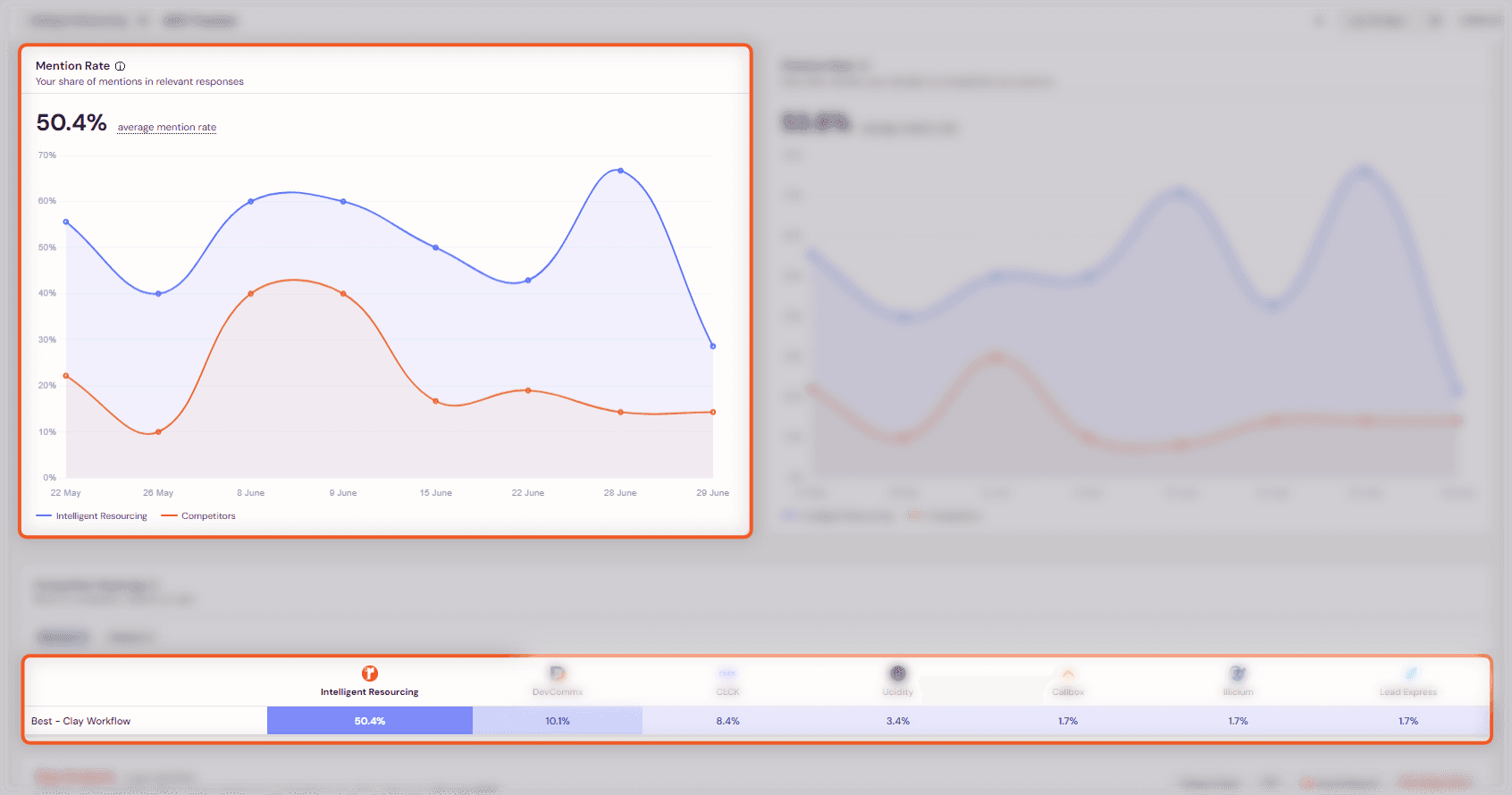
The July 07, 2026 AEO Tracker shows why this system should be built by topic, not across the whole site at once. Intelligent Resourcing performs strongly in the Clay Workflow cluster, with 50.4% AI Share of Voice compared with 10.1% for the nearest competitor. That strength gives each related page more chances to support the next step, whether that is a service visit, a retargeting audience, a sales conversation or a branded search. AI Overview recovery works best when each priority topic has clear answers, consistent language, supporting proof and a connected conversion path.
What Metrics Prove Recovery Is Working?
Ranking and Traffic alone does not prove AI Overview recovery. A successful recovery programme should show that the brand is being seen, cited, clicked and converted in the places that matter commercially.
Use a blended measurement model.
Metric | Why it matters | Where to measure |
CTR on AIO-triggering queries | Shows whether click leakage is improving | Google Search Console |
Citation inclusion | Shows whether the page is being used as a source | Manual SERP checks and AI visibility tools |
Branded search lift | Captures zero-click influence | GSC and analytics |
AI referral velocity | Tracks visits from AI assistants | Analytics referral filters |
Assisted pipeline | Connects visibility to revenue | CRM and attribution |
Topic-level share of voice | Shows whether answer visibility is improving | AEO tracker or prompt monitoring |
Citation counts are helpful, but they are not enough. A 2026 GEO measurement paper distinguishes citation selection, where a platform triggers search and chooses sources, from citation absorption, where a cited page actually contributes language, evidence, structure or factual support to the final answer. The same research found that high-influence pages tend to be longer, more structured, semantically aligned and richer in extractable evidence such as definitions, numerical facts, comparisons and procedural steps.
This pattern shows up in Intelligent Resourcing's own Clay Workflow cluster. A live Google check (July 2026) for "best Clay workflow agency 2026" returns IR's own roundup, "8 Best Clay Workflow Automation Agencies for 2026", in the top position, ahead of GTM Engineering Co, Nebor and European Business Magazine. The same cluster is where AI systems already trust IR as a source: per IR's own AEO Tracker, Google's AI Overview cites Intelligent Resourcing in 80.0% of runs on Clay Workflow queries, with an average position of 1.0.
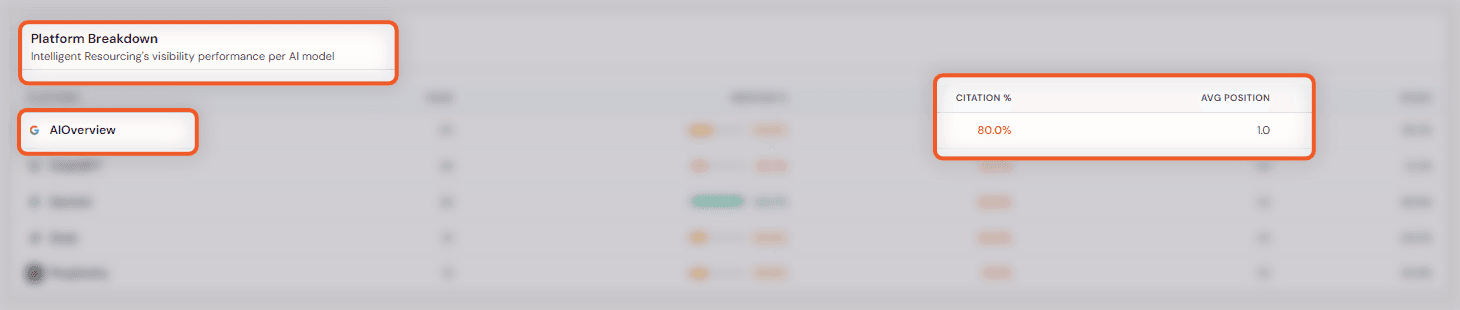
When IR shows up in an AI Overview response for this topic, it is the first brand named, not buried further down. A page does not have to choose between ranking and citation. The same content can hold a page-one position and supply the structured evidence AI Overview reuses as a source.
What Does a 90-Day AI Overview Recovery Roadmap Look Like?
AI Overview recovery should run in cycles. Do not rewrite the whole site. Build a controlled recovery queue, measure the effect and then expand.
Days 1 to 15: Diagnose
Export GSC data: Pull queries, pages, clicks, impressions, CTR and average position.
Tag likely AIO queries: Focus on question-form, definition, comparison and diagnostic searches.
Separate traffic types: Split informational traffic from BOFU traffic.
Map SERP features: Record whether AI Overviews, snippets, ads or forums appear.
Identify leakage pages: Prioritise page-one URLs with high impressions and weak CTR.
Days 16 to 45: Rebuild
Add answer-first blocks: Put the direct answer immediately under the H1.
Insert decision tables: Give AI systems and buyers a clear extraction asset.
Strengthen proof: Add anonymised audit findings, benchmarks and examples.
Improve schema parity: Match FAQ and Article schema to visible content.
Add conversion assets: Create checklists, templates, audits or calculators.
Days 46 to 75: Expand
Publish supporting BOFU pages: Add comparison, alternatives and recovery-specific pages.
Build external proof assets: Create benchmark pages that publishers and AI systems can cite.
Refresh internal links: Connect recovery pages to service, visibility and competitor pages.
Enable sales: Turn the diagnostic framework into discovery questions.
Days 76 to 90: Measure
Recheck CTR: Compare recovered pages against the previous period.
Recheck citations: Monitor whether the page appears in AI Overview or AI assistant answers.
Review pipeline: Look for assisted conversions, branded search and form quality.
Kill or refresh weak assets: If a page gains no impressions, citations or assisted demand, rebuild it with a stronger angle.
The goal is not to reverse every lost click but to protect the traffic that still influences revenue and to build assets that AI systems can trust, quote and surface.
What Mistakes Make AI Overview Traffic Loss Worse?
The biggest mistake is treating AI Overview traffic loss as one problem rather than a mix of SERP displacement, intent compression, ranking volatility, citation competition and changing buyer behaviour.
Avoid these recovery traps:
Blaming every decline on AI: Seasonality, ranking changes and demand shifts still matter.
Rewriting without diagnosis: You can damage pages that are still working.
Chasing informational traffic: Lost top-of-funnel sessions may not be worth recovering.
Burying the verdict: AI systems and buyers both need the answer early.
Ignoring competitors: If another brand is cited, you need to understand why.
Publishing generic content: Redundant advice is easier for AI systems to ignore.
Blocking crawlers reflexively: Controls matter, but blocking often costs more than it protects.
Blocking needs particular care, but not for the reason most teams assume. BuzzStream's analysis of 4 million AI citations across 3,600 prompts found that 92.3% of sites blocking Google-Extended still appeared in AI citations anyway. Blocking a crawler does not reliably protect you from being cited, but it does cost you traffic: separate research from Rutgers Business School and The Wharton School found publishers blocking AI crawlers saw total traffic fall 23.1%. The commercial question is not "how do we hide everything?" It is "which content should be accessible, structured and worth citing?", because blocking rarely delivers the protection teams expect from it.
FAQs
How do I know if Google AI Overviews caused my traffic drop?
Look for pages where impressions and rankings stayed relatively strong, but CTR fell. Then manually check whether AI Overviews or other SERP features appear for the affected queries. If rankings fell at the same time, diagnose SEO loss before blaming AI.
Can I recover traffic lost to AI Overviews?
You can recover some clicks, but not all informational traffic will return. The better goal is to recover commercial demand by rebuilding high-impression pages with answer-first copy, proof, decision tables and click-worthy assets.
Should I block AI crawlers to protect my content?
Not as a reflex. The data shows blocking often fails to reduce citations while still cutting traffic. Use indexing and preview controls deliberately, but keep commercially useful content accessible when citation and discovery matter.
Do AI Overview citations increase clicks?
Not always. The Pew Research data cited above found that users clicked links inside AI summaries in only 1% of visits where such a summary appeared. Citation can support visibility and trust, but the page still needs a strong reason for the buyer to click.
Which pages should B2B companies optimise first?
Start with BOFU pages that already have impressions and rankings: service pages, comparison pages, alternatives pages, diagnostic guides and pages tied to high-value pain points. Do not begin with low-intent glossary content unless it supports a larger commercial cluster.
Is AEO recovery different from SEO recovery?
Yes. SEO recovery focuses on rankings, crawlability, content quality and authority. AEO recovery adds citation eligibility, answer structure, extractable evidence, entity clarity and AI answer visibility. The two overlap, but they are not identical.
How long does AI Overview recovery take?
Most teams should plan around a 90-day cycle. The first two weeks diagnose leakage, the next month rebuilds priority pages, and the final phase measures CTR, citation inclusion, branded lift and assisted pipeline.
Recovery Is About Pipeline, Not Lost Sessions
Losing organic traffic to Google AI Overviews feels like an SEO problem, but for B2B teams it is really a demand capture problem. Some clicks will disappear because the answer is now visible on Google. Some clicks were never commercially valuable. The pages worth saving are the ones where high-intent demand still exists.
The recovery playbook is clear: diagnose before rewriting, prioritise high-impression commercial pages, move the answer and verdict higher, add proof that AI systems can cite, and create assets that buyers need to click.
Intelligent Resourcing helps B2B teams identify the page-one rankings, citation gaps and AI Overview queries leaking pipeline. Book an AEO Recovery Audit to find where your traffic is being absorbed, where competitors are being cited and which pages should be rebuilt first.