

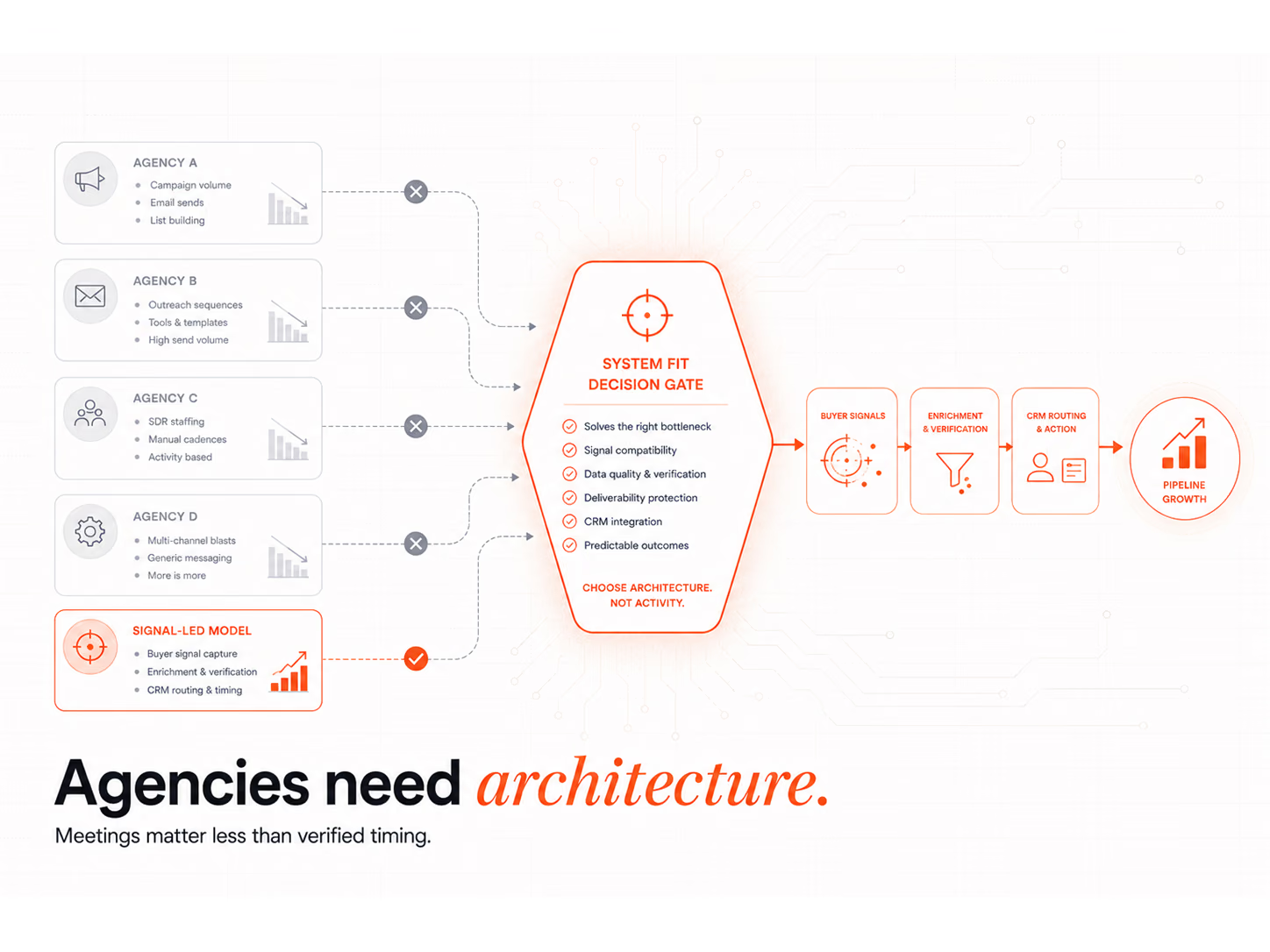
When campaign-led outbound stops producing predictable meetings (the same agency formula booking fewer demos every quarter, deliverability tanking, ICP drifting), most revenue leaders start looking for "a better agency". The real work is choosing the right model for where your pipeline is breaking, not picking a vendor off a shortlist of look-alikes.
This article is published by Intelligent Resourcing. Our own GTM operating-partner model appears first in the list below because it met the same criteria we applied to every other agency on the page (the methodology is in Section III). You can weight our description of it accordingly.
This is a tested evaluation of the 10 outbound agencies running real pipeline for B2B teams in 2026, grouped by the four archetypes you can actually hire from. It is not a directory.
How We Evaluated These Agencies
The Upgrader question is rarely "which agency has the longest feature list", it is "which model fits where my pipeline is breaking, and what will it cost me to switch". The five criteria below set the dimensions every entry is measured on.
- Archetype fit. The four outbound archetypes (volume cold email, quality boutiques, SDR-as-a-Service, GTM operating partners) solve different problems at different prices. Hiring the wrong archetype is the most common reason outbound fails.
- Personalisation and channel depth. Cold email reply rates sit at 1 to 4% on average per Mailshake's 2026 State of Cold Email, and Sopro's analysis of 97.9M emails finds multichannel campaigns lift leads 31% over single-channel. An agency that runs only one channel at thin personalisation will produce thin pipeline.
- Data infrastructure and integration. Hightouch's 2025 study of 384 marketers found 75% of martech pain traces back to disconnected data, not missing tools or missing reps. An agency that bolts onto a fragmented stack is buying you another silo.
- Engagement model and team transparency. Dedicated vs shared SDRs, named team members, weekly working sessions, raw data access. Vanity dashboards hide poor execution.
- Cost versus in-house comparison. Callbox's 2025 comparison puts an in-house SDR team at $20K to $30K per month once recruiting, tooling, and ramp are included, versus $6K to $15K outsourced.
Weighting note: if the system underneath outreach is your primary problem (data, signals, scoring, handoffs), weight criteria 3 and 4 most heavily. If you have a clean system but no team to run it, weight 1, 4, and 5. RAIN Group's seller research finds it takes 8 touchpoints on average to land an initial meeting, which means persistence is non-negotiable across every archetype.
How We Selected These Tools
The evaluation was run by Ronan Leonard, founder of Intelligent Resourcing, drawing on direct experience replacing or wrapping outbound agencies for B2B clients across 2024 and 2025. Each agency was assessed against the five criteria in the previous section, with three inputs per provider: the agency's own website (positioning, services, pricing where published), their Clutch.co profile (rating and verified review count for the services track), and the qualitative pattern of strengths and limitations we have seen wrap onto each archetype in real client deployments.
We included Intelligent Resourcing in the list because buyers comparing outbound options need the full landscape (operating partners included) to make the right call for their situation. The same five criteria apply to our entry.
Outbound Agencies at a Glance
| Provider | Best for | Pricing model | Engagement type | Clutch rating | Typical timeline |
|---|---|---|---|---|---|
| Intelligent Resourcing | Outbound system is the blocker, not lead supply | Custom | Dedicated team | Refs on request | ~30 days to first results |
| Skaled Consulting | Modernising GTM across sales, marketing, success, ops | Custom | Dedicated team | No verified reviews | 90-day roadmap |
| Winning by Design | B2B SaaS wanting Bowtie/SPICED GTM operating system | Hybrid | Hybrid | 4.8/5 G2 (750+ reviews) | 30-60 days to clarity |
| Operatix | Multi-region SaaS outbound with vertical depth | Hybrid | Dedicated team | Not listed | Ongoing retainer |
| CIENCE | Enterprise multi-channel cold outbound + nurture | Custom (from ~$1K) | Dedicated team | 4.2/5 (142 reviews) | First leads in month 1 |
| MarketStar | Global tech outsourcing pipeline + partners + retention | Custom | Dedicated team | Everest PEAK Leader 2025 | Multi-year |
| Leadium | Founder-led omnichannel SDR pods | Retainer (from ~$2.5K) | Dedicated team | 5.0/5 (56 reviews) | Immediate to 90 days |
| Sapper Consulting | TAM 2,000+ wanting email + direct mail | Retainer ($10-49K) | Dedicated team | 3.9/5 (20 reviews) | Pipeline from month 2 |
| Sopro | B2B teams with no internal cold-outreach capacity | Retainer | Dedicated team | 5.0/5 (4 reviews) | Ongoing retainer |
| Belkins | Mid-market+ omnichannel appointment-setting at scale | Custom ($10-49K) | Dedicated team | 4.9/5 (230 reviews) | 30 days to first meetings |
Clutch ratings and review counts verified May 2026. G2 mention for Winning by Design is plain text only.
The 10 Best Outbound Agencies in 2026
Grouped by archetype. Each entry follows the same evaluation template: differentiation hook, overview, Best for, Key features, Pricing, What users say, and Limitation. We start with the operating-partner model (where Intelligent Resourcing sits) because the strongest fit depends on whether you need a campaign or a system.
GTM Operating Partners
Intelligent Resourcing
Unlike traditional outbound agencies that run campaigns, Intelligent Resourcing builds the operating system underneath outbound (data, signals, scoring, routing) and embeds teams to run it, so the engine stays with the client when the engagement ends.
Intelligent Resourcing is a Revenue Operations Studio based in Australia with global delivery. We installed signal-led revenue engines for B2B clients across 2024 and 2025 by combining Clay, HubSpot, n8n, and Smartlead into one connected stack, monitoring target accounts for buying signals (job changes, funding events, tech-stack changes) and triggering outreach only when a Verified Buying Window opens.
Best for: B2B service businesses whose outbound system, not lead supply, is the blocker.
Key features: Live buying-signal tracking across job posts, tech installs, and hiring spikes, which means outreach only fires on accounts in-market this week, not whoever was on last quarter's list. Clay-to-Smartlead enrichment-to-outbound pipeline that runs continuously, so contact records refresh as the database decays. Embedded GTM engineers and SDRs operating inside your tools (HubSpot, Salesforce, Clay), which means the system stays after the engagement.
Pricing: Custom, scoped per engagement. No published rates as of May 2026.
What users say: No public Clutch listing as of May 2026. Verified client references provided on request during scoping.
Limitation: No public pricing or fixed timeline (a sales call is required to scope). For teams that need a $2K-per-month low-commitment volume shop, this is the wrong fit.
Skaled Consulting
Unlike pure-strategy consultancies that deliver a slide deck and leave, Skaled embeds delivery teams alongside the strategy work, with 350,000+ delivery hours and 1,000+ transformations on the books.
Skaled positions itself as an embedded GTM partner rather than a traditional consultancy, running modernisation work across sales, marketing, customer success, and operations with AI and automation. The model fits teams whose problem is multi-function (not just SDR coverage), where the fix involves rebuilding workflows alongside running them.
Best for: B2B revenue teams modernising GTM across the full stack, not just outbound.
Key features: Embedded execution partner model so transformation work is delivered in-flight (not handed off after design), which means change actually lands in tools and team behaviour. AI-deployment capability across the GTM tech stack, so the operating layer keeps pace with current platforms. Multi-function scope (sales, marketing, success, ops), which means you do not need to coordinate three separate vendors.
Pricing: Custom, contact sales. No published tier rates.
What users say: Skaled's Clutch profile lists no verified reviews as of May 2026 (verified May 2026). Track record is documented via case studies on their own site.
Limitation: No verified Clutch reviews and no published pricing or engagement length make it harder to validate fit before a sales call.
Winning by Design
Unlike capability-training firms that stop at education, Winning by Design designs, deploys, and scales the operating system itself, using their proprietary Bowtie and SPICED frameworks across the diagnose-design-deploy methodology.
Winning by Design serves B2B SaaS and recurring-revenue companies wanting a unified GTM operating system across customer revenue optimisation, RevOps, and enablement. The frameworks are well-known in the SaaS GTM community, which means buy-in inside the client team is usually higher than with bespoke methods.
Best for: B2B SaaS and recurring-revenue companies wanting a unified GTM operating system anchored on Bowtie and SPICED.
Key features: Proprietary Bowtie revenue framework that models the full customer journey beyond the funnel, so the GTM design accounts for retention and expansion. SPICED qualification framework for sales conversations, which means rep coaching and deal qualification share a common language. Academy plus team training plus transformation tiers, so engagements can start at $500 (a course) and scale to $500K+ (full GTM transformation).
Pricing: $500 per course (Academy), $25,000+ for team training, $500K+ for full GTM transformations. Freemium content tier.
What users say: Winning by Design holds 4.8/5 on G2 across 750+ verified reviews (as of May 2026). No Clutch profile activity.
Limitation: The diagnostic engagement is effectively a prerequisite for design and deploy phases, which means you cannot pick-and-choose modules cleanly.
SDR-as-a-Service and On-Demand Sales Teams
Operatix
Unlike generalist SDR firms, Operatix specialises in B2B software outbound across cybersecurity, fintech, and martech verticals, with 300+ SDRs deployed across AMER, EMEA, LATAM, and APAC.
Operatix runs outsourced SDR teams for B2B SaaS vendors needing genuine multi-region coverage in 22 languages. The tech-vertical specialisation matters because outbound sequencing for a cybersecurity buyer is materially different from a fintech compliance officer, which generic SDR shops rarely calibrate for.
Best for: B2B SaaS vendors needing multi-region outbound with vertical depth.
Key features: 300+ SDRs operating in 22 languages, so global rollouts ship without bolting on regional sub-vendors. 10 tech-vertical specialisations, which means the SDRs understand the buyer language without a six-month ramp. Coordinated AMER/EMEA/LATAM/APAC delivery, so account coverage follows the buyer's time zone.
Pricing: Not published; custom retainer.
What users say: Operatix's Clutch profile is not currently listing verified reviews (as of May 2026). Proof points live on their own site as case studies.
Limitation: No transparent pricing or low-commitment entry point, which makes early budget conversations harder than with the cold-email shops.
CIENCE
Unlike SDR firms that hire humans and stop there, CIENCE blends AI personalisation with human SDR orchestration: humans direct the campaigns, AI personalises and executes at scale.
CIENCE is one of the original SDR-as-a-Service brands, serving enterprise B2B teams running multi-channel cold outbound, inbound nurture, and data enrichment as a single system. The model fits when you want a full outbound stack on a single retainer rather than four vendors stitched together.
Best for: Enterprise B2B teams running multi-channel cold outbound, inbound nurture, and data enrichment as one system.
Key features: AI plus human SDR orchestration where humans direct strategy and AI personalises and executes, which means per-touch quality holds at higher volume than pure human models. Free GTM Assessment offered as a no-commitment entry point, so buyers can validate fit before signing. Multi-channel coverage on a single retainer (email, phone, LinkedIn, data ops), which means one accountable team across the funnel.
Pricing: From ~$1,000 per project on the low end, scaling to $50,000+ per Clutch's listed range.
What users say: CIENCE holds 4.2/5 on Clutch across 142 verified reviews (as of May 2026).
Limitation: Clutch reviews are polarised: alongside strong testimonials, multiple 1-star reviews allege fabricated leads and refund disputes. Validate fit carefully and confirm reporting transparency before signing.
MarketStar
Unlike SDR-only outsourcers, MarketStar runs Sales-as-a-Service spanning pipeline generation, deal acceleration, partner channel programmes, and retention under one delivery framework.
MarketStar has been running outsourced sales for 40+ years, with an Everest Group PEAK Matrix Leader 2025 designation. The model fits global tech and SaaS organisations outsourcing not just SDRs but full revenue functions (channel, retention, inside sales), where one operator covers what would otherwise be three separate retainers.
Best for: Global tech and SaaS organisations outsourcing pipeline, deal acceleration, partner channels, and retention.
Key features: Sales-as-a-Service operating model covering pipeline, channel, and retention, which means the same operator owns the full revenue motion. 40+ years operating history, so the playbooks are tested against multiple market cycles. Everest Group PEAK Matrix Leader 2025 designation, which means independent analyst validation beyond customer reviews.
Pricing: Custom, contact sales.
What users say: MarketStar is recognised as an Everest Group PEAK Matrix Leader 2025 in sales-as-a-service (analyst recognition replaces a Clutch rating in this case). Average client tenure is reported at 8+ years on their site.
Limitation: Enterprise-only positioning effectively excludes mid-market and SMB buyers. If your team is under 200 staff, MarketStar is rarely the right fit.
Quality-First, Persona-Deep Boutiques
Leadium
Unlike volume cold-email shops that scale via templated touches, Leadium runs founder-led SDR teams on omnichannel pipeline, claiming 67% weighted cost reduction versus in-house build and 73% lift in conversations from channel-optimised data.
Leadium fits founders and revenue leaders wanting a small, accountable team running tailored outbound across email, phone, LinkedIn, and gifting, rather than a factory model. The dedicated-team engagement keeps per-account research depth higher than shared-team alternatives.
Best for: Founders and revenue leaders wanting founder-led SDR teams on omnichannel pipeline rather than a factory model.
Key features: Omnichannel sequencing across email, phone, LinkedIn, and gifting, so persona-deep outreach matches the buyer's channel preference. Channel-optimised data sourcing, which means contacts are reachable on the channel the rep is using. Founder-led pods, so accountability sits with named operators not anonymous SDRs.
Pricing: From ~$1,000 per project on Clutch's listed band; site quotes from ~$2,500 retainer tiers.
What users say: Leadium holds 5.0/5 on Clutch across 56 verified reviews (as of May 2026).
Limitation: The site explicitly flags "limited capacity" and requires a formal intake form before contact, which means engagement timelines depend on availability windows.
Sapper Consulting
Unlike pure cold-email shops, Sapper integrates direct mail with email, phone, and LinkedIn over a 125M+ data-point pool, with guaranteed meeting commitments and a three-months-free clause if targets are missed.
Sapper Consulting runs across 80+ industries with a hard TAM threshold above 2,000 companies, which means the boutique-style economics only work on broad-enough markets. The performance guarantee shifts risk away from the buyer.
Best for: B2B sales teams across 80+ industries with TAM above 2,000 companies wanting predictable pipeline without in-house prospecting.
Key features: Direct-mail layer integrated with email, phone, and LinkedIn, so the sequence reaches buyers across channels less saturated than email alone. Guaranteed meeting commitments with a three-months-free clause if missed, which means there is a real performance backstop. 125M+ data-point pool driving the targeting, so list quality holds across narrow personas.
Pricing: $10,000 to $49,000 typical project size per Clutch.
What users say: Sapper holds 3.9/5 on Clutch across 20 verified reviews (as of May 2026), with multiple 0.5-star reviews. Validate carefully against your specific category.
Limitation: Excludes verticals with TAM under 2,000 companies, which means founders in niche markets are usually out of scope. Polarised reviews require diligence on category-specific case studies.
Volume-Driven Cold Email Shops
Sopro
Unlike fragmented cold-email vendors stitched from sequencer plus VA, Sopro runs a fully managed 10-year-old prospecting service with a live performance portal, 2,861 active clients, and 630K+ conversations started.
Sopro fits B2B teams without internal cold-outreach capacity who need volume prospecting across email, LinkedIn, phone, and intent signals on a managed retainer. The transparency of the live performance portal is a real differentiator versus shops that report on a monthly PDF.
Best for: B2B teams without internal cold-outreach capacity needing managed volume prospecting across multiple channels.
Key features: Live performance portal showing real-time campaign metrics, which means reporting is transparent rather than delivered in a packaged monthly slide. 10-year operating history across 2,861 active clients and 630K+ conversations started, so the playbooks are tested at scale. Multi-channel coverage on one managed retainer (email, LinkedIn, phone, intent), which means coordination overhead sits with Sopro, not your team.
Pricing: Not published; custom retainer.
What users say: Sopro holds 5.0/5 on Clutch across 4 verified reviews (as of May 2026). Sample is small, so weight the 2,861-client portfolio data point more heavily.
Limitation: Fully managed only, no self-service or low-touch tier, and pricing is opaque upfront.
Belkins
Unlike single-SDR providers, Belkins assigns a Center of Excellence pod per client (account manager, SDR, researcher, copywriter, and email-tech expert), so each engagement is staffed across the full outbound function.
Belkins fits mid-market to enterprise B2B revenue teams across 50+ industries wanting omnichannel appointment-setting at scale. Twelve-to-fifteen-month engagement tenure is typical, which means the team builds compounding context on your buyer rather than ramping every quarter.
Best for: Mid-market to enterprise B2B revenue teams across 50+ industries wanting omnichannel appointment-setting at scale.
Key features: Dedicated Center of Excellence pod per client (account manager, SDR, researcher, copywriter, email-tech expert), which means the team covers the full outbound function without you stitching specialists. Coverage of 50+ industries, so the playbooks scale across vertical-specific motions. 100-400+ qualified appointments per year claimed per engagement, so volume expectations are explicit upfront.
Pricing: $10,000 to $49,000 typical project size per Clutch.
What users say: Belkins holds 4.9/5 on Clutch across 230 verified reviews (as of May 2026), the largest verified sample in this list.
Limitation: No transparent pricing on the site, and no self-service or low-touch entry point for teams testing the model before a full retainer.
Which Tool Fits Your Situation
- If outbound keeps breaking at the system level (data, signals, handoffs) and you want the engine to stay after the contract, Intelligent Resourcing is worth evaluating first.
- If you want to modernise GTM across sales, marketing, success, and ops together (not just SDR coverage), Skaled Consulting.
- If you are a B2B SaaS team wanting a proven framework (Bowtie/SPICED) and shared GTM language across the org, Winning by Design.
- If you are a B2B SaaS vendor needing multi-region outbound in 22 languages with cyber/fintech/martech depth, Operatix.
- If you want a full outbound stack (email, phone, LinkedIn, enrichment) on one retainer with a free assessment to start, CIENCE (with diligence on the polarised reviews).
- If you are global enterprise tech outsourcing pipeline + channel + retention together, MarketStar.
- If you want a small, founder-led omnichannel SDR pod with high per-account research, Leadium.
- If you have TAM above 2,000 companies and want email-plus-direct-mail with a meeting guarantee, Sapper Consulting.
- If you have no internal cold-outreach capacity and want a 10-year-old managed service with live reporting, Sopro.
- If you are mid-market+ and want a full Center of Excellence pod for omnichannel appointment-setting at volume, Belkins.
Implementation: What to Expect
Moving from a campaign-led agency relationship (or from in-house spreadsheets) to a structured outbound engagement typically runs through three phases: data and ICP cleanup, sequence and channel build, and embedded execution. For low-effort engagements (volume cold email shops), expect first meetings within 30 days. For mid-effort (SDR-as-a-Service, boutique), pipeline fills from month two as the team learns your buyer. For high-effort (GTM operating partners), the first 30 days are diagnostic and system-build before outbound goes live, which trades a slower start for a more durable engine.
Confirm onboarding support, named team members, weekly working cadence, and data access before committing. Vague "we will handle it" answers are a signal the agency is selling activity, not pipeline.
Honourable Mentions
memoryBlue. A 20-year-old SDR-as-a-Service operator with a SMART framework (Sales, Marketing, Academy, Recruiting, Tech) and an alumni network that feeds talent back to client teams. Clutch rating 4.7/5 across 23 verified reviews. Worth a look for mid-market teams wanting access to a hire-train-deploy pipeline that also produces internal hires later.
Pearl Lemon Leads. London/New York volume shop inside the wider Pearl Lemon Group, marketing "20 meetings in 30 days" tiers from £1,497/month. Best when budget is tight and the priority is meeting volume on a clearly-defined ICP. Validate domain-reputation safeguards before signing because volume shops live and die on inbox placement.
Refine Labs. Mid-market and enterprise SaaS demand-gen agency that shifts teams from lead gen to performance-driven demand, measuring qualified pipeline and revenue rather than MQLs. Demand-gen-leaning rather than pure outbound, so the fit is sideways to this list, but the operating-partner DNA is similar to the GTM Operating Partners sub-group.
Final Verdict
Outbound in 2026 is not a single buy. The right call depends on whether the blocker is execution, expertise, or the system underneath the outreach. If pipeline keeps breaking because the engine is fragmented (data, signals, handoffs), Intelligent Resourcing is the operating-partner model that builds and runs the system with the client owning it after. If you have a clean engine and need execution depth across regions or verticals, Operatix or MarketStar fit. If you have a clean engine and small TAM, Sapper or Leadium. If you have no internal capacity at all, Sopro or Belkins.
Every quarter on the wrong archetype is a quarter of pipeline drift, burned domain reputation, and rep time spent on accounts that never had a buying signal in the first place. The cost of staying on a misfit agency compounds. The cost of switching to the right archetype is bounded.
What is the best outbound agency for B2B SaaS in 2026?
It depends on the specific blocker. For multi-region outbound in cybersecurity, fintech, or martech, Operatix has the strongest vertical depth. For SaaS teams wanting a unified GTM framework (Bowtie/SPICED) across the full revenue org, Winning by Design fits. For SaaS teams whose problem is the outbound system (data, signals, scoring) rather than rep coverage, Intelligent Resourcing fits.
How much does an outbound agency cost in 2026?
Volume cold email shops run from around £1,500/month to mid-five-figures monthly. Boutique and SDR-as-a-Service retainers typically run $10,000 to $49,000 per project per Clutch's listed bands. Operating-partner engagements are custom-scoped, generally six figures annually. In-house SDR teams cost $20,000 to $30,000 per month once recruiting, tooling, and ramp are included.
How long does it take to see results from an outbound agency?
Volume cold email shops promise first meetings within 30 days. SDR-as-a-Service and boutique engagements typically fill pipeline from month two. GTM operating partners use the first 30 to 60 days for diagnostic and system-build before outbound goes live, with results compounding over the following quarters because the engine improves with each cycle rather than running on a fixed playbook.
What is the difference between an SDR-as-a-Service agency and a GTM operating partner?
An SDR-as-a-Service team executes outbound on your behalf, owning campaigns and meeting volume on a retainer. A GTM operating partner builds the system underneath outbound (data, signals, scoring, routing) and embeds operators to run it, with the engine staying client-owned after the engagement. The choice is "buy execution" versus "build owned infrastructure plus run it for now".
Is outsourced outbound suitable for small companies?
Volume cold email shops scale down to founders and seed-stage teams at sub-£2,000/month retainers. SDR-as-a-Service, boutique, and operating-partner engagements typically need at least mid-market budget ($5,000+ per month) to make the unit economics work. For very small teams, a fractional SDR or solo founder running cold outbound with a clear ICP often beats hiring an agency too early.
How do I migrate from an existing outbound agency to a new one?
Audit what is actually transferable: ICP definition, sequences and copy, deliverability infrastructure, and CRM records produced. Most of the value sits in the data and the inbox reputation, not the agency itself. A clean handover means the new agency inherits a working list and a warm-up history rather than starting from zero. Operating-partner engagements absorb this transition naturally because the system is owned by the client rather than the outbound vendor.
Comparisons
Every quarter on a misfit outbound agency is a quarter of burned domain reputation and drifted ICP. A 30-minute Revenue Operations Studio scoping call clarifies whether you need a campaign, a team, or a system.
FAQs
What is the best outbound agency for B2B SaaS in 2026?
It depends on the specific blocker. For multi-region outbound in cybersecurity, fintech, or martech, Operatix has the strongest vertical depth. For SaaS teams wanting a unified GTM framework (Bowtie/SPICED) across the full revenue org, Winning by Design fits. For SaaS teams whose problem is the outbound system (data, signals, scoring) rather than rep coverage, Intelligent Resourcing fits.
How much does an outbound agency cost in 2026?
Volume cold email shops run from around £1,500/month to mid-five-figures monthly. Boutique and SDR-as-a-Service retainers typically run $10,000 to $49,000 per project per Clutch's listed bands. Operating-partner engagements are custom-scoped, generally six figures annually. In-house SDR teams cost $20,000 to $30,000 per month once recruiting, tooling, and ramp are included.
How long does it take to see results from an outbound agency?
Volume cold email shops promise first meetings within 30 days. SDR-as-a-Service and boutique engagements typically fill pipeline from month two. GTM operating partners use the first 30 to 60 days for diagnostic and system-build before outbound goes live, with results compounding over the following quarters because the engine improves with each cycle rather than running on a fixed playbook.
What is the difference between an SDR-as-a-Service agency and a GTM operating partner?
An SDR-as-a-Service team executes outbound on your behalf, owning campaigns and meeting volume on a retainer. A GTM operating partner builds the system underneath outbound (data, signals, scoring, routing) and embeds operators to run it, with the engine staying client-owned after the engagement. The choice is buy execution versus build owned infrastructure plus run it for now.
Is outsourced outbound suitable for small companies?
Volume cold email shops scale down to founders and seed-stage teams at sub-£2,000/month retainers. SDR-as-a-Service, boutique, and operating-partner engagements typically need at least mid-market budget ($5,000+ per month) to make the unit economics work. For very small teams, a fractional SDR or solo founder running cold outbound with a clear ICP often beats hiring an agency too early.
How do I migrate from an existing outbound agency to a new one?
Audit what is actually transferable: ICP definition, sequences and copy, deliverability infrastructure, and CRM records produced. Most of the value sits in the data and the inbox reputation, not the agency itself. A clean handover means the new agency inherits a working list and a warm-up history rather than starting from zero. Operating-partner engagements absorb this transition naturally because the system is owned by the client rather than the outbound vendor.