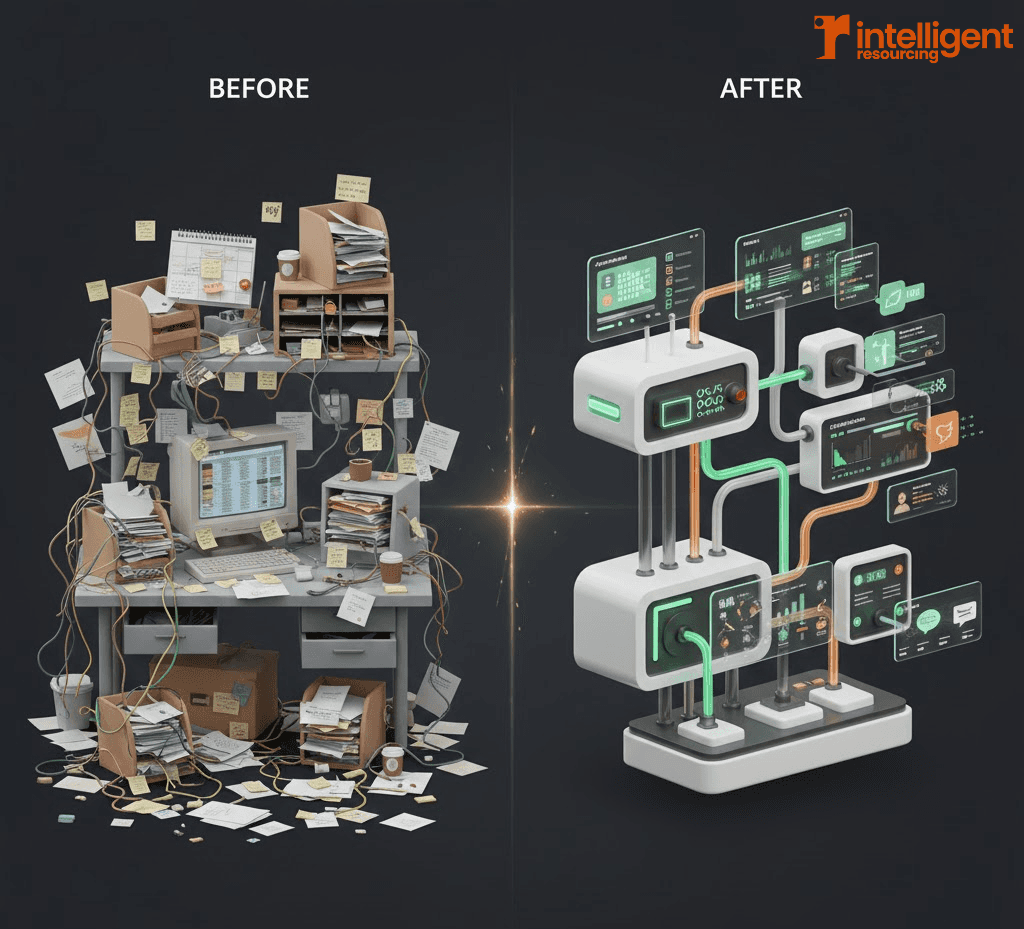

Sales teams are under pressure to drive more pipeline with fewer people, but most are drowning in messy tabs and disconnected tools. The solution isn't just buying more software but to build a connected engine.
We analysed the top 10 outbound automation tools for 2026 to help you choose the right stack for your motion.
Quick Summary: The Top 6 Tools by Use Case
Tool | Best For | Key Feature | Pricing Model |
|---|---|---|---|
1. Persana AI | Signal-Based Outbound | Real-time "job change" & hiring triggers | Credits + Monthly |
2. Salesforce | Enterprise Teams | The "System of Record" for everything | Per User / Tiered |
3. Outreach | Mature Sales Teams | Multi-channel engagement (Calls + Email) | Custom / Quote |
4. HubSpot | All-in-One Growth | Native Marketing + Sales alignment | Free to Enterprise |
5. Apollo.io | Data + Sending | 275M+ Contact Database included | Credits + Seat |
6. Smartlead | High-Volume Email | Unlimited inboxes & warm-up | Monthly Flat Rate |

How Outbound Automation Tools Fit into a Modern Sales Stack
Think less "top 10 list", more jobs to be done.
A healthy outbound stack typically has four layers:
Data & Signals
Finding the right accounts and contacts
Enriching them with firmographic, technographic, and intent signals
Keeping that data fresh
Tools: Persana AI, Apollo.io, plus your enrichment ecosystem
Execution & Engagement
Running email, phone, LinkedIn, SMS cadences at scale
Handling follow-ups automatically
Tools: Outreach, Smartlead, Lemlist, Woodpecker, sometimes Close
CRM & System of Record
Owning accounts, contacts, opportunities, and reporting
Automating internal workflows and routing
Tools: Salesforce Sales Cloud, HubSpot Sales Hub, Close CRM
Network & Social Prospecting
Finding and engaging prospects in the networks they actually live in
Tools: LinkedIn Sales Navigator
You don't need all 10 tools below. You need the right combination for your motion and an operating model that holds it all together.
10 Best Outbound Sales Automation Tools in 2026
1. Persana AI: Signal-Driven Prospecting & Enrichment
Best for: Teams that want AI-driven triggers, fresh data, and outbound plays that react to real-world changes. Persana AI is built for signal-based outbound. It pulls from dozens of data sources to tell you who to talk to and when, then gives you the playbooks to act on it.
Key capabilities:
AI sales triggers: Track job changes, hiring patterns, and other buying signals
Proven outbound playbooks: Access pre-built strategies you can adapt to your motion
Email waterfall: Route emails through multiple providers to maximise delivery
Automated lead generation: Weekly AI-curated lead lists based on your criteria
Real-time enrichment: Continuously updates contact and account records from many sources
Pricing (indicative, starting tiers):
Free tier with limited monthly credits
Paid plans scaling from low hundreds to mid hundreds USD per month, depending on annual credits and volume
Where it fits in your stack: Persana AI sits in the data & signals layer and can also touch execution through its email features. It pairs well with a dedicated engagement tool and a robust CRM.
Verdict: Best for teams moving from "spray and pray" to signal-based targeting.
2. Salesforce Sales Cloud: Enterprise CRM & Automation Backbone
Best for: Growing and enterprise organisations that need a robust, customisable CRM with strong automation.
Salesforce Sales Cloud remains the benchmark for enterprise-grade sales automation. It's more than a database, it's a platform.
Key capabilities:
Automatic data capture from emails, calls, and integrations
Pipeline and territory management with configurable views and rules
AI insights to spot at-risk deals and forecast more accurately
Process automation for approvals, handoffs, and internal workflows
Pricing (per user/per month, typical tiers):
Entry-level tier for small teams
Mid-tier with more automation and customisation
Higher tiers for full enterprise features and support
Where it fits in your stack: Salesforce is your system of record and internal automation hub. You plug data sources (Persana, Apollo) and engagement tools (Outreach, Smartlead, etc.) into it, not the other way around.
Verdict: The mandatory backbone for scaling teams, but requires a dedicated admin.
3. Outreach: Multi-Channel Sales Engagement
Best for: B2B sales teams that want structured, multi-channel cadences and deep engagement analytics.
Outreach is often the "sales engagement layer" in mature stacks.
Key capabilities:
Multi-channel cadences across email, phone, and social
Automation to handle follow-ups and task creation
Analytics and AI-based insights into rep performance and deal progression
Conversation intelligence add-ons for call analysis (depending on plan)
Pricing: Custom/quote-based, typically aligned to the size and complexity of your sales organisation.
Where it fits in your stack: This is your execution & engagement engine. It sits between your CRM and data sources, orchestrating contact with prospects across channels.
Verdict: The gold standard for multi-channel engagement, but overkill for simple email setups.
4. HubSpot Sales Hub: All-in-One for Growing Teams
Best for: Startups and small to mid-sized teams who want CRM + outbound + marketing alignment in one environment.
HubSpot Sales Hub is ideal when you don't want to stitch together five tools just to get going.
Key capabilities:
Email tracking and sequences
Lead scoring and automated follow-ups
Meeting links and scheduling built into workflows
Native integration with HubSpot CRM and Marketing Hub
Pricing (monthly, typical tiers):
Free tier with core features
Entry-level paid plan for small teams
Professional and enterprise tiers for advanced automation and reporting
Where it fits in your stack: For many teams, HubSpot is both CRM and engagement layer. You can later bolt on more specialised tools if you outgrow native sequences.
Verdict: The best "start and scale" platform if you hate integrating separate tools.
5. Apollo.io: Data, Intent & Outreach in One
Best for: Teams that want a large B2B contact database plus integrated outreach.
Apollo.io combines prospecting, intent data, and email sequences into a single platform.
Key capabilities:
Contact and company database with filters for ICP targeting
Intent-based prospecting to uncover accounts showing buying signals
Built-in outbound sequences for email
Data enrichment to complete missing fields in your CRM
Pricing (monthly, typical tiers):
Free tier with limited credits
Paid tiers from lower to mid price brackets, with a custom enterprise tier
Where it fits in your stack: Apollo sits somewhere between data source and lightweight engagement tool. Many teams use it as a data engine feeding into more sophisticated CRM/engagement platforms.
Apollo: Verdict: Unbeatable value for getting data and email sequencing in one place.
6. LinkedIn Sales Navigator: Network-Led Prospecting
Best for: Sales teams who live on LinkedIn and sell into roles that are active there.
Sales Navigator is the prospector's lens into the LinkedIn graph. Research shows that 68% of marketers report that social media marketing has helped them generate more leads, with LinkedIn being the most effective B2B channel.
Key capabilities:
Advanced filtering and search for leads and accounts
Real-time updates on role changes, company news, and shared connections
Saved lists and alerts to stay on top of key accounts
Integrations with CRMs so lists and activity flow into your system of record
Pricing (monthly, typical tiers):
Core tier for individual users
Advanced tier for teams with enhanced features
Custom pricing for larger deployments
Where it fits in your stack: This is your social & network prospecting tool. It works best when integrated with your CRM and engagement platform, not as a standalone island.
Verdict: Essential for researching specific people, but needs a CRM to capture the data.
7. Smartlead: High-Volume Email Outreach & Inbox Rotation
Best for: Outbound-heavy teams (especially agencies or startup SDR pods) that rely on cold email and care about deliverability.
Smartlead focuses on scaling cold email safely.
Key capabilities:
Multi-channel campaigns (email first, with SMS and LinkedIn options)
AI-powered personalisation and testing
Inbox rotation to spread sending across multiple identities and avoid spam traps
Deliverability features to monitor sender reputation
Pricing: Custom/quote-based, based on volume and feature set.
Where it fits in your stack: This is your cold email execution layer. It pairs well with data platforms like Apollo/Persana and a reporting-capable CRM.
Verdict: The #1 choice for agencies and high-volume cold emailers.
8. Lemlist: Personalised Cold Email & Creative Outreach
Best for: Teams that want their outbound to feel more like 1:1 communication than a mail merge.
Lemlist is a cold email tool that leans heavily into personalisation and creativity. Studies show that 66% of B2B buyers are more likely to open personalised emails.
Key capabilities:
Email sequences with dynamic variables
Automated follow-ups based on behaviour
Image and video personalisation embedded in emails
Inbox management features for handling replies
Pricing (monthly, typical tiers):
Entry plan for email outreach
More advanced plan for full sales engagement
Enterprise options on request
Where it fits in your stack: Another engagement layer, especially if you value personalised visuals and brand feel. Often used by agencies and teams wanting standout messaging.
Verdict: Wins on creativity and brand personality; great for smaller, high-touch lists.
9. Close CRM: CRM with Outbound Built-In
Best for: Teams that want calling, SMS, email sequences, and CRM all in one platform.
Close is a CRM built with outbound in mind.
Key capabilities:
Built-in calling and SMS with logging
Email sequences and templates
Pipeline management and reporting
Workflow automation across channels
Pricing (monthly, typical tiers):
Lower-priced startup plan
Mid-tier for growing teams
Higher-tier for full-feature access
Where it fits in your stack: Close can be both a CRM and engagement tool. Perfect for smaller teams who don't want a separate engagement layer like Outreach or Smartlead.
Verdict: The fastest CRM for teams that live on the phone.
10. Woodpecker: Email Automation & Warm-Up
Best for: Outbound teams that rely on email and need help with both sequences and deliverability.
Woodpecker is built for scalable, safe email outreach.
Key capabilities:
Cold email campaigns with automated follow-ups
Warm-up and reputation recovery to keep domains healthy
CRM and tool integrations
Basic analytics for performance tracking
Pricing (monthly, typical tiers):
Plan focused on cold email
Separate warm-up/recovery plan
Sales automation tier for more advanced workflows
Where it fits in your stack: Again, an execution layer focused on email, paired with external data and a CRM.
Verdict: A reliable, safe choice for straightforward cold email campaigns.
How to Choose the Right Outbound Sales Automation Stack
You don't need 10 tools. You need the right few, wired together properly.
Here's how to approach it.
1. Start From Your Motion, Not the Catalogue
Ask:
Who are we targeting (ICP, segments, geos)?
What channels do they actually respond to?
What's our deal size and sales cycle length?
How many reps will be using the system?
A lean startup selling mid-ticket deals might thrive with:
Apollo (data + basic outreach)
HubSpot Sales Hub (CRM + automation)
LinkedIn Sales Navigator
A scaling B2B team with dedicated SDRs might need:
Persana AI + Apollo (signals + data)
Outreach or Smartlead (engagement)
Salesforce Sales Cloud (CRM)
Sales Navigator (prospecting lens)
The stack should reflect your motion and maturity, not what looked slick in a demo.
2. Pick 1-2 Tools per Job
Avoid overlapping tools doing the same thing.
Aim for:
Data & signals: 1-2 sources (e.g., Apollo + Persana)
Engagement: 1 primary platform (Outreach, Smartlead, Lemlist, or Close/HubSpot native)
CRM: 1 system of record (Salesforce, HubSpot, Close)
Social prospecting: Sales Navigator, if your audience lives on LinkedIn
If you're collecting tools "just in case", your reps will feel it first.
3. Check Integration, Reporting, and Ownership
Before you sign anything:
Integration:
Does it integrate natively with your CRM and other key tools?
Can you keep data flowing both ways without hacks?
Reporting:
Can you see the full funnel from lead → meeting → opportunity → revenue?
Or are you stuck with siloed dashboards per tool?
Ownership:
Who owns data quality?
Who writes and maintains sequences?
Who monitors performance and runs experiments?
This is where most outbound automation efforts die: no one actually owns the system.
Why Tools Fail Without a System and a Team to Run It
The pattern is painfully consistent:
Tools are bought with high hopes
Implementation drags
Reps are half-trained
Lists are messy, sequences go stale
Leadership decides "outbound doesn't work"
The truth? Tools are fine. The operating model isn't.
Research shows that 44% of sales reps give up after just one follow-up, yet companies implementing sales automation see an average 14.5% increase in productivity and 12.2% reduction in sales cycles.
A functioning outbound automation engine needs:
Architecture: clear design of how data, tools, and workflows connect
Governance: rules for who does what, when, and how often
Capacity: people dedicated to running, maintaining, and improving the system
That's where Intelligent Resourcing comes in.
How Intelligent Resourcing Turns Tools into a Working Outbound Engine
We don't sell licences. We make whatever tools you choose work together as a system, and we provide expert guidance to run it.
1. System Design: Your Outbound Automation Blueprint
We start by mapping your world:
Your markets, ICPs, and segments
Your existing tools (and what's actually being used)
Your current outbound workflows and bottlenecks
Then we design a coherent outbound operating model:
Which tools play which role (data, execution, CRM, social)
How data flows between them
How leads move from list → outreach → meeting → opportunity
How routing, SLAs, and reporting are handled
You get an architecture you can explain to your board, not another mystery Zap in the background. Learn more about our GTM Engineering services.
2. Implementation Support: Expert Guidance
Once the system is designed, someone has to run it. We provide:
GTM & automation specialists:
Own workflows, integrations, and QA
Monitor enrichment runs and waterfalls
Tune provider mix based on performance and cost
Data & enrichment operators:
Keep lists and records clean and current
Maintain data hygiene: dedupe, merges, parent/child structures
Curate and test new signals
Ops & analytics support:
Monitor performance, flag issues, and propose experiments
Build small experiments (new segments, filters, scores)
Report insights back to RevOps and GTM leaders
We work as an extension of your internal team, inside your tools, in your Slack/Teams, on your reporting cadence.
Your sales leadership focuses on strategy, coaching, and deals. We focus on making sure the machine actually runs.
3. From Tech Spend to Revenue Outcomes
We measure success by the metrics that actually matter:
Meetings booked and qualified opportunities created
Conversion rates across each stage of outbound
Rep productivity (activities that matter, not noise)
Cycle time and cost per opportunity
Our job is not just to "set up tools". It's to turn your outbound stack into a predictable revenue engine.
Companies that implement AI in CRM experience about a 30% reduction in customer churn, while businesses leveraging automation report up to a 300% increase in conversion rates.
Bringing It All Together
Choosing outbound sales automation tools is easy. Turning them into a working GTM system is hard.
If you:
Already have tools like Apollo, HubSpot, Salesforce, Outreach, Smartlead, or Lemlist in place
Aren't getting the pipeline you expected
Don't want to build a large in-house RevOps/GTM engineering team
…then the question isn't "Which tool are we missing?"
It's: "What operating model do we need and who will actually run it day to day?"
That's exactly the gap Intelligent Resourcing is built to fill.
We help you:
Design the right outbound automation system for your motion and market
Rationalise the tools you already have
Implement and maintain the system with expert guidance
If you're ready to move from "we have tools" to "we have a functioning outbound engine", it's time to talk about your stack, your GTM system, and how we can help you run it.
Contact us to start building your outbound automation engine.
Related Resources
Explore more insights from Intelligent Resourcing: