5 Best Sales Engagement Platforms for Your Tech Stack in 2026
An honest comparison of the five best sales engagement platforms for B2B teams in 2026. Pricing, use cases, and which stack actually improves your outreach results.
By Ronan Leonard, Founder, Intelligent Resourcing
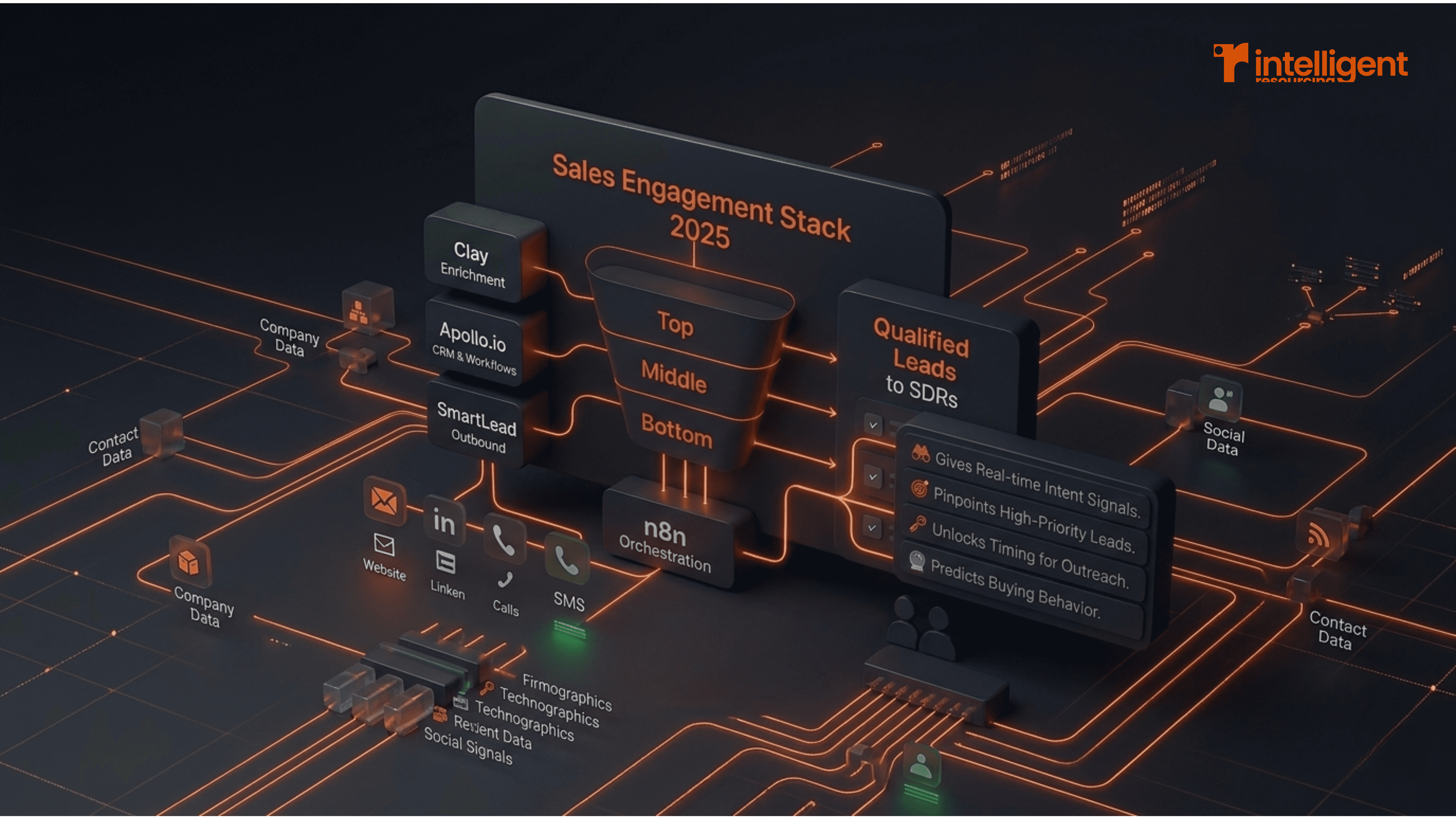
Apollo.io leads on value for teams under 100 seats. Outreach.io serves enterprise Salesforce teams. Salesloft fits mid-market HubSpot workflows. Instantly.ai and Lemlist prioritize cold email deliverability. Every platform executes sequences based on schedules. None trigger them based on live buyer intent. Intelligent Resourcing provides the signal layer that determines when each platform should act.
Apollo.io leads on value: 4.7/5 on G2 with built-in prospecting and sequencing at transparent pricing makes it the strongest all-in-one entry point.
Outreach.io suits large enterprise: Deep Salesforce governance and revenue intelligence, but opaque pricing and heavy onboarding limit accessibility for smaller teams.
Salesloft wins on CRM workflow: Best mid-market fit for teams that prioritise pipeline visibility alongside outreach sequencing.
Instantly.ai and Lemlist prioritise deliverability: Purpose-built for high-volume cold email with inbox rotation, not full sales cycle management.
Signal timing is the shared gap: Every platform on this list executes sequences. None determines when to start them based on live buyer intent. That is what Intelligent Resourcing adds.
Situation | Standalone Platform | Intelligent Resourcing Signal Stack |
New outbound programme, sub-$500/month | Adequate for sequencing basics | More than required at this stage |
Mid-market team on Salesforce or HubSpot | Salesloft or Apollo fits well | Adds intent layer on top; improves sequence-to-meeting conversion |
Enterprise with complex routing and governance | Outreach.io is purpose-built | Signal layer triggers sequences before reps waste capacity |
High-volume cold email (1,000+ sends per day) | Instantly.ai or Lemlist is the right tool | Signal layer prevents burning unready contacts at volume |
Tracking live intent to time outreach | Not natively available on any platform | This is where the Intelligent Resourcing architecture creates the advantage |
Single-vendor requirement, no capacity to orchestrate | Standalone platform is the correct choice | Requires coordination across two to three tools |
No standalone sales engagement platform determines when to reach a buyer based on live intent. Choose Apollo.io for all-in-one prospecting and outreach. Choose Salesloft for CRM-led sales workflows. Choose Outreach.io for enterprise Salesforce governance. Choose Instantly.ai for high-volume cold email. Choose Lemlist for email plus LinkedIn outreach.
The shared gap is timing. These platforms execute outreach, but they do not automatically prove which account should be activated now. That is where a signal layer becomes important.
What Is the Best Sales Engagement Platform?
The best sales engagement platform depends on the job your revenue team needs done. Apollo.io is the strongest all-in-one option for prospecting and sequencing. Salesloft is best for CRM-led mid-market workflows. Outreach.io is best for enterprise Salesforce governance. Instantly.ai is best for high-volume cold email infrastructure. Lemlist is best for multichannel cold outreach that combines email and LinkedIn.
1. Apollo.io
Apollo.io is an all-in-one sales engagement platform that combines B2B contact data, prospecting, enrichment, and outbound sequencing. It is best for teams that want one tool to find prospects, build lists, and run outreach without buying a separate database and sequencing platform.
Is Apollo.io the Strongest All-in-One Sales Engagement Platform?
Apollo.io holds 4.7/5 on G2 from 8,400+ reviews as of April 2026, the highest score among full-platform tools in this comparison. It combines a prospecting database of over 275 million contacts with built-in sequencing, making it the strongest value proposition for teams that need prospecting and outreach in a single environment.
What Does Apollo.io Cost?
As of April 2026, Apollo.io offers a free plan with limited monthly credits. The Basic plan starts at $49 per user per month (billed annually), Professional at $99, and Organisation at $149. The functional free plan lowers the evaluation barrier significantly compared to Outreach.io and Salesloft, both of which require a sales conversation before product access.
What Do Users Say About Apollo.io?
Consistent praise on G2 covers database quality, ease of setup, and value relative to price. Recurring criticisms include data accuracy gaps for non-US markets, particularly Australia and APAC, and an interface users describe as dense once multiple features are active simultaneously.
For Australian revenue teams, the APAC data accuracy point is material. Apollo's database is the strongest in North America. Teams targeting Australian buyers should validate contact accuracy through a trial before committing at scale.
For teams building Clay enrichment workflows to feed Apollo sequences, our personalised outreach with Clay AI guide covers how to connect enriched contact data into outreach platforms.
When Does Apollo.io Fall Short?
Apollo.io does not surface live intent signals. Sequences fire on a schedule, not on buyer behaviour. For teams where timing is the difference between a booked meeting and an ignored email, Apollo.io executes the outreach but cannot determine the right moment to send it.
2. Salesloft
Salesloft is a sales engagement platform for revenue teams that need structured cadences, CRM workflow, conversation intelligence, and pipeline visibility. It is best for mid-market teams that already use Salesforce or HubSpot and want outreach activity connected closely to deal management.
How Does Salesloft Compare for Mid-Market Revenue Teams?
Salesloft holds 4.5/5 on G2 from 4,104 reviews as of April 2026. It is the mid-market alternative to Outreach.io, with a strong CRM workflow for both Salesforce and HubSpot. The platform suits teams that want outreach sequencing alongside deal cadence, pipeline visibility, and conversation intelligence in one environment.
What Does Salesloft Cost?
As of April 2026, Salesloft does not publish pricing publicly. Pricing is available on request and structured as an annual contract. User-reported pricing places the entry point at $75 to $125 per user per month. Like Outreach.io, evaluation requires engaging the Salesloft sales team before product access, which extends the buying cycle relative to Apollo.io's self-serve model.
What Do Users Say About Salesloft?
Consistent positives on G2 cover cadence management, HubSpot and Salesforce integration depth, and conversation intelligence features. Recurring criticisms include pricing opacity, slower reporting refresh speeds, and inconsistent support for non-enterprise accounts.
When Does Salesloft Fall Short?
Salesloft falls short when teams need a built-in prospecting database, transparent self-serve pricing, or lightweight cold email infrastructure. It performs well as a CRM-connected sales engagement platform, but it is not the best fit for teams that want to launch fast without procurement, onboarding, or annual contract discussions.
3. Outreach.io
Outreach.io is an enterprise sales engagement platform built for large revenue organisations that need sequence governance, Salesforce depth, revenue intelligence, and reporting control. It is best for mature sales teams with the operational resources to manage implementation, permissions, and process design.
What Does Outreach.io Cost?
As of April 2026, Outreach.io does not publish pricing publicly. Independent user reports place the cost at $100 to $140 per user per month for standard tiers, rising with add-ons. The opaque pricing model is the most consistent friction point raised in G2 reviews. The buying process requires enterprise-grade resources to match the product.
What Do Users Say About Outreach.io?
Consistent positives on G2 cover Salesforce workflow depth, sequence complexity, and revenue reporting. Consistent criticisms include steep onboarding, slow support response, and an interface users describe as complex during initial implementation. The score reflects a platform that rewards proper setup investment.
When Does Outreach.io Fall Short?
Outreach.io falls short for teams under 20 seats, teams not on Salesforce, and teams that need immediate self-serve usability. For high-volume cold email specifically, Outreach.io is over-engineered and over-priced relative to Instantly.ai or Lemlist.
4. Instantly.ai
Instantly.ai is a cold email platform focused on deliverability, inbox rotation, and high-volume outbound sending. It is best for teams that care more about email infrastructure, sending scale, and cost-per-send than full CRM workflow or enterprise sales cycle management.
When Should You Choose Instantly.ai Over a Full Platform?
Instantly.ai holds 4.9/5 on G2 from 3,200+ reviews as of April 2026, the highest user satisfaction score in this comparison. It is not a full sales engagement platform in the Outreach.io or Salesloft sense. Instantly.ai specialises in deliverability infrastructure, inbox rotation, and high-volume cold email sending.
What Does Instantly.ai Cost?
As of April 2026, Instantly.ai's Growth plan starts at $37 per month, Hypergrowth at $97, and Light Speed at $358. Relative to Outreach.io and Salesloft, the price difference is substantial. For cold email programmes that do not require deep CRM integration or pipeline intelligence, Instantly.ai produces the strongest cost-per-send value in this comparison.
What Do Users Say About Instantly.ai?
Consistent praise on G2 covers deliverability management, inbox rotation, and ease of setup. The most consistent criticism is limited CRM depth: Instantly.ai executes outreach with precision but does not function as a revenue platform. Teams that need pipeline tracking or conversation intelligence require a separate tool alongside it.
For outbound programmes requiring a dedicated cold email infrastructure, our outbound prospecting guide covers how to structure a high-deliverability sending stack.
5. Lemlist
Lemlist is a multichannel cold outreach platform that combines email sequencing, LinkedIn steps, and personalised outreach assets. It is best for teams that want more native personalisation and channel variety than a pure cold email infrastructure tool provides.
Is Lemlist Still Competitive in 2026?
Lemlist holds 4.6/5 on G2 from 1,500+ reviews as of April 2026. It competes with Instantly.ai in the cold email category but differentiates through multi-channel sequencing that incorporates LinkedIn steps alongside email. Lemlist suits teams that want cold email personalisation at the image and video level, not just copy.
What Does Lemlist Cost?
As of April 2026, Lemlist's Email Starter plan begins at $39 per month per user, Email Pro at $69, and Multichannel Expert at $99. The per-user pricing model differs from Instantly.ai's account-infrastructure model. For teams with more than 3 active users running sequences simultaneously, the per-user cost accumulates quickly relative to Instantly.ai.
What Do Users Say About Lemlist?
Consistent positives on G2 cover personalisation, multichannel sequencing, and campaign usability. Users often choose Lemlist when they want more native LinkedIn steps than Instantly.ai provides. The main trade-off is that Lemlist can become more expensive for multi-user teams, and it is not as focused on inbox infrastructure as Instantly.ai.
Our cold email vs LinkedIn automation comparison covers the channel decision in more depth.
When Does Lemlist Fall Short?
Lemlist falls short when deliverability infrastructure and sending volume are the main priorities. Instantly.ai is usually stronger for inbox rotation and scale. Lemlist also falls short for teams that need enterprise CRM governance, pipeline intelligence, or full sales cycle management.
Our cold email vs LinkedIn automation comparison covers the channel decision in more depth.
What Is the Sales Engagement Platform Gap?
Sales engagement platforms execute outreach well. They manage cadences, send emails, sync CRM activity, and report on engagement. But they do not answer the strategic question: should this account be activated now?
A sales engagement platform can help a team contact a prospect, but it does not automatically prove the account is active, in-market, or ready for a specific sequence. If the wrong contacts enter the workflow, faster automation only scales poor timing.
This gap matters because B2B buying is increasingly buyer-led. 6sense's 2024 Buyer Experience Report shows that 69% of the purchase process happens before buyers engage with sellers, and 81% choose a preferred vendor before speaking with sales. In that environment, outreach performance depends less on sending more cadences and more on recognising the Verified Buying Window™ before the buyer has already moved on.
The signal layer bridges that gap by connecting first-party CRM data, third-party intent indicators, firmographic fit, enrichment results, trigger events, and channel rules into one decision model. Without it, teams rely on static lists, manual judgement, or fixed schedules to decide who receives outreach.
How Does Intelligent Resourcing Help Build the Signal Layer?
Intelligent Resourcing helps by designing the signal layer around your sales engagement platform, rather than replacing it. Apollo.io, Salesloft, Outreach.io, Instantly.ai, and Lemlist can all execute outreach. Intelligent Resourcing helps define when those tools should act, which accounts should be prioritised, and how live signals should translate into GTM action.
This can include account qualification rules, enrichment workflows, AI-assisted research, trigger detection, CRM field logic, sequence routing, and reporting loops that show which signals produce real conversations. The platform manages the cadence. Intelligent Resourcing designs the signal logic that decides when the cadence should fire.
For teams already using a sales engagement platform, this means they do not need to rip out the stack. They need to improve the system around it. The goal is to move from activity-based outbound to Signal based systems, where AI supports relevance and speed, but verified buying windows determine who enters the motion.
FAQs
Which sales engagement platform has the highest G2 rating in 2026?
Instantly.ai holds the highest G2 rating in this comparison at 4.9/5 from 3,200+ reviews as of April 2026. Among full-platform tools that include CRM integration, prospecting, and revenue intelligence, Apollo.io leads at 4.7/5 from 8,400+ reviews.
Is Apollo.io better than Outreach.io for most teams?
For most teams under 100 seats, Apollo.io is the stronger choice. It combines prospecting and sequencing at transparent pricing with a functional free entry tier. Outreach.io is the stronger choice for large enterprise teams on Salesforce that require governance, deal health scoring, and dedicated implementation support.
Does Salesloft integrate with HubSpot?
Yes. As of April 2026, Salesloft integrates with both HubSpot and Salesforce. The HubSpot integration syncs contact activity, sequence enrolment, and deal updates between platforms. This is one of Salesloft's primary differentiators over Outreach.io, which is built primarily around Salesforce workflows.
What is the cheapest sales engagement platform in this comparison?
Instantly.ai starts at $37 per month as of April 2026, making it the lowest entry price. Apollo.io offers a functional free plan with limited monthly credits. Both are substantially lower-cost entry points relative to Outreach.io and Salesloft, which require annual enterprise contracts.
Do any of these platforms track live buyer intent signals?
None of the five platforms reviewed natively surface live buyer intent signals as a trigger for sequence enrolment. All five execute sequences based on fixed schedules or manual enrolment. Intelligent Resourcing provides the signal layer that identifies when buyers are actively in-market and triggers sequences accordingly.
Final Take
Sales engagement platforms automate how you reach buyers. The five platforms on this list do that well, each for a different use case. Apollo.io leads on value. Outreach.io leads on enterprise depth. Salesloft leads on CRM workflow. Instantly.ai and Lemlist lead on cold email volume.
What none of them solve is timing. A sequence that fires at the wrong moment produces the same result regardless of which platform sent it. Intelligent Resourcing adds the signal layer that determines when each platform should act, based on live buyer behaviour rather than a fixed schedule.
If you want to go further than measuring outreach activity and start improving when it lands, our signal-based selling guide and lead generation services cover how that architecture works in practice.