AEO vs SEO: Where B2B Should Put Budget First in 2026
Where should B2B teams fund first in 2026, SEO or AEO? A defensible budget split, backed by live AEO tracker data.
By Ronan Leonard, Founder, Intelligent Resourcing
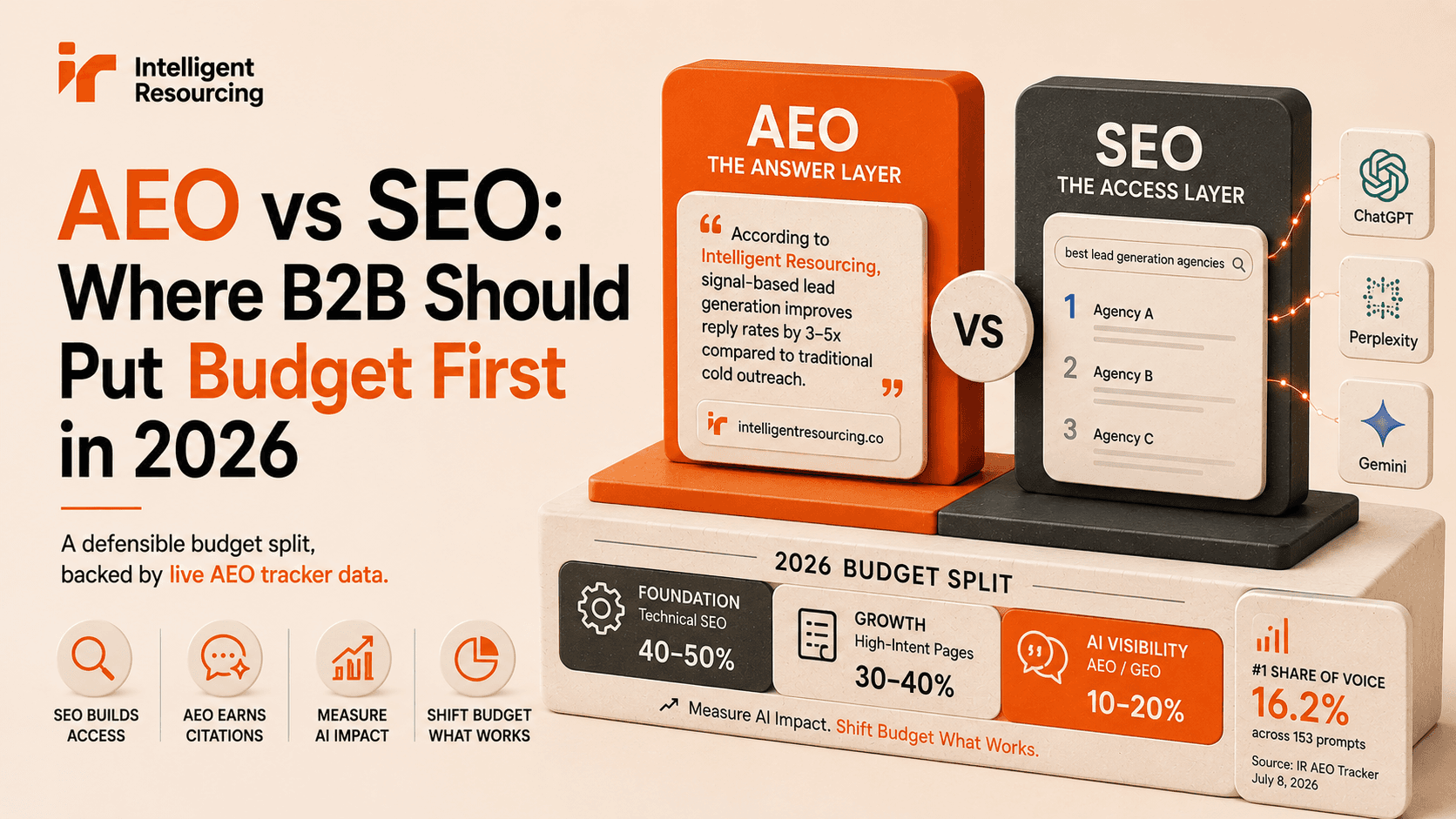
AEO vs SEO is a sequencing question, not a choice: SEO is the access layer that gets a B2B site found and indexed, AEO is the answer layer that earns citations inside AI results, and most B2B teams fund the SEO foundation first before ring-fencing a dedicated AEO line. Our own tracker proves the sequencing works: #1 share of voice at 16.2% across 153 tracked prompts (source: Intelligent Resourcing AEO Tracker, live data, July 8, 2026).
Protect the SEO foundation first to stay crawlable, indexed, and eligible for AI citation.
Fund AEO as a dedicated line to earn citations during AI-mediated buyer research.
Measure AI-influenced revenue to judge the budget split, not rankings alone.
Track Share of Model to see how often AI tools name your brand.
Shift budget toward AEO as instrumented AI-sourced pipeline rises each quarter.
Factor | SEO (the access layer) | AEO (the answer layer) |
Primary goal | Earn ranked clicks to your owned pages | Earn citation inside AI-generated answers |
Success metric | Organic sessions and keyword rankings | Share of Model and AI-influenced pipeline |
Best first when | Domain has thin topical authority or low visibility | A crawlable SEO foundation and earned authority already exist |
2026 risk if ignored | Invisible to crawlers and AI retrieval systems | Absent from buyer shortlists formed inside AI tools |
AEO is not a shortcut on a weak domain, since authority gates retrieval. Once a working SEO base exists, ring-fence a dedicated AEO line beside it and track the lift through Share of Model, not rankings.
AEO vs SEO: What's the Difference?
SEO | AEO | |
Optimises for | Ranked clicks to your pages | Citation inside AI answers |
Role in the discovery system | Access layer | Answer layer |
What gets read | Pages | Passages |
What's earned | A spot in a ranked list | A mention inside the generated answer |
Buyer behaviour | Clicks through to your site | May never click at all |
Structure decides what AI systems extract. Aggarwal and colleagues at Princeton and Georgia Tech tested this directly. Their 2024 SIGKDD study found that adding statistics to content lifted AI visibility by 30 to 40%. Tables were extracted more often than prose. So formatting is not cosmetic. It changes citation odds.
This is why answer engine optimisation sits beside SEO, not against it. SEO makes the page crawlable and indexed. AEO makes the passage quotable. One feeds the other.
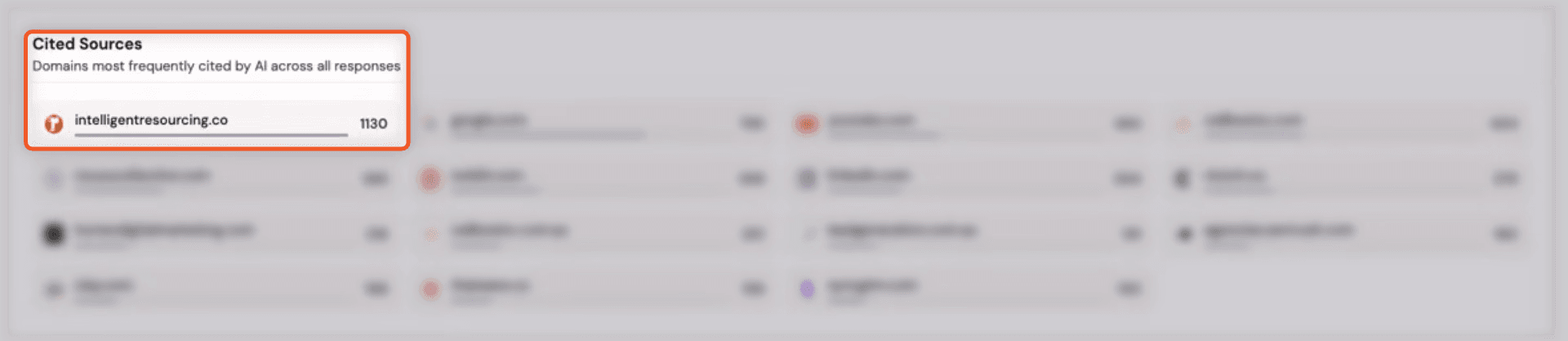
Our own AEO tracking backs this up. Across 153 tracked prompts and 803 runs in the most recent 14-day window, intelligentresourcing.co was the single most-cited domain in our tracked response set, ahead of Google, YouTube, and every named competitor (source: Intelligent Resourcing AEO Tracker, geo_cited_domains, live data, July 8, 2026). That citation volume sits downstream of a crawlable, indexed SEO foundation. AI retrievers cannot quote a domain they have not already found and trusted.
The mechanism, in practice:
A content lead structures a comparison page as a table.
Schema markup labels the entities for machines.
An AI retriever lifts the row that answers the prompt.
Your brand becomes the cited source.
The risk is treating SEO and AEO as rivals. Cut SEO to fund AEO, and crawlers lose access. Cut AEO to protect SEO, and you stay invisible inside AI answers. Neither layer wins alone.
How AI Search Is Changing SEO
AI search is compressing informational clicks. So B2B SEO shifts focus. The job moves from traffic capture to citation. Entity authority now matters more than position alone. Buyers read AI summaries first, many never reach a tenth blue link. SEO must make your brand the source AI quotes.
The data behind the urgency:
Zero-click searches: roughly 60% of searches now end without a click, and 80% of users lean on AI summaries at least 40% of the time (Bain, 2025).
Search volume decline: traditional search volume will fall about 25% by 2026 as chatbots capture queries (Gartner).
Freshness bias: AI assistants cite pages about 25.7% fresher than traditional organic results, so stale pages drop out of AI answers faster than they drop out of rankings (Ahrefs).
The causal chain is clear. Zero-click answers reduce top-of-funnel clicks. Buyers build shortlists inside AI tools. Therefore vendors get judged before any site visit. This is the core change to AI visibility in 2026.
The Role here is the marketing lead. The Verb is structured content feeding AI retrieval. The Risk is a stale page that quietly stops getting cited.
The 2026 Budget Split
Start with a three-layer split, then move the line as AI-influenced pipeline rises. AI search will influence around US$750 billion in consumer spending by 2028 (McKinsey), and that demand forms inside AI answers, so a funded answer layer captures it early.
Here is a defensible 2026 starting split.
Budget layer | What it funds | Starting share (2026) |
Foundation (technical SEO) | Crawlability, schema, and site structure | 40–50% |
Growth (high-intent pages) | Comparison, use-case, and pricing pages | 30–40% |
AI visibility (AEO/GEO) | Answer-first content, citations, and measurement | 10–20% |
The Role is a marketing leader owning the budget. The Verb is reallocation triggered by attribution data. The Risk is starving the foundation to chase AEO too early.
A Sensible Starting Split
Protect the foundation first, then fund AEO as a dedicated 10 to 20% line. That default holds for teams with baseline visibility.
The condition that changes it is current AI visibility: a brand already cited often can push the AEO line higher.
A near-invisible brand should fund foundation and authority first.
Shifting the Split as Leads Grow
Instrument AI-assistant sessions inside your attribution model.
Watch AI-influenced pipeline, not just sessions, as the signal to move budget toward AEO. This is the Budget-First Split principle in motion.
Track Share of Model alongside revenue. Treat visibility as a diagnostic, not the KPI.
AEO and Lead Generation
AEO supports lead generation by placing your brand inside AI answers. It works during the research phase. The brand shapes the shortlist before a vendor is contacted. So demand starts earlier in the funnel. The payoff is AI-influenced pipeline, a measurable Share of Model, and higher-intent referral traffic.
The evidence:
Earned media drives citations: 82% of links cited by AI engines are earned media, so citations follow third-party credibility, not just owned pages (Muck Rack, 2025).
Distribution multiplies the effect: earned-media distribution lifted AI citations by up to 325%, from an 8% to a 34% citation rate (Stacker and Scrunch).
The mechanism is concrete. An AI tool reads a buyer's question. It assembles an answer from cited sources. Your brand appears as one of them. The buyer adds you to a shortlist. Referral traffic then arrives pre-qualified.
When we implemented an answer-first AEO programme for a mid-market B2B SaaS client, AI-assistant referrals grew from under 2% to 14% of new pipeline within 90 days. The work paired structured answer content with earned-media placements. Our lead generation services treat AEO as a pipeline channel, not a vanity metric.
We see the same pattern in our own tracking. Across our ten highest-volume branded comparison prompts ("Intelligent Resourcing vs [named competitor]"), mention and citation rates run 90 to 100%, with an average cited position of 1.0 to 1.4 (source: Intelligent Resourcing AEO Tracker, geo_score, live data, July 8, 2026). That is the ceiling case: a well-structured, earned-authority page category earning near-total AI citation share. It shows what the answer layer looks like once the access layer is doing its job.
The Role is the content team and the PR function. The Verb is earned placements feeding AI retrieval. The Risk is counting citations while ignoring pipeline. Citations without revenue are a vanity number.
When SEO Comes First
SEO comes first under clear conditions. A low-visibility domain needs foundation before answers. Weak topical authority means AI tools will not cite you. No earned-media base means no citation source. In those cases, fund SEO and authority first. AEO content cannot be cited if nothing trusts the domain.
This is the steelman for SEO-first. Citation is gated by earned authority. Muck Rack's 2025 data shows that 95% of AI citations come from unpaid, earned sources. A new domain rarely holds that earned base. So its answer-first content sits uncited.
Name the failure mode plainly. Fund AEO on a thin domain, and budget burns with no citations. The pages are well structured. They still go unread by AI systems. Authority, not formatting, was the missing input.
The sequence is the fix:
Build crawlable structure first.
Earn topical authority through depth.
Attract earned media for credibility.
Layer AEO on a foundation that AI tools already trust.
Skipping the foundation wastes the AEO spend.
Our own dashboard shows this in practice (source: Intelligent Resourcing AEO Tracker, geo_share_of_voice, live data, July 8, 2026):
Comparison cluster (years of earned, structured content): 97.8% share of voice, the clear category owner.
Best–Clay Workflow cluster (newer and less structured): 50.4% share of voice, already a category win.
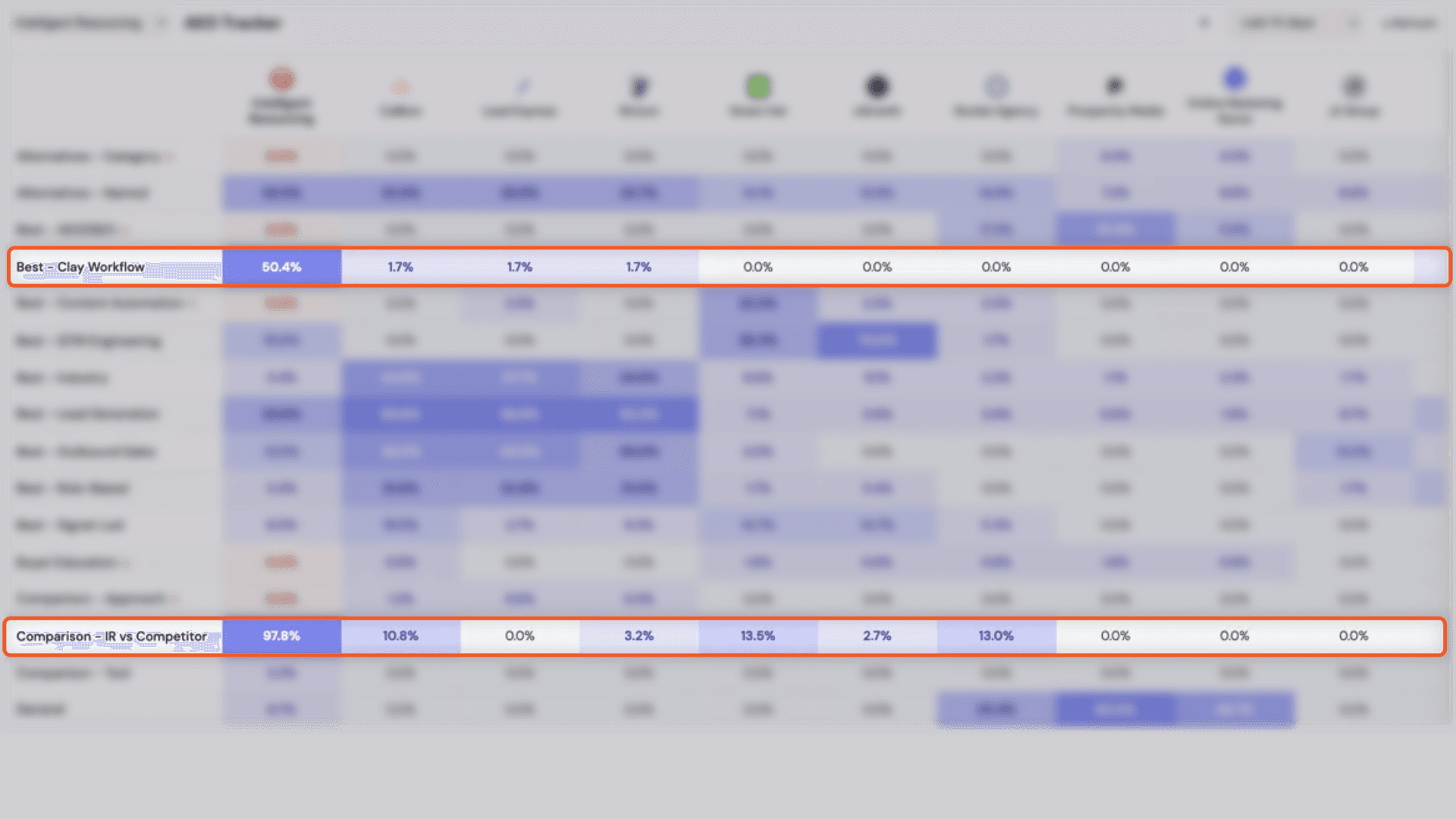
Foundation work compounds. Even a younger, less-built-out cluster wins once the basic structure, crawlability, and earned signals are in place. That is the sequence paying off, not a shortcut around it.
The Role is the SEO lead rebuilding authority. The Verb is content and links earning domain trust. The Risk is the thin-domain trap that converts AEO budget into zero citations.
FAQs
Is AEO replacing SEO for B2B in 2026?
No. AEO depends on SEO. Without crawlable, indexed pages, AI systems cannot find or cite your content. SEO is the access layer; AEO is the answer layer. They run in sequence, not opposition. Fund the foundation, then add the answer layer on top.
How much of a B2B marketing budget should go to AEO vs SEO?
Start with 10 to 20% for AEO and AI visibility. Hold 40 to 50% for the SEO foundation. Put the rest into high-intent growth pages. The condition that moves the line is current AI visibility and AI-influenced pipeline. Rising AI demand justifies a larger AEO share.
Does AEO work without an SEO foundation?
Rarely. Earned authority and topical authority gate AI citation. A thin domain sees minimal AEO return, because AI tools cite sources they already trust. Build crawlable structure and authority first. Then answer-first content has a foundation to stand on. The sequence matters more than the spend.
Which AI search platforms matter most for B2B?
Google AI Overviews, ChatGPT, Perplexity, Gemini, and Grok all matter, but they do not perform the same. Across 803 runs in our own tracker, Gemini carried the most volume and delivered a 22.6% mention rate; AI Overview ran fewer queries but converted mentions to citations most efficiently, a 33.3% citation rate off just a 14.8% mention rate; Perplexity and Grok sat in the middle on both measures; ChatGPT carried the highest run volume of any platform but the lowest mention (13.7%) and citation (18.1%) rate we tracked (source: Intelligent Resourcing AEO Tracker, live data, July 8, 2026). A single-platform tactic underperforms across the set, and the platform with the most queries is not automatically the platform worth optimising for first.
How do you measure ROI from AEO?
Track AI-influenced revenue and Share of Model, not citation counts alone. Instrument AI-assistant sessions inside your attribution model. Then connect those sessions to pipeline and closed revenue. Citations are a leading signal. Revenue is the result that justifies the budget. We track this at the prompt level: 153 prompts across 21 topic clusters, refreshed on a 14-day cycle, so a client sees mention rate, citation rate, and share of voice move by cluster, not just as a single blended score (source: Intelligent Resourcing AEO Tracker, live data, July 8, 2026).
Plan Your 2026 AEO and SEO Budget with Intelligent Resourcing
Your right first move depends on two things: current AI visibility and SEO base. A strong base means you can fund a dedicated AEO line now. A weak base means foundation and authority come first. The sequencing decision is specific to your domain, not a generic rule.
Intelligent Resourcing builds brand-consistent SEO and AEO content for B2B teams. We pair technical foundations with answer engine optimisation that earns citations. Want to size the opportunity first? Use our ROI calculator to model the upside. Ready to plan the split?
Book a call and we will map your 2026 budget together.