B2B Cost Per Lead in Australia
We've done the legwork for you and compiled the 2026 B2B insights on cost per lead, plus some new strategies to help increase your pipeline.
By Ronan Leonard, Founder, Intelligent Resourcing
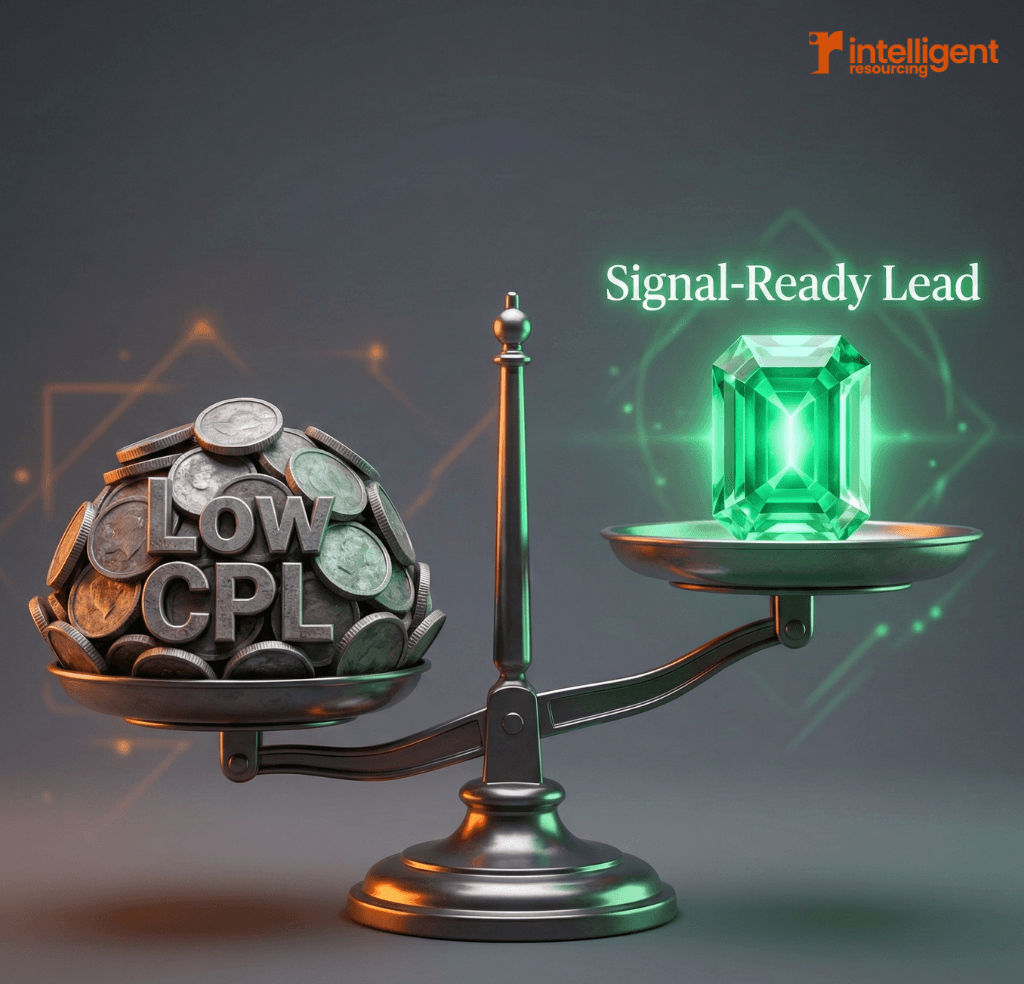
Cost per lead (CPL) is a marketing efficiency metric that measures what you pay to generate one lead. A “good” CPL isn’t the lowest number. It’s one that brings reachable, qualified prospects who agreed to be contacted. In 2026, the fastest way to reduce cost per lead in b2b without harming the pipeline is to trigger outreach from verified buying signals, not static lists.
How to define “qualified lead” to stop reducing CPL and sales waste.
Measure cost per opportunity to link spend to pipeline, not form fills.
Use verified signals to contact accounts inside a verified buying window, eliminating incorrect outreach.
Add consent controls to reduce unsubscribe failures and spam complaints.
Fix routing and CRM hygiene to remove duplicates and decay across campaigns.
CPL-First Buying vs Signal-Led System. This matrix outlines their differences.
Feature | Traditional CPL Buying | Signal-Led System (via Revenue Operations Studio) |
Primary goal | Lower cost per lead | Higher pipeline quality and revenue visibility |
Targeting input | Static lists and broad audience criteria | Live buying signals with verification and qualification gates |
Execution model | Manual SDR follow-up with variable handover quality | Automated workflows with structured routing and governance |
Outcome | Purchased leads with inconsistent readiness | Identified active buyers with traceable engagement history |
Best used for (steelman) | Low-ticket, high-volume or commodity offers | High-value B2B where timing, qualification and trust matter |
If you need low-cost lead volume and your team can handle high reject rates, then choose the traditional CPL-first buying model.
But, if you want to reduce wasted spend and improve the quality and higher intent, then choose signal-led workflows from a Revenue Operations Studio.
What is a good cost per lead metric and what counts as a “lead”?
CPL is simple to calculate:
CPL = total lead gen cost ÷ number of leads
However, differences can exist in how “total cost” is calculated and what counts as a “lead”. If one provider counts any form completed, and another counts only sales-accepted leads, your CPL comparison is faulty before you start.
A practical definition for 2026: a lead is only a lead if it is ICP-aligned, contactable, and consent-safe for outreach, as defined by the ACMA.
Our definition: a lead is ICP-aligned with clear signals and triggers that show the prospect is actively considering a purchase and is ready to engage.
What is a “good” cost per lead in 2026?
CPL varies by industry, channel, competition, and intent. That’s why you should treat benchmarks as ranges, then adjust them to your qualification standard.
Indicative range (broad AU framing): some Australian benchmark summaries put CPL anywhere from $20 to $500+ depending on industry and competition. Industries with high competition or niche markets often see higher CPLs due to the increased demand for qualified leads.
Channel reality check (paid search): one Australia-based Google Ads benchmark report showed the average CPC (Cost Per Click) rising to $3.46, with CPL reaching $83.93 in 2025. CPC refers to the cost you pay each time someone clicks on your ad. As CPC increases, the CPL also tends to rise, which is why“cheap clicks” and “cheap leads” are different problems.
One rule to follow: a “good” CPL is the one that produces a pipeline you can close, inside your capacity, without breaking consent breaking the spam rules.
Why does CPL drop while pipeline quality gets worse?
CPL usually drops when you loosen the parameters:
Broader targeting
Lower intent forms
More aggressive outreach volume
Less ICP qualification
But this creates a second-order consequence in increased costs: sales time, CRM inefficiencies, and deliverability damage. In B2B, that damage is amplified because buying groups are large and timing matters. APAC research notes an average buying group of 12.8 people, which makes “one lead” a weak proxy for “one deal”.
What should you track instead of CPL?
CPL is fine as a diagnostic metric, but not as the KPI you measure in isolation.
Instead consider using this process:
Cost per qualified lead (CQL)
Measures the cost of leads that meet your ideal customer profile (ICP). This metric ensures you're generating high-quality leads that are sales-ready.
Cost per sales-accepted lead (SAL)
A lead that has been reviewed and accepted by your sales team, signifying it meets the criteria for further engagement. This stage ensures that only leads with a verified interest and potential for conversion are prioritised for follow-up.
Cost per opportunity (CPO)
This measures the cost of leads that progress to an opportunity, where a clear path to conversion exists. It focuses on the quality of leads that turn into potential revenue.
Cost per $ of pipeline (or pipeline-to-spend ratio)
This metric reflects the total cost of generating pipeline value, ensuring you're optimising your spend for the highest revenue potential. It measures the return on investment for the lead generation created.
If your CPL improves but CPO worsens, you didn’t improve efficiency, you just shifted waste downstream.
From Speed to Timing
If you’re comparing lead generation services, you’re usually buying speed: enquiries and meetings without the need to hire and train your own sales staff.
In 2026, volume without timing only increases waste. Signal-Led Growth uses verified buying signals to trigger outreach only when an account is in a buying window, which reduces dead conversations and improves conversion timing, as outlined in our lead generation services approach.
How do you reduce cost per lead without sacrificing lead quality?
The key is to reduce waste, not lower your standards.
Here’s how you can do it:
1. Tighten your “qualified lead” definition (before you run campaigns)
Use a scorecard so every channel is measured the same way.
Proof asset: Qualified lead definition scorecard
Field | Pass/Fail rule | Why it matters |
ICP fit | Matches firmographics + use case | Stops broad, low-fit CPL |
Contactability | Valid role + email/phone hygiene | Reduces bounce + no-shows |
Consent-safe | Consent basis documented | Reduces spam complaints |
Buying signal | Trigger present (event/intent) | Improves timing and relevance |
Routing ready | Owner + SLA + sequence attached | Prevents lead rot |
2. Fix routing and speed-to-lead (so paid spend is not wasted)
If leads sit untouched, CPL is irrelevant. You paid for an opportunity then missed it.
To ensure your paid spend delivers results, it’s crucial to optimise both routing and speed-to-lead. By automating follow-up processes and ensuring leads are acted upon immediately, you maximise the value of each interaction. Optimising this process involves GTM engineering, which covers lead scoring, routing and automation workflows to prevent wasted spend.
3. Improve measurement (so you stop funding the wrong channel)
LinkedIn’s own example highlights why measurement changes CPL outcomes: Eftsure paired the LinkedIn Conversions API with Dreamdata and reported a 40% reduction in cost per lead, tied to better attribution and full-funnel visibility. (Use this as a principle: measurement that links spend to pipeline lets you cut waste faster than creative tweaks alone.)
What pricing models change your cost per lead outcome?
CPL is not just a channel metric, it's also a commercial model. Different pricing models impact the effectiveness of your lead generation efforts and influence your CPL outcome.
Cost-per-lead (CPL) pricing:
Best for: low-ticket, high-volume offers where rejects are cheap
Watch-out: incentives drift towards quantity, not quality
Retainer or hybrid pricing:
Best for: B2B where qualification, routing and system health matter
Watch-out: you must define deliverables as outcomes (CPO, pipeline), not “activity”
Intelligent Resourcing’s own pricing guidance for 2026 positions agency pricing broadly from $2,500 to $19,000+ per month, with higher tiers paying for signal-led systems rather than manual volume.
The Strategic Shift: Moving Beyond the Lead Gen Agency
Traditional approaches to reducing CPL often involve hiring an external partner to "crank the handle." However, this creates a fundamental misalignment between volume and value.
A typical lead generation agency can certainly increase top-of-funnel activity. However, activity alone does not guarantee a clean handover, automated routing, accurate measurement, or CRM survivability. Without these foundational elements, the cost of managing "bad" leads often outweighs the savings of a lower initial CPL.
A RevOps Studio can build the permanent system behind your pipeline. Instead of just "buying leads," a Studio defines your signal orchestration, builds the automation and routing rules, and establishes reporting tied directly to revenue outcomes.
The result is a system where efficiency compounds over time instead of starting from scratch every month.
What compliance rules raise your real CPL in Australia?
If your outreach breaches consent or unsubscribe rules, the cost isn’t just financial. It can become deliverability damage and brand risk.
ACMA’s guidance is explicit: you need consent, clear sender identification, contact details, and a working unsubscribe. This applies even if another business sends messages on your behalf.
Two 2026-relevant details to include in your planning:
Branded SMS changes from 1 July 2026: New rules means businesses sending branded SMS/MMS must register with the SMS Sender ID Register.
Enforcement is active: ACMA reported Tabcorp was penalised $4 million for spamming VIP customers, and noted $16.9 million in spam breach penalties over the prior 18 months.
How to estimate CPL before you spend money
Use a simple forecasting model and metrics:
Estimate click cost (CPC) or outreach cost (per contact)
Estimate conversion rate (click-to-lead or contact-to-lead)
Add operations cost (tools + labour + verification)
Apply a quality filter (your CQL/SAL acceptance rate)
Example logic:
If you pay $3 per click (CPC) and 3% of clicks become leads, your cost per lead (CPL) from media alone is about $100.
If only 30% of those leads are sales-accepted (SAL), the CPL for sales-accepted leads is about $333.
This is why signal gating (who/when) and routing (what happens next) often reduces cost more than creative refreshes.
FAQs
Why is my CPL low but sales says the leads are poor?
CPL often drops when targeting broadens or qualification loosens. That shifts cost into sales time, CRM noise, and missed follow-up, which can increase cost per opportunity.
How can I reduce cost per lead without increasing spam risk?
Use verified signals and qualification gates, document consent workflows, and ensure unsubscribes work reliably. ACMA requires consent and an easy unsubscribe, even when a third party sends messages for you.
When should I choose a Revenue Operations Studio instead of a lead gen agency?
Choose a studio when you need the system behind the pipeline: signal definitions, automation, routing, CRM hygiene, and reporting tied to revenue outcomes, not just lead volume.
Systems Over Single Lead Metrics
If you’re optimising cost per lead in 2026, treat CPL strictly as a diagnostic metric. To drive real growth, you must shift focus from top-of-funnel volume toward cost per opportunity and total pipeline value. Cheap CPL is easy to buy. Clean pipeline takes signal gating, routing and measurement that your revenue team can trust.
Lead Generation Services: Explore how we bridge the gap between speed and timing.
B2B Lead Generation Agency Pricing: Review the commercial models that support system-building.
GTM Engineering: See how a Revenue Operations Studio automates your growth.
How to Choose a B2B Lead Generation Agency: Download our signal-first checklist to audit your potential partners