

The problem with the spend-linear model does not compound and most B2B companies discover that ceiling at exactly the moment they have committed the most budget to it. When Return on Ads Spent (ROAS) is declining, Cost Per Lead (CPL) is climbing and the sales team is still waiting for enough qualified opportunities. The question is not whether Salt & Fuessel can run campaigns but what comes after performance marketing for a company whose paid model has reached its ceiling.
When ROAS Drops And CPL Rises, What Is Going Wrong?
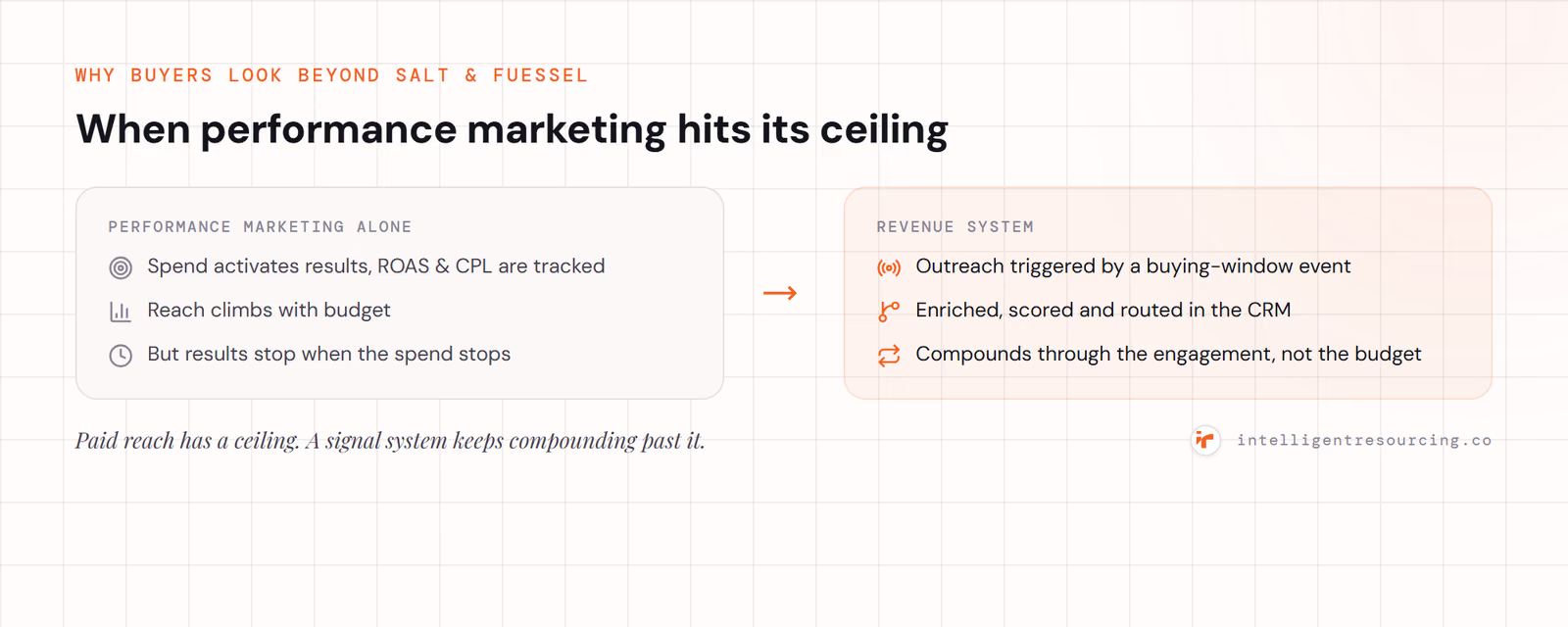
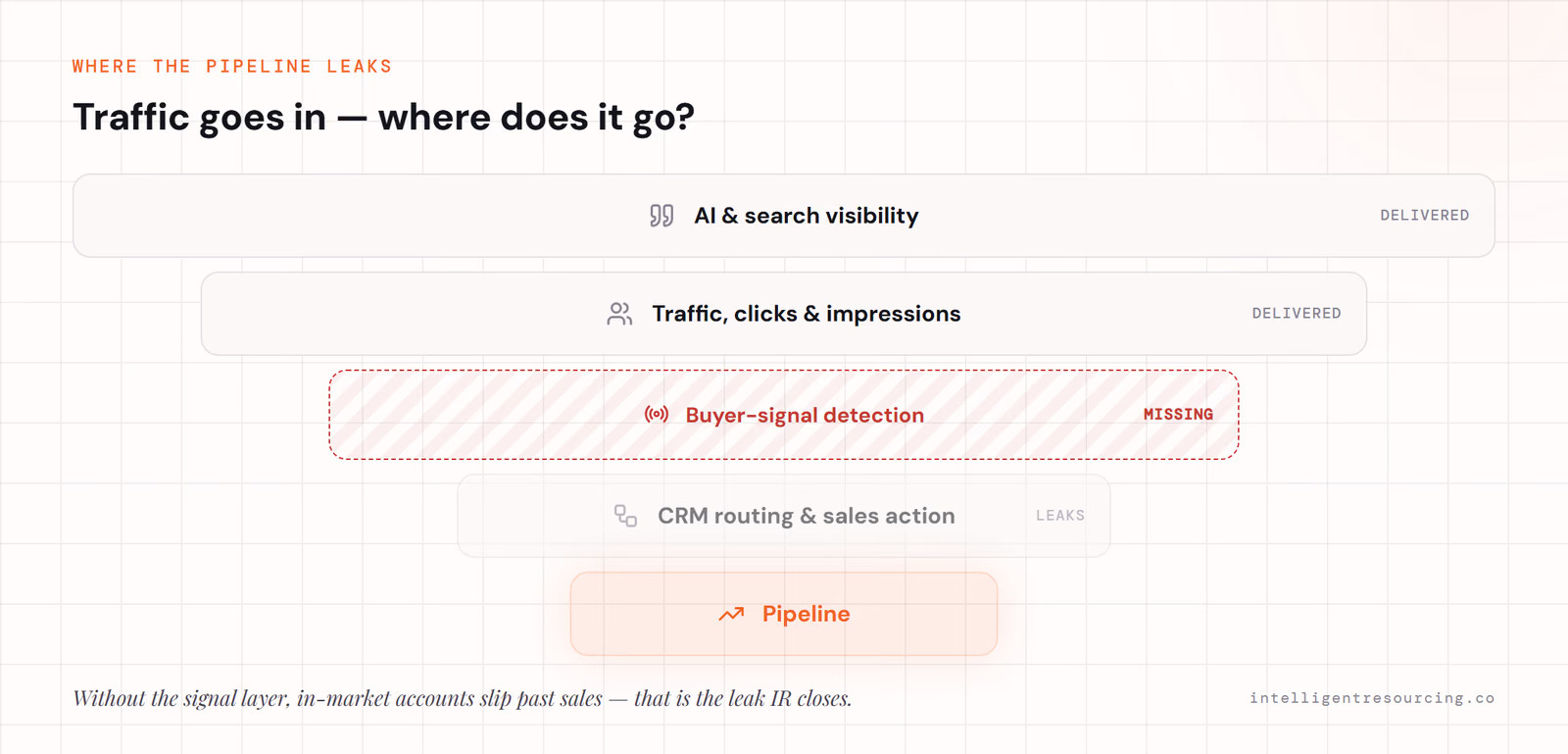
The performance marketing model depends on spend, pipeline usually rises when budget rises, until the same audience has seen too many ads, media costs increase, or the accounts being reached are not ready to buy. When ROAS drops, it is not always an execution failure. It can mean the model is no longer turning extra spend into enough qualified pipeline.
That is what "performance marketing stops performing" looks like in practice: ROAS softens, CPL climbs and the sales team still does not see enough qualified opportunities. Salt & Fuessel is a competent performance marketing operator. Its live site positions the agency across SEO, GEO/AEO, SEM, paid social, social media, email marketing, user research and website design, with SEM messaging focused on conversion, ROI and ongoing optimisation.
The issue is usually the model, not the agency. Industry benchmarks on performance marketing consistently show that only a minority of intent signals convert to qualified opportunities and that a meaningful share of marketing budget is wasted on efforts that fail to drive outcomes. That explains why paid models can keep spending without improving pipeline: the account timing does not improve without a signal layer.
Intelligent Resourcing is the alternative model: signal-led GTM engineering instead of spend-led performance marketing.
That is why the next dollar question is not about which campaign to optimise but whether the architecture itself is the constraint. Adding more spend to a model that has reached its ceiling does not raise the ceiling, it increases the cost of staying at it, and the honest answer is that most performance marketing plateaus are structural rather than executional.
For a side-by-side breakdown of performance marketing against a signal-led model, see Salt and Fuessel vs Intelligent Resourcing compared in full.
What Should Replace The ROAS Metric When Choosing An Alternative?
When performance marketing stops creating enough pipeline, switching to another ROAS-measured model solves nothing. It reproduces the same spend-linear ceiling with a different agency. The evaluation metric for the alternatives in this list is pipeline: meetings booked, accounts reached during a buying window and whether the infrastructure compounds after the engagement ends.
Intent-Correlated Outreach
Does the alternative connect outreach timing to when accounts are actively evaluating? ROAS measures campaign efficiency. The metric that matters after a plateau is whether the agency reaches accounts when buying windows are open, not when the ad schedule fires.
Compounding Return Model
Does the alternative produce returns that compound over time, or remain spend-linear? Performance marketing’s ceiling is structural: more spend creates more results until saturation. The replacement model should build infrastructure on your stack that grows over time.
AEO And AI search Execution
Can the alternative position the client in AI search answers that target accounts use during evaluation? As paid media becomes more expensive, organic AI search positioning becomes a higher-margin pipeline channel for research-heavy B2B decisions.
Pipeline Attribution
Does the alternative measure success by meetings booked and pipeline influenced, rather than impressions, clicks or campaign ROAS?
What Comes When More Spend Stops Creating More Pipeline?
Performance marketing and Signal-Led Growth solve different problems: performance marketing reaches accounts when the budget is active and the campaign is running, while Signal-Led Growth reaches accounts when buying windows are open, triggered by real intent events rather than a campaign schedule that has no visibility into whether those accounts are ready to evaluate.
Salt & Fuessel's model is spend-correlated: more budget creates more activity until the audience saturates or media costs outpace returns. Signal-Led Growth is intent-correlated: the system monitors target accounts for hard signals including job changes, funding events, technology shifts and new operational projects, then triggers outreach only when a Verified Buying Window opens, connecting pipeline to buying readiness rather than to ad spend levels.
The 5 alternatives below are ranked by how directly they solve the specific plateau a revenue leader faces. Intelligent Resourcing replaces the spend-linear model with a Signal-Led Growth architecture. Impressive and Online Marketing Gurus replace paid dependence with organic and AI search visibility. CLCK and DigitalScouts address pipeline follow-up and RevOps gaps that often sit underneath the paid media plateau.
Side By Side Comparison Of The Top Salt & Fuessel Alternatives
| Agency | Pipeline Model | Intent Signal Layer | Compounding Return | Outreach Trigger | Primary Metric |
|---|---|---|---|---|---|
| Intelligent Resourcing | Signal-Led Growth | Yes, Verified Buying Window | Yes, system compounds | Fires when a Verified Buying Window opens | Meetings with in-window accounts |
| Impressive | AI SEO and organic search | Partial, AI search positioning | Yes, organic compounds | No outreach trigger (organic inclusion) | AI answer inclusion, organic visibility |
| Online Marketing Gurus | Full-service SEO and digital marketing | No | Partial, organic compounds | No outreach trigger | Rankings, traffic, leads |
| CLCK | B2B lead generation and HubSpot follow-up | Partial, targeting and follow-up quality | Partial, CRM and follow-up improve over time | Campaign and follow-up cadence | Meetings, pipeline, follow-up quality |
| DigitalScouts | B2B growth, demand generation and RevOps | Partial, ABM and GTM systems | Partial, systems and campaigns compound | Campaign and demand cadence | Pipeline, HubSpot performance, RevOps alignment |
Which 5 Alternatives Should B2b Revenue Leaders Compare First?
The 5 strongest alternatives solve different versions of the same problem. If performance marketing has stopped performing, the right replacement depends on whether the constraint is timing, AI search visibility, organic scale, follow-up quality or revenue operations infrastructure.
1. Intelligent Resourcing
Intelligent Resourcing is the direct answer when performance marketing stops performing: it installs Signal-Led Growth infrastructure that compounds and the pipeline metric is meetings booked with accounts in a buying window, not ROAS on an ad campaign.
The Signal-Led Growth model monitors target accounts for buying signals such as job changes, funding events and tech stack shifts, then triggers AEO-informed outreach when a Verified Buying Window opens.
The infrastructure is built around tools such as Clay, HubSpot and n8n inside the client’s stack and run by Intelligent Resourcing as an ongoing capability. As the signal system matures, the account list grows and the outreach precision improves. Its Lead Generation Services page positions the work around signal detection, enrichment and CRM-ready opportunities.
Intelligent Resourcing's GEO service adds the AEO layer which matters now because target accounts increasingly research through AI-assisted answers before contacting vendors. Intelligent Resourcing connects that research environment back to outreach timing and account selection.
Best for
B2B revenue leaders, especially Series A to C or equivalent, whose performance marketing has plateaued and who want a pipeline system that compounds independent of ongoing ad spend.
Limitation
Intelligent Resourcing does not produce immediate pipeline results the way a paid campaign can because the signal system takes time to install and calibrate before the first signal-triggered meeting is booked. If your goal is pipeline within the current quarter and you have a budget committed to spend, performance marketing produces faster initial activity, and Intelligent Resourcing is the wrong starting point for that timeline.
2. Impressive
Impressive takes the organic alternative to performance marketing's paid model. It helps brands appear inside AI Overviews and LLM-generated results for high-intent buyers who are finishing purchase research before contacting vendors.
Impressive is an Australian digital marketing agency with a clear AI SEO offer. Its AI SEO page says AI search is reshaping how users research, compare and decide, and defines AI SEO as positioning a brand for inclusion inside AI-generated answers, summaries and citations across Google AI Overviews, ChatGPT, Gemini and Perplexity. The same page lists AI audits, prompt research, technical audits, content production and entity-focused content as part of its AI optimisation methodology.
For revenue leaders whose performance marketing has plateaued, Impressive offers the organic alternative. Instead of paying to reach accounts at every stage of evaluation, the brand is positioned inside the AI answers those accounts already use during active evaluation. The model is agency-managed, so clients are not getting a signal system run inside their own stack. Organic AI search positioning compounds in a way paid impressions do not.
Enterprise SaaS companies that want to reduce dependence on paid media by building organic AI search presence that captures B2B buyers during active evaluation.
Impressive does not offer a buyer intent signal layer as its central model. There is no outreach trigger and no signal system run inside the client’s stack in the way Intelligent Resourcing provides. Organic AI search positioning builds over months, not days.
3. Online Marketing Gurus
Online Marketing Gurus is the scale alternative for revenue leaders who need an organic pipeline rebuilt at volume after a performance marketing plateau. It is a stronger fit when the company wants enterprise SEO capacity rather than a bespoke signal system.
OMG is a Sydney-founded digital marketing agency operating at scale, offering digital marketing solutions across SEO, PPC, paid social and website services designed to improve retention, conversion rates and business growth.
For revenue leaders de-risking from over-dependence on performance marketing, OMG offers a recognised organic and digital marketing alternative. As a large Sydney-founded agency operating at scale, capacity is rarely the constraint, which matters for enterprise clients with complex SEO needs. The model is full-service and agency-managed. It does not create an intent-triggered outreach system, and it does not run a signal layer inside the client’s stack. Organic SEO compounds over time, which gives it a different return profile from paid spend.
B2B companies that need enterprise-scale SEO and organic digital marketing rebuilt as a complement to, or replacement for, performance marketing spend.
Full-service breadth means the model is not singularly optimised around pipeline timing. OMG is stronger as a large SEO and digital marketing partner than as a buyer-intent or RevOps infrastructure partner.
4. CLCK
CLCK is the B2B pipeline and follow-up alternative for companies whose performance marketing plateau is not only a media problem. It is the fit when leads are being generated, but the sales system is losing conversations between outreach, CRM, follow-up and close.
CLCK is a Melbourne-based B2B lead generation and HubSpot-focused agency. Its lead generation page says the work is built for businesses selling higher-value services that need outreach, follow-up and CRM to hold together. It also states that CLCK helps companies generate good-fit sales conversations rather than more names in a spreadsheet.
This makes CLCK a useful Salt & Fuessel alternative when the founder does not need a full paid media replacement but needs better targeting, stronger follow-up and CRM discipline around the conversations already being created. CLCK does not position itself around a Verified Buying Window system. Its strength is practical B2B lead generation, HubSpot follow-up and pipeline handling for higher-value buyers.
Founder-led B2B companies or smaller sales teams that need better-fit sales conversations, cleaner HubSpot follow-up and fewer lost leads.
CLCK does not offer a deep AI search positioning layer. It is also not a signal system run inside the client’s stack in the same way Intelligent Resourcing provides.
5. DigitalScouts
DigitalScouts is the HubSpot, demand generation and RevOps alternative for B2B companies whose paid model is exposing a systems problem. It is the fit when the campaign report looks active but the CRM, lifecycle stages, attribution and revenue operations layer cannot prove what is working.
DigitalScouts positions itself as a B2B growth and HubSpot partner that helps marketing, sales and RevOps teams design strategies, systems and campaigns that attract, convert and retain high-value customers. Its site lists Go-To-Market Strategy and ABM, Paid Media and Performance, AI-Powered Marketing Systems, Demand Generation Campaigns, Website and Conversion Optimisation, Content Marketing and SEO, plus HubSpot services across implementation, migration, RevOps enablement and training.
For revenue leaders comparing Salt & Fuessel competitors, DigitalScouts is not the cleanest paid media replacement. It is the operational rebuild option. It helps when performance marketing has plateaued because the business cannot see what happens after the click, how leads move through HubSpot or where opportunities stall.
B2B companies that need HubSpot, demand generation and RevOps alignment before adding more paid spend.
DigitalScouts still includes paid media and performance in its service mix, so it is not a pure break from the performance marketing model. It is stronger for connected GTM and HubSpot systems than for intent-triggered outreach.
Which Alternative Fits Where Your Performance Marketing Is Actually Breaking Down?
The problem has a specific cause, and the right alternative depends on diagnosing it. Saturated audiences and rising CPL point to a different fix than flat conversion, weak AI visibility, poor follow-up or wrong-account targeting.
Your ROAS Is Declining Because Target Account Audiences Are Saturated
Choose Intelligent Resourcing. The Signal-Led Growth model does not rely on audience size. It monitors specific target accounts for buying signals. Audience saturation becomes less relevant when outreach is triggered by account intent rather than by how many more impressions can be bought.
Your paid model is reaching accounts but conversion to pipeline is flat
Paid campaigns reach accounts regardless of whether a buying window is open, which means the problem is timing rather than reach. Intelligent Resourcing’s Verified Buying Window trigger connects outreach to when accounts are actually evaluating. B2B buyers increasingly avoid sellers who send irrelevant outreach, which means mistimed outreach does not only fail to convert but actively damages your pipeline by triggering avoidance in the accounts you most need to reach, before the meeting is even requested.
You Need To Reduce Performance Marketing Spend Dependence And Build Organic Pipeline
Choose Impressive if AI search visibility is the priority. Choose Online Marketing Gurus if broader enterprise SEO scale is the priority. The distinction is focus: Impressive is clearer on AI-generated answers, LLM optimisation and citation frequency, while OMG is stronger for scale, breadth and large-agency SEO capacity.
You Have Made The Decision: Next Step
Intelligent Resourcing maps your target accounts against open buying windows before the session. No commitment required.
What Do You Keep And Need To Rebuild When Paid Marketing Stops Improving The Pipeline
Not everything from a performance marketing engagement is worth abandoning. Audience data, conversion tracking infrastructure and campaign learnings about which messages moved which accounts are inputs into a better model, not sunk costs.
The audience data and message learnings from performance marketing campaigns are the raw material for AEO content and signal-triggered outreach, not a starting point the company has to discard. Creating content that reliably drives action remains one of the hardest parts of B2B marketing, which is exactly why reusing what already worked is more efficient than starting over.
Begin the rebuild by reviewing campaign data, audience segments, conversion events, messaging that produced the lowest CPL, Google Tag Manager setup, CRM attribution, in-flight campaigns and any contracted deliverables. Salt & Fuessel's SEM process includes understanding target audiences, SEM history, goals, budget and measurement expectations, which means useful learning should exist if campaigns have been properly run.
Keep the account list because performance marketing campaigns reveal which companies engaged, which segments converted and which messages created movement. That data becomes the starting point for a Signal-Led Growth target account list, where intent signals layer on top of campaign engagement to identify which accounts are ready to be reached now rather than on a schedule.
Rebuild the outreach trigger by converting fixed campaign cadences into intent-triggered outreach. The message stays largely the same, but the timing shifts from ad schedule to buying window, which is the architectural change that connects outreach to pipeline rather than to impressions.
If Salt and Fuessel is producing measurable pipeline at an acceptable CPL, the question is not whether to switch but whether the current model will keep improving over the next two quarters, because the ceiling on a spend-linear model does not get higher as the audience matures. It gets lower, and the time to build the signal layer is before the plateau forces the decision.
Which Alternative Matches The Pipeline Problem You Are Actually Trying To Solve?

Intelligent Resourcing is the right choice for revenue leaders whose performance marketing has plateaued and who want a Signal-Led Growth system that compounds independent of ad spend.
Impressive is the right choice for enterprise SaaS companies that want organic AI search presence capturing B2B buyers during active evaluation without ongoing paid spend.
Online Marketing Gurus is the right choice for B2B companies that need enterprise-scale SEO and organic digital marketing rebuilt as a paid media alternative, with a large agency behind the work.
CLCK is the right choice for founder-led B2B teams that need better-fit sales conversations, cleaner HubSpot follow-up and pipeline handling after paid campaigns have exposed a follow-up gap.
DigitalScouts is the right choice for B2B companies that need HubSpot, demand generation and RevOps alignment before they add more paid spend.
Salt & Fuessel remains the right choice for B2B companies with the budget to deploy and pipeline needed this quarter. Performance marketing produces faster first results than any organic or signal-led alternative.
The final choice comes back to the hook question. When performance marketing stops performing, what comes next depends on what actually broke. If the issue is timing and buying intent, choose Intelligent Resourcing. If the issue is AI search visibility, choose Impressive. If the issue is organic scale, choose OMG. If the issue is follow-up, choose CLCK. If the issue is HubSpot and RevOps alignment, choose DigitalScouts.
Every quarter your performance marketing retainer continues without a signal layer, your target accounts are evaluating solutions and closing with whoever reached them when their buying window was open, which means the pipeline review that follows will show the same flat number regardless of how strong the campaign ROAS looked.
The discovery session shows which accounts have a Verified Buying Window open right now. 30 minutes. No commitment.
Salt & Fuessel Vs Intelligent Resourcing: The Full Comparison
For a full head-to-head on Salt & Fuessel Vs Intelligent Resourcing: performance marketing versus Signal-Led Growth including methodology, output metrics and architecture.
Comparisons
Intelligent Resourcing maps your target accounts against open buying windows before the session. 30 minutes, no commitment.
FAQs
What does Salt & Fuessel specialise in?
Salt & Fuessel specialises in performance-led digital marketing, including SEO, GEO/AEO, SEM, paid social, social media, email marketing, user research and website design. It is a strong fit for companies that want campaign execution, conversion optimisation and measurable marketing activity tied to spend.
Why does performance marketing plateau for B2B companies?
Performance marketing plateaus when additional spend reaches the same audience too often, media costs rise or target accounts are not actively evaluating. The model continues producing activity metrics, but CPL climbs and ROAS declines because more budget is no longer creating proportionally more pipeline.
What is Signal-Led Growth and how is it different from performance marketing?
Signal-Led Growth monitors target accounts for buying signals and triggers outreach when a Verified Buying Window opens. Performance marketing is spend-correlated and campaign-led. Signal-Led Growth is intent-correlated and infrastructure-led, which means the system continues improving after the engagement matures.
How long does it take to replace performance marketing pipeline with a signal-led model?
A signal-led model takes longer than a paid campaign because the system needs target account criteria, signal logic, enrichment workflows, CRM routing and outreach triggers. Paid campaigns create faster initial activity, but Signal-Led Growth is designed to compound as the buying signal layer matures.
Can I run performance marketing and Intelligent Resourcing’s Signal-Led Growth system at the same time?
Yes. Performance marketing can keep visibility and demand capture running while Intelligent Resourcing builds the signal layer underneath. The models work together when paid media creates awareness and Signal-Led Growth activates outreach when target accounts show evidence that they are ready to evaluate.