

Manual outbound has a ceiling, and rising acquisition costs show it: B2B SaaS companies now spend a median $2.00 in sales and marketing to acquire $1.00 of new ARR, a 14% jump from the year before (Benchmarkit's 2025 SaaS report). When the reply rate keeps sliding and the stack produces no pipeline anyone can attribute, the honest next move is a partner who builds go-to-market as a system, not another set of hands sending emails.
Intelligent Resourcing leads for a signal-led system built and run on your own stack, with The GTM Engineering Company as the transparent-priced fractional option. Understory Agency fits a drowning first marketing hire needing one pod across paid, outbound, content, and RevOps. ColdIQ and Growth Engine X are the most-scaled Clay operators, Forma Nôrden ties every meeting to the signal that triggered it, RevPartners carries the strongest verified score here, SalesCaptain offers a rarer verified score elsewhere in the category, and demandDrive suits teams wanting the build and the SDR reps from one shop.
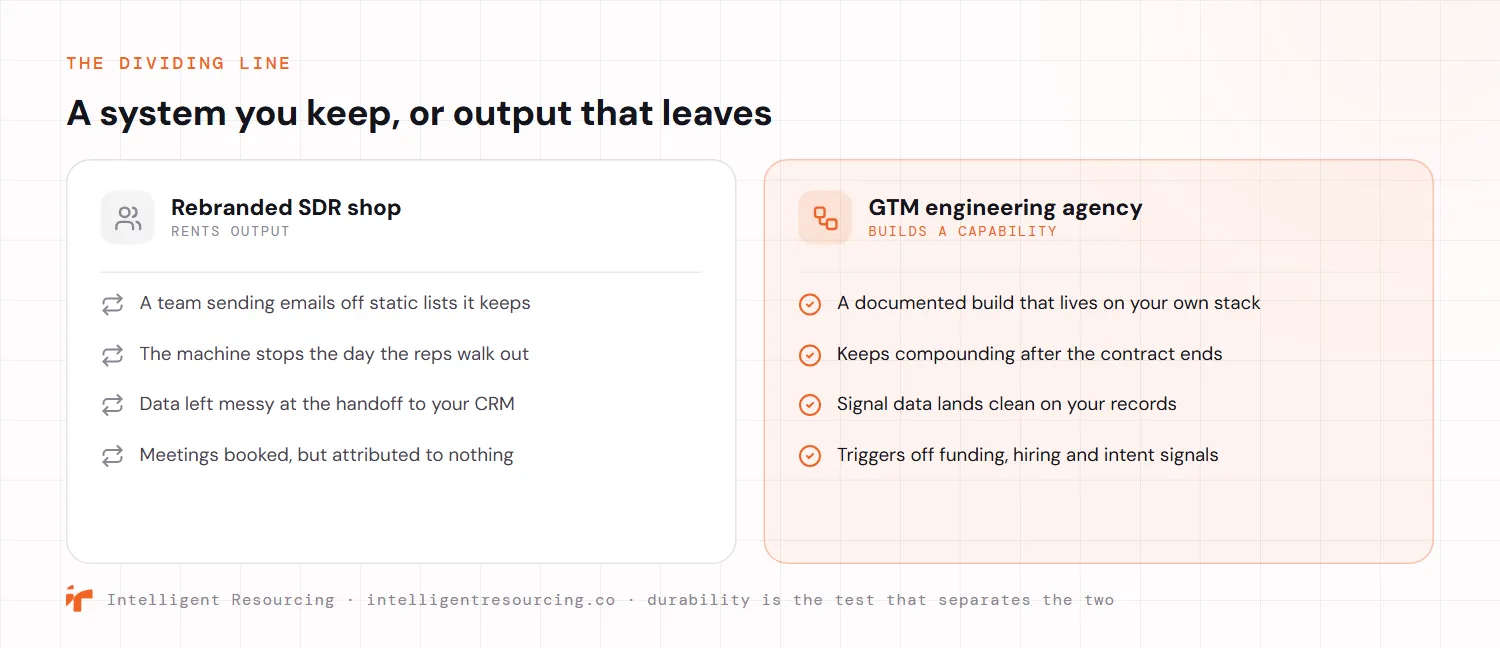
The dividing line across every entry is durability: a real GTM engineering agency builds and runs an ongoing capability on your own stack, documented so your team can operate it, while a rebranded SDR shop rents you output that leaves when the reps do. That durability test is the standard our own GTM engineering practice is built on.
The Upgrade Moment: When Manual GTM Stops Scaling

You know the plateau when you hit it. Sequences that booked meetings last year now bounce off crowded inboxes, and adding volume only speeds up domain burn. Or the stack works in pieces (Clay enriches, the CRM stores, the sequencer sends) but nothing joins into pipeline you can trace to a cause. That is when teams stop hiring another SDR and start looking for GTM engineering that treats go-to-market as a system. The shift is not niche: 54% of the fastest-growing private B2B SaaS companies now employ at least one GTM engineer, against just 3 to 7% of private B2B SaaS overall, based on an analysis of 63 fast-growing companies' hiring patterns (The Signal's hiring analysis). Volume is no longer the lever; relevance is.
A note on transparency: this article is published by Intelligent Resourcing, and IR appears in the list below. It is there because it met the same criteria we applied to every other agency (spelled out in the next two sections), not because we own the page. Weight our description of ourselves accordingly.
How We Evaluated These GTM Engineering Agencies
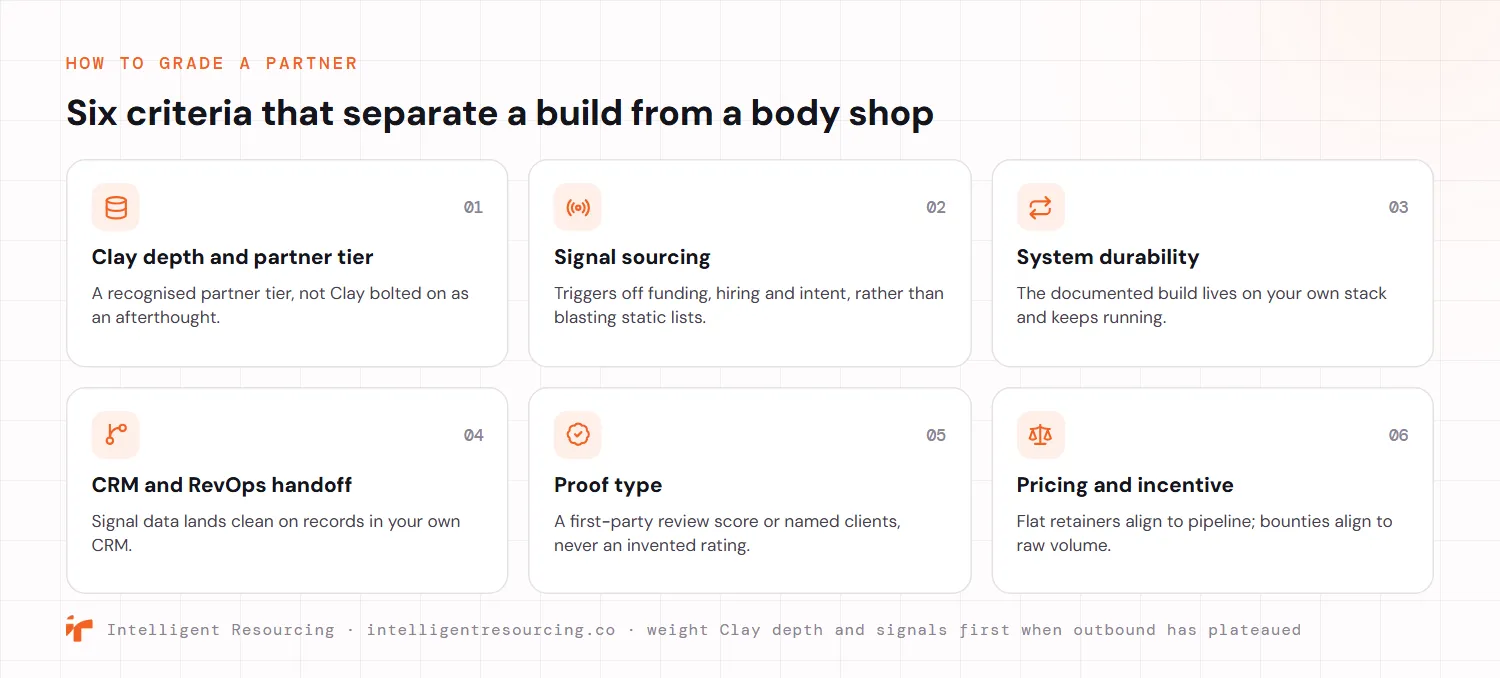
GTM engineering is a systems discipline: the job is to build and run an ongoing capability on your own stack, not run a retainer that stops producing the day payment stops. We scored every agency against six criteria, each chosen because it predicts whether a buyer gets a durable capability or a temporary one.
- Clay depth and partner tier. A recognised Clay partnership separates real GTM engineering from a rebranded SDR shop; Clay adoption sits at 84% among GTM engineers overall and climbs to 96% among agencies specifically (the 2026 State of GTM Engineering), so a missing partner tier is telling.
- Signal sourcing, not just enrichment. The agency should trigger off buying signals (funding, hiring, tech-stack changes, intent) rather than blast static lists, which pushes reply rates up and waste down.
- System durability. The documented Clay workflows, campaigns, and CRM structure sit on your own stack, so the machine runs after the contract ends.
- CRM and RevOps handoff. Signal data must land clean on records in your CRM, whether HubSpot or Salesforce, which is where GTM engineering vs RevOps stops being an abstract distinction.
- Proof type. A verifiable first-party review score (Clutch, G2, HubSpot Directory) or a named-client track record, never an invented rating.
- Pricing and incentive model. Flat retainers align an agency with pipeline; percentage-of-spend or per-meeting bounties align it with volume.
For context, Clay reached 65% adoption among the 63 fastest-growing B2B companies analysed in a separate 2025 study (The Signal's tech-stack study).
Weighting note: if outbound has plateaued, weight Clay depth and signal sourcing most heavily; if the CRM is the bottleneck, weight the RevOps handoff and system durability. If sending capacity is the real gap rather than system design, a roundup of top outbound agencies covers that market instead.
How We Selected and Verified This List
This evaluation drew on agency websites, Clay partner directory tiers, review records on Clutch and the HubSpot Solutions Directory, and named client case studies, across the fourth quarter of 2025 and the first quarter of 2026.
The verification rule is strict: ratings and review counts appear only where they exist on a first-party review platform; where none exists, the agency is graded on a named-client track record rather than an invented number, because a repeated roundup figure is not evidence, and self-published "we rank number one" claims are discounted. Intelligent Resourcing is included because it competes for this query, and omitting it would be dishonest; it is held to the identical standard as every other entry.
Best GTM Engineering Agencies for Series A to Series C B2B SaaS
This segment fits funded, post-PMF SaaS that needs the engine built and, ideally, wired into the wider funnel.
Intelligent Resourcing
Unlike agencies that hand you a managed retainer and keep the machine, Intelligent Resourcing builds and runs a signal-led outbound system on your own stack, documented so your team stays involved. Its Verified Buying Window model monitors target accounts for job changes, funding events, and tech-stack shifts, triggering outreach only when a buying window opens, which means reps work in-market accounts rather than an ageing static list. The Clay, HubSpot, and n8n stack is documented and configured on your own accounts, so it keeps compounding after the engagement, and the metric is meetings with in-window accounts, not traffic.
Best for: B2B founders and revenue leaders at Series A to C who want a GTM engineering system that keeps working after the contract closes.
Key capabilities: Verified Buying Window monitoring, so outreach lands in-window; a Clay, HubSpot, and n8n build that lives on your own accounts, which means no lock-in; founder-led delivery, so the person scoping the build is accountable for it.
Proof: The Verified Buying Window methodology and founder-led delivery by Ronan Leonard, serving Australian and US B2B SaaS; graded on that named track record, not a self-issued rating.
Limitation: IR does not manage paid media, social, or brand-awareness campaigns; for full multi-channel demand gen, Understory fits better.
Pricing: Retainer $8K to $25K a month, or project $15K to $60K; see our pricing for scope bands.
Transition note: Dedicated, founder-led pod. Onboarding and data setup 2 to 4 weeks, first signal-triggered outreach weeks 3 to 5, qualified conversations weeks 6 to 10.
Understory Agency
Unlike outbound-only shops that run GTM engineering as an island, Understory Agency wires it into a single allbound motion: GTM engineering plus paid media, LinkedIn content, creative, and RevOps on one ICP and one data layer. That shared layer means a signal from outbound also feeds retargeting, sales follow-up, and content, so the same intent is worked across channels rather than once and discarded.
Best for: Funded Series A to C B2B SaaS that wants outbound signals to also drive paid retargeting, sales follow-up, and content from one team.
Key capabilities: One ICP and one data layer, which means no fragmented targeting; a Clay Enterprise Partnership behind the enrichment; founder-run accounts, so senior attention rather than a junior handoff.
Proof: Clay Enterprise Partner, with 16 named written testimonials and 8 client video case studies featuring leaders at Clay, RB2B, Nylas, Wiza, and Remofirst; a track record rather than a verified directory score.
Limitation: B2B only, a focused pod rather than a big-agency bench, and its Clutch and G2 footprint is still being built, so weight the case studies over any star rating.
Pricing: Custom flat retainers per service, never a percentage of spend.
Transition note: Founder-run pod (Alex Fine, Ali Yildirim); ongoing retainer scoped per client.
Forma Nôrden
Unlike agencies that report meetings booked and leave the causal chain a mystery, Forma Nôrden is attribution-complete from day one, tracing every meeting to the signal that triggered it. Its seven-layer stack (Albacross for signal detection, n8n for automation, Clay for waterfall enrichment, Claygent for personalisation, Smartlead for execution, HockeyStack for attribution) means you see which signal produced which conversation rather than guessing at ROI.
Best for: B2B SaaS at $1M to $10M ARR that needs signal-based outbound built and managed with full transparency.
Key capabilities: Full-path attribution, so every meeting maps to a trigger; stack transparency, so clients see every Clay table, workflow, and sequence; signal-triggered sequences that reportedly return 4 to 8% reply rates.
Proof: Full-path attribution and complete stack visibility, with reported 4 to 8% reply rates on signal-triggered campaigns; a named-methodology track record rather than a verified third-party score.
Limitation: Exclusively B2B SaaS, so it is not a fit for B2C, physical products, or enterprise-scale complexity.
Pricing: $5K to $15K a month, setup included in the first month.
Transition note: Dedicated team; first meetings in 3 to 4 weeks, steady-state volume by weeks 8 to 10 as domains warm.
The GTM Engineering Company
Unlike black-box retainers that hide the build, The GTM Engineering Company gives seed-to-Series-B founders a fractional single-seat GTM engineer, one person who is RevOps strategist, data engineer, and outbound builder at once, at transparent public prices with no lock-in. For a founder with no in-house RevOps, that means a done-for-you outbound-plus-clean-CRM build without a full-time hire.
Best for: Early-stage, VC-backed founders with no in-house RevOps who want the outbound engine and a clean CRM built without adding headcount.
Key capabilities: A single fractional seat covering strategy, data, and build, which means one accountable owner; published tier pricing, so budgeting is predictable; weekly live builds, so you watch the system take shape.
Proof: 20+ named testimonials with real titles and companies, including a Chief of Staff for Revenue at GitHub, plus Offsite, InvestNext, Ironhack, and elvex; a vetted Clay Solutions Partnership; YC S18 founder Jorge Macías. Discount its self-published "we rank number one" pages; the named testimonials stand on their own.
Limitation: The small-team fractional model suits early-stage builds, not high-volume scale.
Pricing: Starter $4K a month, Growth $6K, Enterprise custom.
Transition note: Fractional single seat; a 3 to 6 month retainer with weekly live builds.
Best GTM Engineering Agencies for High-Volume Outbound at Scale
For Series B and later teams where the problem is scaling a proven outbound motion, not testing whether outbound works.
ColdIQ
Unlike generalist outbound shops, ColdIQ helped define the GTM engineering category and runs a GTM Flywheel that fuses Clay enrichment, intent signals from RB2B and Common Room, email infrastructure, LinkedIn, LinkedIn Ads, and content into one motion. That integration means a single account is worked across enrichment, ads, and outreach at once rather than in disconnected campaigns.
Best for: B2B SaaS at roughly $100K a month revenue and up (Series A and later) that wants a Clay-native outbound and ABM engine run at scale.
Key capabilities: A Clay Elite Studio partnership anchoring enrichment; multi-channel orchestration across email, LinkedIn, and ads, which means one coordinated motion; intent-signal integration, so outreach follows real activity.
Proof: Clay Elite Studio partner with case studies stated in ColdIQ's own wording: AirOps at $9.6M pipeline and $543K closed in three months; Design Pickle from roughly 10 to 58 demos in 14 days; Teikametrics at $300K+ pipeline in nine months. The circulated "4.9/5" figure is unconfirmed on any first-party platform, so weight the track record.
Limitation: Built for scaled teams on a 3-month commitment, EU-based remote delivery, outbound and ABM only.
Pricing: Custom retainer, 3-month initial commitment.
Transition note: Dedicated remote pod; expect the 3-month commitment before judging steady-state output.
Growth Engine X
Unlike agencies that add a Clay sticker to what is really copywriting, Growth Engine X is one of the first and largest Clay agencies, and by Clay's own usage data its single largest enrichment user. The motion is deliverability-first and data-heavy (secondary domains and warm-up, 20+ enrichment data points, AI prospect scoring, personalisation at scale), which means high volume without torching sender reputation.
Best for: Series B and up SaaS (LTV $5K+, $1M+ revenue) that wants to fully outsource a repeatable, high-volume outbound engine.
Key capabilities: Deliverability infrastructure with secondary domains and warm-up, so volume does not wreck inbox placement; 20+ data points feeding AI prospect scoring, which means sharper targeting; personalisation at scale, so volume still reads as relevant.
Proof: Clay Elite Studio partner with named clients Clay, Notion, and Instantly.ai on its live site, plus a Heritage Wealth Capital case study citing 552 positive responses in four months; no first-party review score, so grade on the named clients.
Limitation: Built for higher-volume, later-stage teams, with application-based intake and no first-party review score.
Pricing: Custom, application-based, 3-month minimum.
Transition note: Dedicated team; application-based intake, so factor in qualification time before the build.
DevCommX
Unlike agencies that keep the infrastructure and bill you to run it, DevCommX builds a documented, signal-triggered AI SDR system your team operates after the build. It assembles Clay, Smartlead, HeyReach, Relevance AI, and GPT-4, with signals from LinkedIn, Crunchbase, and BuiltWith, which means a team can cut junior SDR headcount and run the machine itself.
Best for: Series A to C SaaS where outbound is the primary lever and the team wants documented infrastructure it can operate without a bench of junior reps.
Key capabilities: A documented AI SDR stack your team runs, so you are not renting operators; signal triggers from LinkedIn, Crunchbase, and BuiltWith, which means outreach follows real events; fast deploy, reportedly around 18 hours.
Proof: This is the thinnest proof on the list, with published results that are anonymised and self-reported ("40+ qualified demos in 6 weeks" for an unnamed SaaS startup), no named clients, and no third-party reviews, so insist on hard reference checks.
Limitation: Inconsistent public pricing and no verifiable proof; the model can work, but the evidence is self-reported.
Pricing: Custom; treat public figures as unreliable.
Transition note: Dedicated team; deploy reportedly around 18 hours, measurable results in 6 to 8 weeks.
Best GTM Engineering Agencies for RevOps and HubSpot-Centric SaaS
For teams where the CRM and data model are the bottleneck, or that want the RevOps plumbing rebuilt alongside outbound.
RevPartners
Unlike outbound-only shops, RevPartners is the only firm on this list holding Elite accreditation with both HubSpot and Clay, which means it fixes the data model and the outbound in one allbound engagement rather than leaving the CRM as someone else's problem.
Best for: HubSpot-centric SaaS, startup to enterprise, that needs CRM architecture, a unified data model, and fractional RevOps alongside signal-based outbound.
Key capabilities: CRM architecture and unified data modelling in HubSpot, so records stay clean; fractional RevOps, which means senior ops without a full-time hire; signal-based outbound on the same clean foundation, so data does not degrade at the handoff.
Proof: 5.0 across 453 reviews on the HubSpot Solutions Directory, the strongest verified review record on this list. It was acquired by Walker Sands in June 2026 but continues as a standalone-branded operating agency.
Limitation: Strongest for HubSpot-centric orgs and less of a fit for Salesforce-native stacks; RevOps-plus-GTM retainers are quoted custom.
Pricing: Custom; HubSpot implementations from around $1.5K.
Transition note: Dedicated or embedded fractional RevOps; timeline custom or project-based.
SalesCaptain
Unlike agencies that retrofit a GTM engineering label onto SDR work, SalesCaptain builds end-to-end signal-based outbound natively on Clay and carries one of the only verified review scores in the category. Its scope runs from ICP research across intent, funding, and revenue signals (250+ data points) through Clay and AI-agent workflows to CRM sync into HubSpot and Salesforce and execution across email, LinkedIn, and SMS, which means the whole top of funnel is built and run in one place.
Best for: B2B SaaS and services, startup to enterprise, that want full top-of-funnel infrastructure built and operated for them.
Key capabilities: ICP research across 250+ data points, so targeting is grounded in real data; Clay and AI-agent workflows, which means orchestration rather than manual list-pulling; multi-channel execution with CRM sync, so activity lands clean on the record.
Proof: 4.7 across 20 verified reviews on Clutch, which we lead with over any roundup; named logos include Optimizely, Zendesk, BigCommerce, and Adobe Commerce.
Limitation: Homepage framing leans "top-of-funnel outbound," so confirm the specific GTM engineering scope for your build.
Pricing: Around $3,500 a month commonly cited, with a $5,000+ minimum project on Clutch.
Transition note: Dedicated, with an optional coaching track for in-house teams; ongoing retainer.
demandDrive
Unlike a boutique that only builds the infrastructure, demandDrive pairs the GTM and RevOps build with managed SDR and BDR execution from the same shop, which means one partner installs the system and runs the outbound on top of it.
Best for: B2B companies across SaaS, cybersecurity, healthcare, and manufacturing that want one partner to build the infrastructure and run the outbound on it.
Key capabilities: A combined engineering build and managed rep team, so build and calling desk share context; a certified Clay Studio Partnership (May 2026) behind the data layer; 10+ years operating, which means process maturity.
Proof: Named, quantified case studies from demandDrive's own site: $16M pipeline for Medrio, 1300% ROI for Jenzabar, a 70% reduction in cost of qualified leads for The Lee Company, and $136M in opportunities for Qorvo. Its G2 star score is not cleanly verifiable, so grade on the case studies.
Limitation: Broader than a GTM-engineering-only shop, since it also does web design and general demand gen, so scope the engagement carefully.
Pricing: Custom.
Transition note: Hybrid, an engineering build plus managed reps; ongoing retainer.
Which GTM Engineering Agency Fits Your Situation
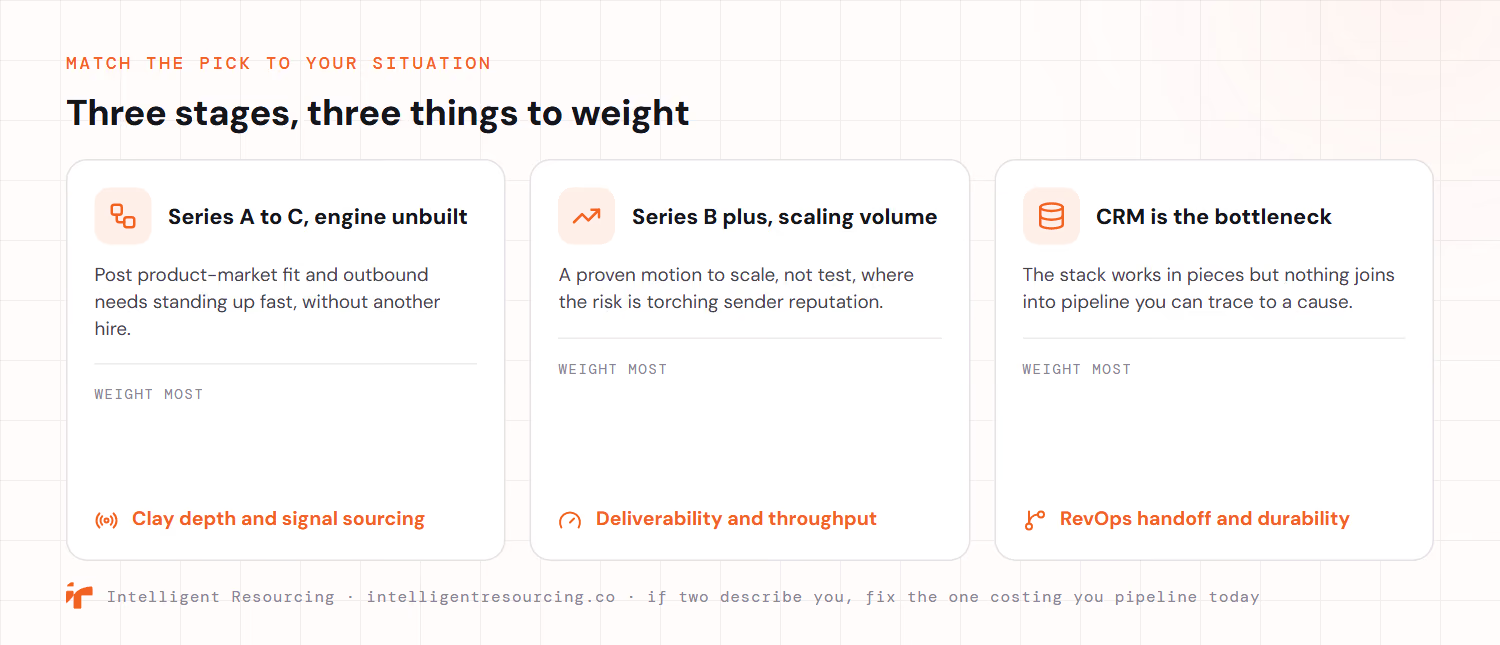
Match your situation to the pick, not the loudest brand.
- Just closed a Series A and need outbound stood up fast without hiring: Intelligent Resourcing for a signal-led system built on your own stack, or The GTM Engineering Company for a transparent-priced fractional build.
- First marketing hire, drowning, and you need one pod across paid, outbound, content, and RevOps: Understory Agency.
- Series B and outbound has plateaued on volume: ColdIQ or Growth Engine X for a heavy-duty Clay rebuild.
- $1M to $10M ARR and you need attribution proving which signals drive revenue: Forma Nôrden.
- You live in HubSpot and the CRM is a mess: RevPartners.
- You want the build and the SDR reps from one shop: demandDrive.
- You want a verified review score before you sign: RevPartners on the HubSpot Solutions Directory, or SalesCaptain on Clutch.
If two conditions describe you, weigh the one costing you pipeline today: when volume is the bottleneck, start with the Clay-heavy operators; when the CRM is the bottleneck, start with RevPartners and fix the foundation first. A different constraint needs a different list. Agencies that specialise in AI citation tracking in Australia sit outside this comparison.
If a signal-led system on your own stack sounds right, book a discovery call with Intelligent Resourcing and map your accounts against open buying windows before you commit.
Implementation and Onboarding: What to Expect
The transition runs in three phases. First, ICP and signal definition: you and the agency agree which accounts matter and which triggers (funding, hiring, tech-stack changes, intent) count as a buying window. Second, the stack build: Clay workflows, CRM wiring into HubSpot or Salesforce, and deliverability infrastructure such as secondary domains and warm-up. Third, go-live and optimisation, where sequences fire on live signals and get tuned against reply data.
A realistic timeline is onboarding in 2 to 4 weeks, first signal-triggered outreach in weeks 3 to 5, and qualified conversations in weeks 6 to 10. Treat week-one meeting promises with suspicion, because they usually mean pre-warmed shared domains or a pre-built static list, both of which erode deliverability and relevance.
A clean CRM handoff matters because over 60% of B2B sales and marketing teams say poor data quality directly disrupts pipeline handoffs (an Integrate survey). Before signing, ask three questions: who controls the Clay workflows and sending domains at the end, which specific signals the system triggers off, and whether the agency will show a live working system rather than a slide deck.
Honourable Mentions
Earleads positions as GTM-engineering-as-a-service that leaves the build on your own stack, which fits the durability test here. It falls short on proof: results are self-reported, with no named logos or third-party reviews, so it could not be graded against agencies that show verifiable outcomes. Worth a look for teams comfortable running their own reference checks.
MGSH is Clay-native, brand-led, and carries strong founder pedigree, so it is credible on capability. It is a two-person UK and EMEA boutique with no public case studies, so it did not clear the proof bar for a main-list buyer who needs evidence before committing budget.
GTM6 and DarwinApps GTM each fit a specific slice, GTM6 for VC-backed early-stage teams and DarwinApps for the $10M to $100M ARR band. Both were held back by lighter verifiable proof, though either can suit a buyer whose stage matches.
Belkins runs large-scale appointment setting with a long history and real capability. It sits here rather than on the main list because it is a traditional managed-SDR model rather than signal-based GTM engineering, so it does not leave a documented capability on your own stack. Teams that want appointments booked rather than a system built are shopping a different market. Our roundup of Australian B2B lead generation agencies ranks those firms.
Comparisons
Intelligent Resourcing maps your target accounts against open buying windows, then builds and runs a signal-led outbound system on your own stack, with your team involved. Book a discovery call to see which accounts are worth pursuing this quarter before you commit.
FAQs
What is a GTM engineering agency, and how is it different from an SDR agency?
A GTM engineering agency builds go-to-market as a system: ICP and signals, Clay enrichment and orchestration, multi-channel triggers, and CRM wiring on your own stack. An SDR agency supplies people, and their output leaves when the reps do. The fastest tell is Clay depth, because 96% of agencies now use Clay, so a real partner holds a recognised partner tier rather than treating Clay as an afterthought.
How much does a GTM engineering agency cost in 2026?
Most quote custom retainers, commonly $3,000 to $15,000 a month depending on scope, with transparent exceptions such as The GTM Engineering Company at $4K to $6K. Signal-based systems typically run a materially lower cost per qualified meeting than traditional SDR outbound. For scope bands, see GTM engineering pricing.
How do I tell a real GTM engineering agency from a rebranded SDR shop?
Check four things: a recognised Clay partner tier, the specific buying signals they trigger off, whether the documented system lives on your own stack afterward, and verifiable proof (a first-party review score or named-client outcomes, not an invented rating). If they cannot name the signals or will not hand over the workflows, it is selling labour, not infrastructure.
Which GTM engineering agencies have verified third-party reviews?
In this young category, most do not, which is normal rather than a red flag. The two with verifiable first-party scores are RevPartners (5.0 across 453 reviews on the HubSpot Solutions Directory) and SalesCaptain (4.7 across 20 reviews on Clutch). Every other agency here is graded on named-client track records.
Should I hire a GTM engineering agency or build the function in-house?
Usually both, in sequence. GTM engineer talent is scarce and expensive, with a median salary around $127,500 and postings up 205% year over year (a 1,000-job analysis), so buy the build from an agency, insist on a documented system that lives on your own stack, then let an in-house GTM engineer inherit a working machine rather than build from zero.
How long does a GTM engineering agency take to show results?
Expect first signal-triggered outreach in weeks 3 to 5 and qualified conversations in weeks 6 to 10, with steady-state volume around weeks 8 to 10 once sending domains finish warming. Faster promises usually mean shared pre-warmed domains or pre-built static lists.