

Most teams don't have a sales problem. They have a system problem dressed up as one. Clay is the tool everyone wants to plug in, and an entire generation of Clay sales automation agencies has formed to do the plugging. The work they ship is real, but it stops at the campaign layer, not the engine. This piece walks through what Clay actually does in a modern GTM stack, the limits of the campaign-led agency model, the four dimensions that decide whether a Clay partner is worth hiring, and when to skip the agency and build a Clay-powered revenue system instead.
Clay's Real Role in Modern GTM
Clay as the central data and automation layer
Clay is the enrichment, research, and automation layer that sits in the middle of a modern GTM stack. It pulls firmographics, intent, hiring signals, and contact data from multiple providers, runs AI-driven research on top, and pushes structured records into the CRM. Used well, Clay turns the "who do we contact and why now" question from a manual research task into a workflow output.
Why everyone is suddenly talking about Clay agencies
Clay has exploded in popularity as B2B teams race to operationalise enrichment and intent. The talent gap is real: most internal teams cannot wire Clay against their CRM, deliverability stack, and sequencer without help. That gap is what every Clay sales automation agency is selling into.
The limits of traditional Clay sales automation agencies
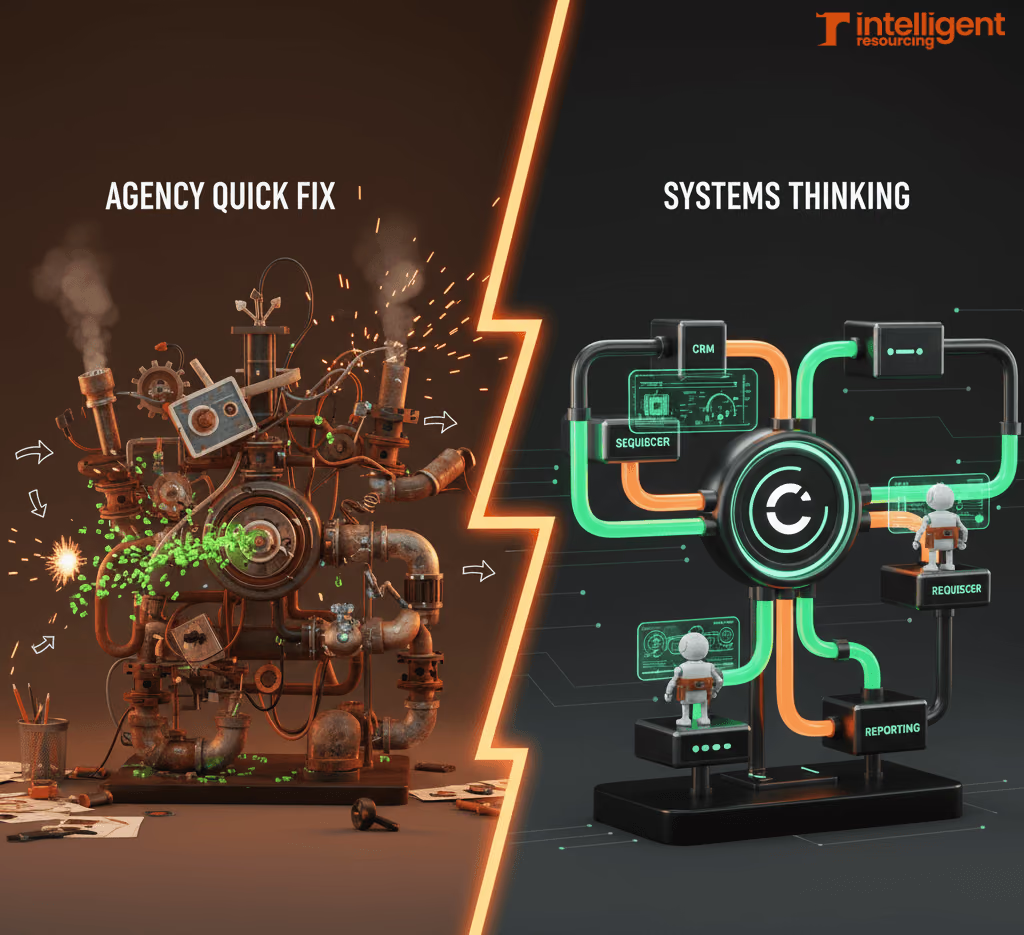
A traditional Clay agency builds you Clay workflows. Two limits show up reliably. First, the work is campaign-shaped: a sequence runs, meetings book for a quarter, the engagement ends, and the system goes stale. Second, the agency owns the engine, not the client, which means renewals and rebuilds compound rather than the engine compounding.
Campaign-first, system-second
Campaign work is the easiest sell, so it is what most agencies lead with. The reality is that sales cycles are tighter than they used to be: Ebsta's 2025 GTM benchmarks show sales cycles 9% shorter year on year, with the top sellers running at 11x the velocity of the bottom. Campaign-led Clay work does not move that velocity gap. The engine underneath it does.
Tool stack overload without ownership
HockeyStack's 2024 GTM benchmark analysed 135 companies and ~$690M in spend and found Q4 cost-per-opportunity rose 85% as volume plays failed, while the 46% of companies that grew leaned into efficiency and referral spend. Adding tools and campaigns without owning the engine is the volume-play pattern. It is what burns out by Q4.
Where this leaves GTM leaders
You can buy more Clay campaigns from an agency. You can hire in-house operators (slow and expensive). Or you can build the operating system underneath Clay so campaigns stop being the unit of work. The third option is what most teams should be evaluating; the first two are usually the path of least resistance, not the path of best return.
A smarter way to think about Clay partners
The question is not "which Clay agency should I hire" but "what job am I hiring a Clay partner to do". Choosing between Clay agencies in Australia gets easier once you answer the second question. The four dimensions below decide which type of partner fits which job.
The four dimensions that actually matter
A useful Clay partner has to deliver across all four dimensions below. Most agencies sit on one or two and stop there.
1. GTM Strategy and ICP Design
Defining who you target and why now. Without sharp ICP and Verified Buying Window logic, even perfect Clay enrichment generates the wrong list.
2. Data and Enrichment Architecture
Designing the enrichment waterfalls, intent capture, and signal-scoring logic that turn raw data into a routable record. This is where Clay technical depth matters.
3. Workflow and Integration Engineering
Wiring Clay into the CRM, sequencer, deliverability stack, and reporting layer so the workflow runs end-to-end rather than as a one-off campaign output.
4. Talent and Ownership
Who runs the engine on day 31. If the answer is "the agency", you have rented a workflow. If the answer is "your team, with an embedded specialist", you have built infrastructure.
The 3 main types of Clay partners you'll meet
Three archetypes show up consistently in the Clay services market. Each covers some of the four dimensions and misses others. Pick by the dimensions you cannot cover internally.
Type 1: Campaign Agencies — campaign-led, sequence-focused
Run sequences, book meetings, report on opens and replies. Cover Dimension 1 thinly (campaign-level ICP only) and Dimension 3 partially (enough wiring to run their own campaigns). Light on architecture and ownership. Best when you have a clean engine already and need execution depth on a defined campaign for one or two quarters.
Type 2: Implementation Shops — technical builds, then handover
Strong on Dimension 2 and Dimension 3: they design enrichment architectures and integrate Clay against your stack. Hand over the build and exit. Weak on strategy (your ICP work is your problem) and ownership (your team runs day 31). Best when you have GTM strategy locked and want a clean technical build.
Type 3: Revenue Operations Studios — design, build, and embed
Cover all four dimensions: design the GTM motion and ICP, architect the Clay data layer, engineer the integrations, and embed operators to run the engine day-to-day. The work survives the contract because the client owns the system. Best when the gap is the operating model itself, not a missing sequence or a missing integration.
How Intelligent Resourcing uses Clay to build revenue systems
Intelligent Resourcing is a Revenue Operations Studio that uses Clay, HubSpot, and n8n to build the engine, then embeds operators to run it. The Clay piece is one layer of a connected system, not the product. Below is the framework we run on every engagement.
Our Clay-powered revenue engine framework
1. Diagnose and Design
Start with the GTM motion, the ICP, and where the engine is actually leaking. The diagnostic decides whether Clay is the right answer at all (sometimes the real fix is upstream of any tool).
2. Architect and Implement in Clay
Build the enrichment waterfall, signal capture, and scoring layer in Clay. Wire it to the CRM via Evergreen CRM hygiene so the records stay current as the database decays.
3. Embed a GTM Pod
A GTM pod (RevOps lead, Clay specialist, SDR support) operates inside the client stack. The pod runs the engine, surfaces what to tune, and trains the in-house team. No "rented workflow" pattern.
4. Scale and Govern
Once the engine is live, Signal Response Protocols route real buying signals to the right rep within minutes. Reporting, governance, and the playbook stay with the client. The engine compounds rather than resetting on renewal.
Where Clay sales automation agencies still make sense
Three scenarios where a traditional Clay agency is the right buy.
- A defined 1-quarter campaign push. You have a clean engine and want to surge volume on a single play. A campaign agency handles the spike without rebuilding anything.
- A one-off technical build. You have the in-house team and the ICP locked, but you need a Clay specialist for 4-6 weeks to build the architecture and hand it over.
- You are pre-team and pre-system. Earliest stage, no SDR, no RevOps, no CRM hygiene. A boutique Clay agency buys you 6 months of pipeline while you build internally.
Outside those three, a traditional Clay agency tends to be the wrong shape for the problem. The fix usually sits upstream of the campaign.
Build in-house, hire an agency, or partner with a Revenue Operations Studio?
The honest comparison across the three buying options.
Option 1: Build In-House
Pros: full ownership, deep institutional knowledge, no margin paid to a vendor. Cons: 6-12 months to ramp, expensive Clay talent is scarce, and the team builds on every other priority at the same time. Best for teams with the patience and the budget to absorb the ramp.
Option 2: Hire a Clay Sales Automation Agency
Pros: fast to start, predictable monthly cost, vendor brings playbooks. Cons: campaign-shaped output, engine sits at the agency rather than with you, results decay on contract end. Best for teams who need a tactical push and have a clean engine to plug it into.
Option 3: Partner with a Revenue Operations Studio
Pros: design, build, and embed in one engagement; engine stays with the client; framework covers all four dimensions, not just the campaign layer. Cons: higher upfront investment than a campaign agency, requires the team to engage with the operating-model question. Best for teams whose problem is the operating model, not the campaign output.
What to do next
Two practical steps before you sign any Clay services agreement.
1. Map your Clay-powered revenue engine
On one page, draw the buying signals you want to act on, the data sources that produce them, where they land in the CRM, and which workflow fires what. If you cannot map this in 30 minutes, a campaign agency is not the missing piece. The map is.
2. Pick the partner type that fits the gap
Use the 3 partner types above. If the gap is execution depth on a clean engine, pick a Campaign Agency. If the gap is one technical build, pick an Implementation Shop. If the gap is the operating model itself, pick a Revenue Operations Studio. Combine Clay GTM engineering with embedded operators and the engine compounds; pick the cheaper option and it does not.
What is a Clay sales automation agency?
A services firm that builds Clay-based outbound workflows, usually packaged as a monthly campaign retainer. Common scope: enrichment setup, sequence build, deliverability infrastructure, and meeting volume reporting. The work is real, but it sits at the campaign layer and rarely covers GTM strategy, full integration, or talent embedded inside the client team.
What is the difference between a Clay agency and an Ops Studio?
A Clay agency runs Clay-powered campaigns on your behalf, often on a monthly retainer. An Ops Studio designs the operating model, builds the Clay-powered engine inside the client stack, and embeds operators to run it. The Clay agency model rents you a workflow. The Ops Studio model builds you infrastructure that stays after the contract.
When is a Clay sales automation agency the right choice?
When you have a clean GTM engine and need execution depth for a defined campaign push (1-2 quarters), when you have ICP and operating model locked and need a one-off technical build, or when you are very early stage and want pipeline cover while you build internal capability. Outside those three, the campaign-led agency model usually is not the right shape for the problem.
Can a traditional Clay agency build an enterprise GTM system?
Most cannot. The agency model is optimised for campaign delivery, not for designing the underlying operating model that an enterprise GTM system needs. Enterprise builds require GTM strategy, data architecture, workflow engineering, and embedded operators together. That is the Ops Studio remit, not the campaign agency remit.
How long does it take to build a Clay-powered revenue engine?
Diagnostic and design land in the first 30 days. Implementation runs 30-90 days depending on scope, with the engine going live progressively as components ship. Embedded operators take over from day 30-60 to run the engine in production. The compounding value shows up from the second quarter onward as signal data, scoring, and CRM hygiene improve cycle on cycle.
Do we keep the Clay system after the engagement ends?
Yes, in the Ops Studio model. The Clay workspace, the CRM integrations, the scoring logic, and the documented playbook all sit inside the client's stack. The Ops Studio embeds operators to run it during the engagement and trains the in-house team to take over. That is the difference between a rented workflow and an owned system.
Comparisons
Most Clay agencies sell sequences. Intelligent Resourcing builds the engine underneath them and embeds operators to run it. Your team owns the system on day 31, not us.
FAQs
What is a Clay sales automation agency?
A services firm that builds Clay-based outbound workflows, usually packaged as a monthly campaign retainer. Common scope: enrichment setup, sequence build, deliverability infrastructure, and meeting volume reporting. The work is real, but it sits at the campaign layer and rarely covers GTM strategy, full integration, or talent embedded inside the client team.
What is the difference between a Clay agency and an Ops Studio?
A Clay agency runs Clay-powered campaigns on your behalf, often on a monthly retainer. An Ops Studio designs the operating model, builds the Clay-powered engine inside the client stack, and embeds operators to run it. The Clay agency model rents you a workflow. The Ops Studio model builds you infrastructure that stays after the contract.
When is a Clay sales automation agency the right choice?
When you have a clean GTM engine and need execution depth for a defined campaign push (1-2 quarters), when you have ICP and operating model locked and need a one-off technical build, or when you are very early stage and want pipeline cover while you build internal capability. Outside those three, the campaign-led agency model usually is not the right shape for the problem.
Can a traditional Clay agency build an enterprise GTM system?
Most cannot. The agency model is optimised for campaign delivery, not for designing the underlying operating model that an enterprise GTM system needs. Enterprise builds require GTM strategy, data architecture, workflow engineering, and embedded operators together. That is the Ops Studio remit, not the campaign agency remit.
How long does it take to build a Clay-powered revenue engine?
Diagnostic and design land in the first 30 days. Implementation runs 30-90 days depending on scope, with the engine going live progressively as components ship. Embedded operators take over from day 30-60 to run the engine in production. The compounding value shows up from the second quarter onward as signal data, scoring, and CRM hygiene improve cycle on cycle.
Do we keep the Clay system after the engagement ends?
Yes, in the Ops Studio model. The Clay workspace, the CRM integrations, the scoring logic, and the documented playbook all sit inside the client's stack. The Ops Studio embeds operators to run it during the engagement and trains the in-house team to take over. That is the difference between a rented workflow and an owned system.