
Recruiters rarely struggle because they lack tools. They struggle because their tools don't talk to each other sourcing lives in one tab, enrichment in another, and the CRM becomes a battlefield of duplicated records and mistrust.
This article is not about theoretical automation. It's about how recruitment teams both in-house and agency actually run safe, repeatable, end-to-end workflows using Clay. Without CRM mess. Without losing control. And without relying on recruiter memory.
Why Recruitment Workflows Break Without a System
Most recruitment "processes" are held together by habit and goodwill: sourcers exporting from LinkedIn, recruiters enriching profiles on the fly, and admins trying to clean up CRM records after the fact. The result? Duplicate candidates, inconsistent data, broken reporting and frustrated teams.
The scale of the duplication problem is staggering: research shows that 45% of all new records entered into CRMs are duplicates, with API integrations experiencing an 80% duplicate rate. For recruitment teams specifically, this can mean 15-30% of your entire CRM database consists of duplicate candidate records, each costing an estimated $96 to resolve.
CRMs were never designed to act as workflow engines. They store data, not logic. When candidate data enters without validation or verification, it quickly becomes unreliable. This is why so many talent teams abandon enrichment workflows or lose confidence in outreach tools.
The fix isn't "better tools." It's better systems specifically, automated recruitment sourcing systems that apply orchestration, enrichment, and QA in the right order, before the CRM is ever touched.
What a Modern Recruitment Workflow Looks Like
From Candidate Discovery to Outreach Readiness
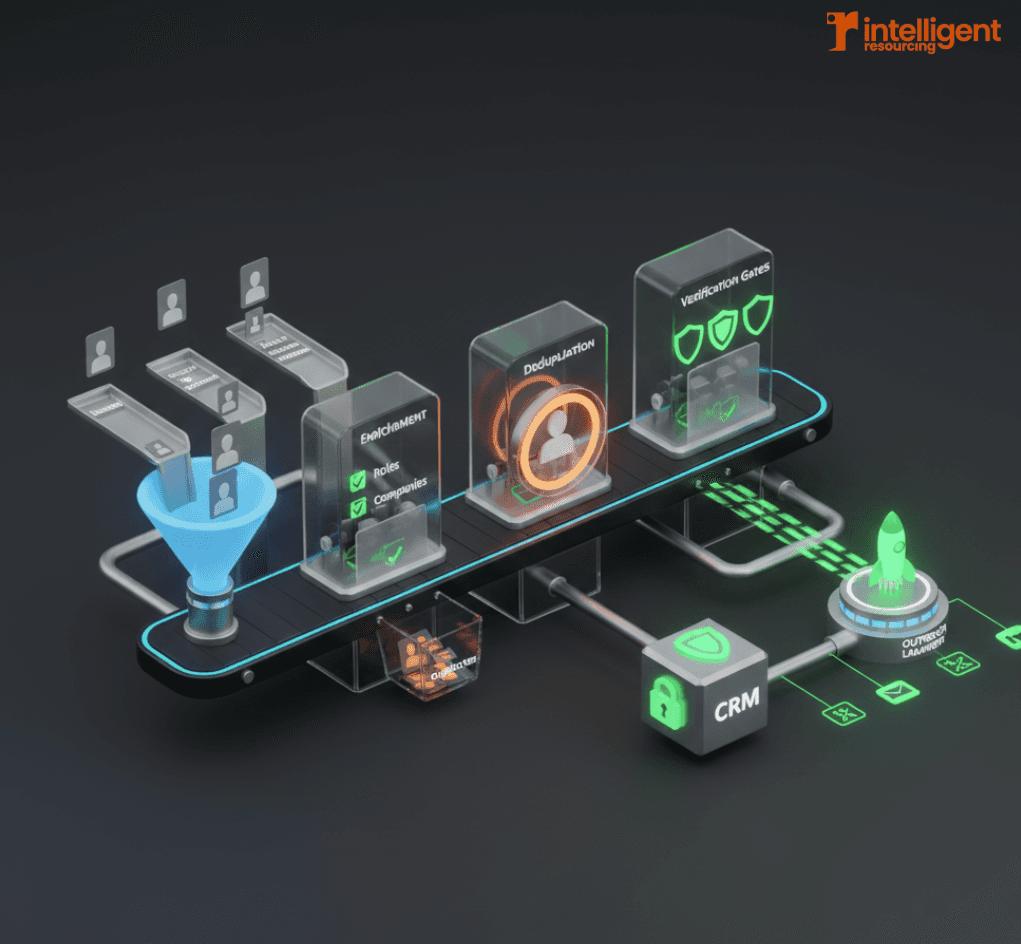
A stable, repeatable workflow follows five core stages:
Candidate sourcing – via LinkedIn exports or structured search inputs
Enrichment & validation – confirming titles, employers, contact confidence
Deduplication – preventing candidate duplication before CRM entry
CRM sync – controlled write-back with field-level logic
Outreach activation – sequenced hand-off once the candidate is verified
Where Clay Fits in the Stack
Clay is not your sourcing tool. It's not your outreach platform. It's the system in between the orchestration layer that ensures every record is verified, deduplicated, and safely enriched before anything enters your ATS, CRM, or outbound sequence.
Think of Clay as your recruitment operating system:
Inputs: LinkedIn lists, search exports, role-based sourcing
Logic: filters, enrichment, verification, deduplication
Outputs: CRM write-back, outreach readiness, reporting consistency
With 87% of companies now using AI recruiting tools in 2025 and the AI recruitment market projected to reach $1.12 billion by 2030, implementing proper workflow orchestration isn't optional it's competitive necessity.
Step 1 – Candidate Sourcing Inputs
LinkedIn Exports and Search-Based Lists
Recruiters and sourcers typically begin with:
Manual exports from LinkedIn Sales Navigator or Recruiter
Role-based search lists created in spreadsheets or sourcing platforms
Why Input Quality Matters
You can't automate your way out of poor inputs. If your sourcing data is out-of-date, misaligned with role requirements, or inconsistently formatted, no amount of automation will clean it up later. In Clay, input quality is step zero.
Standardising sourcing inputs (by geography, seniority, function, etc.) ensures everything downstream remains reliable. According to recent studies, 67% of hiring decision-makers cite time savings as the main advantage of using AI in recruitment but only when the input data is clean from the start.
Step 2 – Enrichment for Passive Candidates
What Recruiters Actually Need Enriched
Most recruitment workflows fail when they enrich everything for the sake of volume. What recruiters actually need:
Current role confirmation
Company context (e.g. growth stage, industry)
Contact confidence, not contact quantity
Clay Enrichment Logic for Recruitment
In Clay, enrichment is conditional. You can instruct the system to:
Skip low-confidence candidates
Pause workflows where enrichment fails
Apply fallback enrichment logic only when needed
This keeps your CRM free from junk data and your team focused on high-quality candidates. Research shows that organisations using AI report 89.6% greater hiring efficiency and 85.3% time savings, but only when enrichment is strategic, not indiscriminate.
Related guide: How to Use Clay for Candidate Sourcing: Practical, Compliant Workflows
Step 3 – CRM Enrichment Without Duplication
Why Duplicate Candidates Kill Recruiter Trust
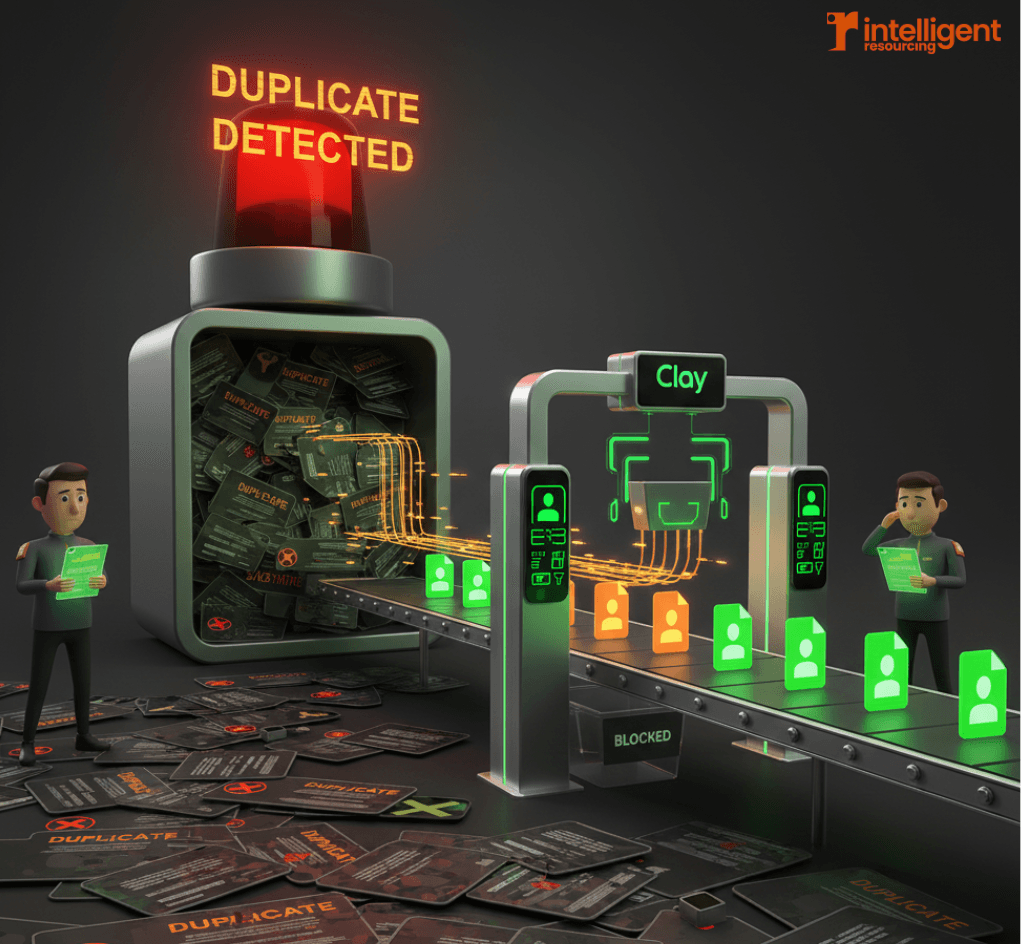
Duplicated records create confusion:
Multiple versions of the same candidate assigned to different recruiters
Broken sequences and conflicting outreach
CRM reporting that no one trusts
Once trust in the system erodes, recruiters revert to spreadsheets. The cost is significant: duplicate data problems cost U.S. businesses more than $600 billion annually, with recruitment teams bearing a disproportionate burden.
Deduplication Logic in Clay
Clay allows you to deduplicate based on:
Email + domain matching
Candidate name + current company
Custom logic for rehires or legacy records
You control the matching thresholds, so nothing enters your CRM without clearance.
Safe CRM Write-Back Rules
Clay can be configured to:
Only write back to specific fields (e.g. sourcing source, email confidence)
Avoid overwriting recruiter-entered notes or stages
Hold updates until verification gates are passed
This protects recruiter work while maintaining clean data, a critical balance as automation adopters fill 64% more jobs and submit 33% more candidates per recruiter.
Step 4 – Outreach Activation Without Risk
When a Candidate Is "Outreach Ready"
Not every enriched candidate is ready for contact. Clay ensures:
Confidence thresholds (email + role) are met
Compliance checks (e.g. geography-based restrictions) are passed
Stale records or partial enrichments are filtered out
Connecting Clay to Outreach Tools
Outreach should be triggered by logic, not by guesswork. Clay can pass verified, CRM-matched records to tools like Smartlead or your preferred outreach platform. But the activation step is always governed by rules, not human judgment alone.
With AI-assisted messaging correlating with a 9% higher likelihood of quality hire, the orchestration layer between enrichment and outreach becomes critical.
Related guide: Personalised Outreach with Clay: AI Copy & Deliverability
Running Recruitment Workflows With Offshore Teams
Separating Human Execution From System Logic
Offshore sourcers shouldn't make data quality decisions. In a well-structured Clay system:
Sourcers source—Clay qualifies
Clay enriches and verifies—Ops teams QA
Recruiters act on already-verified records
Why Clay Reduces Offshore Risk
By separating sourcing from decision-making:
You reduce judgment calls by offshore teams
Data quality remains consistent
System logic enforces rules that humans can't remember at scale
Companies report reducing salary costs by up to 70% when combining offshore sourcing with proper workflow automation but only when the system prevents data quality issues from the start.
Visibility for Onshore Team Leads
Clay provides:
Workflow audit trails
Error logs for failed enrichments
Clear hand-offs from sourcing to outreach
No more wondering why a candidate was contacted twice or not at all.
Common Recruitment Workflow Mistakes
Without system logic, teams fall into predictable traps:
Syncing directly from sourcing tools into CRMs without verification
Relying on recruiters to act as QA
Enriching every candidate, regardless of quality
Using uncontrolled two-way syncs that overwrite recruiter input
Clay prevents all of the above through:
Pre-CRM deduplication
Confidence-gated enrichment
Controlled write-back rules
Verification gates before activation
Given that 73% of companies plan to invest in automation by 2025, implementing these safeguards isn't just best practice it's table stakes.
Example Recruitment Workflow (Conceptual Walkthrough)
Here's how a clean Clay workflow typically looks:
Input: Sourcer uploads a LinkedIn export
Enrichment: Clay confirms current role, validates email
Deduplication: Candidate checked against CRM for matches
CRM Sync: Clean data written back to non-recruiter fields only
Outreach Readiness: Candidate queued for Smartlead or added to outreach-ready list
Every step is logged, auditable, and repeatable.
How This Workflow Scales Into Templates
Once your logic is stable, you can turn it into templates for different sourcing goals:
Executive search
Volume roles
Passive talent nurturing
See: 7 Clay Automation Templates for Recruiters (From Sourcing to Deduping) for pre-built recruitment workflow templates.
Frequently Asked Questions
How does Clay prevent duplicate candidates in my CRM?
Clay uses pre-CRM deduplication logic based on email, domain, name, and company matching. You control the matching thresholds, so candidates are checked against your existing CRM records before any write-back occurs. This prevents the 45% duplicate rate common in uncontrolled integrations.
Can Clay work with offshore sourcing teams?
Yes. Clay is specifically designed to separate sourcing execution from data quality decisions. Offshore teams source candidates, while Clay handles verification, enrichment, and CRM qualification eliminating judgment calls and maintaining consistency at scale.
What enrichment providers does Clay support for recruitment?
Clay integrates with 100+ data providers including LinkedIn, Apollo, Hunter, Clearbit, and more. The platform uses conditional logic to try multiple providers in sequence, maximizing data coverage while minimising credit waste.
How long does it take to set up a recruitment workflow in Clay?
A basic sourcing-to-CRM workflow can be built in 2-3 hours. Complex workflows with multiple enrichment fallbacks, compliance checks, and outreach activation typically require 1-2 days of initial setup, then become fully automated templates.
Does Clay replace my ATS or CRM?
No. Clay is an orchestration layer that sits between your sourcing tools and your ATS/CRM. It ensures data quality, prevents duplicates, and adds enrichment then writes clean, verified records back to your existing systems.
What happens if enrichment fails for a candidate?
Clay workflows include conditional logic for enrichment failures. You can configure the system to: pause the workflow for manual review, skip to alternative enrichment providers, or route low-confidence records to a separate holding table for later processing.
Can Clay automate outreach directly?
Clay can trigger outreach by passing verified candidates to platforms like Smartlead, Instantly, or Lemlist. However, activation is always governed by confidence thresholds and compliance rules ensuring only truly outreach-ready candidates receive contact.
How do I prevent Clay from overwriting recruiter notes in my CRM?
Clay's write-back rules are field-level configurable. You can specify exactly which fields Clay can update (typically sourcing metadata and contact data) while protecting recruiter-entered fields like notes, stages, and relationship history.
Recruitment Automation Is About Trust
Recruitment automation shouldn't mean "faster spam." It should mean "higher confidence, lower risk."
The data is clear: with 65% of recruiters already using AI tools and 81% of companies planning to invest in AI-driven recruitment by 2027, the competitive advantage goes to teams who implement automation correctly with proper orchestration, deduplication, and quality gates.
Clay enables recruitment teams to scale sourcing and outreach without compromising data quality, CRM hygiene, or team trust. It's the orchestration layer that brings discipline to candidate data and gives recruiters time back to do what they do best.
Ready to Build Recruitment Workflows That Actually Work?
If your recruitment workflows are breaking under volume, we design and run Clay systems that offshore and onshore teams can trust.
Our proven approach:
✓ Audit your current sourcing-to-CRM flow and identify duplication risks
✓ Design custom Clay workflows with pre-CRM deduplication and enrichment logic
✓ Implement controlled CRM write-back that protects recruiter work
✓ Train your team (onshore and offshore) on the new system
✓ Provide ongoing support and workflow optimisation
What you get:
Repeatable, auditable workflows from sourcing to outreach
70%+ reduction in duplicate candidate records
Confidence-gated enrichment that maximises quality per credit
Clear handoffs between offshore sourcing and onshore recruiters
Templates you can clone for different hiring campaigns
Book a Free Workflow Consultation – We'll review your current recruitment tech stack and show you exactly where automation can eliminate duplicates and scale your sourcing without losing control.
Related Resources
GTM Engineering Resources