

Why Compliance Matters in Automated Candidate Sourcing
As sourcing scales, so does exposure to compliance risk. Recruitment teams handling thousands of candidates across regions face increasing pressure to keep data quality high and automation practices within legal and ethical bounds. According to recent GDPR enforcement data, violations related to consent and data security have resulted in over €2.8 billion in fines as of 2023. Many misconceptions still exist about automation being inherently non-compliant when in fact, compliance failures are almost always design failures.
The stakes are high: 65% of global businesses are not fully GDPR-compliant, according to Gartner research. Yet automation done correctly can actually reduce risk while improving efficiency. Research shows that recruitment automation reduces time-to-hire by 7-15% approximately 4.5 days per role while companies save an average of $90,000 per recruiter annually.
Clay enables governed, rule-based candidate sourcing workflows that reduce risk, not amplify it. It's not about removing humans from the process, it's about removing inconsistency.
What "Compliant Candidate Sourcing" Actually Means
Compliance vs Caution
Compliance means adhering to lawful data usage and governance not avoiding automation altogether. Many recruitment teams default to manual processes out of fear, rather than building controlled automation that is actually safer. Around 73% of European organisations enhanced their customer data management practices in response to GDPR, demonstrating that proper systems design is the path forward.
The Difference Between Data Access and Data Activation
Gathering candidate data is not inherently non-compliant. It's how that data is acted upon that matters. Clay separates sourcing inputs from activation logic, meaning you can enrich and verify without triggering outreach prematurely.
Where Clay Fits in the Candidate Sourcing Stack
What Clay Does Not Do
Clay is not a scraping tool, an ATS, or an outreach platform. It doesn't pull profiles without input, send cold emails, or replace your CRM.
What Clay Controls
Clay manages workflow logic: sequencing enrichment, applying verification thresholds, and orchestrating data movement based on rules. It's the governance layer sitting between input and output. Think of it as your GTM engineering command center for recruitment workflows.
See how this fits within broader candidate sourcing automation systems in our guide to Automate Candidate Sourcing: Clay for Recruiters Guide.
Step 1 – Exporting Candidates from LinkedIn Safely
Manual Sourcing Inputs
Candidate data should always be manually exported by recruiters or sourcers. Clay should never initiate sourcing itself. This creates a clear ownership layer and ensures proper consent chains are maintained.
Standardising Input Data
LinkedIn exports should follow consistent formatting. Avoid unstructured notes or free-text fields that create inconsistencies downstream. 67% of recruiters save time using AI for repetitive tasks, but only when data inputs are standardised.
Step 2 – Enrichment Sequences That Respect Data Quality
What to Enrich and What to Ignore
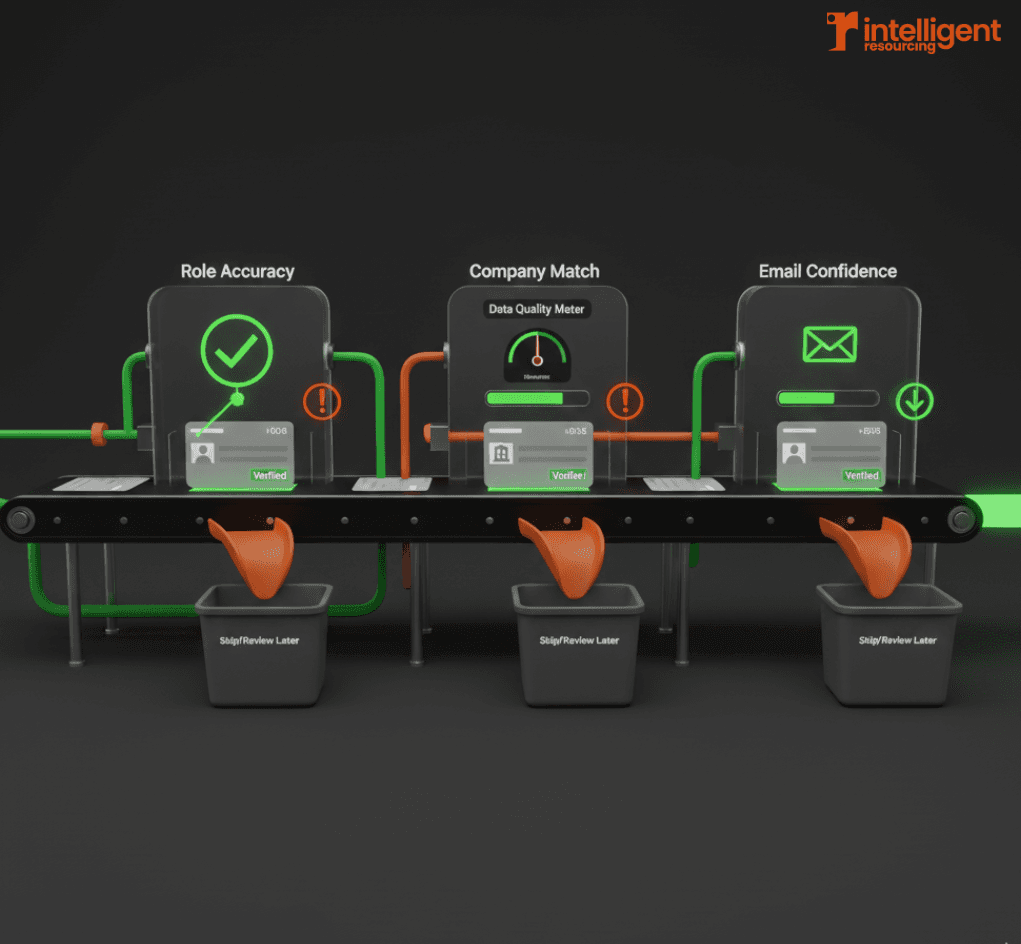
Clay enables focused enrichment verifying role accuracy, company size, or basic context. Avoid over-enriching with speculative or unused fields. Research shows that automated screening reduces initial review time by 71% while improving match accuracy when properly configured.
Conditional Enrichment Logic in Clay
Enrichment should only occur when source confidence is high. Clay's conditional logic allows you to skip low-confidence records and stop enrichment mid-workflow if quality fails. This is similar to how online signals work in GTM workflows you only act when data quality thresholds are met.
Step 3 – Verification Gates Before CRM Sync
Why Verification Is a Compliance Control
Passing data into your CRM without confirming its accuracy increases compliance and operational risk. Clay prevents this by enforcing gates before write-back. Companies using recruitment automation report 98% improvement in hiring efficiency, largely due to these quality controls.
Confidence Thresholds in Clay
Set minimum email verification scores or require role freshness to pass. These thresholds act as safety valves in your automation flow. Learn more about implementing email verification and deliverability best practices in your Clay workflows.
Step 4 – Deduplication and CRM Hygiene
Why Duplicate Candidates Create Legal and Operational Risk
Multiple candidate records create confusion, expose personal data to unauthorised users, and result in repeat outreach sometimes across geographies. Under GDPR, data controllers must demonstrate that they process personal data lawfully and maintain accurate records.
How Clay Prevents Duplicate Records
Clay uses email and domain-level identity checks before syncing to your CRM. You can enforce 'write-once' rules that preserve recruiter trust and candidate privacy. This is part of building intelligent lead generation workflows that respect data governance.
Step 5 – Outreach Readiness Without Auto-Sending
Why Clay Should Never Auto-Contact Candidates
Recruiter sign-off must remain part of the workflow. Clay doesn't trigger outreach; it prepares a verified record for human review. This aligns with GDPR's principle that automated decision-making should not replace human oversight in critical hiring decisions.
Preparing Candidates for Recruiter-Led Outreach
Clay ensures every candidate reaching your ATS or outreach tool has been verified, deduplicated, and enriched. The recruiter receives clean, compliant context not unqualified lists. Learn how to use signals for personalising cold email sequences while maintaining compliance.
Running Compliant Sourcing Workflows
Separating Labour from Decision-Making
Clay allows team members to execute sourcing tasks while keeping decision logic centralised. This separation reduces compliance errors and judgment drift across your recruiting team.
Auditability and Accountability
Clay logs every action, providing traceability. You know who sourced, when it was enriched, and why it passed or failed QA. This audit trail is essential for demonstrating GDPR compliance.
See our operational walkthrough in Recruitment Workflows with Clay: From Sourcing to Outreach.
Common Compliance Mistakes Recruiters Make
Over-enriching every candidate
Syncing unverifiable data into the CRM
Treating automation as a shortcut
Allowing uncontrolled two-way sync
Processing candidate data without a clear legal basis
Clay workflow design prevents these by enforcing stages, rules, and verification checkpoints. 89% of HR professionals recognise that AI can improve the applicant application process, but only when properly governed.
Example Compliant Candidate Sourcing Workflow
Export LinkedIn candidates to CSV
Upload to Clay; trigger enrichment if role and company data present
Apply verification gate for email and role accuracy
If pass, deduplicate against CRM
If unique, sync clean record to ATS
Mark record as outreach-ready for recruiter review
How This Workflow Becomes Reusable Templates
Once designed, your Clay flows can be saved as templates: executive search, high-volume roles, regional workflows, and more. This is what GTM engineers specialise in building repeatable systems that scale.
Compliance Comes from Design, Not Restraint
The answer to automation risk is not less automation, it's better automation design. Clay gives recruitment teams the control layer they need to scale candidate sourcing safely. The data supports this approach: 87% of companies now use AI in recruitment, and those with properly designed systems report 31% faster hiring times and 50% improvement in quality of hire.
Yet only 8% of companies use AI throughout the entire recruitment process, suggesting most organisations are taking a balanced approach exactly what compliant Clay workflows enable.
The question isn't whether to automate candidate sourcing. It's whether you'll do it with proper governance or expose your organisation to unnecessary risk.
Build Compliant Recruitment Systems That Scale
Ready to transform your candidate sourcing while maintaining full compliance? We specialise in designing Clay workflows that deliver the efficiency gains you need while respecting data governance requirements.
What You Get When Working With Us:
✅ Compliant-by-Design Workflows - Clay implementations that build compliance into every step, not as an afterthought
✅ Audit-Ready Documentation - Complete process documentation and audit trails that demonstrate GDPR compliance
✅ Reusable Templates - Custom workflow templates for executive search, high-volume hiring, and regional variations
✅ Ongoing Support - Regular workflow reviews to ensure your systems evolve with changing regulations
Why Choose Intelligent Resourcing:
Certified GTM Engineers with deep Clay expertise
Proven track record helping recruitment teams save 15+ hours weekly
Compliance-first approach that protects your organisation
Flexible engagement models from project-based to retainer support
Don't let compliance concerns hold back your recruitment automation.
Frequently Asked Questions
Q: Is using Clay for recruitment compliant with GDPR?
A: Yes, when properly configured. Clay itself is a workflow tool that processes data according to your rules. Compliance depends on how you design your workflows ensuring you have a legal basis for processing, implementing verification gates, and maintaining human oversight. Clay enables compliant automation; it doesn't create compliance issues by itself.
Q: Can Clay automatically scrape candidate profiles from LinkedIn?
A: No. Clay requires manual data input. Recruiters must export candidate lists themselves, maintaining clear data ownership and consent chains. This manual sourcing step is actually a compliance feature, not a limitation.
Q: How long should we retain enriched candidate data?
A: Under GDPR, you should only retain data as long as necessary for the recruitment purpose. Seek explicit consent if storing for future opportunities. Most organisations retain active candidate data for 6-12 months for specific roles, and 1-2 years with explicit consent for talent pools.
Q: What's the difference between Clay and an ATS?
A: Clay is a data enrichment and workflow orchestration tool, not an Applicant Tracking System. Clay sits upstream of your ATS, preparing clean, verified, enriched candidate records before they enter your recruiting pipeline. Your ATS manages the actual recruitment process.
Q: Do I need to notify candidates that I'm using Clay?
A: You need to notify candidates that you're processing their data and explain how you're doing it. This is typically covered in your privacy policy. Since Clay is a data processing tool you control, it's part of your data processing infrastructure that should be disclosed.
Q: How does Clay help reduce bias in candidate sourcing?
A: Clay's rule-based approach applies consistent criteria to all candidates. By automating enrichment and scoring based on predefined parameters, you reduce subjective human bias. However, you must ensure your criteria themselves are non-discriminatory.
Q: What happens if a candidate requests their data be deleted?
A: You must honor data deletion requests under GDPR. Clay provides tools to identify and remove specific records. Maintain processes to track where candidate data lives (Clay, ATS, CRM) and ensure deletion across all systems.
Q: Is email verification legally required?
A: While not explicitly required by GDPR, verification gates serve multiple compliance purposes: they ensure data accuracy (a GDPR principle), reduce unwanted contact (respecting candidate privacy), and demonstrate responsible data processing.
Q: Can I use Clay for candidate sourcing in multiple countries?
A: Yes, but ensure your workflows account for regional data protection laws. GDPR applies to EU candidates regardless of where your company is based. Other regions have their own requirements (CCPA in California, POPIA in South Africa, etc.).
Related Resources & Pages
Clay Workflows & Automation
Clay Workflow Expert Services - Professional Clay implementation and training
How To Reduce Email Bounce Rates Using Smart Fallback Logic In Clay