

Automated candidate sourcing sounds like a dream until poor data, CRM duplication, or tool misalignment turns that dream into daily cleanup. Many recruitment teams are stuck between manual sourcing that doesn't scale and fragmented tools that break trust with consultants and clients.
But automation doesn't have to mean chaos. With the right design, Clay for recruiters becomes a reliable sourcing infrastructure, not just another list scraper.
This guide shows how to build stable, compliant, and scalable candidate sourcing workflows using Clay. If your team operates within a signal-driven data workflow, this is how automation becomes your most trusted recruiter.
Why Manual Candidate Sourcing No Longer Scales
Traditional sourcing methods manual LinkedIn exports, spreadsheets, and repetitive CRM tasks start strong, then buckle under volume. As teams grow or distribute tasks across multiple recruiters, data quality fractures.
According to research, recruiters spend up to 40% of their time reviewing resumes manually, with 72% of hiring managers reporting they've missed great candidates due to human error. The real costs? Hours wasted on deduplication (with 15-30% of CRM contact records consisting of duplicate entries), decaying candidate records, and recruiter frustration from seeing the same contact 15 times.
Modern recruitment teams need systems, not more sourcing tools. Tools give you speed. Systems give you scale, accuracy, and confidence. Companies using recruitment automation reduce time-to-hire by 7-15%, saving an average of $90,000 per recruiter per year.
What Automated Candidate Sourcing Really Means
Automation Without Losing Control
Many recruiters hesitate to automate because they've been burned before. Bots pulling junk data, automations creating chaos in the CRM, or outreach happening without oversight.
But automation done right is governed automation. Clay doesn't just automate tasks it enforces rules:
No verified email, no CRM write
No enriched role, no outreach
No duplicate, no new record
This gives recruiters confidence, not confusion. With 87% of companies now using AI in their recruitment processes, the question isn't whether to automate it's how to automate with control and precision.
Clay's Role in Recruitment Workflows
Think of Clay as the orchestration layer between:
Sourcing inputs (LinkedIn, custom lists, job boards)
Enrichment (email, company data, role verification)
CRM (write-back with deduplication and rules)
Outreach (triggering sequences when ready)
Clay is not the enrichment tool. It's the system that governs what gets enriched, when it gets synced, and who sees it. For teams managing complex GTM engineering workflows, this orchestration capability becomes the difference between chaos and predictable results.
Designing a Reliable Candidate Sourcing Workflow
Source Ingestion (LinkedIn and Beyond)
Clay supports manual and programmatic sourcing. Recruiters can upload LinkedIn exports, scrape public profiles via search-based lists, or ingest candidates based on role criteria or location. The key is starting with intent who you're sourcing, not just where.
This shift is important for distributed teams. Instead of chasing profile volume, Clay helps define structured inputs that lead to usable, verified candidates. Research shows that AI-powered recruitment tools can reduce hiring costs by 30% per hire while improving candidate quality.
Enrichment for Passive Candidates
Passive candidates require context. Clay enrichment layers include:
Role confirmation (Is this person still in the role?)
Company size, location, industry tags
Email and contact data with confidence scoring
These checks are especially valuable when working with hard-to-reach roles or emerging markets. With 58% of recruiters finding AI most useful for candidate sourcing, enrichment becomes your competitive advantage.
For deeper insight into structuring enrichment, refer to our guide on Clay & n8n API Workflows: Automating GTM Processes with Enrichment and Orchestration.
CRM Enrichment Without Duplication
Why Recruitment CRMs Are Especially Fragile
Most recruitment CRMs break under volume. Candidates often appear multiple times due to small variations in spelling, job titles, or emails. Add in multiple sourcers, and the result is conflict: two recruiters calling the same person or overwriting notes.
Studies show that duplicate records make running searches difficult for 48% of teams, with 38% wasting time creating the same contacts repeatedly. This isn't just inefficient it damages your professional reputation with candidates and clients.
Using Clay for Deduplication Before CRM Entry
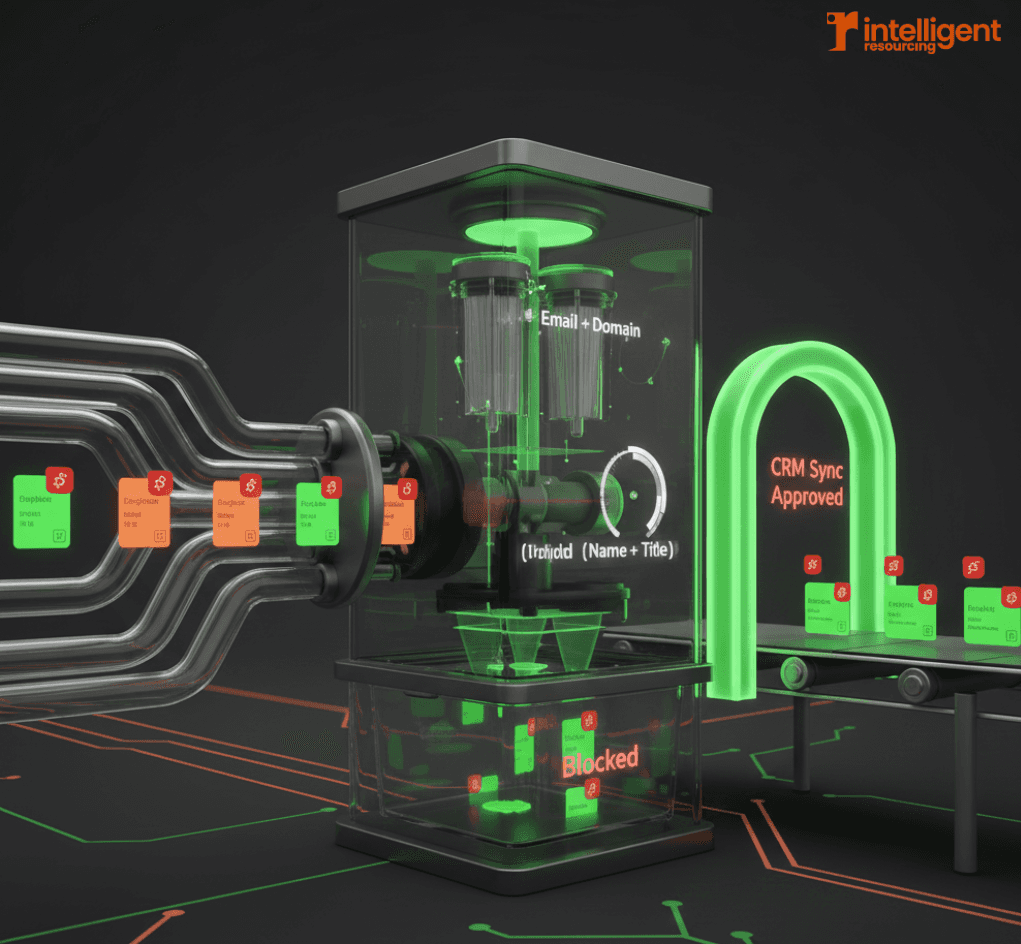
Clay performs identity matching at the field level:
Email + domain combinations
Name + company + title cross-checks
Confidence thresholds that block low-quality entries
Instead of deduplicating after the fact, Clay prevents duplicates at source. This proactive approach to data quality ensures your CRM remains a trusted source of truth rather than a data swamp requiring constant cleanup.
Controlled Write-Back to the CRM
Clay workflows can enforce strict write-back rules:
Only update if confidence > 90%
Never overwrite recruiter-added fields
Don't write to CRM if enrichment is partial
This protects recruiter trust no overwritten notes, no surprise CRM changes.
Running Clay Workflows Across Distributed Teams
Separating Execution From Control
Clay allows sourcers to execute workflows while system owners retain governance. This separation is crucial for distributed recruitment teams:
Sourcers handle task execution (upload lists, run enrichment)
RevOps or Ops manage workflow rules (what happens after enrichment)
This prevents misfires and maintains data quality across multiple team members and locations.
Preventing Data Drift Across Teams
Drift happens when teams run slightly different workflows. Clay solves this through:
Standardised templates
Centralised refresh logic
Locked confidence thresholds
Everyone runs the same logic, whether they're working from different offices or time zones. This consistency is critical when operating with distributed teams.
Why Clay Enables Safe Team Scaling
Clay minimises judgement calls. If a candidate doesn't meet criteria, they don't enter the CRM or outreach list. This allows operations to scale sourcing teams without worrying about human error or over-enrichment.
Research shows that companies using automation save an average of 792 hours per hire, with 81% of employers observing lower time-to-hire. For more practical examples, explore our Clay Workflow Expert resources.
Frequently Asked Questions
1. How does Clay prevent duplicate candidates in recruitment CRMs?
Clay uses pre-entry deduplication logic based on domain, email, and role matching. It ensures that records are checked before they ever reach your CRM eliminating duplicates at source, not after. This prevents the 15-30% duplicate rate that plagues most recruitment databases.
2. Can Clay be used by distributed sourcing teams?
Yes. Clay allows sourcers to execute structured workflows without compromising data quality. Execution and control are separated sourcers that work within governed templates, not ad hoc processes.
3. What types of verification gates can be used in a recruitment workflow?
Recruitment workflows can include gates for role relevance, email validation, location accuracy, and company match confidence. These gates ensure only qualified candidates move forward, reducing wasted outreach by up to 75%.
4. Does Clay support one-way sync to recruitment CRMs?
Absolutely. Clay can be configured for one-way or conditional CRM sync, preventing overwrites and ensuring system stability especially important for sensitive candidate records.
5. How does Clay help with recruitment compliance?
Clay's audit logs track who enriched a candidate, when, and with what data. Combined with confidence thresholds and verification gates, this ensures compliance with GDPR, UK DPA, and Australian recruitment privacy rules.
6. Can Clay handle sourcing beyond LinkedIn?
Yes. While LinkedIn is common, Clay supports sourcing from role-based lists, domain inputs, or manual uploads offering flexibility without compromising structure. This multi-channel approach is essential for comprehensive talent acquisition strategies.
Ready to Transform Your Recruitment Operations?
Stop losing candidates to manual processes and CRM chaos. The recruitment teams winning in 2025 aren't working harder; they're working with systems that scale.
With Clay automation properly implemented, you can:
✓ Reduce time-to-hire by up to 75% through intelligent workflow automation
✓ Eliminate 15-30% of duplicate records that damage your CRM integrity
✓ Save an average of $90,000 per recruiter annually on manual sourcing tasks
✓ Scale your sourcing teams with confidence and control
✓ Ensure compliance with GDPR, UK DPA, and Australian privacy regulations
Three Ways to Get Started:
1. Build Your Revenue Engine
Let our team design and implement your complete Clay recruitment automation system from sourcing to CRM sync to outreach orchestration.
👉 Explore GTM Engineering Services
2. Master Clay Workflows
Access expert guidance and proven templates to implement Clay automation in your recruitment operations.
👉 Discover Clay Workflow Solutions
3. Get Expert Guidance
Schedule a consultation to discuss your specific recruitment challenges and discover how Clay workflows can transform your operations.
Don't let your competitors automate while you're stuck in spreadsheets. The difference between struggling recruitment teams and those thriving in 2025 isn't talent it's systems. And systems start with the right Clay workflow architecture.
Contact Intelligent Resourcing today to turn your recruitment chaos into a predictable, scalable revenue engine.
Related Resources & Further Reading
Explore these additional guides to master your recruitment automation
Signal-Based Marketing & Content
3 Content Automation Case Studies - Real examples of automation transforming lead generation
Future Trends in Marketing Content Automation 2026 - Stay ahead of automation trends
How to Overcome 11 Content Automation Challenges - Practical solutions for common automation obstacles