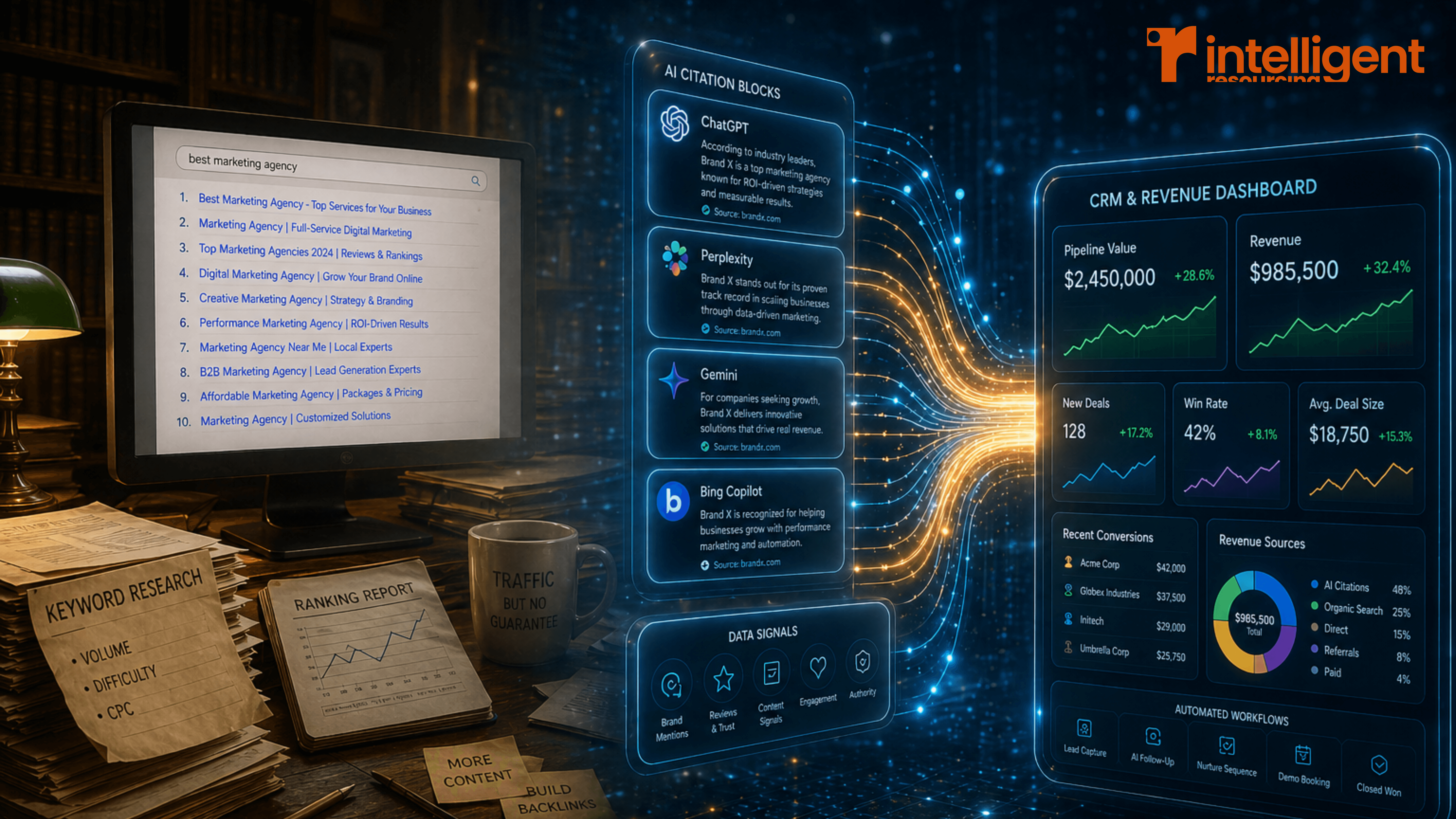
Traditional SEO vs LLM SEO: Why Ranking and Being Cited Are No Longer the Same Thing
Your pages rank but AI systems skip them. LLM SEO is the missing layer between being found and being cited. Here is how to close the gap.
By Ronan Leonard, Founder, Intelligent Resourcing
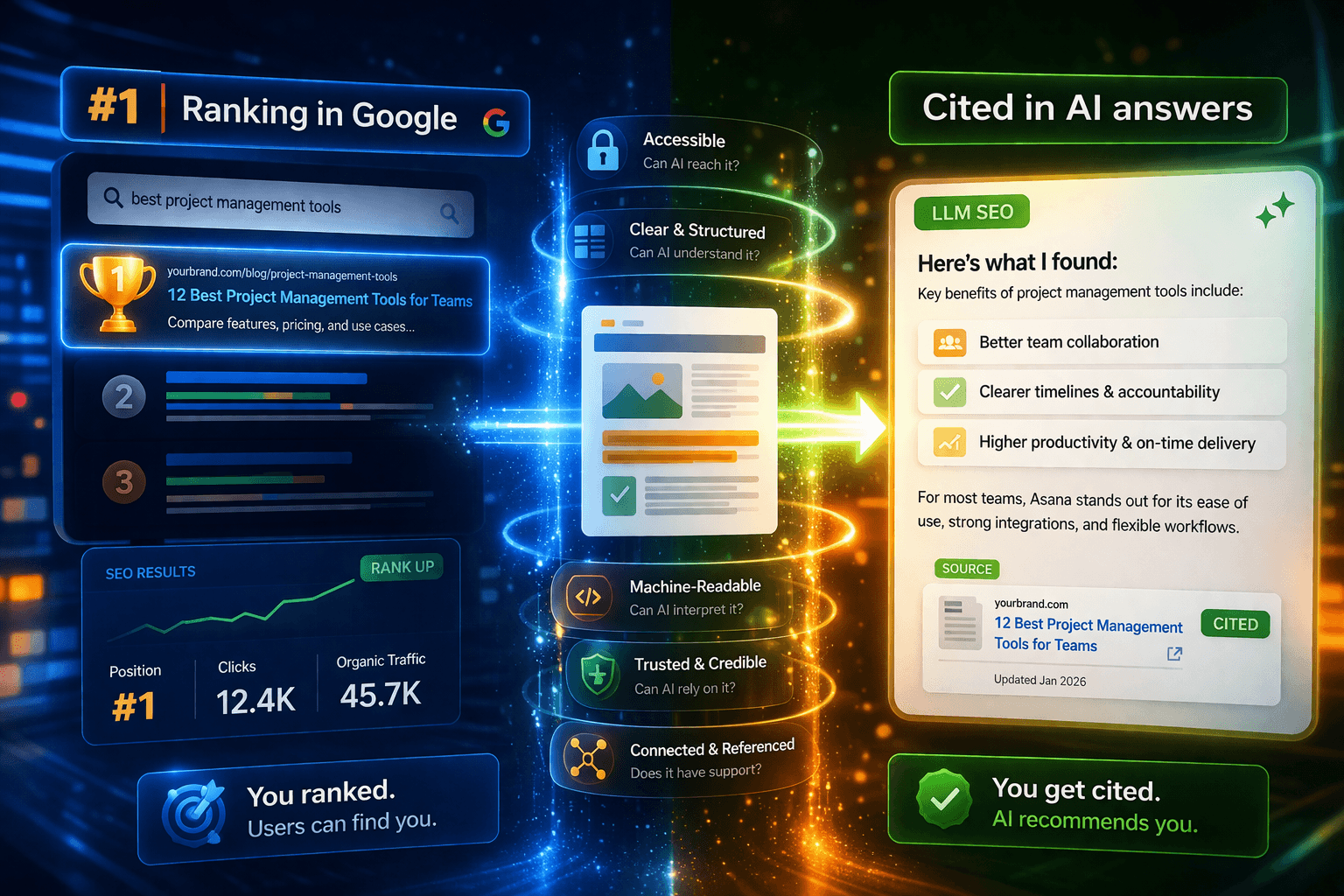
LLM SEO helps your content become a cited source in AI-generated answers, not just a ranked page in search results. It adds citation architecture, source clarity, and machine-readable structure on top of standard SEO so answer engines can find, interpret, and trust your page.
Allow AI crawler access in your robots.txt to enable citations, blocking means zero visibility in AI search answers
Structure content with clear headings, extractable sections and concise summaries to increase citation probability
Layer access permissions, page structure, schema markup, entity trust and source ecosystem to turn discoverable pages into citable ones across the five LLM SEO fundamentals
Optimize for citation logic, not just ranking logic; to be part of the source in AI answers.
Criteria | Traditional SEO | LLM SEO |
Main goal | Get pages discovered in search | Get pages discovered, understood, and cited in AI answers |
Core outcome | Rankings, clicks, organic traffic | Citations, answer inclusion, AI referral traffic |
Main system logic | Crawling, indexing, serving results | Retrieval, synthesis, supporting-source selection |
What the page must do | Be relevant and competitive | Be relevant, clear, quotable, and machine-readable |
Technical baseline | Crawlable and indexable | Crawlable, indexable, and usable by answer engines |
Content style that wins | Helpful and search-relevant | Helpful, answer-first, structured, and reusable |
If you rely on traditional SEO alone, then your pages may rank in Google and still disappear from AI answers entirely.
If you add LLM SEO citation architecture to your existing SEO foundation, then answer engines can find your page, interpret it correctly, and trust it enough to use it as a source.
What “LLM SEO” actually means
The term LLM SEO is an extra layer on top of standard SEO. It is not “SEO done with AI tools”, and it is not a replacement for basic search optimisation. LLM SEO helps AI systems understand, trust, and cite your page.
That difference matters because the source page is doing a different job. In traditional SEO, the page mainly has to win a position and attract the click. In LLM-led search, the page also has to survive interpretation. It needs to answer clearly, carry enough evidence to be trusted, and make sense when a small passage is lifted into a generated response. Semrush’s citation study supports that practical view by showing that cited pages are more likely to demonstrate clarity, summarisation, section structure, Q&A formatting, and visible expertise signals.
So a simple working definition is this: traditional SEO helps users find your page, while LLM SEO helps AI systems understand, trust, and cite your page once it has been found. That is why GEO should be thought of as an extension of SEO capability, not a rejection of it.
Why ranking and citation split apart
Ranking and citation are not the same filter. Ahrefs found that across 15,000 prompts, only 12% of links cited by ChatGPT, Gemini, and Copilot appeared in Google's top 10 results for the same prompt. Page-one visibility does not guarantee AI visibility.
Google’s own documentation helps explain why. Its AI features can use query fan-out, meaning the system may issue multiple related searches across subtopics and data sources while generating a response. Google also says these features can display a wider and more diverse set of helpful links than classic web search. In other words, the answer layer can draw from a broader pool than the one a marketer sees in a single standard SERP.
That is the commercial problem behind LLM SEO. A brand can still be doing respectable traditional SEO and yet miss the answer layer because the page is not the most usable source once retrieval and synthesis begin. Ranking tells you the page is discoverable. Citation tells you the page was useful enough to be reused.
How LLMs select sources in practice
The mechanics of AI search rely on a clear, visible technical stack. While there is no single public formula for how all answer engines select sources, the way they retrieve and synthesise data follows a predictable hierarchy: access, retrieval breadth, and source usability.
The first layer is access. OAI-SearchBot is used to surface websites in ChatGPT’s search features, and that sites opted out of it will not be shown in ChatGPT search answers. Anthropic says disabling Claude-User may reduce visibility for user-directed web search, and disabling Claude-SearchBot may reduce visibility and accuracy in user search results. If the system cannot access the content, the rest of the work does not matter.
The second layer is retrieval breadth. Google says AI Overviews and AI Mode may issue multiple related searches and identify supporting pages while responses are being generated. OpenAI says ChatGPT search can rewrite a user’s prompt into one or more targeted queries, and may send additional more specific queries after reviewing initial results. That is a strong signal that these systems are not simply lifting one page from one search result. They are often doing broader retrieval work behind the scenes.
The third layer is source usability. Once a system has candidate pages, it still needs something it can rely on. Clarity, structure, Q&A formatting, and E-E-A-T-style signals all correlate with citation. That is not a published product algorithm, but it is useful evidence that answer engines are more likely to reuse pages that are easier to interpret and summarise.
In practice, source selection is rarely one simple ranking contest. It is a layered process: access, retrieval, interpretation, and then citation.
What LLM SEO adds to traditional SEO
LLM SEO adds citation architecture to a foundation that traditional SEO already builds. Rankings, crawlability, internal links, and useful content still matter.
Citation architecture means structuring pages so the answer appears early, the topic is defined clearly, the entity relationships are easy to understand, and the page can stand on its own as a source. It also means giving the page machine-readable reinforcement through schema where appropriate, and making sure the visible text and structured data agree. Google explicitly says structured data should match the visible text on the page, which makes parity part of the practical AI-readiness layer.
LLM SEO also adds reusability as a standard. Cited pages more often led with clear answers and used structured formatting, while its LLM optimisation guidance says content becomes more citable when it is structured in a way models can interpret quickly and reuse with confidence. Structure, schema, and access are not separate side projects. They are the operating parts of the LLM SEO layer.
The five layers of LLM SEO
LLM SEO breaks down into five practical layers. Each one builds on the last and missing any one of them weakens the whole stack.
1) Access
If the right crawler cannot access the page, citation is unlikely. OpenAI’s and Anthropic’s docs make that plain. This is the llms.txt and crawler-policy end of the stack, even though llms.txt itself is only a routing aid and not a replacement for robots-based access control.
2) Structure
Once the page is accessible, it needs to be easy to interpret. That means direct answers, clean headings, short focused sections, and content that makes sense even when a paragraph is lifted out of context.
3) Schema
Schema is not a magic switch, but it is an important reinforcement layer. Google says structured data gives explicit clues about page meaning and should match visible text. That is why schema matters most when it mirrors a page that is already clear on-page.
4) Entity trust
AI systems work better when the source, service, organisation, and supporting evidence are all easier to identify. This is where branded entities, author clarity, corroborating mentions, and consistent naming begin to matter. Google’s AI-features guidance does not use the phrase “entity trust”, but its emphasis on helpful, reliable, people-first content and snippet-eligible indexed pages points in the same practical direction.
5) Source ecosystem
A strong page inside a trusted ecosystem outperforms a strong page alone. The GEO paper is useful here because it formalised optimisation for generative engines as a distinct problem and showed that visibility gains vary across domains, which suggests brands need more than one generic content tactic. They need a broader source strategy. That is where AI search marketing and off-page proof start to connect back into the on-page work.
Why platform coverage still matters
LLM SEO is a framework, not a single-platform checklist. Google, ChatGPT, and Claude all expose slightly different mechanics.
Google says AI features can use query fan-out and show a wider variety of links than classic search. OpenAI documents OAI-SearchBot and a search interface built around answers with linked sources. Anthropic documents separate bots for user-directed retrieval and search optimisation. So the broad job is similar across platforms, but the details are not identical.
That is why it makes sense for this cluster to have both a wider LLM SEO article and a narrower ChatGPT search optimisation article. The wider article explains the architecture. The narrower article explains one important platform in detail. Brands that only optimise for one environment may still miss visibility elsewhere.
Common mistakes brands make with LLM SEO
Most brands make the same five mistakes with LLM SEO: wrong assumptions about rankings, blocked crawlers, weak pages, misused schema, and single-page thinking.
Assuming rankings transfer directly into citations. Being visible in Google helps but it does not guarantee that an answer engine will choose your page as a source. Ahrefs found only 12% overlap between AI cited URLs and Google's top 10 results for the same prompt.
Blocking the wrong crawler. OpenAI and Anthropic both make clear that access rules directly affect whether content can be used in their search experiences. Brands sometimes work hard on AI-ready content while their crawler permissions quietly undermine the result.
Publishing generic pages that never answer the question directly. Semrush's study found that clarity and summarisation had the strongest positive correlation with AI citations. Long, vague introductions and mixed-purpose paragraphs are the fastest way to lose citation potential.
Treating schema as a rescue tactic. Schema helps reinforce meaning but Google requires the visible page to do the primary work. Structured data must match the text users can actually see. If the page itself is unclear, markup will not save it.
Thinking one page can do everything. Brands need service pages, proof pages, explanatory pages, and supporting entities that work together. The GEO paper showed that visibility gains vary across domains, which confirms this is a systems problem, not just a copywriting problem.
What a sensible LLM SEO programme looks like
A sensible LLM SEO programme keeps standard SEO fundamentals and adds the missing layers on top. It does not start over. It builds forward.
The five steps follow a clear order:
Keep the technical baseline healthy. Crawlability, indexability, internal links, and good page hygiene still matter. Google confirms that core SEO best practices remain the foundation for AI features.
Improve the pages that matter most commercially. Make them answer-first, clearly structured, and easy to cite. Service pages, pricing pages, and proof-led guides are the strongest starting points.
Reinforce those pages with clean schema and consistent entities. The visible text and structured data should say the same thing.
Make sure the right crawlers can access the right content. OpenAI and Anthropic both document separate crawler controls that directly affect AI search visibility.
Track what happens afterwards. Not only rankings but citations, referral traffic, and the pages AI systems actually surface.
That is the point where LLM SEO stops being a buzzword and becomes an operating model. It connects technical access, content structure, schema, and commercial measurement into one system. That is also why it fits naturally inside generative engine optimisation services rather than sitting outside them.
The practical takeaway for B2B teams
Ranking is still valuable. It is just no longer the only visibility question that matters.
The more useful question is this: once an AI system finds your page, will it understand it clearly enough, trust it enough, and cite it confidently enough to use it in an answer? That is the job of LLM SEO.
Brands that want to show up in answer engines need better source architecture, not just better ranking reports. If your team already does SEO, you do not need to start over. You need to add the layer that turns a discoverable page into a citable one.
FAQs
What is LLM SEO?
LLM SEO is the practice of improving how your content is discovered, interpreted, and cited by AI systems that generate answers from web sources. It adds a citation and interpretation layer on top of standard SEO rather than replacing SEO entirely.
Is LLM SEO different from normal SEO?
Yes, but it builds on normal SEO rather than replacing it. Traditional SEO helps pages get discovered in search. LLM SEO adds the extra work required to make those pages useful as sources in AI-generated answers.
Do rankings still matter for LLM SEO?
Yes. Rankings still matter because discoverability still matters. But they are not enough on their own. Ahrefs’ overlap research suggests AI citations and top-10 search rankings only partially overlap.
Is crawler access enough on its own?
No. OpenAI and Anthropic both show that access matters, but Semrush’s research suggests citation potential also depends on clarity, structure, and reusable page design.
What pages should a brand prioritise first?
Start with pages that already matter commercially: service pages, comparison pages, pricing pages, proof-led guides, and other assets that answer buyer questions directly. Those pages usually have the clearest path from citation to business value. This is an inference from the evidence on source usability and citation structure, rather than a published vendor formula.
Conclusion
Traditional SEO is still the foundation. But it is no longer the whole job.
The brands most likely to win in AI search are not just those with discoverable pages. They are the ones with accessible, well-structured, evidence-backed pages that answer engines can actually trust and cite.
Do not optimise only for rankings. Optimise for source usefulness.