

Why Templates Matter in Modern Recruitment
Recruitment teams waste hours rebuilding workflows for every role, region, or team. According to recent industry data, recruiters using automation fill 64% more jobs and submit 33% more candidates per recruiter compared to those relying on manual processes. This 'custom every time' approach doesn't scale; it introduces inconsistency, compliance risk, and lost productivity.
With 73% of companies planning to invest in recruitment automation by 2025, the shift toward systematic, template-driven workflows isn't just a trend, it's becoming table stakes for competitive hiring. Templates eliminate operational gaps by giving teams a safe, reusable starting point that already bakes in verification, routing, and deduplication logic.
Clay automation platforms enable recruiters to connect over 130 data sources and build sophisticated enrichment workflows without writing code, making them ideal for scaling recruitment operations efficiently.
What Makes a Recruitment Template Safe to Reuse
Templates vs One-Off Automations
One-off workflows might work for one campaign, but they're brittle. Without documentation or control logic, they break as soon as teams scale or change hands. Research shows that organisations using AI-powered recruitment tools report 31% faster hiring times and 50% improvement in quality of hire metrics.
Governance Built into Clay Templates
The best Clay templates include verification gates, conditional enrichment, and safe CRM sync defaults. They're systems, not shortcuts and they're designed to be trusted across hiring teams. GTM Engineering principles ensure these templates maintain data quality while reducing manual overhead.
Recruitment automation systems built with Clay protect data quality while reducing manual overhead, allowing teams to focus on relationship-building rather than data entry.
Template 1 – Passive Candidate Enrichment
When to Use This Template
Use for early-stage sourcing or market mapping when recruiters want signals, not spam lists. This template helps identify candidates who might be open to opportunities based on behavioural signals and profile completeness.
What the Workflow Does
It enriches role and company context only, skipping incomplete or low-confidence records. The workflow pulls data from multiple sources using Clay's waterfall enrichment, ensuring maximum data coverage while maintaining quality thresholds.
By combining firmographic data with behavioural signals, recruiters can build comprehensive candidate profiles that inform personalised outreach strategies.
Template 2 – Email Verification Before CRM Entry
Why Verification Is Non-Negotiable
Email verification protects your sender reputation and ensures compliance with anti-spam regulations. Invalid emails can damage your domain authority and waste valuable recruiter time. Companies typically save 30% in recruiting costs by using pre-screened candidate databases and automated assessments.
How the Template Prevents Bad Data
Clay blocks low-confidence emails and halts enrichment if no verified contact is found. The template uses multiple verification providers in sequence, checking deliverability, syntax, and mailbox existence before allowing records to proceed.
This signal-based approach ensures only high-quality, actionable candidate data enters your recruiting systems.
Template 3 – Candidate Scoring for Outreach Readiness
Scoring Signals Recruiters Actually Trust
Scoring combines role match, recency, and location. Recruiters get a score, not just a list. Institutions using intelligent, behaviour-driven scoring models have seen up to a 70% increase in lead generation ROI and smoother conversion pathways.
The template evaluates factors like skills alignment, years of experience, current employment status, and geographic fit to produce an objective readiness score.
Why This Is Not Auto-Outreach
The template prepares the data, but recruiters retain full control over when contact happens. This human-in-the-loop approach ensures compliance with recruiting best practices while leveraging automation for efficiency. Learn more about building scalable GTM systems that balance automation with human judgment.
Template 4 – CRM Deduplication and Record Hygiene
Why Duplicate Candidates Create Operational Risk
Duplicates create ownership conflicts, confuse reports, and lead to multiple contact attempts damaging both candidate experience and recruiter productivity. Poor data quality costs organisations significantly in wasted time and missed opportunities.
How the Template Enforces Clean Records
It uses identity matching logic and one-write CRM rules to keep your database clean. The template checks email addresses, phone numbers, LinkedIn URLs, and full names across multiple fields to identify potential duplicates before they're created.
When duplicates are detected, the system routes them for manual review or automatically merges them based on predefined business rules, ensuring your recruitment data remains trustworthy.
Template 5 – Offshore Sourcer Input Control
Separating Execution from Decision-Making
Sourcers add candidates, but Clay validates data and routes it for recruiter approval. This separation ensures quality control while enabling your sourcing team to work at scale.
The template creates a structured handoff where sourcers focus on volume and initial qualification, while recruiters focus on relationship-building with pre-validated, enriched candidates.
Audit Trails and Accountability
Every action is logged, so you know who added what and when. The template captures timestamps, data sources, enrichment providers used, and any manual overrides, creating full traceability for compliance and quality assurance purposes.
This level of transparency is essential for teams managing global sourcing operations across multiple time zones and skill sets.
Template 6 – Outreach Preparation (Without Sending)
Why Clay Should Never Auto-Contact Candidates
This protects compliance boundaries and keeps recruiters in control. Automated contact without human review can violate recruiting ethics, GDPR requirements, and candidate privacy expectations.
What 'Outreach-Ready' Actually Means
It ensures fields are clean, contacts are verified, and enrichment is complete. The template validates that you have:
Verified email address and phone number
Current employment information
Relevant skills and experience data
Personalisation variables for messaging
Compliance flags (opt-out status, contact preferences)
Only when all prerequisites are met does the candidate move to "outreach-ready" status, where recruiters can craft and send personalised messages. This approach aligns with intelligent signal-based marketing principles.
Template 7 – Role-Based Workflow Variations
One Core System, Multiple Role Variants
You can customise inputs for tech vs non-tech roles without changing the core logic. The template uses conditional branching to apply role-specific enrichment sources, scoring criteria, and qualification thresholds.
For example, technical roles might pull from GitHub and Stack Overflow, while sales roles focus on LinkedIn activity and quota attainment signals.
How Templates Prevent Process Drift
Locked logic with configurable inputs ensures consistency across sourcing teams. As 65% of recruiters now use AI in their hiring processes, maintaining standardised workflows becomes essential for quality control at scale.
Changes to the template require approval and version control, preventing ad-hoc modifications that could compromise data quality or compliance. This systematic approach mirrors best practices in GTM Engineering.
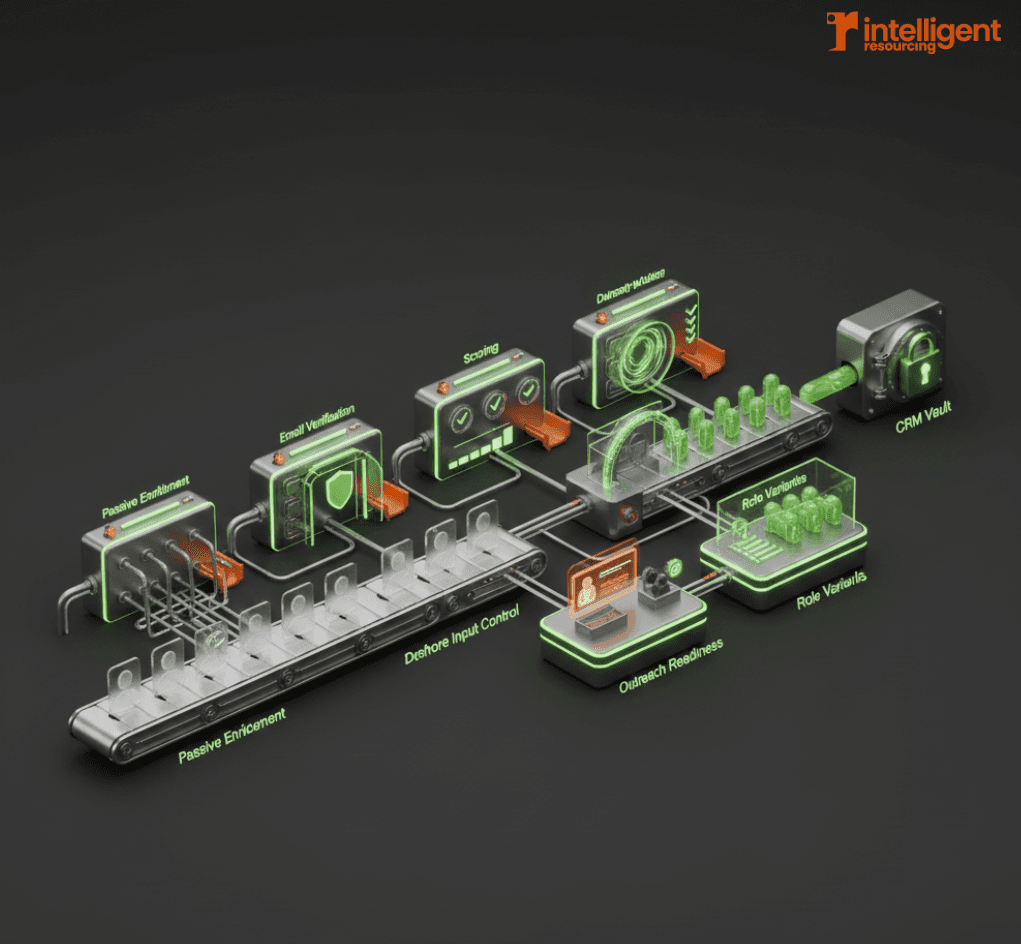
How These Templates Work Together as a System
Each template shares a common design language verification, enrichment, CRM logic that allows them to function as a connected library. Instead of building new logic every time, teams reuse systems that are proven, governed, and auditable.
The templates create a data pipeline where each stage adds value:
Passive Enrichment builds the initial candidate pool
Email Verification filters for contactable candidates
Candidate Scoring prioritises by fit and readiness
Deduplication maintains database integrity
Offshore Control enables scalable sourcing
Outreach Prep validates readiness for contact
Role Variants ensure relevance across hiring needs
This systematic approach reflects how modern revenue systems are engineered for scalability and predictability.
When to Customise and When Not To
Templates should protect logic that affects compliance and data quality. Flexibility belongs at the input level sourcing filters, role titles, or seniority requirements.
Lock down:
Verification thresholds
Compliance checks
CRM sync logic
Deduplication rules
Make flexible:
Source selection
Scoring weights
Geographic filters
Skills requirements
This balance ensures consistency where it matters while allowing recruiters to adapt to specific hiring needs. Organisations report 89.6% greater hiring efficiency and 85.3% time savings when using properly configured automation.
Speed Comes from Standardisation
Templates are not hacks; they're safe defaults that let your team move faster without sacrificing control. Clay makes it possible to build once, scale often, and trust the system every time.
The data supports this approach: 87% of companies now use AI recruiting tools, with the market projected to grow from $577.7 million in 2023 to $1.05 billion by 2032. Organisations that adopt template-based automation early gain significant competitive advantages in talent acquisition.
As recruitment becomes increasingly data-driven and candidate expectations rise, the ability to deliver personalised, timely outreach at scale becomes essential. Templates provide the foundation for this capability while maintaining the quality and compliance that modern recruiting demands.
Transform Your Recruitment Operations Today
Your sourcing workflows shouldn't slow your recruiters down they should accelerate them. If you're spending hours on manual enrichment, dealing with duplicate records, or struggling to maintain consistency across your recruiting team, it's time for a systematic solution.
Ready to Build Your Recruitment Automation System?
We offer a free 30-minute consultation where we'll:
Audit your current recruiting workflows
Identify automation opportunities
Provide a customised implementation roadmap
Share relevant case studies from similar organisations
Two ways to get started:
Schedule Your Free Strategy Call → – Book a time that works for you
Explore Our GTM Engineering Services → – See how we help companies scale
Don't let manual processes hold your recruiting team back. Let's build systems that scale with your ambitions.
Frequently Asked Questions
Q: How long does it take to set up these templates?
A: Initial setup typically takes 2-4 hours per template. Once configured, they can be deployed for new roles in minutes.
Q: Can these templates integrate with our existing ATS?
A: Yes, Clay integrates with major ATS platforms including Greenhouse, Lever, Workday, and BambooHR through native connections or APIs.
Q: What happens if a data provider changes their API?
A: Templates use waterfall enrichment, automatically falling back to alternative providers if one becomes unavailable.
Q: Do we need technical skills to manage these templates?
A: No, Clay's no-code interface allows recruiters to manage templates without programming knowledge. However, initial setup benefits from GTM Engineering expertise.
Q: How much do Clay credits typically cost?
A: Clay uses a credit-based system where most enrichment actions cost 1-2 credits. Plans start at $149/month for 2,000 credits.
Q: Can templates handle international recruiting?
A: Yes, templates can be configured for global operations with region-specific compliance rules, data sources, and language preferences.
Related Resources
Explore these additional guides to maximise your recruitment automation:
GTM Engineering & Automation
Comprehensive Overview of the GTM Engineer Role: Understand how GTM Engineers build scalable systems
What a GTM Engineer Brings to Your Go-to-Market Strategy: Real-world use cases and applications
GTM vs RevOps: Which One Do SMEs Actually Need: Choosing the right operational approach
Reddit as a Research Tool: How to Automate HubSpot Listening with n8n
Clay vs ZoomInfo Pricing in 2026: Forecasting True GTM Stack Costs
How to Choose a B2B Lead Generation Agency: Signal-First Checklist
Boost Lead Quality: Sales Prospecting with AI Agents