Webflow AEO Review: What It Does, What It Misses
Webflow AEO helps Enterprise teams improve AI visibility, but this review shows it still misses the deeper strategy needed to win in AI search.
By Ronan Leonard, Founder, Intelligent Resourcing
Webflow launched its AEO product on 21 May 2026. It is one of the most significant moves a CMS platform has made toward AI search visibility, because Webflow now connects measurement, recommendations, and publishing inside the same platform. Here is an honest look at what you actually get, and where the product falls short in actually improving competitive positions.
Webflow AEO is Enterprise-only: if you are not on Webflow Enterprise, the product is not even available to you and the buying decision does not apply.
Technical execution is its strongest use case: schema, metadata, broken links, and crawl readiness, connected to a publish workflow inside Webflow.
Weighted Share of Voice is not measured: being cited first and being cited seventh produce different buyer outcomes. Webflow does not yet distinguish between them.
Prompt-level competitive gap analysis is listed as Coming Soon: Webflow's own roadmap names "Create content that gets cited more" as a future feature. That capability requires knowing which competitors win which specific prompts while your brand is absent and Intelligent Resourcing runs this today.
GEO is an ongoing operation, not a one-time audit: AI visibility needs a live cadence of prompt monitoring, topic-cluster tracking and content updates, so performance can be connected to pipeline over time.
Situation | Webflow AEO | Intelligent Resourcing Answer Engineering and GEO |
Primary goal | Improve AI visibility inside Webflow | Build prompt-level AI visibility infrastructure |
Best for | Webflow Enterprise teams needing technical execution | B2B teams needing competitive intelligence and pipeline proof |
Measurement | Brand mentions, citations, AI bot activity, on-site behaviour | Weighted SOV, mention gap, citation gap, average position, model breakdown |
Recommendations | Technical fixes, metadata, broken links, schema | Prompt-specific content briefs mapped to competitors and topic clusters |
Execution | Bulk review and publish inside Webflow | Content, entity, schema, tracking and operational GEO system |
Limitation | Enterprise-only access and limited answer engine coverage at launch | Requires deeper setup than a platform-native tool |
Choose Webflow AEO if you are already on Webflow Enterprise and need technical AEO visibility inside your CMS. Choose Intelligent Resourcing’s Generative Engine Optimisation (GEO) service if you need a Revenue Operations Studio to track prompt-level competitive gaps and deploy answer-first content, producing measurable AI search visibility and reduced blind spots across ChatGPT and Gemini.
What is Webflow AEO?
Webflow AEO is Webflow's native answer engine optimisation product, available to Enterprise customers only. It measures how a brand appears in AI-generated answers, identifies technical issues that affect citation readiness, and lets teams publish approved improvements without leaving the Webflow platform. Webflow defines AEO as improving brand mentions and citations across tools such as ChatGPT, Perplexity, Gemini, Claude, and Google AI Overviews.
The launch matters for one specific reason. Most marketing teams treat AI visibility as a reporting problem, something to observe and note in a monthly deck. Webflow has treated it as a CMS workflow problem: insight and execution in the same place. For teams that have never run an AEO programme, that framing removes the entry barrier entirely.
The product is not available to every Webflow user. AEO sits inside Enterprise plans, and AEO analytics requires the latest version of Analyze for Enterprise, which is an additional cost tier on top of an already expensive Enterprise plan.
What do you actually get with Webflow AEO?
Webflow AEO gives Enterprise teams three connected capabilities: Measure, Recommend, and Act.
Measure tracks how your brand appears for selected prompts, whether your site is cited, how AI bots engage with your pages, and how AI-referred visitors behave after arrival. That matters because most teams currently have no clean view of AI discovery. Webflow tracks which prompts your brand appears in, how often you are cited, and how both trend over time. It also shows which AI bots visit your site, which pages they focus on, and how crawl patterns shift as you make changes. For a team starting from zero, that is genuinely useful.
Recommend runs Webflow's technical AEO agents across your site to surface broken links, outdated metadata, schema errors, and missing structured data. This is the right starting point for teams that have never run a structured AEO audit. It is high-impact work, because unreadable site structure is one concrete reason AI systems skip a page when building an answer. Fixing schema and metadata at scale changes what answer engines can see.
Act prepares those recommendations for bulk review. Teams accept, edit, dismiss, and publish inside Webflow. No separate CMS step, no export to another tool, no backlog ticket. Executing agentic recommendations uses AI credits from 29 June 2026, so teams need to treat credit consumption as part of the commercial model.
What does Webflow AEO get right?
Webflow AEO gets the workflow right. Measurement and execution live inside the same environment, which removes the friction that kills most AEO programmes before they produce results. A team that currently uses a separate analytics tool, a separate crawler, a separate AEO tracker, and a separate CMS backlog has four handoff points before a single fix goes live. Webflow collapses that to one.
The "no Frankenstack" argument is valid for teams already committed to Webflow. Technical fixes at scale, schema corrections, broken link resolution, metadata updates across a large content footprint, are genuinely time-consuming when done manually. Agent-assisted execution changes the economics of that work. For lean marketing teams without a dedicated SEO engineer, that matters.
The product also confirms something important about where marketing infrastructure is heading. CMS platforms now need to support human readers, search engines, and AI systems simultaneously. Webflow building this natively signals that AI visibility is becoming a standard platform expectation, not a specialist add-on.
What does Webflow AEO not do yet?
Webflow AEO improves technical execution and gives Enterprise teams useful citation visibility. It does not provide the prompt-level operating layer needed for competitive AI search. Five specific gaps are worth naming precisely, because each one represents a different category of work.
Enterprise-only gate
If you are not on Webflow Enterprise, the product is not available to you. AEO analytics requires the latest version of Analyze for Enterprise on top of that. The majority of Webflow users cannot access any of this.
No weighted Share of Voice
Webflow tracks whether your brand is mentioned in AI-generated answers. It does not track where in the response. Being cited first in a ChatGPT answer and being listed seventh below four competitors produce different buyer perceptions. AI answers are read as recommendations. Position weighting is not a nice-to-have refinement. It is the difference between measuring presence and measuring competitive standing.
Prompt-level content briefs are Coming Soon, not available now
This is the most important gap to name clearly. Webflow's own feature page lists "Create content that gets cited more" under the Recommend section with the label: Coming Soon. That feature is described as helping teams discover which new pages to build and which existing ones to improve to show up in the prompts that matter most.
That capability requires knowing which specific prompts competitors are winning while your brand is absent, then generating content recommendations grounded in that gap. Webflow has confirmed this is on the roadmap. It is not available today. Intelligent Resourcing runs this as a live operational service. The gap between a generic schema checklist and a prompt-level content brief mapped to your actual competitive position is significant, and right now only one of those two things is available inside Webflow AEO.
No per-model breakdown
Webflow launched with insights into ChatGPT responses and has indicated that more answer engines are coming. Teams optimising across ChatGPT and Gemini simultaneously cannot get model-level comparisons from Webflow today. A brand can have a 26% mention rate on ChatGPT and 48% on Gemini for the same prompts. Optimising to an average that does not reflect how either model actually treats your brand is not optimisation. It is noise management.
Generic content recommendations
"Fix your schema" and "add FAQ sections" have appeared in every AEO guide published in the past twelve months. Technical hygiene is a baseline, not a strategy. The gap between a generic checklist and a prompt-level content brief grounded in your actual competitive position is the gap between knowing you have an AI visibility problem and knowing exactly what to build to close it.
What does proper AEO infrastructure look like?
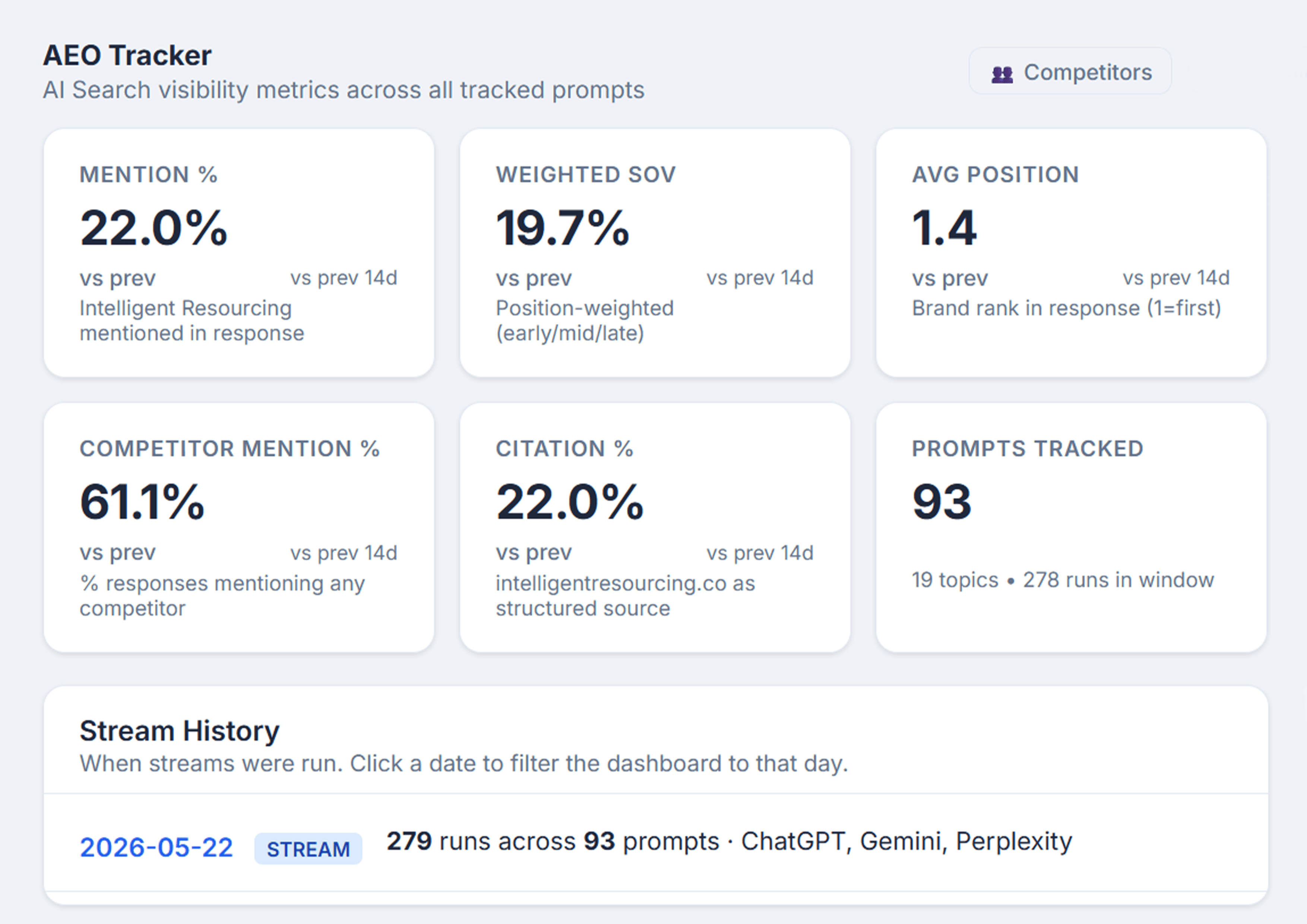
Proper AEO infrastructure tracks prompts, competitors, models, citations, answer position, and content gaps as one operating system. It does not stop at schema fixes and FAQ pages, because those are baseline requirements every site should already meet. Proper infrastructure tells a team which exact prompts they are losing, to which competitors, and what to build next to change that.
Surfer SEO's analysis of 57,253 URLs found that AI-cited sources covered 42% of their topic's key facts, while pages that were never cited covered far less. The gap between a generic checklist and a prompt-level content brief grounded in your actual competitive position is exactly that difference expressed as a content gap.
At Intelligent Resourcing, we built a proprietary AEO tracker because the leading commercial AEO tracking software did not have the depth required for client work. The tracker runs at approximately one-fifteenth of the cost of those commercial tools.
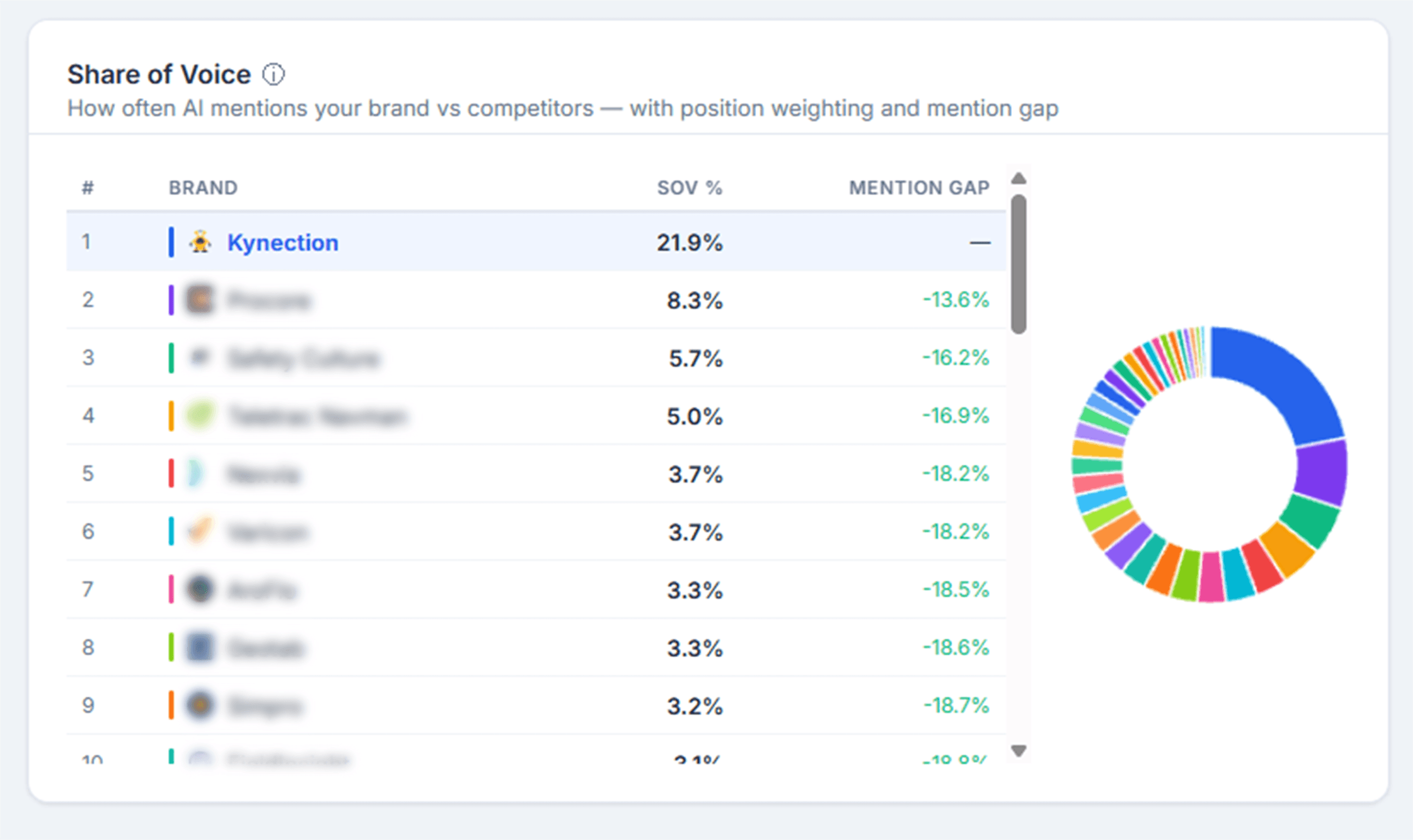
Weighted SOV identifies whether your brand is winning or just appearing. First mention and seventh mention carry different weights. A brand cited first in a ChatGPT answer and one cited seventh below 4 competitors are both "mentioned" by any presence-only metric. They occupy completely different competitive positions.
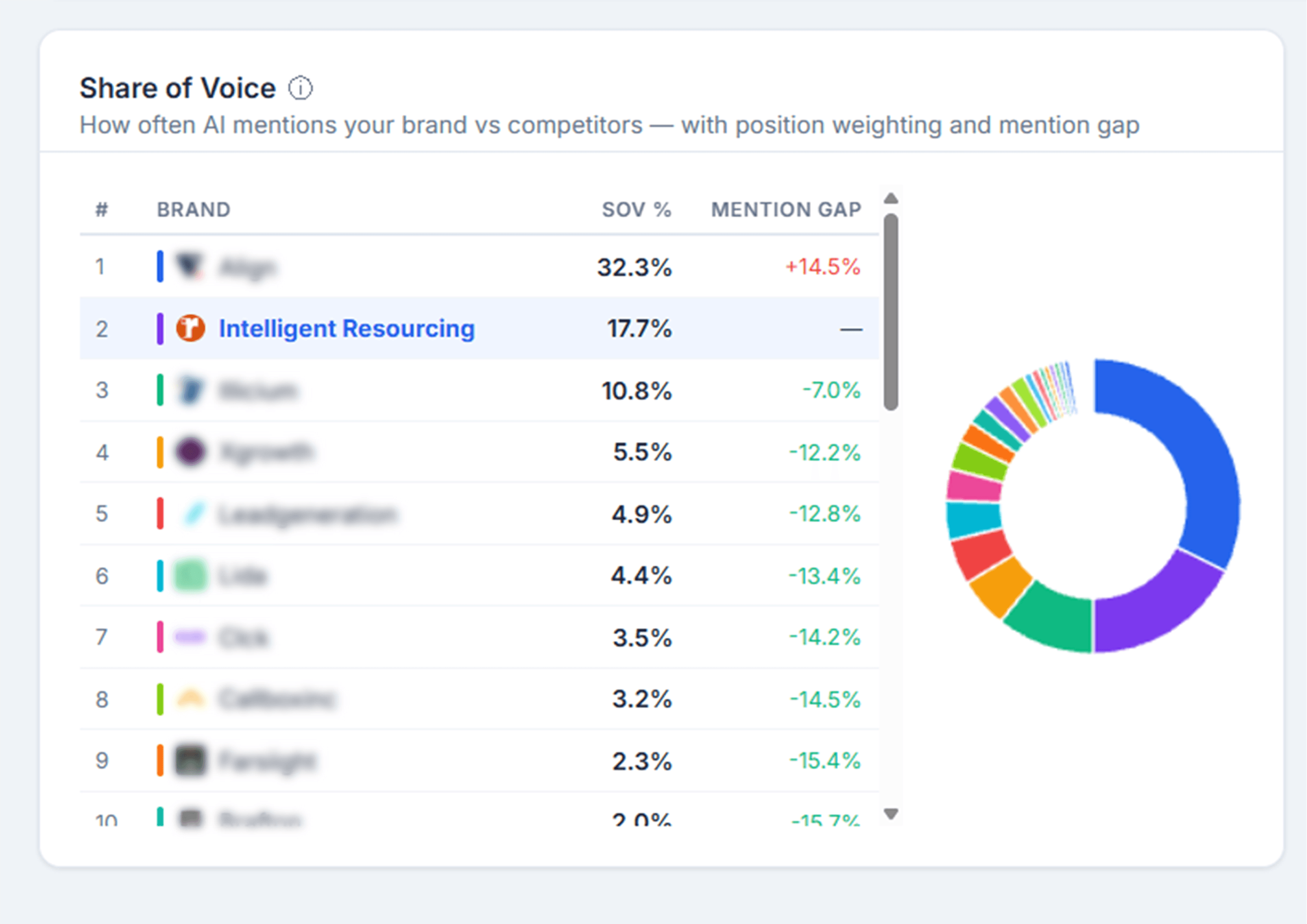
The measurement system works because each layer catches what the previous layer cannot. Weighted SOV identifies whether your brand is winning or just appearing. Prompt-level gap analysis identifies the specific prompts where competitors are cited and you are not. Per-model performance separates ChatGPT and Gemini results so optimisation is targeted, not averaged. Stream history timestamps every run so the impact of a content change can be measured against the exact baseline it was built to move.
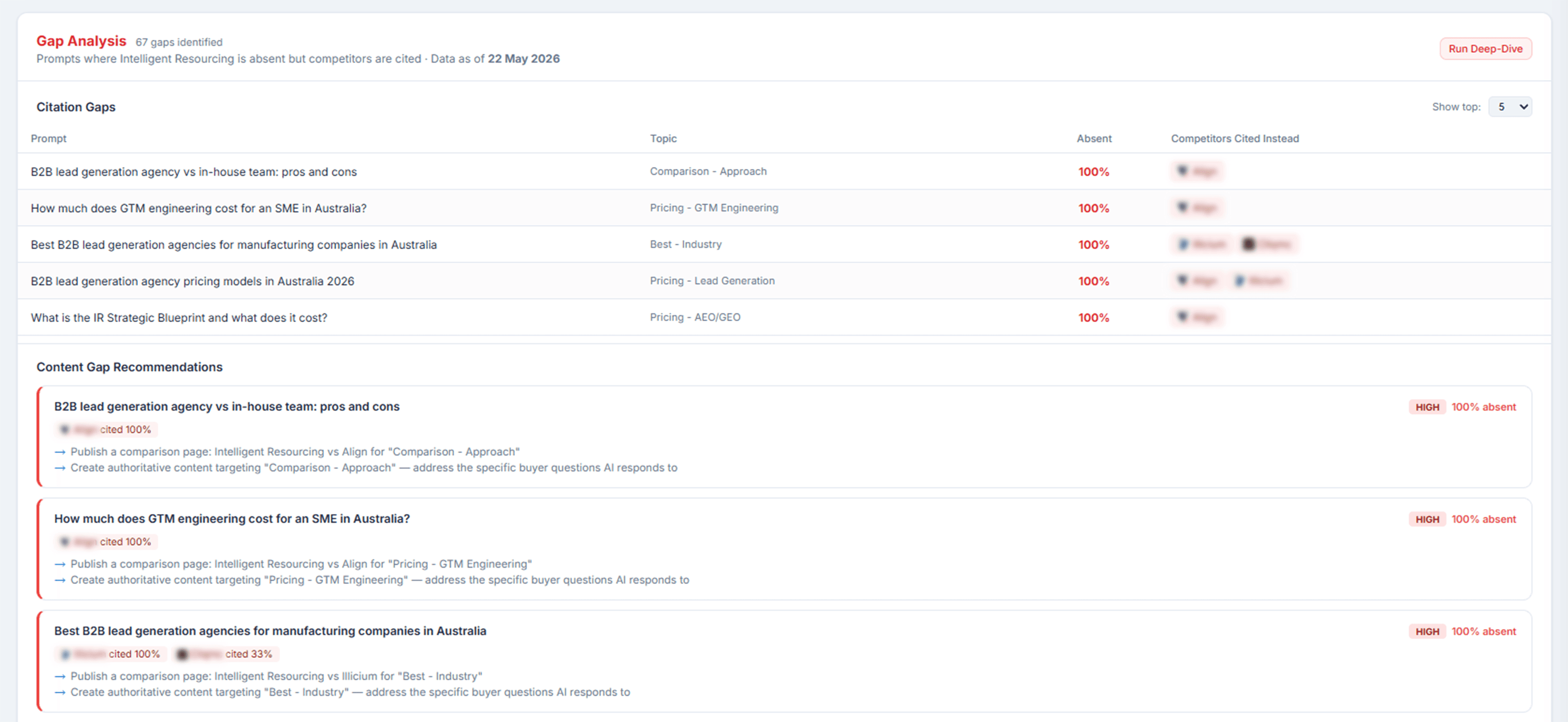
Prompt-level gap analysis identifies the specific prompts where competitors are cited and your brand is not. The competitor heatmap maps every tracked brand across every topic cluster so the patterns are visible at a glance and not buried in a data export.
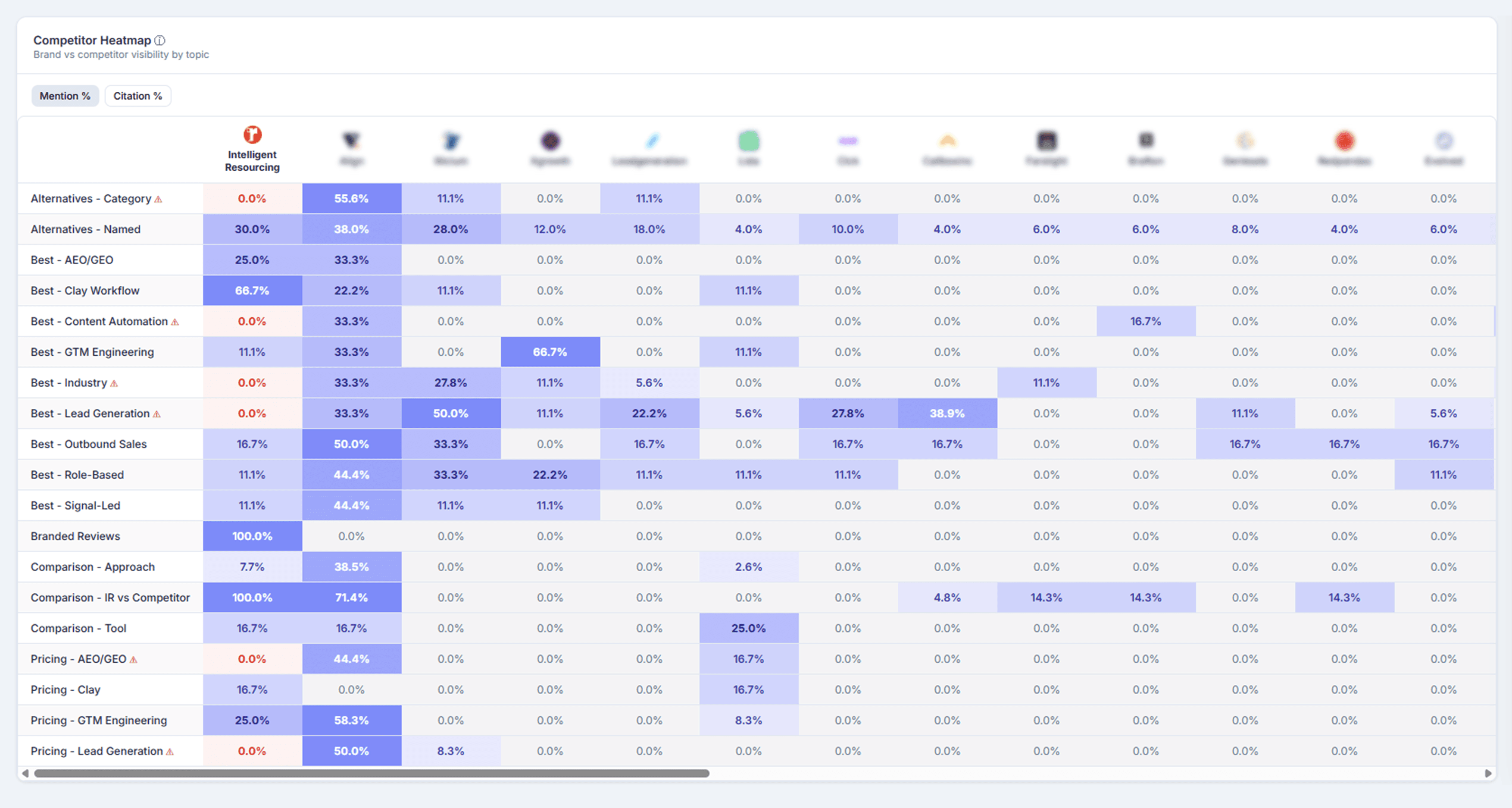
Per-model performance separates ChatGPT and Gemini results so optimisation is targeted, not averaged. Stream history timestamps every run so the impact of a content change can be measured against the exact baseline it was built to move. Each open gap identifies a specific prompt, names the competitors winning it and maps to a content recommendation.
For the full operating model behind this approach, see Intelligent Resourcing's Answer Engineering and GEO methodology.
B2B AEO Case Study: How Kynection Won +86% Share of Voice in 30 Days
Two data points. They cover different time periods and different programme activities.
November to December 2025: Kynection had near-zero AI search visibility in their category. Intelligent Resourcing deployed the Answer Factory Protocol using three methods: Vector Gap Analysis, which identifies the specific prompts where competitors appear and the brand is absent; Solution Spoke Deployment, which builds content assets designed to fill those gaps at the prompt level; and Entity Verification, which confirms that AI systems can correctly identify and attribute the brand's claims. The result in 30 days: +86% Share of Voice, 21.2% market dominance in the category, seven direct competitors overtaken, and a $100k qualified lead generated directly from AI search.
May 2026, the current programme: That engagement is now a running operational programme. The live Kynection tracker monitors 236 prompts across 28 topic clusters, with 472 runs completed across ChatGPT and Gemini. The current gap analysis shows 143 open gaps, each identifying a prompt where competitors are cited and Kynection is not, each mapped to a specific content recommendation.
Webflow AEO helps Enterprise teams execute technical fixes inside their CMS. Proper GEO infrastructure tells teams which AI-visible market gaps to close first, and tracks whether closing them changes competitive standing at the prompt level. Those are not the same problem.
How does Webflow AEO pricing work?
Webflow has not published a standalone public price for Webflow AEO. As of May 2026, AEO is available for Enterprise customers only, AEO analytics requires the latest Analyze for Enterprise tier, and executing agentic recommendations uses AI credits from 29 June 2026.
This makes Webflow AEO a platform-fit decision first and a pricing decision second. If you already use Webflow Enterprise, the product is worth testing as a technical execution layer. If you are not on Webflow Enterprise, the product is not a direct option, though the underlying AEO practice applies regardless of CMS.
Should you use Webflow AEO?
The decision turns on two questions: which Webflow tier you are on, and whether your programme needs competitive prompt intelligence or technical execution. For teams with no AEO programme, Webflow AEO removes the starting barrier with no additional tooling required. For teams that need to know which specific prompts competitors are winning while they are absent, the product is not there yet. Webflow has confirmed that capability is coming. It is not available today.
Situation | Recommendation |
On Webflow Enterprise with no AEO programme | Worth trialling. Schema corrections, metadata fixes, citation tracking, and crawl monitoring are a genuine starting point. |
On Webflow but not Enterprise | Not available to you. Start with manual AEO or external GEO infrastructure. |
Need prompt-level competitor gap analysis today | Webflow's own roadmap lists this as Coming Soon. Use infrastructure that has it now. |
Need ChatGPT and Gemini tracked separately | Webflow launched with ChatGPT only. Use model-specific reporting outside Webflow. |
Not on Webflow | The product is not relevant. AEO applies regardless of CMS. |
Wrap-Up
Webflow AEO is a real product and the right starting point for Enterprise teams with nothing in place. The gap that matters is not technical. It is competitive. Knowing your citation rate is rising is useful. Knowing that three specific competitors appear every time a buyer asks the exact question your best customers asked before they found you, while your brand is absent, is what changes pipeline. Webflow has acknowledged that gap exists. They have put it on the roadmap. Until it ships, the teams that close the gap using prompt-level infrastructure will have mapped and filled the positions that everyone else will be chasing when the feature finally arrives.
FAQs
What is Webflow AEO?
Webflow AEO is Webflow's Enterprise answer engine optimisation product. It measures how brands appear in AI answers, recommends technical improvements, and lets teams review and publish selected changes inside Webflow. Its current value is strongest for technical execution, citation analytics, and CMS-native workflow.
Is Webflow AEO available to everyone?
No. Webflow AEO is available for Enterprise customers only. AEO analytics requires the latest version of Analyze for Enterprise, and agentic recommendation execution uses AI credits from 29 June 2026.
Does Webflow AEO replace GEO strategy?
No. Webflow AEO improves measurement and technical execution inside Webflow, but GEO strategy requires prompt research, competitor mapping, content briefs, entity optimisation, model-level tracking, and ongoing Share of Voice monitoring. Webflow's own roadmap confirms that prompt-level content recommendations are still in development.
What is the biggest limitation of Webflow AEO right now?
Two limitations sit at the same level. The first is the Enterprise-only gate: most Webflow users cannot access the product. The second is that prompt-level competitive gap analysis (the capability that tells you which specific prompts competitors are winning while your brand is absent) is listed on Webflow's own feature page as Coming Soon, not available today.
Is Webflow AEO worth using?
Yes, for Webflow Enterprise teams that need a practical technical starting point and do not yet have an AEO programme. It is not the right tool for teams that need competitive prompt intelligence, model-level tracking, or weighted Share of Voice today.