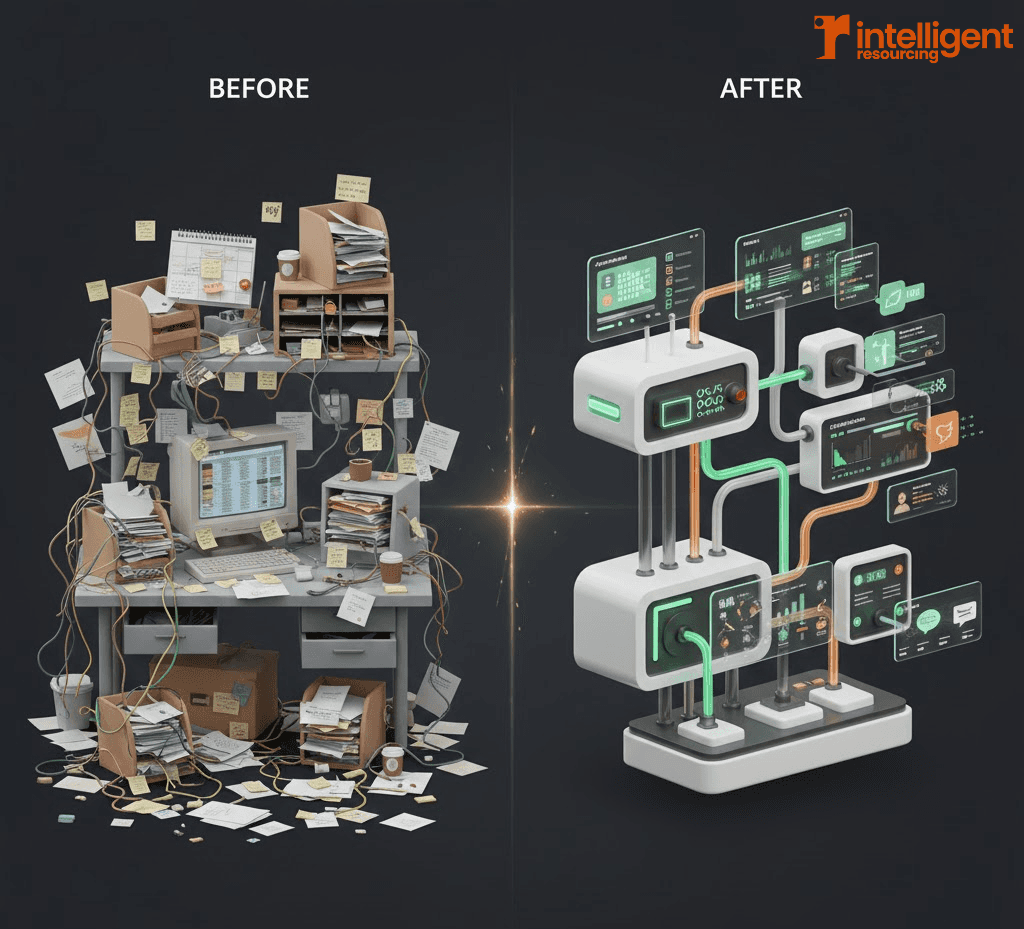
Account-Based Marketing Agency for Signal-Led Targeting of In-Market Accounts
Signal-led targeting replaces static lists with live buying signals. See how to detect in-market accounts and trigger action before competitors do.
By Ronan Leonard, Founder, Intelligent Resourcing

Account-based marketing agencies help you pick the right 50 or 100 accounts and run coordinated campaigns against them. But, what most agencies do not do is tell you when one of those accounts is actually ready to buy. A Signal-led targeting detects buying windows through hiring movement, funding events, technology changes, role changes, website engagement and CRM activity, then prioritises accounts and triggers outreach only when evidence of buying intent exists.
ABM agencies target accounts: Most plan campaigns around ICP lists, personas and buying committees.
Static lists lose timing: Account selection becomes weak when it is not refreshed by live buying signals.
Signal-led targeting prioritises action: Outreach starts when an account shows evidence of commercial movement.
Building your own ABM stack works while one person can watch every account by hand. It stops working once the account list grows past that.
A Revenue Operations Studio installs the signal layer on top of the tools you already run, rather than replacing your agency or your sales team.
Criteria | Traditional ABM Agency | Signal Led Targeting |
Primary output | Campaigns and assets | Signal-led Targeting System |
Account selection | Static ICP and named account lists | Live buying signals and Verified Buying Windows |
Execution | Marketing-led campaigns | GTM Engineering plus Growth Agent activation |
Data layer | Segmentation and enrichment | Clay workflows, CRM routing and signal scoring |
Measurement | Engagement, impressions and meetings | Qualified pipeline, buying-window movement and accepted opportunities |
Best for | Brand awareness and broad account coverage | High-value B2B pipeline generation |
If the goal is brand awareness, creative production or broad enterprise coverage, an agency does that well. However, if the real problem is that sales spends time on accounts that match the ICP but are not ready to buy, you need a Revenue Operations Studio to build the signal-led system that tells your team which companies are in-market, why now, and what action to trigger next. This is the architecture that turns account fit into account timing, which a static list can never do on its own.
What Is an Account-Based Marketing Agency?
An account-based marketing agency helps B2B companies focus sales and marketing effort on a defined set of high-value accounts. Instead of marketing to a broad audience, ABM concentrates resources on the companies most likely to become meaningful customers.
Typical account-based marketing services include ideal customer profile definition, account list creation, buying committee mapping, messaging, paid media, content, sales enablement, outreach sequencing and performance reporting. In a traditional model, the agency plans campaigns around the accounts that sales and marketing agree to pursue.
That model can work when the goal is awareness across named accounts. It becomes weaker when the goal is a qualified pipeline. The hardest question in ABM is not "Which accounts match our ICP?" It is "Which of these accounts is showing evidence that now is the right time to act?"
That is where signal-led targeting changes the category.
Why Traditional ABM Campaigns Miss In-Market Accounts
Traditional ABM often starts with a static account list. The team agrees on target industries, company sizes, regions and job titles, then campaigns are built around those accounts. The list may look strategic, but it quickly becomes disconnected from real buyer behaviour.
A company can match your ICP and still have no active need. Another account may be moving quickly because of a new executive hire, funding event, technology change, operational problem or expansion signal. Static account selection treats both accounts as equal, even though their commercial timing is completely different.
This matters because modern B2B buyers do not move through a neat linear funnel. Gartner's March 2026 sales survey found that 67% of B2B buyers now prefer a rep-free experience, up from 61% a year earlier, which means buyers increasingly research, compare and shortlist vendors before a seller ever sees the deal move.
Traditional ABM campaigns usually fail in five ways:
They confuse fit with intent: A company can look perfect on paper without being ready to buy.
They overvalue engagement: Ad clicks and content views may signal awareness, not commercial urgency.
They separate sales and marketing: Campaign data often sits outside the CRM workflows sellers use daily.
They create false efficiency: Teams report activity while SDRs still chase accounts with no timing.
They miss trigger events: Hiring, funding, technology and leadership changes are often spotted too late.
The result is account coverage without account readiness. Marketing can say the campaign reached the right companies, but sales still asks: "Why should we contact them now?"
What Does Signal-Led Targeting Mean?
Signal-led targeting replaces static account targeting with live account intelligence. It uses behavioural, contextual, technographic and CRM signals to decide which accounts deserve attention, which message should be used and which channel should be activated.
A signal is any data point that suggests an account is moving closer to a buying decision. One signal is rarely enough. The value comes from signal stacking: multiple pieces of evidence that point to a Verified Buying Window.
Common buying signals include:
Signal type | What it shows | Examples |
Behavioural signals | An account is actively researching a problem or solution. | Repeat website visits, pricing page views, comparison page activity, webinar attendance, high-intent content consumption. |
Contextual signals | The business is changing in a way that may create new demand. | Funding, expansion, restructuring, new office openings, hiring spikes, market entry. |
Technographic signals | The account’s technology environment is changing or creating gaps. | New tools installed, legacy systems replaced, CRM changes, automation gaps. |
People signals | Key decision-makers or operational owners are changing. | New revenue leaders, decision-maker role changes, new operational owners. |
Engagement signals | The account or contact is interacting with your sales and marketing activity. | LinkedIn interaction, email replies, previous sales conversations, CRM movement. |
This is signal-based targeting: finding evidence, interpreting it, scoring it and routing it into action not just usual lead generation with a better list
Demandbase describes modern account-based GTM as a system that analyses signals, accounts and buying group activity to prioritise action across revenue teams. That reflects the broader market shift: ABM is moving away from campaign planning and towards revenue intelligence.
What Intelligent Resourcing Builds Instead of a Standard ABM Campaign
Intelligent Resourcing is a Revenue Operations Studio that builds the signal targeting system behind account-based growth.
A standard ABM agency may create campaigns for a list of target accounts. Intelligent Resourcing builds the infrastructure that decides which accounts should enter motion, what evidence triggered the motion and how sales should act.
That infrastructure can include Clay workflows, CRM fields, signal scoring, enrichment logic, routing rules, channel activation and Growth Agent execution. The goal is not to produce more campaign activity but to create a working revenue system that identifies in-market accounts and moves them into qualified sales conversations.
Instead of asking, "Can an ABM agency get us in front of these accounts?" the better question becomes, "Can our GTM system detect when an account is entering a buying window, then act before competitors do?" Intelligent Resourcing helps answer that question through GTM Engineering, signal-based targeting and Growth Agent activation.
How Does Signal-Led Account Targeting Work?
Signal-led targeting works best when the system is designed before the campaign. The process starts with the account universe, then adds signal logic, enrichment, routing and activation.
1. Define the ICP and buying committee
The first step is to define which accounts matter which includes industry, company size, region, revenue model, technology environment, buying triggers and commercial fit. The buying committee also needs to be mapped, since a single contact is rarely enough in a complex B2B deal.
2. Map the signals that indicate movement
The next step is deciding what counts as meaningful movement. Signals should be specific enough to support action.
3. Build the account intelligence layer
This is where GTM Engineering matters, tools such as Clay can be used to enrich accounts, monitor data points, identify contacts, check firmographic fit and connect signals with outreach logic. The account intelligence layer should connect to the CRM, sequencing tools and reporting dashboards, so the system becomes part of daily sales execution rather than another spreadsheet.
4. Score and prioritise accounts
Not every account deserves immediate outreach. Signal-led targeting separates accounts into practical stages:
Aware: The account matches the ICP or shows light engagement.
Active: The account shows multiple aligned signals.
In-market: The account shows strong evidence of a Verified Buying Window.
5. Trigger outreach by signal type
A new sales leader should receive a different message from a company that just changed CRM. The signal shapes the message, the channel and the next action. That is the difference between personalisation and relevance. Personalisation says, "I saw your company." Relevance says, "This specific change suggests this specific problem may now matter."
6. Route opportunities into CRM
A signal-led system only works if sales can see and trust the evidence. CRM routing should show what signal was detected, which account it relates to, which contact is relevant and what action has been recommended.
7. Measure pipeline, not activity
Useful metrics include in-market accounts detected, signal-to-action speed, accepted meetings, opportunity conversion, pipeline generated, sales cycle movement, win rate by signal type and CRM completeness.
Agency vs Studio: Two Different Operating Models
An ABM agency and a Revenue Operations Studio can both support account-based growth, but they solve different problems.
Need | Better Fit |
Creative campaign production | ABM agency |
Brand awareness across named accounts | ABM agency |
Display advertising and campaign assets | ABM agency |
Signal detection and scoring | Intelligent Resourcing |
Clay and CRM workflow build | Intelligent Resourcing |
Growth Agent execution | Intelligent Resourcing |
Pipeline accountability | Intelligent Resourcing |
Owned GTM infrastructure | Intelligent Resourcing |
If you need campaign assets, events, paid media and broad account awareness, a traditional ABM agency may be the right fit. If you need to know which accounts are in-market and trigger action from live evidence, Intelligent Resourcing is the stronger model.
This is important for companies with high-value deals. When an SDR or Growth Agent works the wrong account, the cost is not just a wasted email. It is wasted attention, wasted sequencing, wasted management time and missed timing elsewhere. SEEK's July 2026 salary data puts the average Sydney SDR salary at $78,333, before management, tools, data, enablement and overhead are added which support that poor targeting is expensive.
What Should You Measure in a Signal-Led Targeting System?
A signal-led targeting system should make revenue teams more precise. That means the measurement framework must move beyond impressions, clicks and generic meetings.
Track the number of in-market accounts detected. This shows whether the system is finding meaningful buying windows. Track the percentage of those accounts that receive action within a defined timeframe, since a strong signal loses value when outreach happens too late. Measure accepted meetings, not just booked meetings, and track opportunity conversion by signal type, because some triggers will consistently outperform others.
A practical measurement model should include:
Metric | Question it answers |
Signal quality | Which signals correlate with accepted opportunities? |
Speed to action | How quickly does the team respond after a signal appears? |
Pipeline contribution | How much qualified pipeline is sourced from signal-triggered accounts? |
Growth Agent productivity | How much time is spent on accounts with evidence of timing? |
CRM completeness | Are signals, contacts, account stages and next actions recorded correctly? |
The aim is a clearer route from market movement to qualified pipeline.
Who Is Intelligent Resourcing Best For?
Intelligent Resourcing is best suited to B2B companies that need account-based growth to produce qualified pipeline, not just campaign visibility.
The strongest fit is usually a company with high-value accounts, a defined ICP, a long or complex buying cycle and a sales team that needs better timing.
SaaS, technology, professional services, industrial or consulting firms.
Teams with an existing CRM that is underused or poorly structured.
Companies where SDRs or sales teams spend too much time on low-readiness accounts.
Organisations that want a GTM infrastructure built and run for them, instead of renting campaign execution.
It is not the best fit for every company and less suitable for very early-stage businesses with no ICP clarity, low-ticket transactional offers, brands that only want awareness campaigns or teams looking for rented contact lists. Signal-led targeting works when there is enough commercial value to justify precision.
Build Your Own Signal-Led Targeting Stack
The strongest targeting systems are built and run, not rented.
Intelligent Resourcing builds and runs the account-based growth infrastructure behind it: signal detection, enrichment, CRM routing, Growth Agent activation and revenue reporting, mapped against your target accounts and built in Clay and your CRM.
That means your sales and marketing teams stop arguing about whether an account is worth pursuing. They can see the evidence, understand the timing and act from the same system. Instead of building another static target account list.
Intelligent Resourcing helps you answer four practical questions:
Which accounts match our ICP?
Which accounts are showing evidence of movement?
What signal explains why now?
What action should sales or Growth Agents take next?
When those questions are answered inside your GTM system, ABM becomes more than a campaign. It becomes a repeatable revenue motion, built and run for you rather than rented one campaign at a time.
Book a signal-led targeting build with Intelligent Resourcing's GTM Engineering team.
FAQs
What does an account-based marketing agency do?
An account-based marketing agency helps B2B companies identify target accounts, build account-specific campaigns, align sales and marketing activity, and measure engagement across the buying committee. Traditional services often include account selection, messaging, paid media, content, outbound support and reporting.
Is Intelligent Resourcing an ABM agency?
No. Intelligent Resourcing captures ABM demand, but it operates as a Revenue Operations Studio. It builds signal-led targeting systems, GTM workflows and Growth Agent execution models for B2B companies that need qualified pipeline from in-market accounts.
What is signal-led targeting ?
It is a system that uses live buying signals to decide which accounts to target, when to contact them and what message to use. It replaces static account lists with real-time account prioritisation based on behavioural, contextual, technographic and CRM evidence.
What is the difference between ABM and demand generation?
Demand generation usually creates broader market awareness and inbound demand. ABM focuses effort on selected high-value accounts. Signal-led targeting connects both by using account-level signals to trigger targeted sales and marketing action.
What makes the best account-based marketing agency in Australia?
The best partner should understand Australian B2B buying behaviour, outreach compliance, CRM operations, sales hand-offs and account-level signal detection. For complex B2B sales, pipeline accountability matters more than campaign volume.
When should a company move from traditional ABM to signal-led targeting?
A company should move to signal-led targeting when static account lists, broad campaigns and generic outbound are no longer producing enough qualified pipeline. The clearest sign is when sales agrees the target accounts are right, but still lacks a strong reason to act now.