

How do you turn a buying signal into a cold email?
Use a 4-line shape: the signal, what it means, how you help and one ask. Line 1 names the event and its source, and line 2 says what it means for a team like theirs. Line 3 links it to one result, and line 4 asks one easy question. Keep it short, because buyers read on a phone.
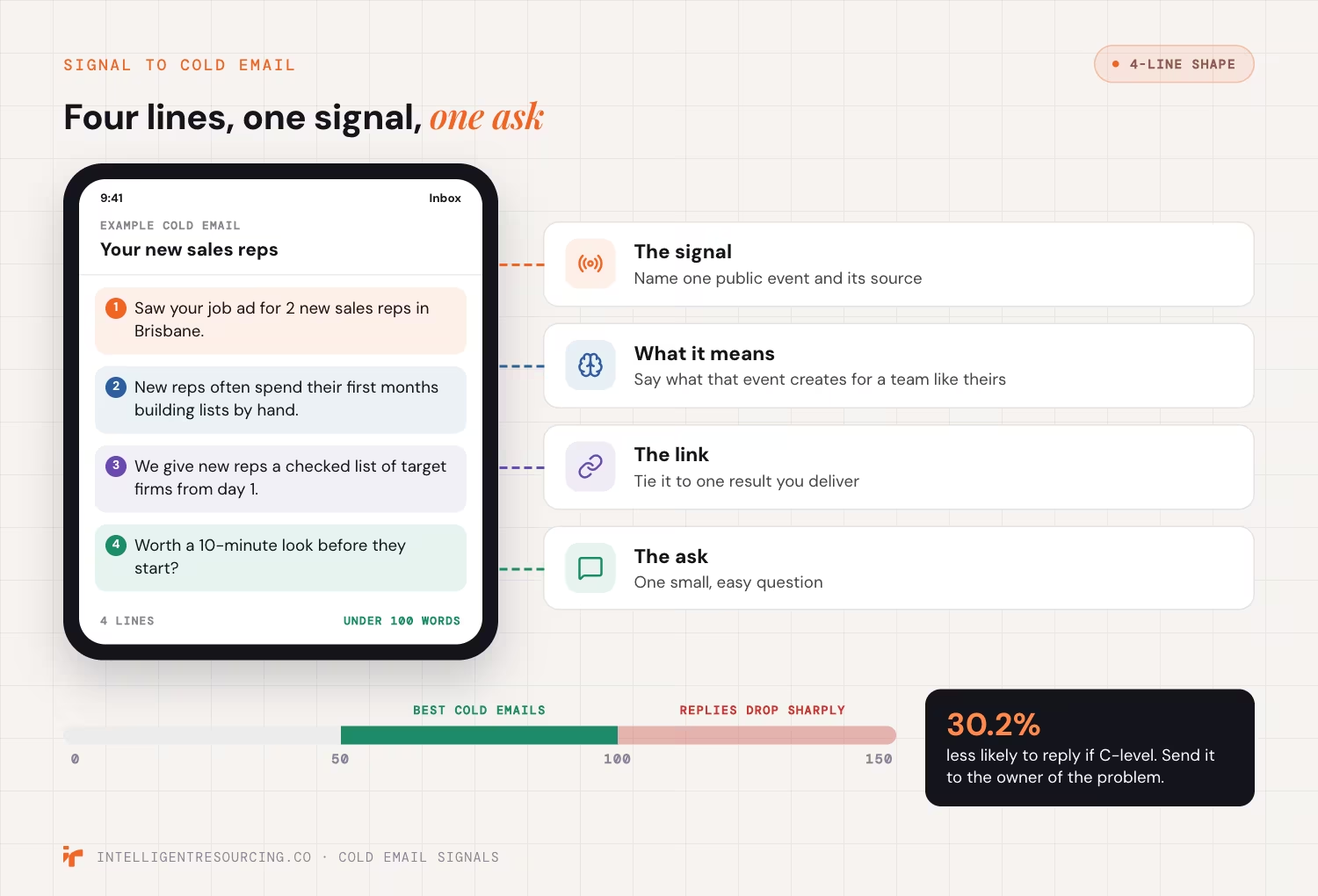
Here is the shape for a hiring signal:
| Line | Job | Example |
|---|---|---|
| 1. The signal | Name one public event and its source | "Saw your job ad for 2 new sales reps in Brisbane." |
| 2. What it means | Say what that event creates | "New reps often spend their first months building lists by hand." |
| 3. The link | Tie it to one result you deliver | "We give new reps a checked list of target firms from day 1." |
| 4. The ask | One small, easy question | "Worth a 10-minute look before they start?" |
Length matters as much as the hook. Gong Labs data from January 2026 found the best cold emails land between 50 and 100 words. Replies drop sharply past 100 words.
The same 2026 Gong study found C-level leaders are 30.2% less likely to reply to cold email than other staff. So send the email to the person who owns the problem the signal points to. For a sales hiring signal, that is often the head of sales, not the chief executive.
Most teams call this personalisation. We call the rule that maps each signal to a message a Signal Response Protocol, because the signal decides the message, not the rep's mood that day. Our agentic signal listening work builds those rules into one daily system.
Which signals make the best first line?
The best first-line signals are recent, public and tied to a budget or a goal. A new leader, a job ad for a role you support, a new tool or a new office all work. Each one gives the buyer a fact they can check, so the email reads as research, not a guess.

Funding is the signal most guides start with, yet it is rare. The State of Australian Startup Funding 2025 report counted 390 announced deals in 2025, worth $5.4 billion in total.
That is about 7 or 8 rounds a week across the whole country. A list built on funding alone runs dry fast.
So mix several signal types. Here is how each one reads as a first line:
| Signal | Example first line | Why it earns a reply |
|---|---|---|
| New leader | "Congrats on the new role running sales at Acme." | A new leader brings a fresh brief and new goals |
| Job ad | "Saw you are hiring 3 support staff in Perth." | A hire shows a gap the team is paying to fill |
| New tool | "Noticed you moved your website to a new platform." | A new tool brings set-up work and new needs |
| New office | "Saw the news on your Melbourne office." | A move means new suppliers, staff and systems |
| Funding round | "Congrats on closing your Series A." | New money comes with growth targets |
Each line names the source of the fact. For a full guide to the funding case, see how to scale outbound after a funding round.
How do you mention a signal without sounding creepy?
Mention only public facts the buyer would expect a stranger to know, such as a press release, a job ad or a LinkedIn post. Never quote private tracking, like which pages they read on your site. Name the source, keep it to one line, then move to their problem, not your data.

The Office of the Australian Information Commissioner (OAIC) ran a 2026 privacy survey of 1,511 adults. The 2026 survey found 87% are more concerned about privacy than 5 years ago. Yet 92% of 2026 respondents said data use can be fine under some conditions, mainly a clear purpose (69%) and a chance to opt in (68%).
That gives you 4 rules for each line:
- Public: use facts anyone could find, never data from your own tracking tools.
- Sourced: say where you saw it, such as "saw your job ad".
- Relevant: only mention events tied to the problem you solve.
- True: check the fact is right and recent before you send.
The last rule fails most often. One client's bought data was so unreliable, a record might show 100 staff against $4M revenue, that their reps were confirming prospects by hand on Street View. A wrong fact in line 1 ends the email, because it proves you did not look.
Not every signal is worth a line in business-to-business (B2B) sales. To sort real intent from noise, read our guide to B2B buying signals.
Should you research signals by hand or automate it?
Automate the finding and checking of signals, and keep a person on the message for your top accounts. Code spots a new job ad across thousands of firms in minutes. People judge better whether a signal matters. Most teams use both: systems find and verify, and reps edit and send.

Time is the real limit. Salesforce's 2026 State of Sales report surveyed 4,050 sales staff in late 2025. The 2026 report found 48% lack the time to do enough cold outreach. In the same 2026 report, sellers expect artificial intelligence (AI) agents to cut prospect research time by 34% and email drafting by 36%.
The risk with AI is made-up facts. A model asked to "personalise" will sometimes invent a detail that sounds right. So split the work:
| Task | Who does it | Why |
|---|---|---|
| Find signals | A system | It watches thousands of firms each day |
| Check the facts | A system, then a person for top accounts | A wrong fact costs more than a slow email |
| Write line 1 | A template filled with checked facts | The fact is pasted in, not made up |
| Edit lines 2 to 4 | A rep | Tone and judgement still need a person |
This is how we work. We produce a full account brief for every target overnight. The facts are inserted by code, not written by the model, and an adversarial check tries to break every brief before a rep sees it. For one client brand, the engine produced 100 sales-ready account briefs in a single overnight run, each with verified site-level mapping.
For the copy side, see our guide to AI copy and deliverability.
What do Gmail, Yahoo and Outlook require from cold email senders in 2026?
All 3 big inbox providers now block or reject bulk mail that fails basic checks. Bulk senders must pass sender ID checks, offer one-click unsubscribe on marketing mail and keep spam reports low. Since November 2025, Gmail has stepped up its checks, and more failing mail is now rejected.
The ID checks have short names. SPF (Sender Policy Framework) and DKIM (DomainKeys Identified Mail) prove a message really came from your domain. DMARC (Domain-based Message Authentication, Reporting and Conformance) tells inboxes what to do when those checks fail.
Google's bulk sender help page says that starting November 2025, Gmail is ramping up enforcement, with temporary and permanent rejections.
In 2026, Google counts anyone sending close to 5,000 messages a day to Gmail as a bulk sender. Its 2026 guidance asks senders to keep spam rates below 0.1% and never reach 0.3%.
Microsoft followed in 2025. Its 2025 Outlook sender rules apply to domains sending more than 5,000 emails a day.
Microsoft set 5 May 2025 as the start date. Mail that fails is rejected with a "550 5.7.515" error.
| Provider | In force since | Who it covers | What happens if you fail |
|---|---|---|---|
| Gmail | February 2024, stricter from November 2025 | Close to 5,000 or more messages a day | Temporary and permanent rejections |
| Yahoo | February 2024 | Bulk senders, plus core rules for all senders | Mail filtered, unsubscribes must be honoured within 2 days |
| Outlook | 5 May 2025 | Over 5,000 emails a day | Rejected with error 550 5.7.515 |
Yahoo's rules, in force since February 2024, match on the core points: SPF and DKIM, a DMARC policy, one-click unsubscribe and a spam rate under 0.3%. Signal-based email helps you stay under these limits, because a list built from real events is small. Fewer, better-aimed emails mean fewer people hit the spam button.
Is signal-based cold email legal in Australia?
Yes, if you follow the Spam Act 2003. Each sales email needs consent, true details on who sent it and an unsubscribe link that works. Consent can be assumed for a work address that is openly published. But that only holds when your email is about the person's job, and they have not said no to such mail.
The rules come with big fines. In April 2026, the Australian Communications and Media Authority (ACMA) fined Latitude Finance $3.96 million for spam breaches.
Between March 2024 and April 2025, the firm sent more than 2.3 million marketing messages without correct contact details. Of those 2024 and 2025 messages, 344,416 also had no working unsubscribe.
Each rule maps to one check before you send:
- Consent: only email work addresses that are openly published, about something tied to the person's role.
- Identify: show your business name and real contact details in each email.
- Unsubscribe: include a link that works, and stop sending once someone uses it.
Signals help with the first rule too. A job ad or a new role shows why your email relates to the person's work. If you want help building signal-based outreach that stays inside these rules, talk to our team.
Buyer Intent
Learn how you can optimise your email strategy using behavioural signals and automation tools.
FAQs
Is cold email still effective in 2026?
Yes, when it is short, relevant and sent to the right person. Bulk mail that fails sender checks now gets rejected more often. A cold email built on one real, recent event at the buyer's firm gives them a reason to read it.
Can AI personalise cold emails from buying signals?
Yes, but keep facts and wording apart. Let a system find and check the signal, then paste that fact into line 1 of the email. Let AI help draft the other lines, and have a person check every email to top accounts before it goes out.
How long should a signal-based cold email be?
Aim for 50 to 100 words in about 4 lines. Gong's 2026 data found replies drop sharply once emails pass 100 words. Use one signal, one link to your offer and one question.
Should you mention a website visit in a cold email?
No. Quoting which pages someone read on your site feels like being watched, even if your tool can see it. Use the visit to decide who to email and when, then open with a public fact such as a job ad or a news story.