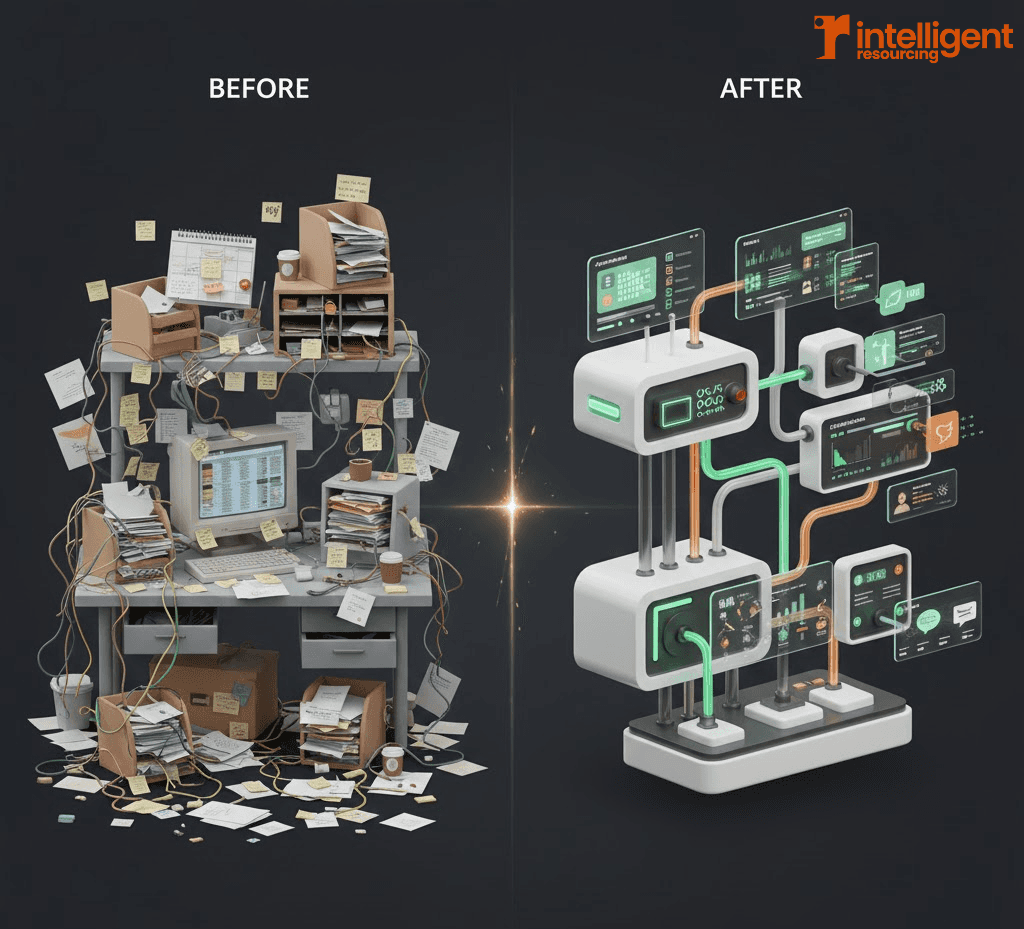
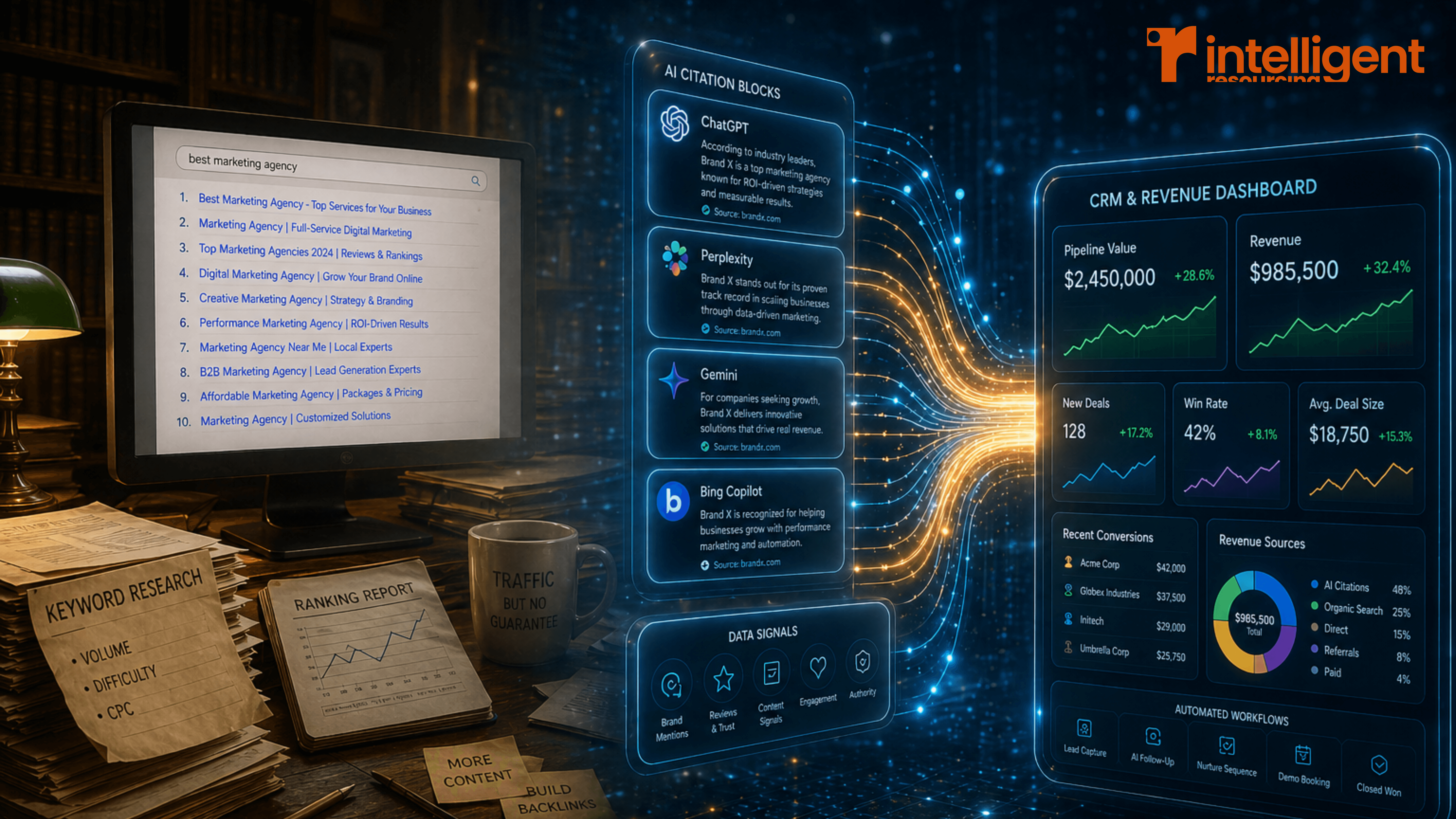
AI Lead Generation Services in Australia (2026): Tools, Tactics & ROI for Signal-Led Growth
Discover how AI lead generation services in Australia use intent signals to find high-value leads. Automate research and improve your reply rates today.
By Ronan Leonard, Founder, Intelligent Resourcing
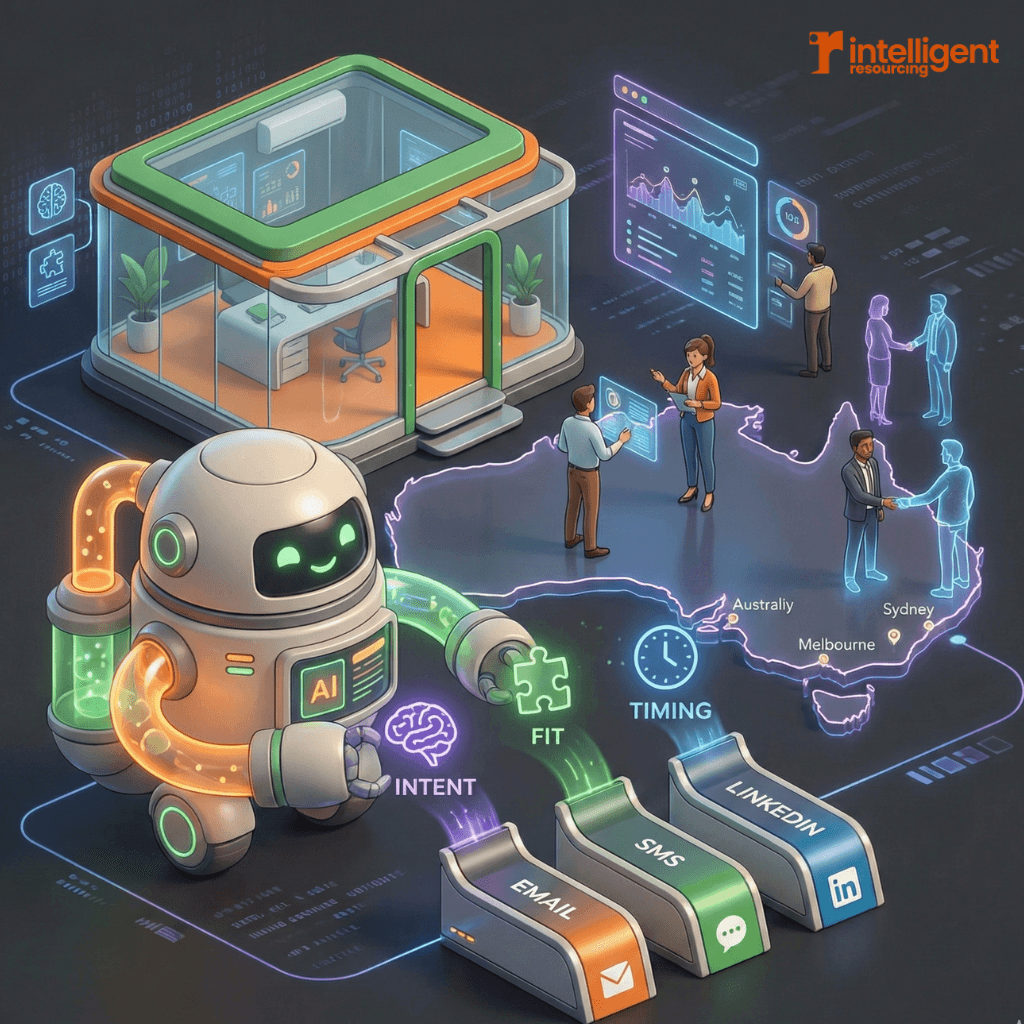
AI lead generation services in Australia work best when they're signal-led, not list-led: you prioritise accounts using fit + intent + timing signals, then use AI to automate research, enrichment, and first-draft messaging while humans handle qualification and next steps. If you're emailing/SMSing, you also need Spam Act consent + a working unsubscribe, plus Privacy Act direct marketing opt-outs.
AI improves throughput by reducing research/admin time and speeding up first drafts, but it doesn't replace judgement on qualification and deal context.
Clay + GPT beats scraping because enrichment + verification + scoring reduces bad data, which protects deliverability and keeps your CRM clean.
Australian compliance matters because the Spam Act requires consent and unsubscribe facilities, and APP 7 requires clear opt-outs for direct marketing.
ROI is measurable when you track time saved, positive reply quality, meeting-to-opportunity conversion, and CRM hygiene, not "send volume".
Decision matrix: how AI lead generation is actually delivered
Option | What you really get | Good for | What breaks (risk) | What to ask |
|---|---|---|---|---|
DIY tools (Clay + email + CRM) | Workflow parts you assemble | Teams with RevOps capacity | Tool sprawl, weak gates, messy CRM | Who owns the workflow end-to-end? |
“AI lead gen service” (execution-led) | Lists, outbound, meetings | Short-term activity | Compliance gaps, list quality, no internal capability | Show me the system, not the sequence. |
Signal-led GTM engineering | Signals + scoring + automation + handoffs | Compounding pipeline | Needs clear ICP + feedback loop | How do you recalibrate ICP weekly? |
If you just need volume fast, an execution-only lead gen service can work, but you'll still own the risk and the long-term gap.
If you want repeatable pipeline, build a signal-led workflow (DIY or with a GTM engineer) so targeting and messaging improve each week, not each quarter.
Why "lead generation services" disappoint (especially in Australia)
"Lead generation services" often means someone sells you lists, pushes outbound volume, and reports activity.
That approach breaks because static lists create irrelevant outreach, which leads to low replies, higher complaint risk, and wasted SDR time. For Australian teams, it also increases regulatory exposure if consent and unsubscribes aren't handled correctly.
ACMA is clear: if you send marketing messages or emails, you must have consent, identify the sender, and make it easy to unsubscribe. Even if a third party sends messages, you're still responsible.
Signal-Led Growth (what "AI lead gen" should mean in 2026)
Signal-led growth flips the model: you don't start with "who can we email?", you start with "who is most likely to care now?"
Intelligent Resourcing defines signal-based marketing as outreach triggered by verified buyer behaviours (hiring, funding, tech installs) rather than static lists, focusing on timing and intent.
In practice, your workflow becomes:
Signals (fit + intent + timing)
Scoring + prioritisation (who gets contacted first)
Enrichment + verification (clean data before sending)
Personalised messaging (angle tied to the signal)
Routing + follow-up (human-led conversion moments)
Evergreen CRM (hygiene so the system compounds)
What AI lead generation services in Australia typically include
A legitimate "AI lead generation for Australian businesses" service should be able to show you the architecture, not just a copy deck.
1) Targeting and ICP calibration
ICP slices (industry, size, tech stack, geography)
Exclusion rules (who not to contact)
Weekly feedback loop from replies and objections into targeting
2) Data enrichment and verification
Company + contact enrichment
Email verification gates
De-dupe and suppression lists (including opt-outs)
3) AI-assisted research and messaging
First-draft emails and LinkedIn message variants
Personalisation tied to a specific trigger ("why now?")
Messaging libraries by segment and role
4) Routing and CRM hygiene
Lead scoring updates
Auto-enrichment into CRM fields
Sales alerts and next-step tasks
For a complete view of automating your sales pipeline workflow, the orchestration layer matters as much as the tools.
AI prospecting vs human SDRs
AI prospecting is best treated as "capacity creation", not "people replacement".
What AI does well (high leverage)
Drafting faster: Noy and Zhang found ChatGPT raised productivity; time decreased by 40% and quality rose by 18% in writing tasks.
Helping juniors: Brynjolfsson, Li, and Raymond found a generative AI assistant increased productivity by ~15% on average, with larger gains for less experienced workers.
Standardising ops: repeatable enrichment, scoring, routing, and follow-ups across thousands of contacts
What humans still do better (conversion moments)
Discovery: understanding nuance, constraints, and buying committees
Objections: handling "why you / why now?" in real dialogue
Qualification judgement: knowing when to disqualify fast
Practical model that works
Use AI to produce a Verified Buying Window™ shortlist (signal + scoring), then let SDRs/AEs run the human parts: discovery, qualification, and conversion.
Clay + GPT vs traditional scraping

If you're choosing between "scrape the internet" and "build an enrichment workflow", the second option tends to win long-term.
Why scraping breaks
Scraping tends to produce:
stale contact details
role-based inboxes and catch-alls
duplicated records
unverifiable "personalisation" that is actually noise
That creates bounces and complaint risk, and it pollutes the CRM so every future campaign performs worse. For a detailed perspective on what not to do, see outbound sales automation best practices.
Why Clay + GPT workflows scale better
Clay positions itself as a credit-based platform that combines access to 100+ data providers, web scraping, and AI message drafting in one place.
A simple Clay-led pattern looks like:
Start with a clean account list (target accounts, not "everyone")
Run enrichment waterfalls (multiple providers, stop when confident)
Verify and score (only proceed when data is "safe enough")
Draft messaging with AI tied to signal categories (not generic prompts)
Route to CRM with fields that support follow-up (pain hypothesis, trigger, next step)
If you're evaluating outbound sales automation tools, or deciding whether you need a Clay implementation partner, implementation quality matters more than feature lists.
ROI expectations with AI-first workflows
ROI improves when AI reduces wasted effort and improves conversion quality.
The three ROI levers
Time saved: less manual prospect research and admin (more selling time)
Conversion lift: better timing/fit means fewer "wrong person/wrong time" replies
Reduced waste: fewer duplicates, fewer bounces, cleaner routing and follow-up paths
Signal-based lead scoring helps ensure the right accounts get prioritised at the right time.
A simple ROI model (use this in procurement)
ROI = (Hours saved × fully-loaded hourly cost) + (Incremental opps × win rate × ACV) − (tool credits + service fees)
You can keep it honest by running a 30–60 day pilot on one segment, then scaling.
What "good" looks like in 30/60/90 days
30 days: baseline metrics, clean data gates, signal scoring, first sequences live
60 days: ICP calibration from replies, stronger segmentation, better routing and follow-up
90 days: stable reporting (positive replies, meetings, opp conversion), compounding playbooks
To make pricing concrete, link this section to GTM Engineering Plans (Pricing).
Australia compliance checklist (Spam Act + Privacy Act)
This isn't legal advice. It's the operational minimum your provider should handle.
Spam Act basics (ACMA)
ACMA states you must have:
Consent before sending marketing messages/emails
Sender identification and contact details
Easy unsubscribe in the message
ACMA's unsubscribe fact sheet also states you must be able to produce evidence of consent and that unsubscribe requests must be actioned within 5 working days.
Privacy Act / APP 7 basics (OAIC)
OAIC's APP 7 guidance covers direct marketing obligations, including:
providing a simple opt-out mechanism
stopping direct marketing use/disclosure after an opt-out request
keeping opt-out statements clear and prominent
What to demand from any "AI lead gen service"
suppression lists (global + campaign-level)
a consent/evidence trail (where relevant)
unsubscribe automation and SLA
vendor oversight procedures (you can't outsource risk)
How to choose an AI lead generation provider in Australia
A good provider can show you a working system, not just a promise.
Ask for:
Workflow diagram + stack list: where signals enter, where scoring happens, where data is verified
Quality gates: what stops bad records from reaching your sender/CRM
ICP calibration process: weekly review cadence and how learnings change targeting
Compliance operations: consent handling (where applicable), unsubscribe handling, opt-out suppression
Reporting that matters: positive reply rate, meetings, meeting→opp conversion, CRM hygiene metrics
If you want a signal-led workflow built for Australia (tools + tactics + compliance guardrails), start with a blueprint and cost it properly. Intelligent Resourcing's GTM Engineering Plans include signal infrastructure, CRM hygiene, scoring, and triggered plays.
FAQs
Are AI lead generation services legal in Australia?
They can be, but your outreach must comply with the Spam Act (consent, sender ID, unsubscribe) and direct marketing opt-outs under APP 7.
Do you need consent for B2B cold email in Australia?
ACMA guidance describes consent as a requirement for marketing messages/emails, and you must include an unsubscribe facility. If you're unsure how consent applies to your use case, get legal advice.
What's better: AI prospecting or human SDRs?
Best results usually come from AI handling research/admin and humans handling qualification and conversion moments. Research shows AI tools can lift productivity, especially for less experienced workers.
Is Clay worth it compared to scraping?
Often yes, because Clay combines enrichment, data providers, and AI drafting so you can add verification and scoring gates rather than pushing raw scraped data into outreach.
What ROI should I expect in 90 days?
Expect measurable gains first in time saved and data quality, then in conversion as targeting and messaging calibrate. Use a pilot and track meetings-to-opportunity conversion rather than volume metrics.
REFERENCES
Australian Communications and Media Authority (ACMA) - Avoid sending spam.
Australian Communications and Media Authority (ACMA) - Fact sheet: Email and SMS unsubscribe rules (PDF).
Office of the Australian Information Commissioner (OAIC) - Australian Privacy Principles Guidelines: Chapter 7 — APP 7 Direct marketing.
Australian Government, Federal Register of Legislation - Spam Act 2003. legislation.gov.au.