
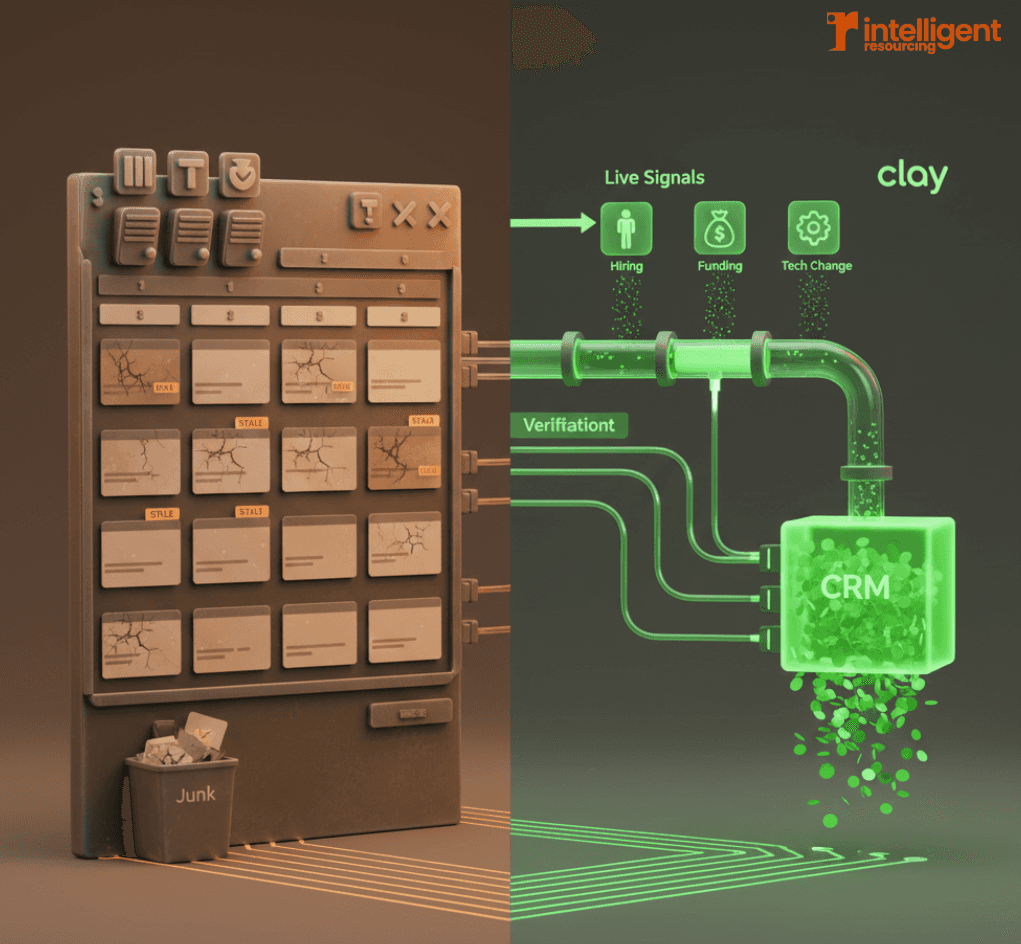
Most SaaS teams still build prospecting lists the same way they did five years ago: download firmographics from a provider, filter by job titles and company size, then hand the list to SDRs. But in a signal-driven GTM system, that static approach breaks quickly. ICPs evolve. Timing changes. Context gets lost.
This article shows how Clay prospecting for SaaS flips traditional list building on its head by treating signals, not filters, as the foundation. With Clay, SaaS GTM teams can build prospecting systems that react to the market, maintain CRM integrity, and tie top-of-funnel actions to pipeline outcomes.
Why Static Prospecting Lists Fail SaaS Teams
Static prospecting lists are brittle. SaaS companies move fast hiring today, pivoting tomorrow, and changing tech stacks often. A list pulled last week could already be out of date.
Targeting based on static firmographics, like industry and headcount, ignores timing and buying signals. Worse, it leads to outbound that feels generic and misaligned.
Modern SaaS prospecting must be signal-driven, where the list updates when buyer behaviour changes, not when an SDR remembers to refresh a CSV. Clay enables this by letting you build dynamic workflows that ingest signals, qualify leads, and activate outreach at exactly the right time.
This shift becomes even more important within a signal-driven GTM system, where lead accuracy, timing, and verification are critical across outbound, scoring, and CRM attribution.
What Signal-Based Prospecting Means in Practice

Lists That React, Not Just Exist
Traditional lead lists are static snapshots. Signal-based lists behave more like real-time feeds. They don’t just sit in a spreadsheet they change as market data changes.
Signals that can trigger prospect inclusion include:
Recent hiring in sales or tech roles
New funding rounds
Tech stack changes (e.g. adding Salesforce)
Web activity or buying intent
Rather than pulling a list based on assumptions, you build a workflow that says: “If a company matches our ICP and shows this signal, enrich and qualify them for outbound.”
Why Clay Is Built for Signal-Based Prospecting
Clay was designed for this exact use case. Unlike list scraping tools or enrichment databases, Clay operates on workflow-first architecture.
You can:
Ingest signals from third-party data, public APIs, or CRM events
Apply logic to define inclusion criteria
Enrich only when a record meets qualification conditions
This avoids over-enrichment, reduces API costs, and keeps lists clean.
ICP List Building in Clay
Defining a SaaS ICP Beyond Firmographics
Modern ICPs aren't just about company size or industry. Clay lets you build nuanced criteria, such as:
Role signals: e.g. presence of a RevOps lead or Head of Product
Buying committee clues: job titles that imply multi-threading potential
Growth signals: hiring trends, funding history, or product launches
These inputs help you go beyond generic lists and build qualified prospect queues tied to actual buying potential.
Translating ICP Logic Into Clay Workflows
In Clay, you can build workflows that reflect ICP logic precisely:
Conditional filters: e.g. “Only include if job title contains ‘RevOps’ AND funding is within 6 months”
Multi-step logic: apply one set of filters before enrichment, another after
Avoiding broad pulls: filter early to limit enrichment to high-quality leads
This structure prevents noisy data from entering your outbound pipeline.
Maintaining ICP Integrity Over Time
Your ICP may remain stable but your data won’t. Clay workflows can run refresh cycles that:
Re-qualify based on signal thresholds
Remove stale records if signals expire
Trigger reactivation when a company re-enters your ICP
No more “set it and forget it” lists. Your system adapts to market movement.
Smartlead Activation From Clay
When a Lead Is “Ready” for Outbound
Just because a record looks promising doesn’t mean it’s ready for outbound. Clay allows you to set activation gates, such as:
Verified work email
Confirmed job role and seniority
Confidence thresholds for enrichment fields
This means only sales-ready records reach your outbound tool.
Passing Clean Records to Smartlead
Clay integrates smoothly with tools like Smartlead. But instead of syncing every enriched lead, Clay holds them until they pass all checks ensuring:
No low-confidence emails hurt deliverability
No role mismatches waste SDR time
No duplicates flood your CRM
Why Activation Timing Matters More Than Volume
High-volume outreach doesn’t outperform smart timing. HubSpot found that prioritising lead quality over quantity led to 67% higher conversion rates for B2B teams (HubSpot, 2024).
With Clay, you send fewer emails, but at the right time with signals that show readiness, not guesswork.
To understand how this scales into outbound systems, see our guide to Automating B2B SaaS Outbound with Clay.
Field Mapping to CRM for Pipeline Attribution
Why Attribution Starts at Prospecting
Most revenue teams lose the trail between prospecting and pipeline. When a lead enters the CRM, the source signal often gets stripped or overwritten. This makes it impossible to connect lead source to close rates or pipeline quality.
Mapping Clay Fields to CRM Objects
Clay allows custom field mapping that preserves signal context. You can sync:
Source signal: e.g. “Hiring: 5 SDR roles”
ICP match indicators: score, confidence, logic pathway
Enrichment metadata: confidence scores, last refresh date
This builds attribution directly into your CRM from the first touchpoint.
Ensuring Prospecting Data Supports Revenue Reporting
By syncing signals and qualification steps into CRM, you get:
Accurate lead source attribution
Clean campaign performance tracking
Insight into which signals lead to closed revenue
For deeper CRM configuration, check out Clay + HubSpot/Salesforce integrations.
Example: A Signal-Based SaaS Prospecting Workflow
Here’s what a typical Clay prospecting workflow looks like at scale:
Signal Ingestion
Company appears in a funding announcement feed or adds new job roles on LinkedIn.ICP Qualification Logic
Workflow checks if company meets defined SaaS ICP criteria.Conditional Enrichment
Only enriched if all signals pass thresholds (e.g. verified hiring data + correct role presence).Verification Gates
Email is verified, role is checked, duplicates removed.CRM Sync
Qualified records are pushed to the CRM with all signal metadata.Smartlead Activation
Clay triggers Smartlead sequence with custom messaging based on signal type.
This workflow behaves more like a SaaS data product than a contact list. It’s always on, always accurate.
Common Mistakes in Clay Prospecting (and How to Avoid Them)
Treating Clay like a list scraper
Clay is not meant to pull static lists. It’s a signal orchestration platform.Activating leads without verification
Outbound tools don’t fix bad data. Clay helps prevent it in the first place.Over-enriching before qualification
Save API credits and system load by filtering before enrichment, not after.Letting SDRs act as QA
Manual triage creates inefficiency. Build quality checks into the workflow instead.
How This Connects to the Wider Clay GTM System
Prospecting is the first control point in your GTM engine. The quality and timing of leads you send downstream affects everything outbound, scoring, routing, and pipeline analysis.
Signal-based prospecting sets the foundation for the kind of reliable system we explore in Scale With Clay GTM Workflows: Build Reliable Systems.
Signal-based prospecting sets the foundation for the kind of reliable system we explore in Scale With Clay GTM Workflows: Build Reliable Systems.
Better Lists Come From Better Systems
High-performing SaaS outbound starts with prospecting but not the kind built on static lists and broad filters. With Clay, your lists evolve in real time, trigger activation only when conditions are right, and connect cleanly to pipeline reporting.
Think less about downloading data and more about designing workflows.
If you're ready to rethink how your team finds, qualifies, and activates leads let’s talk.
FAQs: Signal-Based SaaS Prospecting With Clay
What makes Clay different from traditional list tools?
Clay is workflow-driven, meaning it builds prospect lists from signals and conditional logic not static filters or CSV exports.
Can I use Clay to prospect into new ICPs?
Yes. You can build workflows for any ICP definition using signals like funding, hiring, role presence, or tech stack changes.
How does Clay improve outbound reply rates?
By only activating leads that pass role validation, email verification, and timing signals, Clay reduces irrelevant outreach and increases response likelihood.
What kind of signals can Clay ingest?
Hiring data, funding announcements, intent data, CRM activity, enrichment API outputs, and more.
How do I ensure good CRM attribution with Clay?
Map Clay fields like source signal, confidence scores, and qualification steps directly into CRM custom fields.
Is Clay only useful for outbound teams?
Not at all. While outbound teams use Clay heavily, it’s equally valuable for building scoring, routing, and enrichment systems upstream.
Ready to Transform Your Prospecting System?
Most SaaS teams are still prospecting like it's 2019. They're burning SDR hours on manual research, sending outreach to cold leads, and losing attribution between prospecting and pipeline.
You don't have to do this alone.
At Intelligent Resourcing, we specialise in building signal-driven GTM systems that do the heavy lifting for you. We design, build, and deploy Clay workflows that:
React to buying signals in real-time — No more stale lists or missed opportunities
Qualify leads automatically — Only sales-ready prospects reach your team
Preserve attribution — Track which signals drive closed revenue
Scale without breaking — Built to grow with your business
Whether you're running outbound for the first time or redesigning your entire GTM stack, we help SaaS teams move from guesswork to systems.
Related Resources & Pages
Latest Insights from The Signal Files: