

What Does a Signal-Based Marketing Agency Actually Do?
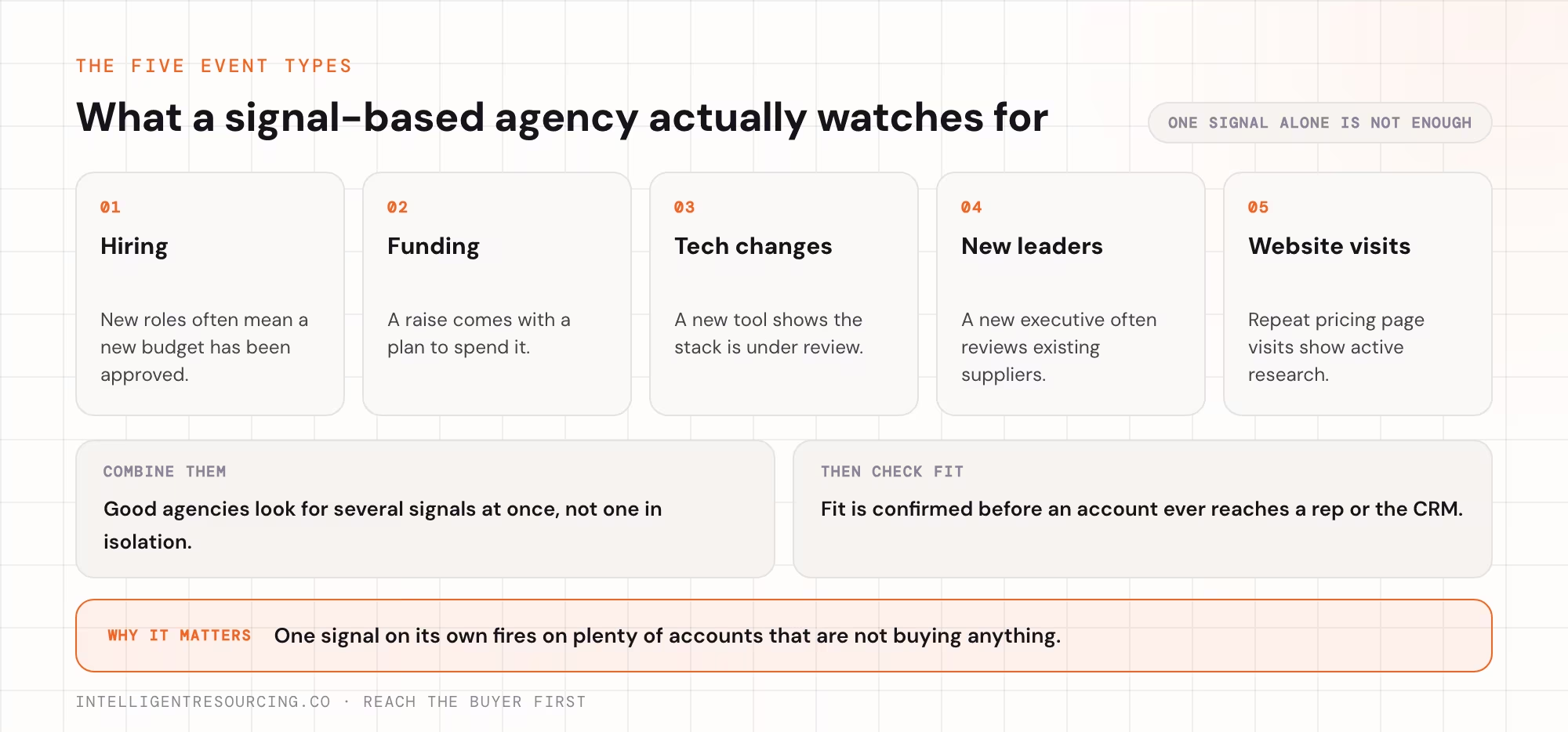
A signal-based marketing agency watches target accounts for events that show a need to buy. When one appears, it checks that the account fits and starts a campaign. Common events are a hiring spike, a funding round, a new executive or repeat visits to a pricing page. The aim is to reach the buyer first.
The agencies here track a mix of 5 event types:
- Hiring: new roles often mean a new budget.
- Funding: a raise comes with a plan to spend it.
- Tech changes: a new tool shows the stack is under review.
- New leaders: a new executive often reviews suppliers.
- Website visits: repeat pricing page visits show active research.
Hiring is easy to see in Australia. Jobs and Skills Australia counts online job ads each month and describes the count as a proxy for recruitment activity.
One signal alone fires on many accounts that are not buying. Good agencies look for several signals at once, and check fit before an account reaches a rep or the CRM. Our guide to how signal-based marketing works explains the method.
Agencies and software tools overlap here, so it helps to know what you are paying for. A tool shows which accounts are active. An agency also decides what to send, who sends it and when, then runs the campaign for you. That extra work is what the prices on this list cover.
How Were These 8 Agencies Selected and Ordered?
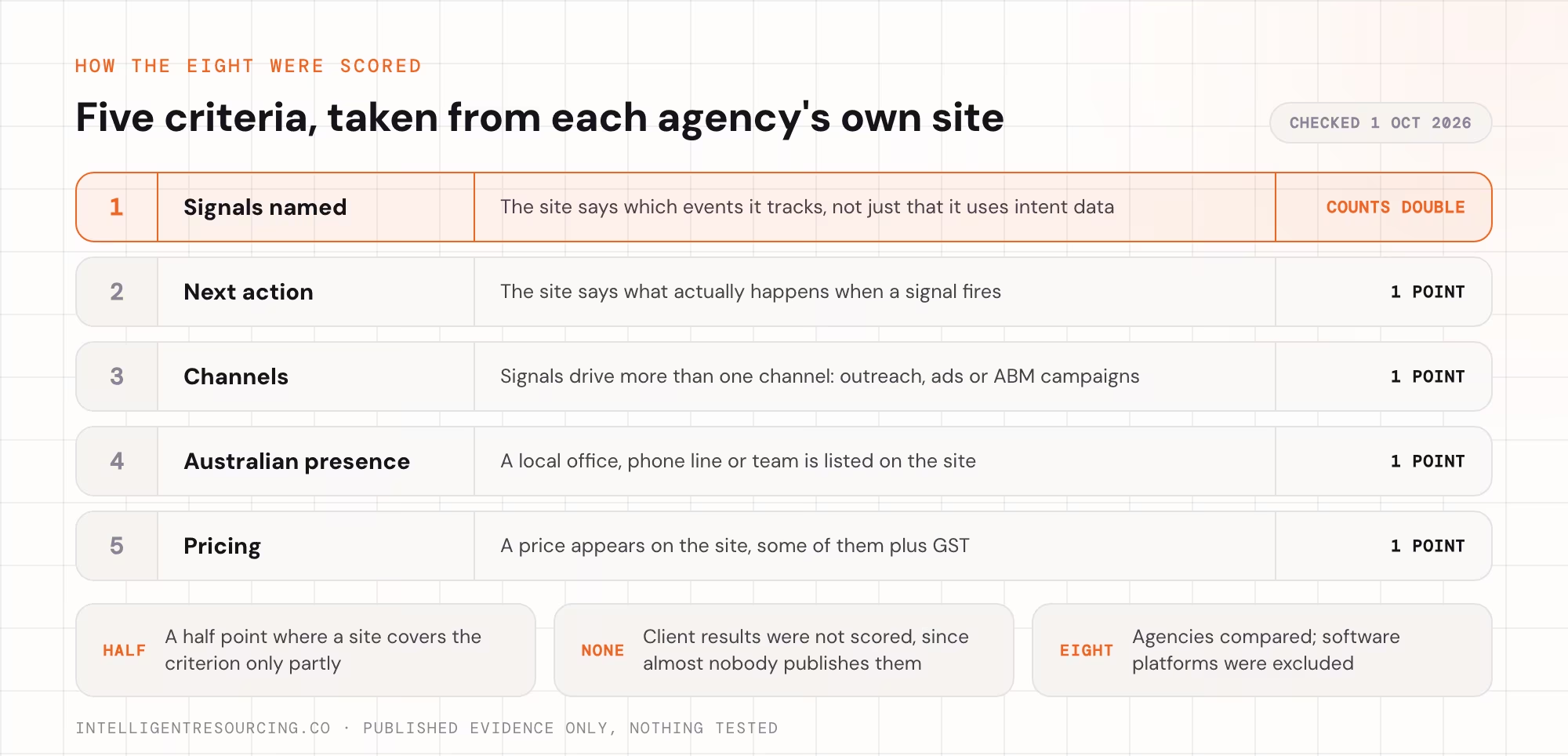
We started with agencies named in artificial intelligence (AI) answers and B2B directories for this search. We kept only firms whose own sites describe signal work, then scored each on 5 criteria. Software platforms were left out, since this list compares agencies. Every site was checked on 1 October 2026.
AI answers matter here because buyers now build shortlists in them. In G2's March 2026 survey of 1,076 B2B decision makers, generative AI chatbots were the top source shaping vendor shortlists, named by 54%.
Each criterion scores 1 point when a site covers it fully and half a point when it covers it partly:
- Signals named. The site says which events it tracks. This counts double, since it is what buyers search for.
- Next action. The site says what happens when a signal fires.
- Channels. The signals drive more than one channel, such as outreach, ads or account-based marketing (ABM) campaigns.
- Australian presence. The site lists a local office, phone line or team.
- Pricing. A price appears on the site, some plus GST.
DevCommX and Intelligent Resourcing got the same score. DevCommX ranks first because it also runs ads. Where a page did not show something, we say so and give the date.
We did not score client results. Few agencies publish them, and the ones we found are each agency's own figures. The switcher proof in each entry shows the best evidence each site offers, so you can judge it for yourself.
How Do the 8 Agencies Compare on Signal Work?
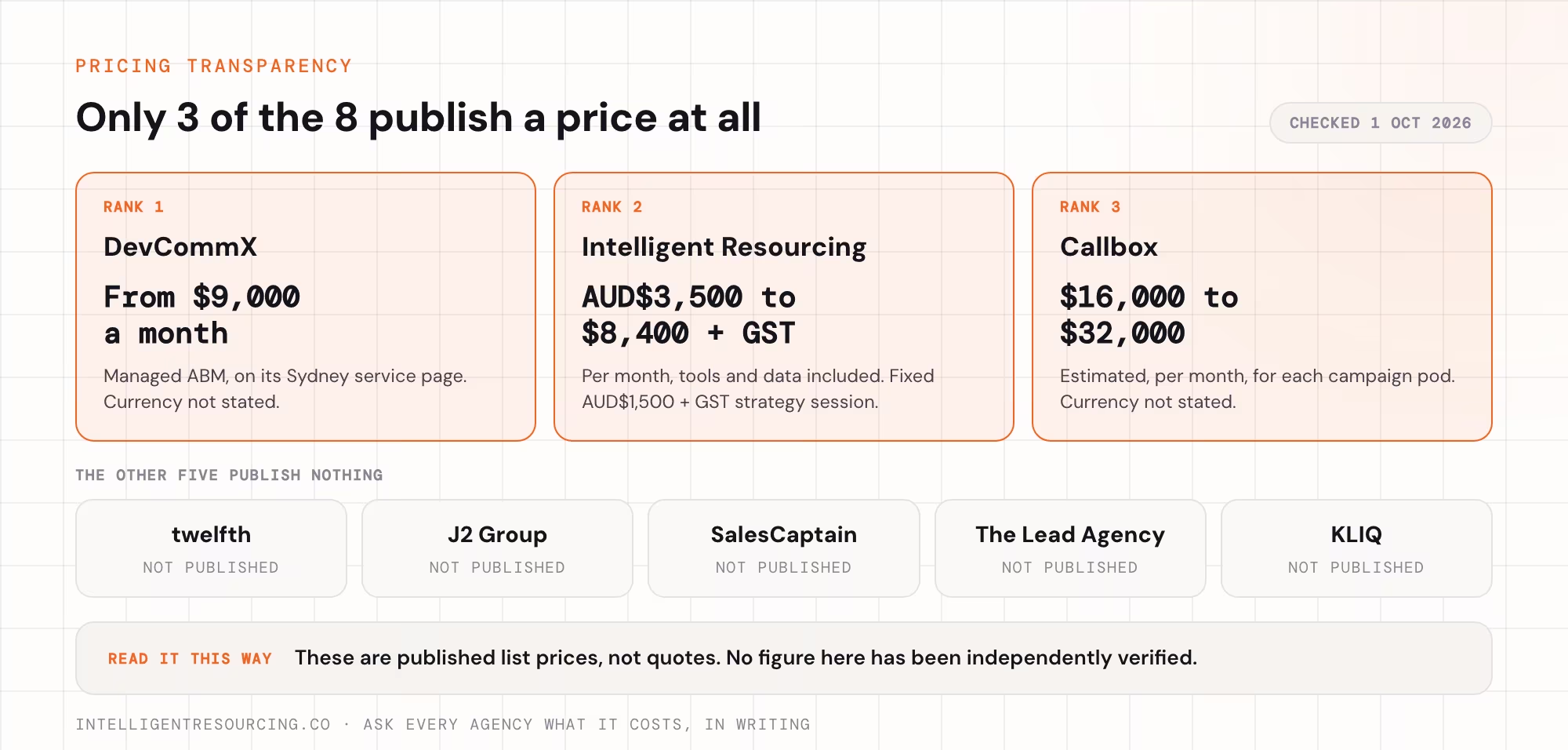
Only DevCommX, Intelligent Resourcing and Callbox publish pricing. DevCommX meets most of the 5 criteria. The table shows what each site says about signals, channels, local presence and price. Rows show each agency's own claims, which we did not test.
| Rank | Agency | Signals named | Channels | Australian presence | Pricing |
|---|---|---|---|---|---|
| 1 | DevCommX | Firmographic, technographic, behavioural, intent | Outreach, LinkedIn, ads, events | Sydney service page | From $9,000 a month |
| 2 | Intelligent Resourcing | Need, Budget and Intent groups | Outreach and CRM, no ads | Melbourne team | AUD$3,500 to $8,400 plus GST a month |
| 3 | Callbox | Buying intent score | Email, LinkedIn, inbound, outbound | Sydney phone line and city pages | $16,000 to $32,000 a month for each campaign pod |
| 4 | twelfth | Signal framework | Paid, outbound, CRM | None listed | Not published |
| 5 | J2 Group | Verified intent signals | Email, LinkedIn, field sales | Melbourne | Not published |
| 6 | SalesCaptain | Intent, funding, revenue data | LinkedIn, email, text | None listed | Not published |
| 7 | The Lead Agency | Buyer signals across the nurture journey | Inbound and outbound | Melbourne and Sydney | Not published |
| 8 | KLIQ | Not described | ABM, search, social | Melbourne, Sydney, Adelaide | Not published |
Verified on each agency's own website on 1 October 2026.
Channels is where DevCommX, Callbox and twelfth beat Intelligent Resourcing. Pricing is the biggest gap: DevCommX lists managed ABM from $9,000 a month, while 5 of the 8 publish no price.
See which of your target accounts is showing a buying signal this week. A short signal audit shows what your list is missing, with no commitment to a build. Book it at the end of this guide.
Which 8 Signal-Based Marketing Agencies Made the List?
These 8 agencies scored highest on what their sites publish, from DevCommX (number 1) to KLIQ (number 8). Each entry gives an overview, the buyer it suits, one limitation and the best proof on its own site. Most run ABM, which targets a named list of companies.
1. DevCommX
The clearest path from signal to campaign we found, with a price on the page.
DevCommX sells go-to-market (GTM) engineering, with an ABM service for Sydney. Its Sydney page says it ranks accounts by signal strength rather than company size.
It uses intent data to time outreach, then runs outreach, LinkedIn, ads and events for each account. Clients keep what it builds.
Best for: Teams selling to large accounts that are worth reaching on several channels.
Limitation: Its About page gives no head office (checked 1 October 2026). Ask who staffs an Australian account.
Switcher proof: Its Sydney page says its signal ranking typically surfaces 20 to 30% more high-propensity accounts than a simple list pull. That figure is DevCommX's own.
Next is an agency that builds the system inside your CRM, without ads.
2. Intelligent Resourcing
A signal system built inside your own CRM, at a published monthly price.
Intelligent Resourcing is a Melbourne B2B agency running GTM engineering for Australian companies. It tracks 3 signal groups that combine: Need, Budget and Intent.
When all 3 appear together, the account is in a Verified Buying Window. The system then tells your team what to do next and why. Pricing runs AUD$3,500 to $8,400 plus GST a month, tools and data included.
Best for: Teams with a defined ideal customer profile (ICP) and a working CRM that want to own the system.
Limitation: It does not run paid media, so its signals do not feed ads. It is the wrong start for a team without a defined market.
Switcher proof: No named GTM engineering client result is published on its site (checked 1 October 2026). A fixed AUD$1,500 plus GST GTM Strategy Session tests fit first.
Next is a large team that runs the outreach for you.
3. Callbox
The largest multi-channel team on this list, with a monthly price in public.
Callbox was founded in 2004 and provides outsourced B2B marketing and sales support, with an Australian phone line and city pages. It sells in campaign pods, each one a dedicated outreach unit for a single market segment or persona.
Its Australian pricing page puts an estimated monthly investment of $16,000 to $32,000 on each pod, which covers a dedicated sales development representative (SDR), a multi-channel cadence, enriched contact data, campaign manager oversight and weekly reporting. The page does not state a currency.
Best for: Companies that want outreach capacity this quarter, across several regions.
Limitation: Its Australian homepage shows a buying intent score in a graphic but does not say which signals set it. Ask for the list in writing.
Switcher proof: Its global homepage cites Clutch reviews numbering more than 100 and a G2 rating of 4.4 from over 90 reviews (checked 1 October 2026). Its Australian reviews page claims a narrower base, more than 30 client reviews.
Next is a small team built around one signal framework.
4. twelfth
The only agency here that publishes a named Signal framework as its own method.
twelfth is a boutique B2B agency founded by Steve Armenti, who its site says spent 7 years at Google. It describes 3 proprietary frameworks: Signal framework, Segmentation and Funnel Design, and Demand Creation versus Demand Capture.
It says signal identification finds your best opportunities, then segmentation builds the funnels and demand execution runs ads, outreach and CRM work.
Best for: B2B software firms selling into the US that want ads and outbound from one team.
Limitation: Its homepage lists no Australian office and no pricing (checked 1 October 2026). Its own positioning line is modern ABM for growth-stage B2B, so treat the signal work as one layer of that, not the whole offer.
Switcher proof: A homepage testimonial from Rey Fernando, chief executive of eight25, praises its use of Clay for account lists, contact identification and intent data.
Next is an agency that adds Australian sales staff to its signal work.
5. J2 Group
Intent-led ABM with trained sales development staff attached.
J2 Group is a Melbourne firm that recruits, trains and manages SDRs, onshore and offshore. Its ABM programmes contact priority accounts several times, where intent signals show interest.
It tracks email and LinkedIn engagement to adjust messages mid-campaign. Pricing is not published on its site (checked 1 October 2026).
Best for: Teams that need people making contact within a month.
Limitation: Its site does not say which intent signals it verifies, or how they reach the client's CRM.
Switcher proof: Its ABM page says its prospect lists and outreach copy influenced nearly $1 million in GoCardless's Australia and New Zealand pipeline, from the first campaign.
Next is an agency that runs signal-based outbound overseas.
6. SalesCaptain
Outreach on several channels, based on intent and funding data, run from London.
SalesCaptain is a London-based B2B outbound agency. Its homepage says it combines your target niches with intent data, funding data, revenue data and more than 250 additional data points to find companies actively looking for products like yours.
It runs campaigns across LinkedIn, email and text, and lists operations in the United States, Canada, the United Kingdom, Europe and Asia.
Best for: Australian firms selling into the US or UK.
Limitation: Australia is not among the regions its homepage lists, and no pricing appears on the pages checked (1 October 2026).
Switcher proof: A homepage case study reports more than 120 booked meetings and $1.5 million in new revenue over 12 months.
Next is an agency that maps signals to the nurture journey.
7. The Lead Agency
B2B content and nurture mapped to buyer signals, from Melbourne and Sydney.
The Lead Agency is an Australian B2B marketing agency with offices in Richmond, Melbourne and in Sydney. Its ABM page says it builds multi-touch omnichannel campaigns mapped to buyer signals, to engage prospects through the lead nurture journey.
It mixes inbound and outbound, with lead nurturing, automation and content, under a method it calls the LEAD Principle.
Best for: Firms with long sales cycles that want marketing in contact across the whole journey.
Limitation: Its pages describe signals at the level of the nurture journey rather than named account events. It suits staying in touch more than fast outreach.
Switcher proof: No quantified client result appeared on the pages checked (1 October 2026).
The last agency runs ABM through search and digital channels.
8. KLIQ
B2B ABM and search marketing from a local team with 3 Australian offices.
KLIQ is a B2B digital marketing agency working in Australia since 2013, with offices in Melbourne, Sydney and Adelaide, plus Kuala Lumpur and Leicester. It runs ABM, and client quotes on its site mention search engine optimisation (SEO), search engine marketing and its own KLIQmetrics reporting dashboard.
It also publishes guidance on using Google Ads for ABM.
Best for: Teams that want ABM run through search and digital channels by a local team.
Limitation: Its homepage and About page do not describe how account signals are found or routed (checked 1 October 2026). Note that kliq.com.au is a parked domain offered for sale; the agency's site is kliqinteractive.com.
Switcher proof: A founder quoted on its site says KLIQ introduced them to ABM and helped sharpen their target audience.
IMA B2B and TEAM LEWIS also came up. Neither described signal detection on the pages checked, so neither made the 8.
What If You Already Run ABM on a Fixed Target List?
A fixed target list shows which accounts fit, but not which ones are buying this month. Signal-based targeting keeps the list but moves active accounts to the top each week. That matters because buyers form shortlists early, and an account reached after that is hard to win.
TrustRadius surveyed 2,164 technology buyers in 2024. Shortlists averaged 2 or 3 products, and 71% bought their top choice. The lesson for any B2B seller: timing decides who makes the list.
Switching from a fixed list to signals takes 4 steps:
- Keep the list to decide which accounts are worth watching.
- Add 3 signal types: hiring, funding and website behaviour.
- Agree who responds to each signal, on which channel and how fast.
- Compare the pipeline from accounts that signalled with the rest after 1 quarter.
Our breakdown of which buying signals predict pipeline covers step 2.
What If Most of Your Buyers Are in Australia?
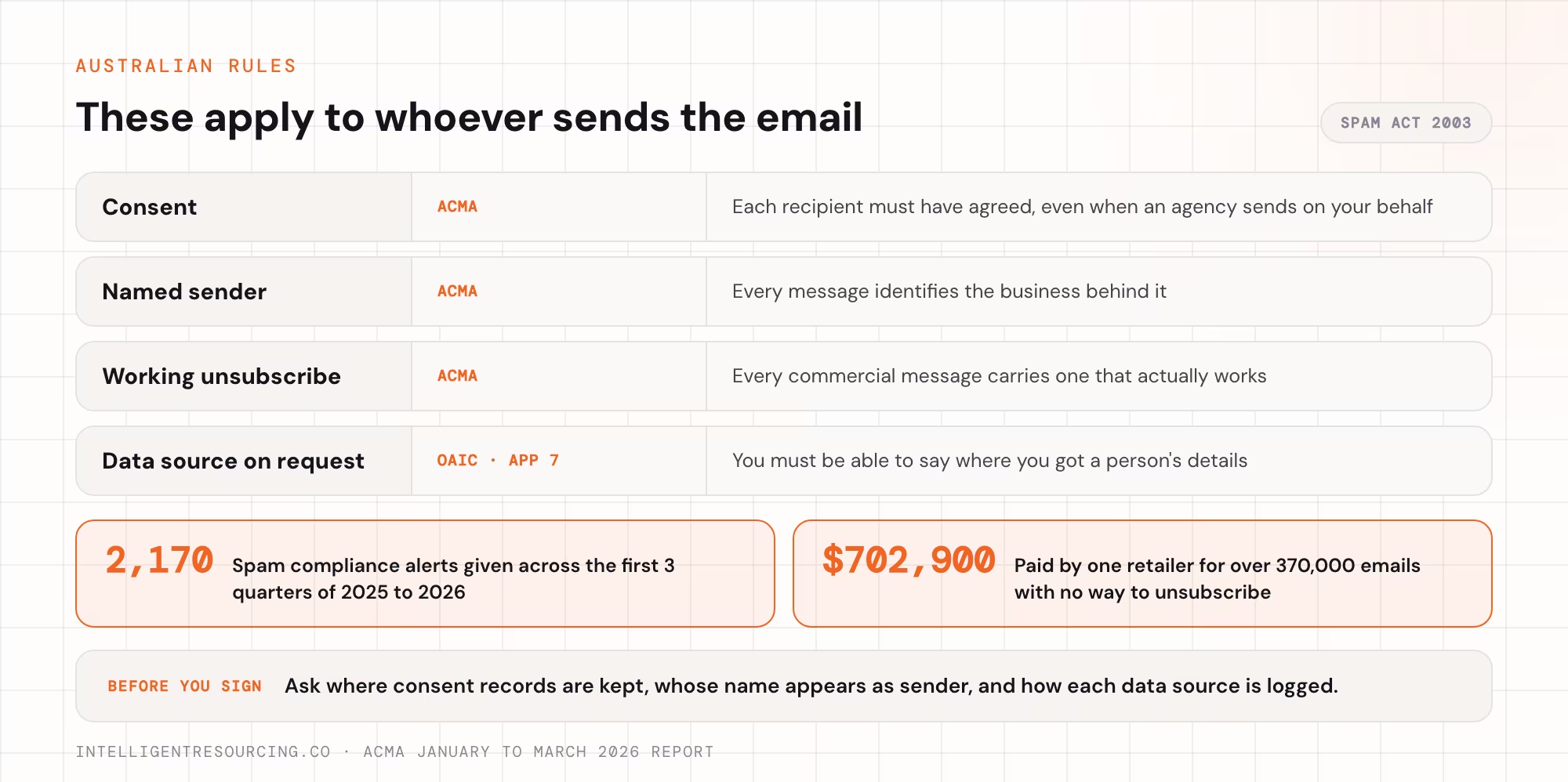
Australian spam and privacy rules apply to marketing sent to Australian inboxes, whoever sends it. The Australian Communications and Media Authority (ACMA) enforces the spam rules. The Office of the Australian Information Commissioner (OAIC) oversees privacy. Both apply in full to agency-run campaigns.
| Rule | Who sets it | What it means |
|---|---|---|
| Consent | ACMA | Each recipient must have agreed, even when an agency sends for you |
| Named sender | ACMA | Every message identifies the business behind it |
| Working unsubscribe | ACMA | Every commercial message carries one |
| Data source on request | OAIC, under Australian Privacy Principle 7 (APP 7) | You must say where you got a person's details |
The ACMA is active. Its January to March 2026 report records 2,170 spam compliance alerts across the first 3 quarters of 2025 to 2026. In that report, one retailer paid $702,900 for sending over 370,000 marketing emails with no way to unsubscribe.
Privacy rules also reach the data behind the signals. The OAIC names lead lists bought from other companies as one source in its guidelines on direct marketing.
Ask any agency 3 questions before signing:
- Where are consent records kept? You need them if a complaint arrives.
- Whose name appears as the sender? Messages must identify the business behind them.
- How is each data source logged? You need it to answer an APP 7 request.
If You Are Choosing Now, Which Agency Fits Your Situation?
The right agency depends on 3 things: whether signals must drive ads, whether you want to keep the system, and how soon you need people making contact. Match your situation below, then check that agency's entry for price and proof.
Your signals need to drive ads as well as outreach
- Shortlist: DevCommX and twelfth.
- Why: both run paid and outbound work from the same signals.
- Not a fit: Intelligent Resourcing, which does not run ads.
- Ask first: which signals trigger an ad, and which trigger outreach?
You want to own the system when the engagement ends
- Shortlist: Intelligent Resourcing and DevCommX.
- Why: both say the client keeps what is built.
- Less suited: J2 Group and Callbox, whose sites do not say the client keeps the system (checked 1 October 2026).
- Ask first: what do you keep, in writing, if the engagement ends?
Still deciding how to buy this? Compare a managed service with a software platform first.
You need people making contact this quarter
- Shortlist: J2 Group for Australian SDRs, or Callbox for several regions at once.
- Why: both supply outreach staff, and a new SDR takes an average of 3.0 months to ramp in The Bridge Group's 2025 study of 351 B2B companies.
- Also consider: SalesCaptain, if your buyers are in the US or UK.
- Ask first: how many accounts does each rep cover, and who picks them?
You have already chosen Intelligent Resourcing, next step
- Step 1: book the fixed AUD$1,500 plus GST GTM Strategy Session.
- What it is: a one-off scoping engagement.
- Commitment: no retainer.
The GTM Strategy Session also scopes the GTM engineering build.
Compare your target list against live buying signals. The signal audit below shows which accounts to act on first, with no commitment to a build.
Which Signal-Based Marketing Agency Should You Shortlist First?
Pick the provider that is strongest where your team is weakest. For most Australian B2B teams, that means DevCommX for reach, Intelligent Resourcing for a system you own or Callbox for a team. Here is the case for each agency in one line:
- DevCommX publishes signal-ranked lists, 4 channels and a price from $9,000 a month.
- Intelligent Resourcing routes Need, Budget and Intent signals inside your CRM from AUD$3,500 plus GST a month.
- Callbox brings a team founded in 2004 and a published price of $16,000 to $32,000 a month for each campaign pod.
- twelfth runs a signal framework across paid and outbound but lists no Australian office.
- J2 Group adds SDRs it manages from Melbourne to intent-based ABM.
- SalesCaptain uses intent, funding and revenue data for outreach into the US, UK and Europe.
- The Lead Agency maps content and nurture to buyer signals across the journey.
- KLIQ runs ABM and search work from Melbourne, Sydney and Adelaide.
Comparisons
Book a signal audit of your target accounts to see which ones are showing a buying signal this week, with no commitment to a build.
FAQs
How is a signal-based marketing agency different from an ABM agency?
An ABM agency works from a fixed list of target accounts. A signal-based agency moves accounts up that list when something changes, such as hiring or funding. Here, DevCommX ranks accounts by signal strength, while KLIQ runs ABM without saying how it finds signals.
What does a signal-based marketing agency cost in Australia?
Only 3 of these 8 agencies publish a price. DevCommX starts at $9,000 a month, Intelligent Resourcing runs AUD$3,500 to $8,400 plus GST a month, and Callbox lists an estimated $16,000 to $32,000 a month for each campaign pod. The other 5 showed no price on 1 October 2026.
Which buying signals do these agencies track?
Most track hiring, funding, tech changes and website visits. DevCommX names company details, the tools a company uses and online behaviour. SalesCaptain names intent, funding and revenue data. Intelligent Resourcing groups signals into Need, Budget and Intent, and The Lead Agency maps signals to the nurture journey instead.
Can an overseas signal-based agency run campaigns to Australian buyers?
Yes, but Australian spam rules still apply to messages sent to Australian inboxes. The ACMA requires consent, accurate sender details and a working unsubscribe. twelfth and SalesCaptain list no Australian office, so ask each how it meets those rules.
How long before a signal-based programme shows a pipeline?
The agencies publish their own estimates rather than independent figures. DevCommX's Sydney page says first measurable pipeline outcomes arrive in 4 to 6 weeks. SalesCaptain's homepage claims 5 to 15% growth in new deals in the first 90 days.