

Why is lead generation so painful for Australian SMEs?
Lead generation is painful for Australian SMEs because manual prospecting, spray-and-pray outreach, disconnected tools, and agency dependence add cost without building an internal system. The 9% YoY growth in the martech landscape to 15,384 solutions makes the tool problem worse, not better. The fix is system ownership, not tool addition.
The symptoms you already recognise
Most Australian small and mid-sized businesses are stuck in some version of:
- Manual research- Sales and founders living in LinkedIn, Google, and the ABN register, building lists by hand.
- Spray-and-pray outreach- Same email, same subject line, same message to everyone. Tiny reply rates, no learning.
- Disconnected tools- Apollo here, HubSpot there, a spreadsheet for tracking. Nothing truly joined up.
- Agency dependence- Pay for "meetings as a service", get short-term pipeline. No internal system or capability when the contract ends.
The martech landscape grew 9% to 15,384 solutions, according to chiefmartec's 2025 Marketing Technology Landscape Supergraphic. Tool sprawl is the problem and system ownership is the answer.
Australian businesses more than doubled their AI R&D spend to $668.3 million in 2023-24, up from $276.3 million in 2021-22, per the Australian Bureau of Statistics' 2025 R&D release. The signal is clear: AI investment is funded. The gap is operational, not financial.
The root cause: not enough system, not enough capacity
The real issue is not laziness or missing AI. It is the absence of a clear operating model for lead generation, and nobody dedicated to building and running that operating model. AI and automation should be pointed at a structured engine, not at random hacks. That engine is built around the Revenue Blueprint: who is most likely to care now, not who can be emailed.
What are the four pillars of an AI-powered lead gen engine?
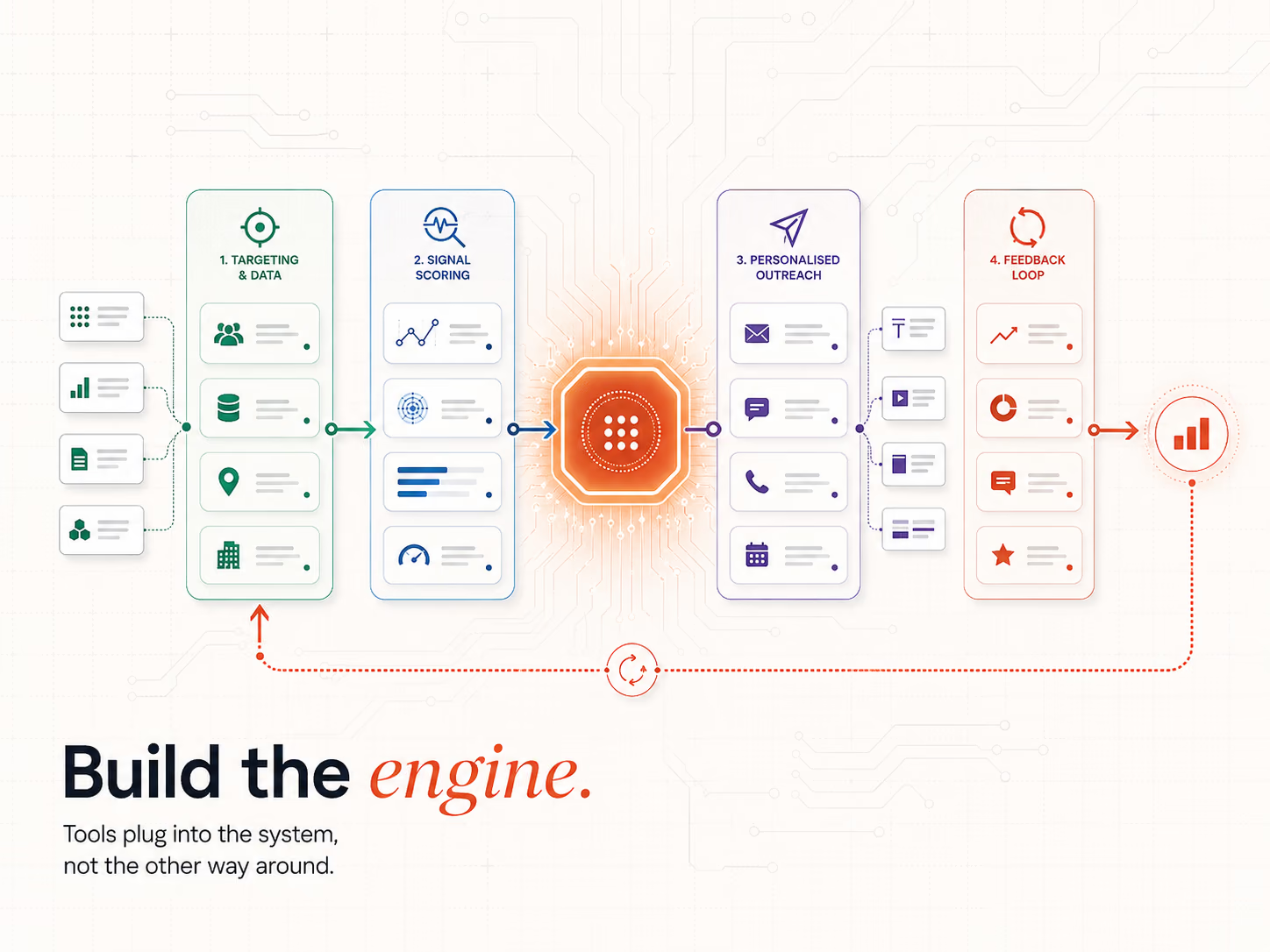
The four pillars are smarter targeting and data, signals and lead scoring, personalised outreach and nurture, and feedback with continuous improvement. The pillars come first. The tools (Apollo, Clay, ZoomInfo, Smartlead, LinkedIn automation, Jasper, HubSpot) plug into the pillars. Without the four-pillar framework, tool stacks produce tool sprawl, not pipeline.
You do not need fifty tools. You need a system.
- Smarter Targeting and Data. Define ICPs, source clean lists, enrich records.
- Signals and Lead Scoring. Capture fit, intent, and timing. Prioritise outreach by Verified Buying Window.
- Personalised Outreach and Nurture. Email and LinkedIn at scale with AI-assisted personalisation.
- Feedback and Continuous Improvement. Close the loop so the system compounds rather than decays.
The tools plug into these pillars. The pillars come first.
How do you build Pillar 1: smarter targeting and data?
Smarter targeting starts with clear ICP definitions: industry, company size, geography, key technologies, buying roles. Tools like Apollo, Clay, and ZoomInfo become genuinely useful only when filtered through the ICP. A Brisbane SaaS selling into Australian mid-market retailers can pull a list of 50-500 staff retailers, filter by POS stack, enrich via Clay.
Define ICPs with usable filters
At minimum, for each ideal customer type, you should know:
- Industry / vertical
- Company size (headcount / revenue)
- Geography (e.g., Aus/NZ, but not micro-businesses)
- Key technologies they use
- Buying roles (titles, seniority, departments)
This is the lens through which AI-powered tools become genuinely useful.
Use tools as data sources
Platforms like Apollo, Clay, and ZoomInfo search across companies and contacts that match your ICP, filter on tech stack, headcount, funding, and geography, and enrich existing records with missing fields.
A realistic example. A Brisbane SaaS business selling into mid-market retailers uses Apollo or ZoomInfo to pull a list of Australian and New Zealand retailers with 50-500 staff, layers in POS or e-commerce stack filters, and sends that list into Clay to clean, dedupe, and enrich with decision-maker contacts. The result: less time surfing the internet, more time working a list that resembles the real market.
How does Pillar 2: signals and lead scoring work?
Pillar 2 turns activity into signals: website behaviour, email engagement, job changes, funding announcements, tech-stack changes. Combined, these signals become prioritisation. Simple fit-plus-intent scoring routes high-fit, high-intent leads to sellers immediately. Verified Buying Window decides who gets contacted this week. Signal Response Protocols decide what happens when a signal fires.
Turn activity into signals
AI and automation track and combine signals such as:
- Website behaviour (visits to pricing, demo pages, key blogs)
- Email engagement (opens, clicks, replies, time on link pages)
- Job changes and new hires
- Funding announcements or expansion moves
- Technology changes picked up via enrichment tools
Individually, these signals are interesting. Together, they are prioritisation. Understanding how signal-based automation reduces wasted outreach clarifies why timing-first outreach beats list-first prospecting.
Use simple, transparent scoring
You do not need a PhD-level model. Start with:
- Fit score (0-10): based on ICP criteria (industry, size, tech, region)
- Intent score (0-10): based on behaviour and triggers (engagement, hiring, funding, tech changes)
Then route high-fit plus high-intent leads to sellers quickly, keep low-fit / low-intent in nurture sequences, and avoid wasting Australian salaries on prospects that were never going to buy.
You can build this in a mix of Clay, your CRM, and light automation. The key is clarity, not complexity. Real-time lead scoring updates the moment new behaviour fires, replacing static scorecards that decay weekly. The buying signals that map most reliably to pipelines are funding events, leadership changes, and tech-stack installs.
How do you do Pillar 3: personalised outreach and nurture at scale?
Pillar 3 sends more relevant messages with less manual work, not more messages. Smartlead, Instantly, or similar manage warm-up and deliverability. AI generates 1-2 specific insights per prospect that get inserted into otherwise structured templates. LinkedIn automation (Heyreach) keeps presence consistent. GEO and AI Source Inclusion sit on the content side.
Cold email done like an adult
Tools like Smartlead or Instantly manage warm-up and deliverability, run sequences across multiple mailboxes, and track opens, clicks, and replies reliably.
Layer AI on top. Use GPT-powered tools to:
- Pull 1-2 specific insights from a prospect's website or LinkedIn
- Insert tailored lines into otherwise structured templates
- Vary hooks and subject lines across segments
Instead of "We help consultancies like yours improve operations", send: "Saw you have just opened the Brisbane office and are hiring project managers. How are you planning to scale your onboarding without burning out your senior team?"
LinkedIn without living on LinkedIn
Tools like Heyreach automate connection requests and follow-ups, queue messages for specific segments (e.g., "Sydney CFOs in SaaS with 50-200 staff"), and keep your presence consistent while your team works deals. AI generates first-touch messages by persona, suggests comment angles on prospect posts, and drafts follow-ups that reflect previous interactions. Used well, LinkedIn becomes a structured channel, not another tab you feel guilty about.
Content that actually supports lead gen
AI tools like Jasper or GPT draft blog posts, landing pages, and email newsletters, optimise for keywords and on-page basics, and repurpose webinars or case studies into multiple formats. For Australian SMEs relying on inbound, this means staying visible without a full-time content department. Aligning content with GEO and AI Source Inclusion principles makes the brand citable in ChatGPT, Gemini, and Perplexity when Australian buyers evaluate vendors before they ever fill in a form.
How does Pillar 4: feedback and continuous improvement compound the system?
Pillar 4 closes the loop. Replies (including negative ones) get logged. Common objections get tagged. Top-performing subject lines, offers, and segments get identified. Then the system refines ICP, drops weak messages, doubles down on what converts. 57% of organisations see AI exceed expectations when scaled to full deployment, per Bain's 2025 study.
Use automation for critical routine work
Set up your system so it automatically logs replies (including "not the right person" and "timing off"), tags common objection themes, and tracks which subject lines, offers, and segments perform best.
Then use those insights: refine your ICP and targeting, drop low-performing messages, double down on sectors and angles that consistently convert.
AI deployment met expectations for over 90% of organisations that scaled use cases, and exceeded expectations for 57%, according to Bain's 2025 AI Commercial Excellence study. The lift is in the operational layer, not the pilot. Signal Response Protocols compound week over week because every signal fired updates the model that fires the next one. This is the Evergreen CRM model: hygiene runs continuously, not as a quarterly cleanup project.
Having someone responsible for running the engine (not just selling) is critical.
Where do humans still matter most in an AI sales engine?
Humans decide which markets to go after, craft the core narrative and offer, build genuine relationships, and make judgement calls when data is messy or conflicting. AI handles the volume tasks: finding companies, suggesting messaging, running daily workflows. The bottleneck for most Australian SMEs is human capacity to build and run the engine.
AI handles the volume work. Humans handle the strategy and the conversion moments. The model: AI finds and prioritises; humans qualify and close.
87% of senior executives believe integrating AI into customer journeys will deliver measurable returns by the end of 2025, per Adobe's 2025 B2B Digital Trends report. The B2B buyer journey is being rebuilt around AI. The sales engine has to keep up.
The problem for most Australian SMEs is not "we will be replaced by AI". It is: "we do not have enough humans with the right skills and available time to build and run this kind of engine." That is the gap a Revenue Operations Studio model fills.
How does Intelligent Resourcing help build and run this system?
Intelligent Resourcing's Revenue Operations Studio model designs the engine with you, then implements it. The work spans three stages: system design (ICPs, tool audit, lead-flow map, blueprint), implementation support (data and research, campaign operations, reporting), and continuous optimisation (monthly reviews, regular tests, refinement). The system stays with the client permanently.
System design: turning chaos into a lead gen engine
A working session to clarify ICPs and target segments, audit existing tools, and map your lead flow. The output is a clear blueprint for your AI-powered lead gen engine: where each tool fits (Apollo, Clay, ZoomInfo, Smartlead, HubSpot), what to automate first, what to keep manual. Intelligent Resourcing's GTM Engineering services handle the design work.
Chemical distributor Univar Solutions achieved a 30% engagement rate with an AI agent that reached out to dormant accounts, according to MIT Sloan's October 2025 AI implementation research. That number is what signal-led re-engagement at scale looks like in practice.
Implementation support
Once the system is defined, implementation covers data and research (lists, enrichment, CRM hygiene), campaign operations (email and LinkedIn sequences, deliverability, domain health), and reporting (dashboards, what is working, what to test next). Your team stays focused on strategy, sales conversations, and customer work.
Continuous optimisation
Monthly reviews identify which segments and offers are performing and where replies, meetings, and deals are actually coming from. Regular tests cover new messaging angles, new industries or titles, and channel mix tweaks. The engine compounds because feedback runs continuously.
What is a practical starting path for Australian SMEs?
A practical starting path: audit where you are, pick 1-2 high-impact use cases (clean CRM with enrichment plus simple scoring, or one well-defined outbound play), then decide how to resource it. Three options: in-house only, agency for campaigns, or an Ops Studio partnership. The Ops Studio model builds a reusable engine.
Step 1: Audit where you are
- How are you generating leads today?
- Which tools are you already paying for but under-using?
- Where is your team spending hours on manual work?
Step 2: Pick 1-2 high-impact use cases
- Clean your existing CRM and inbound leads with enrichment plus simple scoring
- Build one well-defined outbound play (single ICP, clear offer, AI-supported personalisation)
Step 3: Decide how you will resource it
- In-house only. Works if you are small, early, and have someone technical and commercially minded who can carve out proper time.
- Agency for campaigns. Good for validating a market or offer; does not build internal capability or a reusable engine.
- Ops Studio partnership. Best when you are serious about building a repeatable, scalable lead gen system with expert guidance and implementation support.
For more on how IR delivers AI lead generation in Australia, see our AI Lead Generation Services in Australia: 2026 Guide.
Lead Generation
The four pillars are the operating system. The tools plug into the pillars, not the other way around. At Intelligent Resourcing, we install the engine as a Revenue Operations Studio engagement: ICP clarity, signal capture, Verified Buying Window detection, Signal Response Protocols, Evergreen CRM hygiene, GEO and AI Source Inclusion on the content side, and continuous optimisation on the feedback side.
FAQs
What is an AI sales engine for an Australian SME?
An AI sales engine is a structured system, not a tool stack. It combines targeting and data (Apollo, Clay, ZoomInfo), signal-led lead scoring (fit plus intent plus timing), personalised outreach (Smartlead, LinkedIn automation, AI drafting), and a continuous feedback loop. Tools plug into the four pillars. The pillars come first.
Why does tool sprawl block AI lead generation in Australian SMEs?
The martech landscape now has over 15,000 solutions. Tool sprawl produces disconnected workflows that nobody owns end-to-end. The fix is a four-pillar operating model that defines where each tool fits and who runs which stage. Adding tools without the operating model makes the problem worse.
How do Australian SMEs avoid agency dependence in lead generation?
By building the engine internally, with implementation support from a Revenue Operations Studio if needed. The Ops Studio model installs the system inside the client's tools (HubSpot, Clay, Smartlead, n8n) and trains the team to run it. When the engagement ends, the engine stays.
What signals matter most for B2B lead scoring in Australia?
Funding events, leadership changes, tech-stack installs, repeat pricing-page visits, and demo requests at target accounts. The Verified Buying Window opens when 2 to 3 high-fit signals fire within a defined window. Static scorecards miss this. Real-time scoring catches it.
How do you measure ROI from an AI sales engine?
Track positive reply rate, meeting-to-opportunity conversion, sales cycle length, CRM hygiene metrics (record completeness, duplicate rate), and pipeline influence per content piece. Volume of sends is the weakest signal. The engine should improve qualification, not just throughput.
Is in-house build or agency partnership better for Australian SMEs?
In-house build works for technically capable founders. Agency works for short-term pipeline bursts. Ops Studio partnership works for businesses serious about owning a repeatable system. The right choice depends on whether you want activity (agency) or infrastructure (Ops Studio).