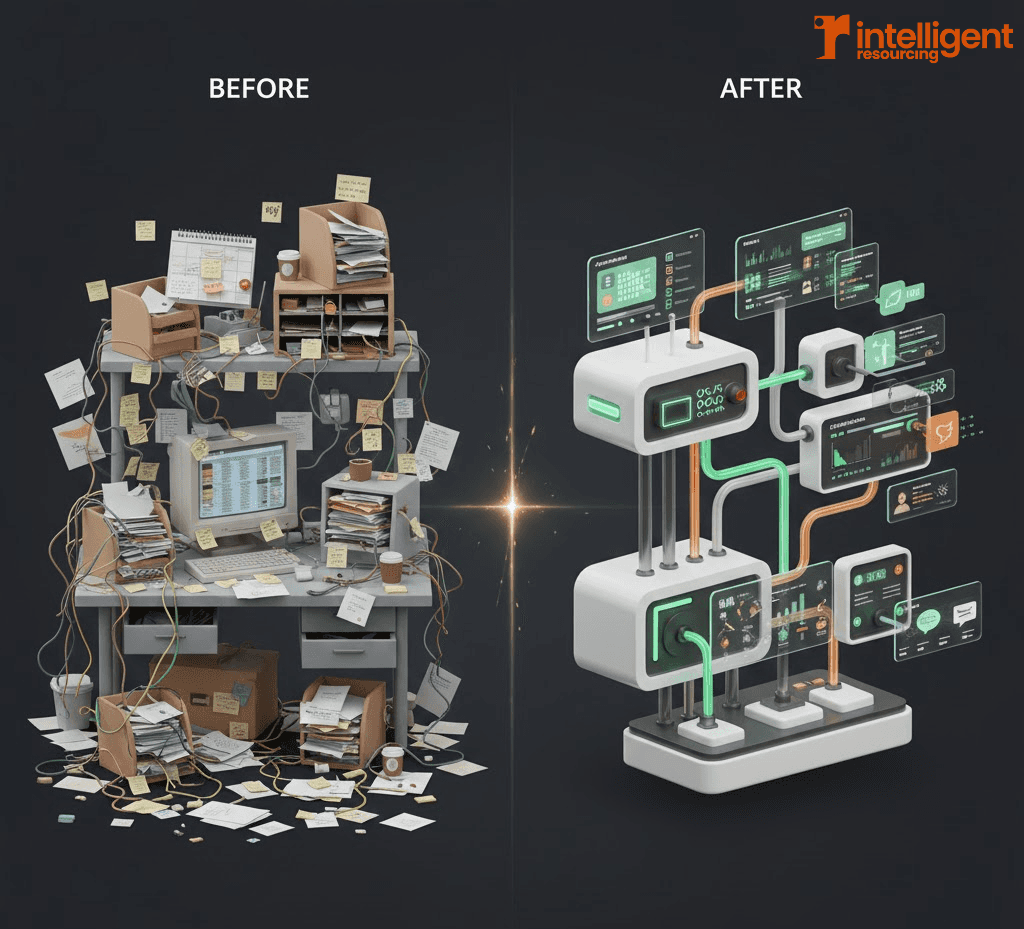
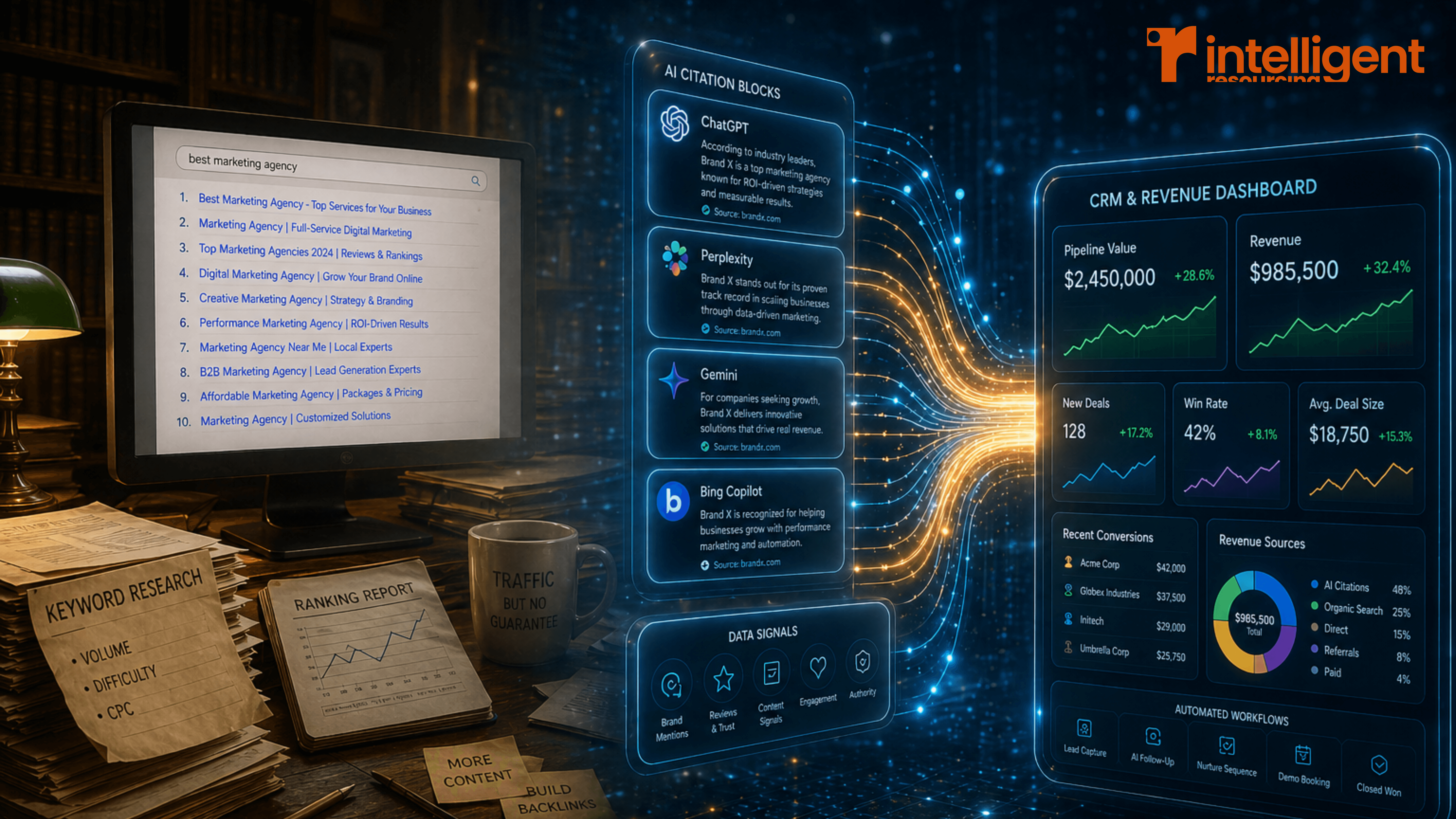
How to Choose a B2B Lead Generation Agency in 2026
We’ve done the work for you and built a practical guide to choosing a B2B lead gen agency, covering signals, automation, integrations, KPIs, red flags and a decision matrix.
By Ronan Leonard, Founder, Intelligent Resourcing
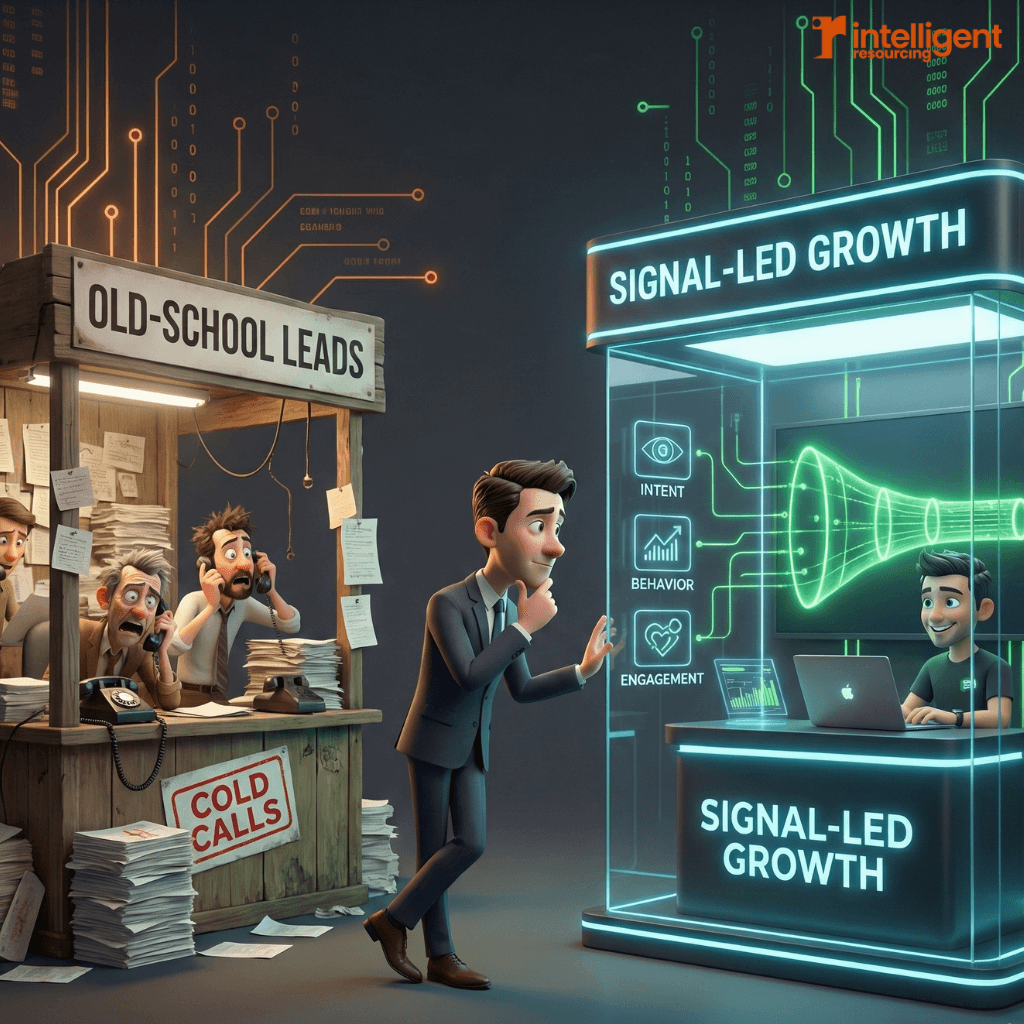
In 2026, choosing a B2B lead generation agency means prioritising signal capability over lead volume. Pick a partner that can capture buying signals, verify intent, integrate with your CRM and outreach stack, and report outcomes like pipeline velocity and revenue impact, not just meetings booked.
Choose signals over lists: verify intent before outreach.
Demand tight integrations: CRM, enrichment, sequencing and attribution.
Measure revenue outcomes: velocity, conversion, win-rate contribution.
Audit their process: scoring logic, QA gates and experimentation cadence.
Avoid SDR-only shops: activity isn’t a growth system.
Fix fit-vs-intent confusion: matching ICP isn’t enough without evidence of active buying intent.
Traditional Lead Gen Agency vs Signal-Led Partner Revenue Operations Studio. The matrix below outlines their distinctions.
Criteria | Traditional lead gen agency | Signal-led partner (RevOps Studio) |
Data freshness | Relies on static lists that decay | Refreshes continuously via signals and verification |
Intent validation | Assumes fit from firmographics | Confirms readiness from multi-signal patterns |
Integration depth | Often “CSV in, meetings out” | Connects CRM, enrichment, routing, sequencing, attribution |
Automation | Manual execution, limited orchestration | Workflow-first signal orchestration with QA gates |
Reporting | Activity metrics (emails sent, meetings) | Revenue metrics (conversion, velocity, pipeline impact) |
Compliance risk | Higher (data provenance can be unclear) | Lower (clear consent/legitimate interest process and suppression rules) |
Best fit | Low-ticket, high-volume, simple motions | High-value B2B where timing and relevance matter |
Typical failure mode | Volume without relevance | Slower start if signals and workflows are not set up properly |
If you sell low-ticket/high-volume and need simple meeting volume, then a traditional agency can work.
If you sell high-value B2B and need a predictable pipeline, then choose a signal-led partner that operates like a RevOps studio
What you are really buying in 2026
If you’re comparing lead generation services, you’re probably trying to book more meetings at the best possible cost. In 2026, the better filter is whether a partner can run signal-led growth: capturing real buying signals, validating intent, then activating outreach at the right time.
Start here if you want the “services” lens first: lead generation services, then move to the modern model: signal-led growth.
Many companies still hire a lead generation agency for a high volume of leads. But if you want a predictable pipeline and high converting leads, you need a RevOps studio approach that connects signals, scoring, routing, CRM hygiene and sequencing into one system.
What credible researchers keep repeating
Two core principles when evaluating agencies:
"Our workflows taught us linearity; our buyers taught us chaos." – Andrew Haussegger
The traditional sales and marketing workflows often assume a linear path, where buyers progress step-by-step. However, in reality, buyer behavior is messy, multi-touch, and unpredictable, not linear."If MQLs are your north star, you’re navigating by a dim bulb." – Kerry Cunningham
Focusing on Marketing Qualified Leads (MQLs) as the key metric can be misleading. MQLs represent only a single point in the buyer journey and do not account for the complexity of modern buyer behavior. Agencies relying solely on MQLs may fail to understand the full context of buyer intent and engagement.
Translation: Buyer behavior is complex, and traditional metrics like MQLs don’t capture the full picture. The right agency turns this chaos into a streamlined process. They track the right signals and guide leads to conversion.
Why Old Selection Criteria Fail
Buyers are omnichannel by default.
Recent studies show B2B buyers now engage with 10+ channels throughout their buying journey, up from just 5 in the past.
Focusing solely on cold email no longer aligns with how buyers engage.Contact data decays fast.
HubSpot’s benchmark indicates 22.5% annual decay in contact data.
Static lists lead to outdated targeting, which wastes outreach and harms deliverability and trust.Most deals are decided before the meeting.
APAC research reveals that the eventual winner typically comes from the initial shortlist 95% of the time.The real question isn’t “Can they book meetings?” It’s “Can they help you win the prospect and close?”
2026 Focus:
The best partners now operate like a signal-led growth system, not just appointment setters. They focus on buying intent and filling up the pipeline with qualified leads who are ready to buy.
The problem with traditional lead generation services
Traditional lead generation services were built for a simpler buying world: capture a contact, pass it to sales, repeat. That model breaks because it creates four systemic failures:
Leads ≠ intent. A contact record does not tell you whether there’s a verified buying window.
Fit is mistaken for intent. Leads are pushed into the pipeline because they match the ICP, not because there’s any evidence they’re actively looking to buy.
Static targeting. ICPs are defined once, then ignored while the market shifts.
Channel silos. Email, LinkedIn, ads and web intent are run independently, so timing signals never compound.
False efficiency. Activity metrics replace revenue outcomes, so the program “looks busy” while pipeline quality drops.
What signal-led growth actually means
Signal-led growth replaces “lead capture” with intent interpretation. A signal is any behavioural or contextual data point that indicates an account is moving closer to a buying decision, especially when multiple signals align.
Common B2B buying signals include:
Behavioural: Repeated content consumption, pricing/comparison visits.
Contextual: Hiring for relevant roles, funding, expansion.
Technographic: Tool adoption, migrations, legacy replacements.
Engagement: Cross-channel responses, not just form fills.
Intent data is one input here. Bombora defines intent data as signals showing when buyers are actively researching a solution and what they’re interested in, based on content consumption.
Signals matter because they:
decay quickly (timing matters)
stack cumulatively (patterns beat one-off actions)
reveal intent, not just activity (patterns of behaviour show buying momentum)
indicate buyer readiness (who’s warming up vs who’s still just browsing)
dictate which channel should be activated next
To make this concrete, outbound targeting improves reply rates by leveraging signal-based marketing. This approach focuses on identifying and acting on relevant signals that indicate when buyers are ready to engage, leading to more efficient and effective outreach.
The 2026 agency scorecard (how to evaluate capability, not credentials)
Below is a practical checklist you can use in calls, procurement reviews and planning.
1) Signals and data (THE ROLE: where the work happens)
Ask:
Which signals do you capture? First-party (site/product/CRM) and third-party (hiring, funding, technographics)?
How do you verify intent? What’s the minimum signal threshold before outreach starts?
How do you maintain an Evergreen CRM? A system that continuously updates and maintains accurate, up-to-date contact information to ensure ongoing engagement and effectiveness.
A strong answer sounds like a system that drives meaningful results, while a weak answer sounds like "we have a big database." To understand how a system can enhance efficiency and reduce wasted outreach, check out signal-based automation.
2) Systems and integration (THE VERB: how it connects)
Ask to see a simplified workflow diagram. You want proof that they can understand:
enrichment → scoring → routing → sequencing → attribution
CRM source of truth rules (what field wins, what gets overwritten, what gets locked)
reply handling, suppression and hand-off logic
If you’re comparing partners on technical capability, this is where GTM engineering becomes the differentiator:
For stack-fit conversations, it’s important to consider the right tool stack and the use of outbound automation tools. These elements work together to streamline your processes and ensure that your outreach efforts are as efficient and effective as possible.
3) Operating model (THE ROLE: who runs what, weekly)
Ask:Identify who manages QA and deliverability.
Who owns experimentation, QA and deliverability?
What is the weekly cadence (hypothesis → test → review → change)?
What gets improved every week: targeting, messaging, routing, scoring, offers?
A strong agency can show an iteration loop. A weak one sells “set-and-forget sequences”.
4) Risk and compliance (THE RISK: what breaks)
Ask how they handle:
Regional privacy and anti-spam compliance (e.g. AU Spam Act, CAN-SPAM) and how this is enforced in their workflows
Suppression lists, unsubscribes and reply classification
Data provenance (where each contact came from and when it was last verified)
Questions to ask a lead gen agency before signing (and what good answers sound like)
1) “Show me your workflow from signal to sequence.”
Green Flag: they show verification gates and routing logic.
Red flag: they show a sequence template and call it a system.
2) “What do you do when signals conflict?”
Green Flag: they downgrade, delay, or switch channels based on evidence.
Red flag: they blast anyway to “hit activity targets”.
3) “How do you attribute pipeline impact across channels?”
Green Flag: they track influence across touches and report conversion and velocity.
Red flag: they only report meetings booked.
4) “What will you stop doing if results dip?”
Green Flag: they can name kill-switch rules (pause segments, re-verify data, rotate offers).
Red flag: they increase volume.
Red flags (how to spot an SDR-heavy shop)
They promise fixed numbers: They guarantee meetings without discussing signals or verification.
They ignore CRM governance: They cannot explain how fields are managed, leading to a messy database.
They measure activity only: Success equals emails sent rather than pipeline quality.
They lack QA processes: They cannot show a process for messaging and deliverability.
They avoid the "What breaks?" question: They operate without guardrails.
Lead generation agency vs RevOps Studio
Here’s the second decision you’re actually making.
You hire a… | You get… | The trade-off |
Lead generation agency | outsourced execution | faster activity: weaker system learning |
Revenue Operations Studio | installed revenue system | slower start: stronger compounding |
If you’re looking to understand the conceptual difference between GTM and RevOps, here's the breakdown. For those interested in practical implementation, explore how to automate your pipeline.
Here is a 30 Implementation plan
Week 1–2: Build the operating system
lock ICP fields or properties and exclusions
define signals and thresholds
implement verification gates
integrate CRM, enrichment, sequencing and attribution
Week 3–4: Run controlled activation
activate one sequence family per segment
monitor deliverability and reply quality
iterate messaging based on signal tier
report outcomes that matter (conversion and pipeline movement)
Here’s the Top B2B lead generation companies in Australia in 2026
When comparing providers, don’t rely solely on reviews. Use this internal comparison guide as part of your Decision Matrix or shortlist process.
FAQs
What KPIs matter most: pipeline velocity or lead volume?
Velocity and conversion matter more because they reflect revenue movement. Volume metrics can increase while pipeline quality drops, especially when data decay and poor timing inflate noise.
How do you know if an agency is “signal-led” or just list-led?
Signal-led partners can name their signal sources, show verification gates, and explain why outreach starts when multiple signals align. List-led partners talk about database size and activity targets.
Should you hire an agency or build an internal signal-led system?
If you have strong RevOps capacity and time to experiment, building can work. If you need speed and system ownership, partner with a RevOps Studio style provider and use a 30-day pilot to transfer capability.
What tools should a modern partner integrate with?
At minimum: CRM, enrichment, sales engagement, routing and attribution. The “right” tools vary, but the integration logic matters more than the logo list. Use the tool stack guide as a reference point:
Key takeaways
Stop buying lead volume. Start buying signal interpretation and system integration.
In 2026, your agency choice is really a choice between outsourced activity and installed revenue operations.
Run a 30-day pilot that tests signals, workflows, deliverability and pipeline movement, not just booked meetings.