

What are the most common GTM engineer use cases?
A GTM engineer builds 6 kinds of system: data enrichment, lead routing, signal scoring, outbound sequences, AI agent rules and pipeline reports. Each one takes a manual task off a rep's desk. The job is to build, not to advise. The engineer writes the workflow, tests it and keeps it running once it is live.
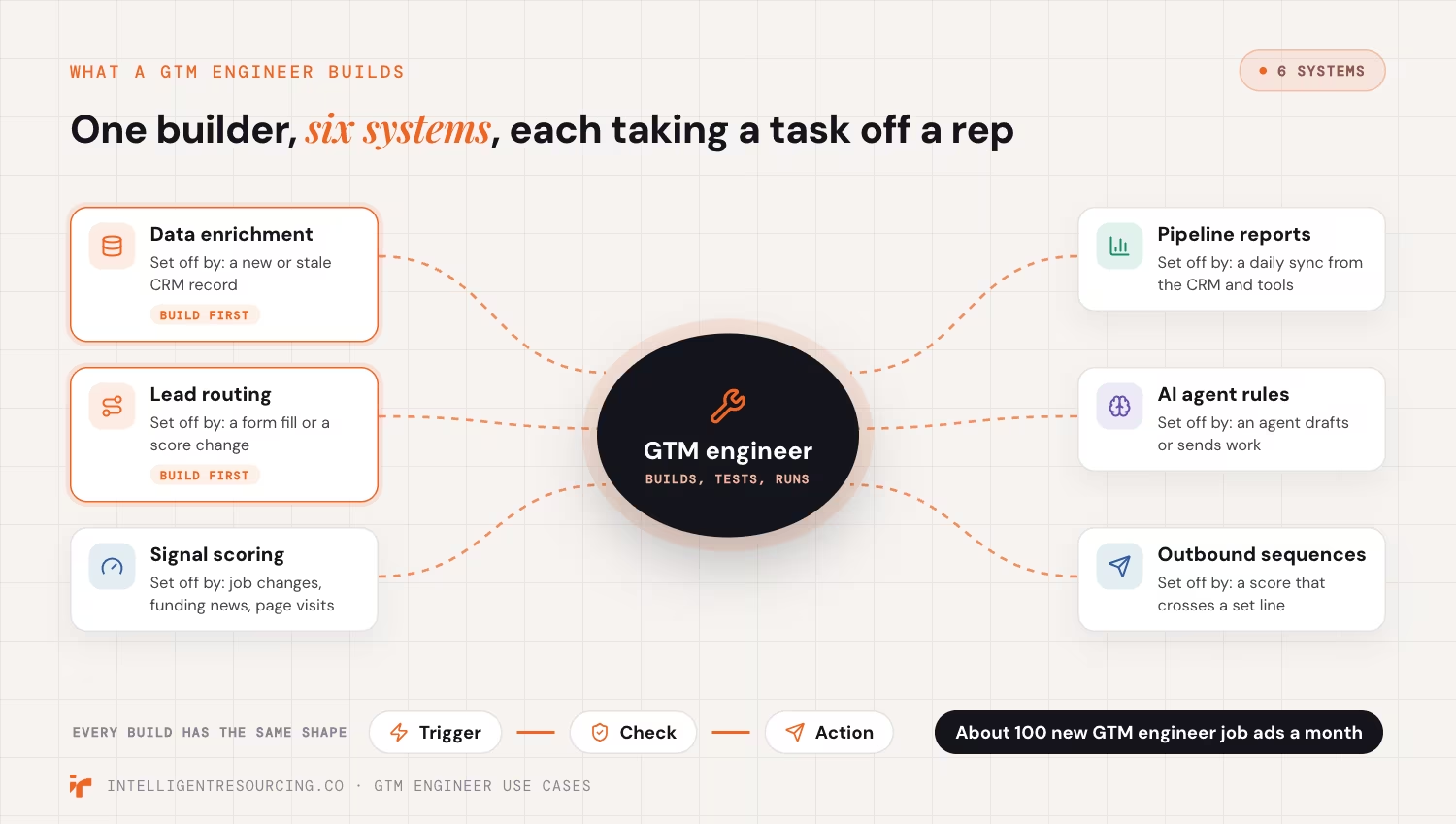
Demand for the role is real. Clay's April 2026 GTM engineering guide says about 100 GTM engineer job ads now go live each month. The same guide lists real builds by working GTM engineers. 4 builds stand out:
- Inbound routing. One model in the 2026 guide scores new sign-ups for $25k-plus potential and auto-assigns the best leads.
- Call capture. A script listens to sales calls, pulls out company facts and writes them back into the CRM.
- Intent outreach. A workflow watches which firms visit the site and sends a tailored email while interest is high.
- Expansion alerts. A scan of support threads flags requests for paid features, so account managers know who to call.
Each build has the same shape: a trigger, a check and an action. If you want the role itself defined first, read our guide to the GTM engineer. This article stays on what the role builds.
How does a GTM engineer build a signal-based lead score?
A signal-based lead score adds points for fit and for timing. Fit asks if a company matches your ideal customer profile (ICP). Timing asks if something just changed, such as a new sales leader or a visit to your pricing page. The GTM engineer sets the points, tests them on past deals and sends high scores to reps.
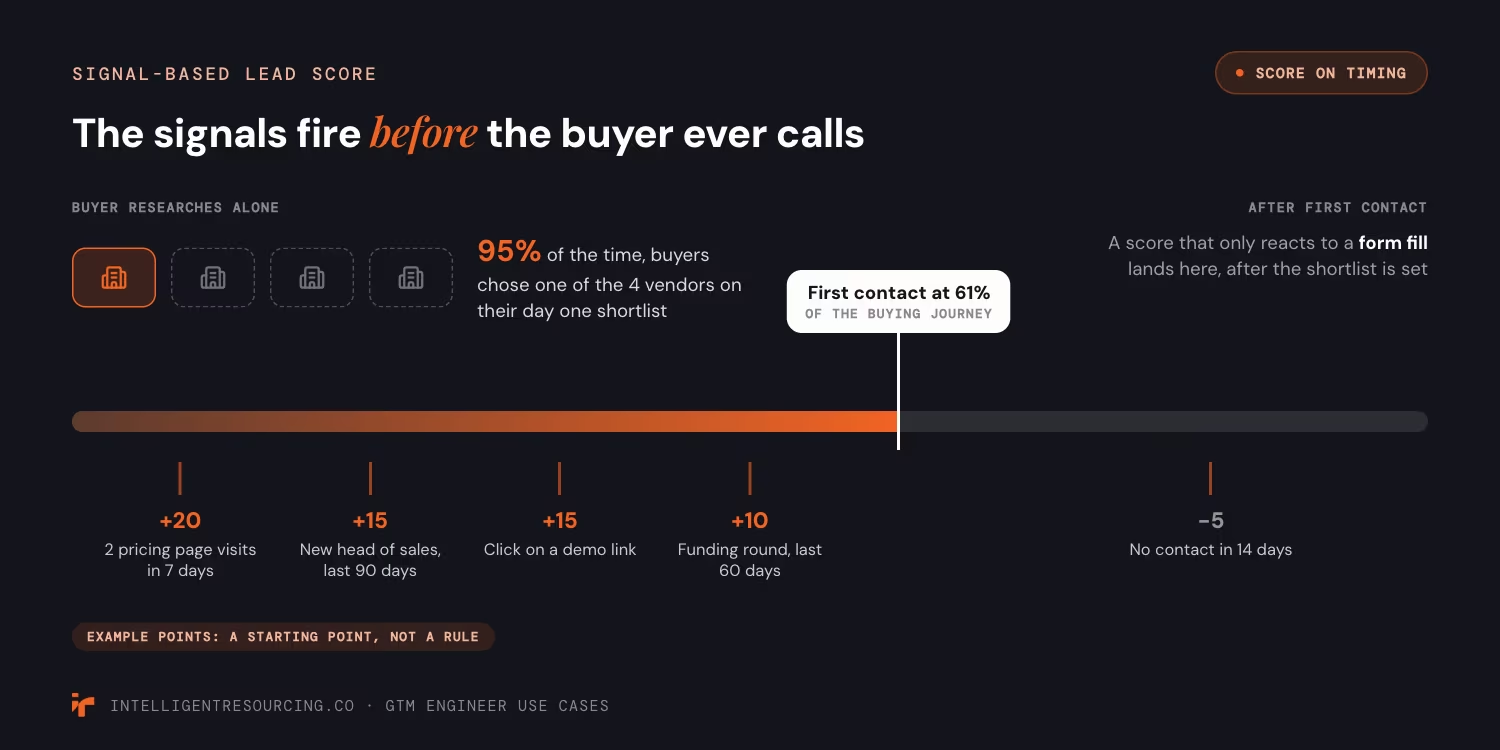
Timing matters because buyers decide early. The 6sense 2025 Buyer Experience Report surveyed nearly 4,000 B2B buyers. In 2025, buyers made first contact 61% of the way through their journey. In 2025, they also chose from one of the 4 vendors on their day one shortlist 95% of the time.
So a score that only reacts to a form fill comes too late, because the shortlist is already set.
Here is an example score. The points are a starting point, not a rule:
- +20 points for 2 pricing page visits in 7 days.
- +15 points for a new head of sales in the last 90 days.
- +15 points for a click on a demo link.
- +10 points for a funding round in the last 60 days.
- -5 points for no contact in 14 days.
In practice, the system spots a new head of sales on LinkedIn. It fills in the account details, adds 15 points and starts a short email sequence within 24 hours. That is the core of signal-based outreach. We prove our scoring against reality first: a client's already-decided deals are run through it blind, so the model is validated before it scores a new prospect.
What does an automated enrichment and routing workflow look like?
An enrichment and routing workflow fills gaps in each new record, checks the facts and sends the lead to the right rep. It runs each time a record is created or goes stale. Because it runs on its own, reps stop checking prospects by hand. Leads also stop waiting in a queue with no owner.
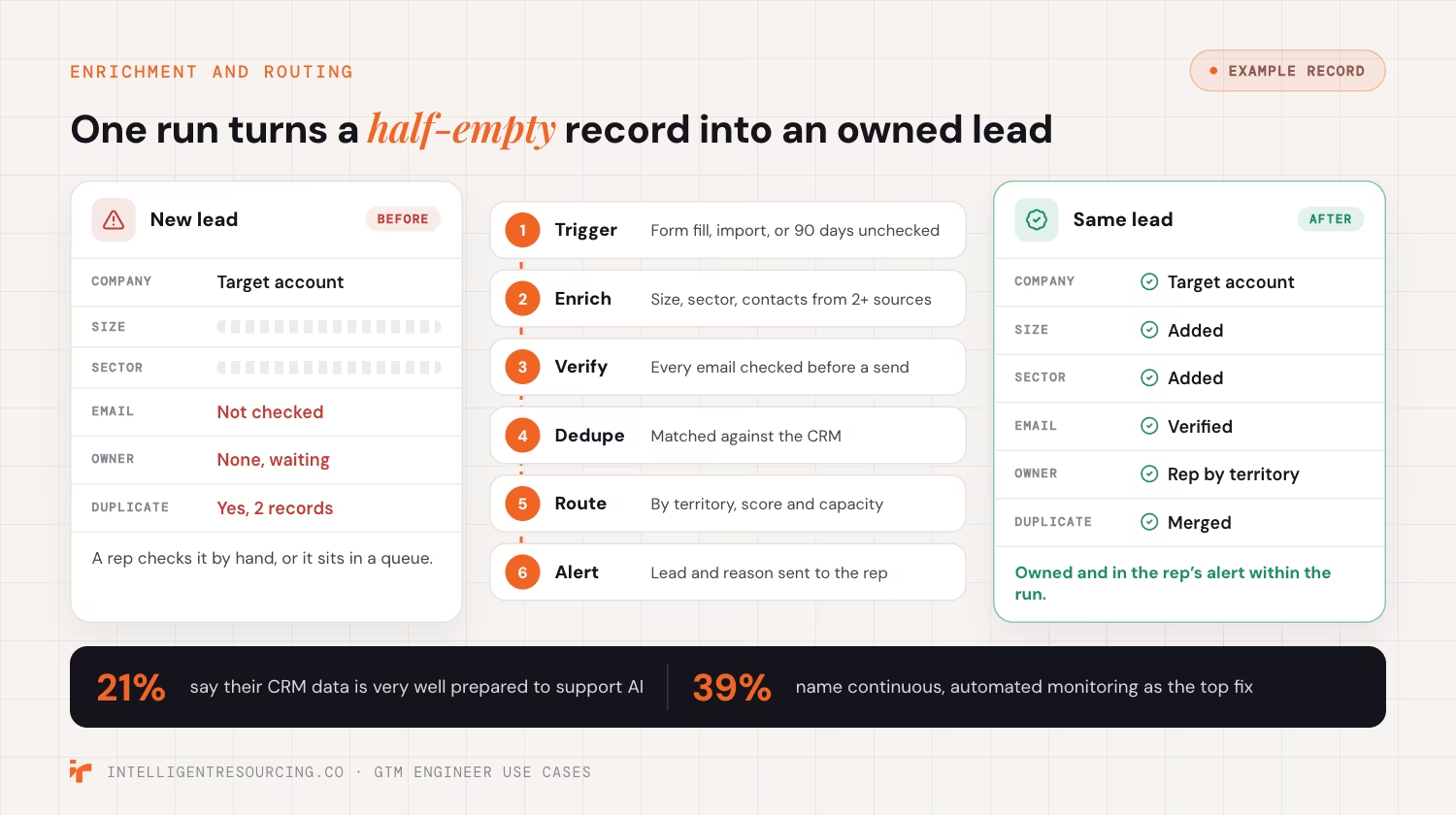
Most CRMs are not ready for this work yet. Validity's 2026 CRM data survey of 500 marketers was released in August 2026. In that 2026 survey, just 21% said their CRM data is very well prepared to support AI. The top fix in the same survey, cited by 39%, was continuous, automated monitoring that catches and fixes data issues in real time.
A typical build runs in 6 steps:
- Trigger. A form fill, a new import or a record that has not been checked in 90 days starts the run.
- Enrich. The workflow pulls company size, sector and contact details from 2 or more sources.
- Verify. It checks each email before any send. Bad emails get a fallback, so email bounce rates stay low.
- Dedupe. It matches the record against the CRM, so no rep gets a contact the team already owns.
- Route. It assigns the lead by territory, score and rep capacity.
- Alert. It posts the lead and the reason it scored in the rep's Slack channel.
This work adds up fast. We took 4,665 uncategorised CRM leads, categorised and enriched every one, and narrowed them to the core ICP, work that would take a sales team hundreds of hours by hand.
Can AI SDRs and agents replace a GTM engineer?
No, because an AI sales development rep (SDR) or agent runs on data and rules that someone has to build. A GTM engineer builds and keeps up those rules. When the data is messy, the agent sends the wrong message to the wrong person, only faster. So agents raise the value of GTM engineering work instead of replacing it.
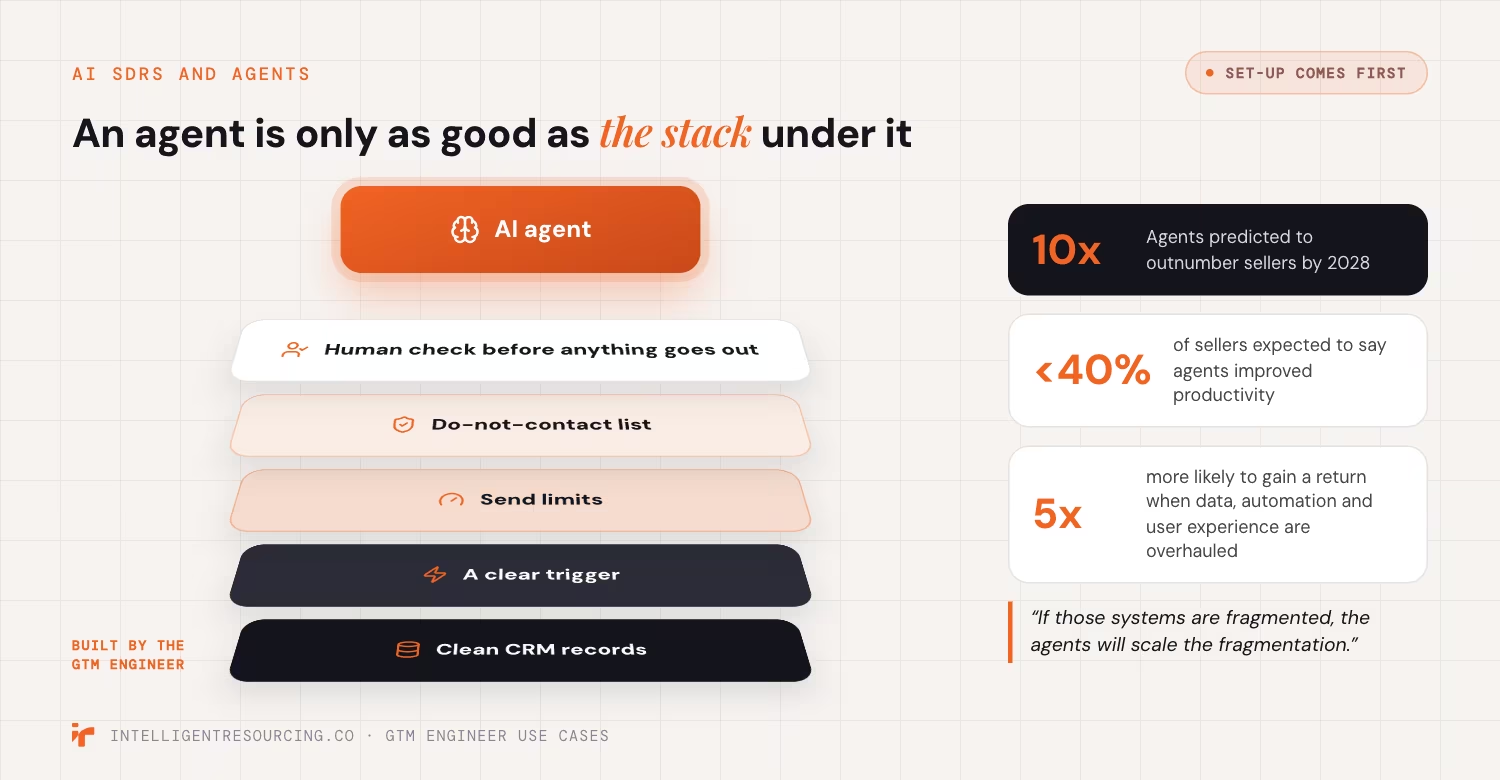
In July 2026, Gartner predicted agents will outnumber sellers by 10 times by 2028. Yet the same 2026 release expects fewer than 40% of sellers to say AI agents have improved productivity. Gartner's Dan Gottlieb named the cause: "If those systems are fragmented, the agents will scale the fragmentation." The same 2026 release predicts that chief sales officers who overhaul data, automation and user experience will be 5 times more likely to gain a return from AI.
That is why the GTM engineer's agent work is mostly set-up. The engineer gives each agent clean records, a clear trigger, send limits, a do-not-contact list and a human check before anything goes out. We start with clean CRM data first, because an agent can only be as accurate as the records it reads.
What are the signs you need a GTM engineer?
You need a GTM engineer when reps spend more time on admin than on selling. Other signs are data in tools that do not talk to each other, and campaigns that take weeks to launch. Each sign points to a missing system, not a missing person. The fix is a build that removes the manual step for good.
The cost shows up in selling time. Salesforce's 2026 State of Sales report surveyed 4,050 sales staff in 22 countries, Australia included. The report, published in February 2026, found the average seller spends 40% of their time selling. In the same 2026 report, over half of sales leaders with AI (51%) said disconnected systems are slowing down their AI plans.
Look for these signs in your own team:
- Reps research and check prospects by hand before each call.
- Leads wait hours or days before a rep owns them.
- Sales says marketing leads are a poor fit.
- Reports arrive weeks late, or no one trusts the numbers.
- A new campaign needs a developer before it can launch.
We see the same pattern in our work. Across multiple B2B clients, business development reps reported losing 40 to 60% of their working week to manual prospecting and data verification before the engine. If 2 or more of these signs fit, book a GTM systems review.
Should you hire a GTM engineer in-house or bring in a specialist?
Hire in-house when GTM engineering work never stops, such as many products, markets or campaigns that change each month. Bring in a specialist when you need a set list of builds shipped and handed over. The two deciding questions are how much of the work is ongoing, and whether you can pay a senior salary.
It is a senior hire. RevGuild's 2026 GTM engineer salary report looked at 190 US job ads from June 2025 to June 2026. In 2026, it found a $150,000 median base salary (USD) across 71 ads that showed pay.
In the 2026 data, the median person in the role had 7.4 years of experience before taking the title. These are US figures. As of October 2026, we found no open Australian salary survey for the role.
A specialist suits a firm that needs 3 or 4 core builds and a team to run them after. An in-house hire suits a firm with a long list of builds, a CRM owner and work that changes every week. The case for in-house is real: a full-time engineer learns your product and buyers in depth, which an outside team takes time to match. If you want the builds shipped and owned by your team, see our GTM engineering service.
GTM Engineering
Talk to our GTM engineering team about which build to ship first: CRM enrichment, lead routing, signal scoring or AI agent rules.
FAQs
What does a GTM engineer do?
A GTM engineer builds the systems behind sales and marketing. That means data enrichment, lead routing, signal scoring, outbound sequences and pipeline reports. The engineer builds each workflow, tests it and keeps it running. The aim is to take manual steps off reps so they spend more time selling.
What is a GTM engineer's salary?
RevGuild's 2026 report found a $150,000 median base salary (USD) across 71 US job ads that showed pay. In that 2026 report, the median person had 7.4 years of experience before taking the title. As of October 2026, there is no open Australian salary survey for the role.
What is the difference between a GTM engineer and RevOps?
Revenue operations (RevOps) sets the process, targets and reporting across sales, marketing and customer success. A GTM engineer builds and runs the systems that carry out that process. In short, RevOps decides how the revenue engine should work, and the GTM engineer builds it.
What tools does a GTM engineer use?
RevGuild's 2026 review of 303 US job ads found HubSpot named 166 times, Clay 150, Salesforce 150 and SQL, a database query language, 149 times. The exact mix depends on your CRM.
Can you run GTM workflows without a dedicated hire?
Yes, if the scope is small and fixed. A specialist can build the core workflows and hand them to your team to run. Complex systems with many products or markets need someone who owns them full time.
How do you know if your GTM system is working?
Track how long leads wait for an owner, how many records are complete, and how much time reps spend selling. Then track pipeline by source. A working system cuts wait time and lifts selling time.