

What Actually Breaks First When a Growth-Equity-Backed Company Tries to Scale?
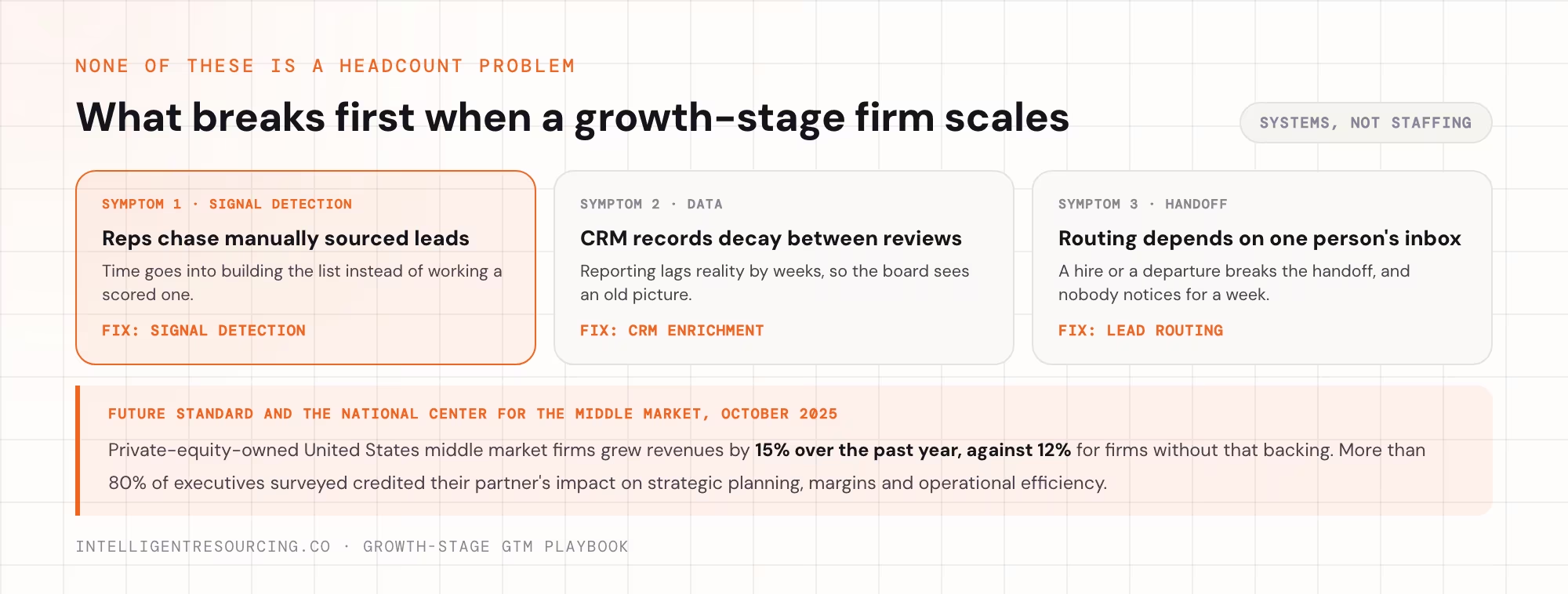
Signal detection and customer relationship management (CRM) hygiene break first. The sales team is rarely the real problem.
A growth-equity-backed firm usually starts its hold period with a working product and a funded plan. The gap that stalls revenue is usually a manual go-to-market (GTM) layer, not a staffing shortfall.
The same pattern holds across private equity (PE) more broadly. Future Standard's October 2025 study with the National Center for the Middle Market found PE-owned United States middle market firms grew revenues by 15% over the past year, against 12% for firms without PE backing. More than 80% of the middle market executives surveyed said their PE partner had a positive impact on strategic planning, margins and operational efficiency.
Systems come first. Growth follows.
Three symptoms show up early:
- Reps chase manually sourced leads instead of working a scored list.
- CRM records decay between quarterly reviews. Reporting lags reality by weeks.
- Routing depends on one person's inbox. A hire or a departure breaks the handoff.
None of these is a headcount problem. A sixth rep cannot fix a CRM that nobody owns. The system has to change first, or the new hire inherits the same mess. The same pattern shows up across GTM partners serving PE-backed portfolios.
Which GTM Systems Should Be Fixed Before Any New Hire?
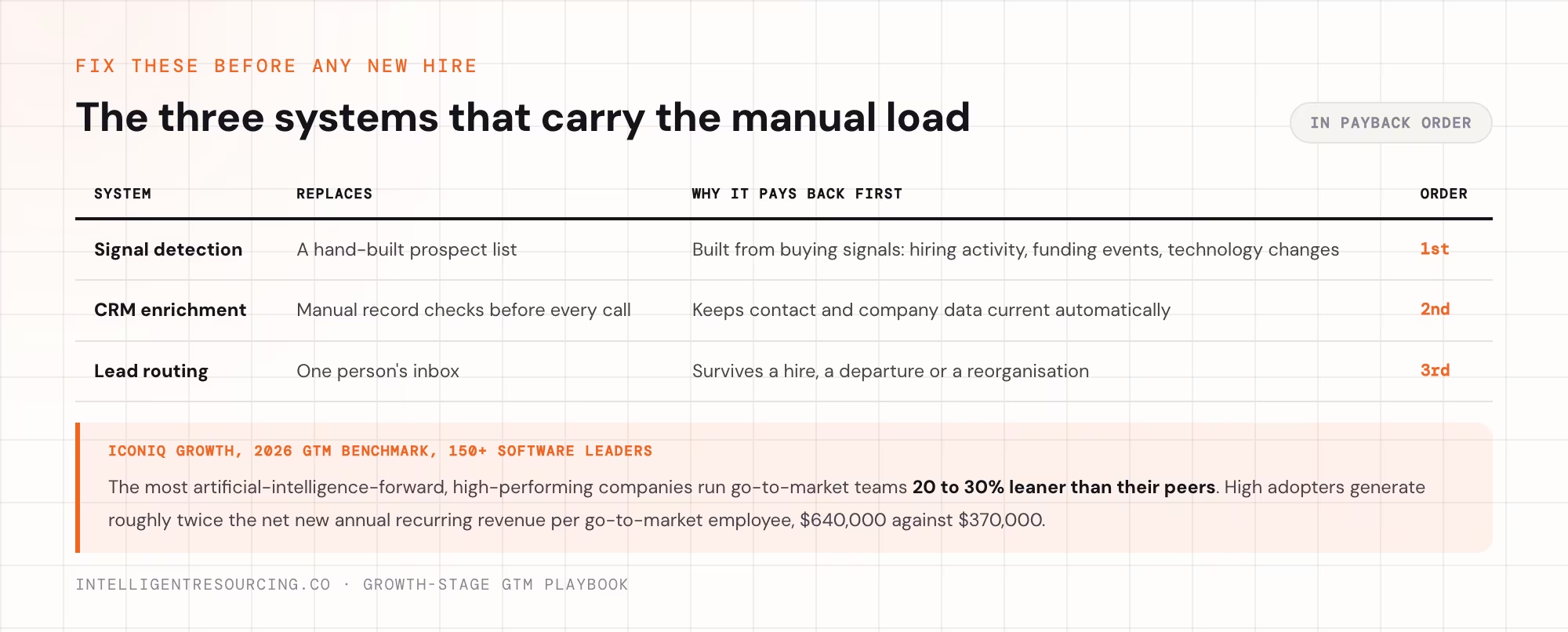
Three systems carry the heaviest manual load: signal detection, CRM enrichment and lead routing. Fix these first. A growth-equity-backed firm gets more pipeline from the team it already has, before it pays for a new one.
ICONIQ Growth's 2026 GTM benchmark report drew on more than 150 business-to-business (B2B) software GTM leaders. It found the most artificial intelligence (AI) forward, high-performing companies run GTM teams 20 to 30% leaner than their peers. High AI adopters also generate roughly twice the net new annual recurring revenue per go-to-market employee, $640,000 against $370,000.
Growth is no longer coming from more bodies. It is coming from better systems.
The three fixes, in the order they remove manual work:
| System | Replaces | Why it pays back first |
|---|---|---|
| Signal detection | A hand-built prospect list | Built from buying signals: hiring activity, funding events, technology changes |
| CRM enrichment | Manual record checks before every call | Keeps contact and company data current automatically |
| Lead routing | One person's inbox | Survives a hire, a departure or a reorganisation |
Intelligent Resourcing runs this fix as a managed service, so a rep works a scored list rather than building one. Fix these three and a firm does not need a bigger team to carry more pipeline. It needs a system the team is not fighting every day.
For the build behind each fix, see the full GTM workflow library. This section covers the strategy. That one covers the build.
When Does Adding Headcount Still Make Sense?

Headcount still wins in three cases: deals already in motion, markets with no track record to model signals against, and pipeline a board needs within one quarter. In each case, a system takes too long to pay back before the window closes.
The Bridge Group's 2025 research on sales development reps, covering 351 B2B companies, found average ramp time fell to 3.0 months, the lowest since 2010. Average tenure sits at 1.9 years. A firm choosing between a hire and a system fix should count that three-month ramp as a real cost. It is not just the salary.
Three cases where hiring now is the right call:
| Situation | Why a system is not fast enough |
|---|---|
| A deal is already in motion | No system replaces a senior rep's judgement mid-negotiation |
| The market has no track record | No comparable buyers exist yet to model signals against |
| The board needs pipeline within one quarter | A system build rarely clears that timeline from a cold start |
Outside those three cases, the three-month ramp is the reason to fix the system first. Hire once it is running, not before. The same trade-off shows up in the choice between building versus hiring in-house.
How Should the Fixes Be Sequenced Over the First Two Quarters?
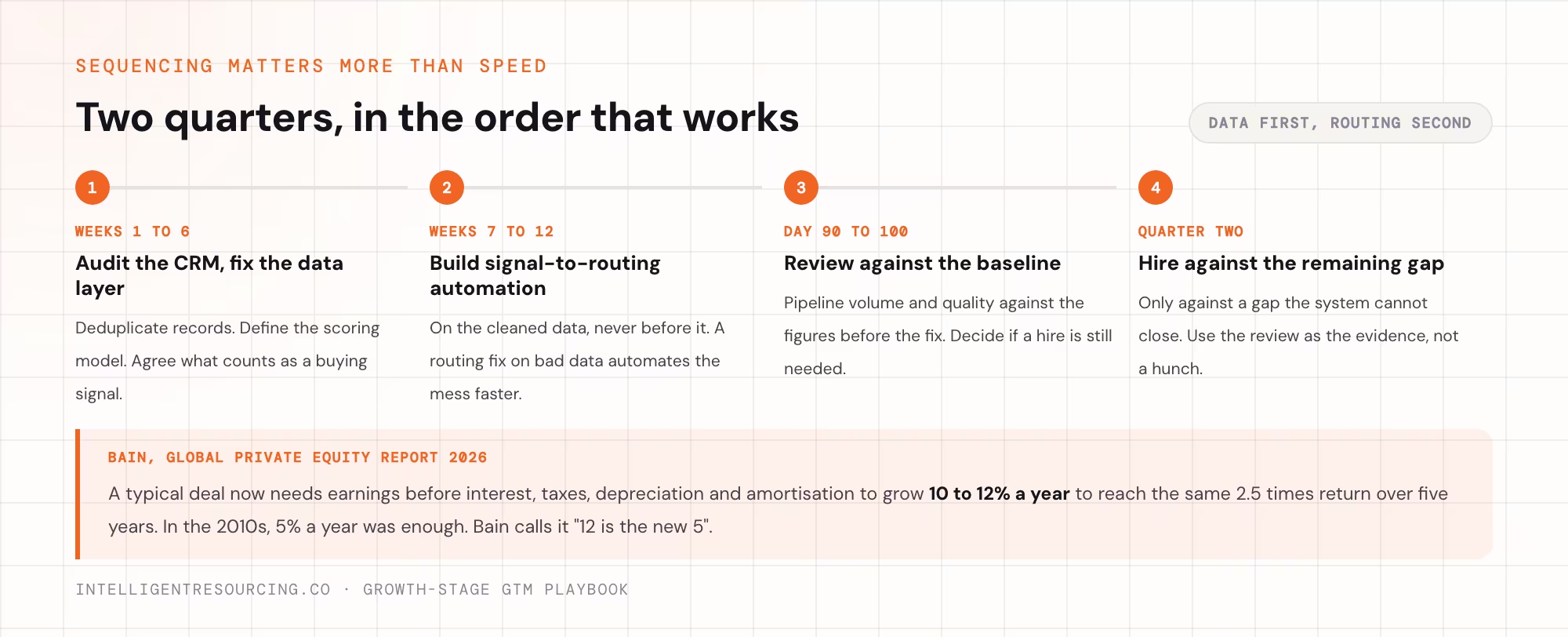
Fix the data layer in quarter one. Automate routing in quarter two. Review before any hiring decision.
Sequencing matters more than speed. A routing fix built on bad data just automates the mess faster.
Bain's 2026 Global Private Equity Report, reported in its own release of 23 February 2026, found a typical deal now needs earnings before interest, taxes, depreciation and amortisation (EBITDA) to grow around 10 to 12% a year to reach the same benchmark 2.5 times return over five years. In the 2010s, 5% a year was enough. Bain calls the shift "12 is the new 5", and its advice to the firms that reach that growth rate is to turn differentiation into a system, not a slogan.
A growth-equity-backed firm should treat its first 100 days the same way: as the window to build the system, not to make a hiring call.
A two-quarter sequence that works in practice:
- Weeks 1 to 6: audit the CRM and fix the data layer. Deduplicate records. Define the scoring model. Agree what counts as a buying signal.
- Weeks 7 to 12: build the signal-to-routing automation on the cleaned data.
- Day 90 to 100: review pipeline volume and quality against the baseline before the fix. Decide whether a hire is still needed.
- Quarter two: hire only against a gap the system cannot close. Use the review as the evidence, not a hunch.
A hire made before this review is a guess. A hire made after it is a decision backed by data. The broader case for sequencing systems ahead of headcount sits under Revenue Operations as a service line.
What Does Efficiency, Not More Spend, Look Like in Practice?
Efficiency means the same team closing more pipeline from a cleaner system. It does not mean a bigger team closing the same pipeline from a messier one.
For a growth-equity-backed firm, that gap matters more than most. Capital is harder to win than it was, and wasted spend is hard to replace.
Capstone Partners' January 2026 update expects growth equity funds to keep growing in size and to prioritise companies with scaled EBITDA of $10 million or higher. Investors stay flexible on terms, sizing and deal volume. They stay rigid on company quality.
Capital selectivity is the constraint that report measures. Systems are what a firm controls, no matter how selective capital gets.
In practice, efficiency looks like this:
| Without the fix | With the fix |
|---|---|
| Reps work a cold, manually sourced list | Reps work a scored list, and win rate rises without a sixth salary |
| CRM updates wait for the next quarterly clean-up | The CRM reports pipeline accurately the day it changes |
| Growth pauses while a replacement ramps up | A routing rule survives a departure |
None of this needs more spend. It needs systems built before the next hiring round, not after it. The same idea applies to signal-based marketing for B2B teams: act on the right signal, do not just reach more people.
Systems that compound do not need rebuilding at the next growth stage. A firm that fixes them now buys itself out of the same fight two years from now.
GTM Engineering
To map the two-quarter sequence against your current CRM and routing, book a GTM strategy session with Intelligent Resourcing.
FAQs
How long does it take to fix GTM systems before scaling headcount?
A realistic sequence runs two quarters. Allow six weeks to fix the data layer, six weeks to automate routing, then a review around day 90 to 100 before any hire.
What is the first system to fix in a growth-equity-backed company?
CRM data quality comes first. A scoring model built on dirty data just automates bad decisions faster. The data layer is always the starting point.
Does fixing systems first delay revenue growth?
No, it protects it. Bain's 2026 Global Private Equity Report found a typical deal now needs EBITDA to grow around 10 to 12% a year to reach a 2.5 times return over five years, against about 5% in the 2010s. Hitting that bar depends on systems that keep compounding, not a hire that masks the gap for a quarter.
When should a growth-equity-backed company still hire before fixing systems?
Three situations justify it: a deal already in motion, a market with no track record to model signals against, or a board deadline for pipeline within one quarter.
How is a growth-stage GTM playbook different from a Series A GTM playbook?
A Series A firm is usually still finding product fit and building its first GTM motion from nothing. A growth-equity-backed firm already has fit and capital. The work here is fixing and scaling existing systems, not building them from zero.