

Why Does Family-Office Backing Change the GTM Plan?
Family-office backing changes a company's go-to-market (GTM) priorities. Growth spending has to support the investor's goal, whether that is steady profit, long-term value or a future sale. That decides whether to invest in new customers, existing accounts, salespeople or better revenue systems.
Patient capital is not unlimited capital. UBS's 2025 Global Family Office Report surveyed 317 single family offices across more than 30 markets. It put private equity at 21% of the average portfolio in 2024, and offices planning changes meant to cut that to 18%. Growth money competes with every other allocation.
A manufacturer can win more contracts and earn less profit, because production and delivery costs rise with volume. Targeting higher-margin customers may beat expanding the sales team.
Agree what growth means before approving spend: the target, who owns execution, and how results are measured.
Why Does Revenue Stall Even When the Business Has Capital?
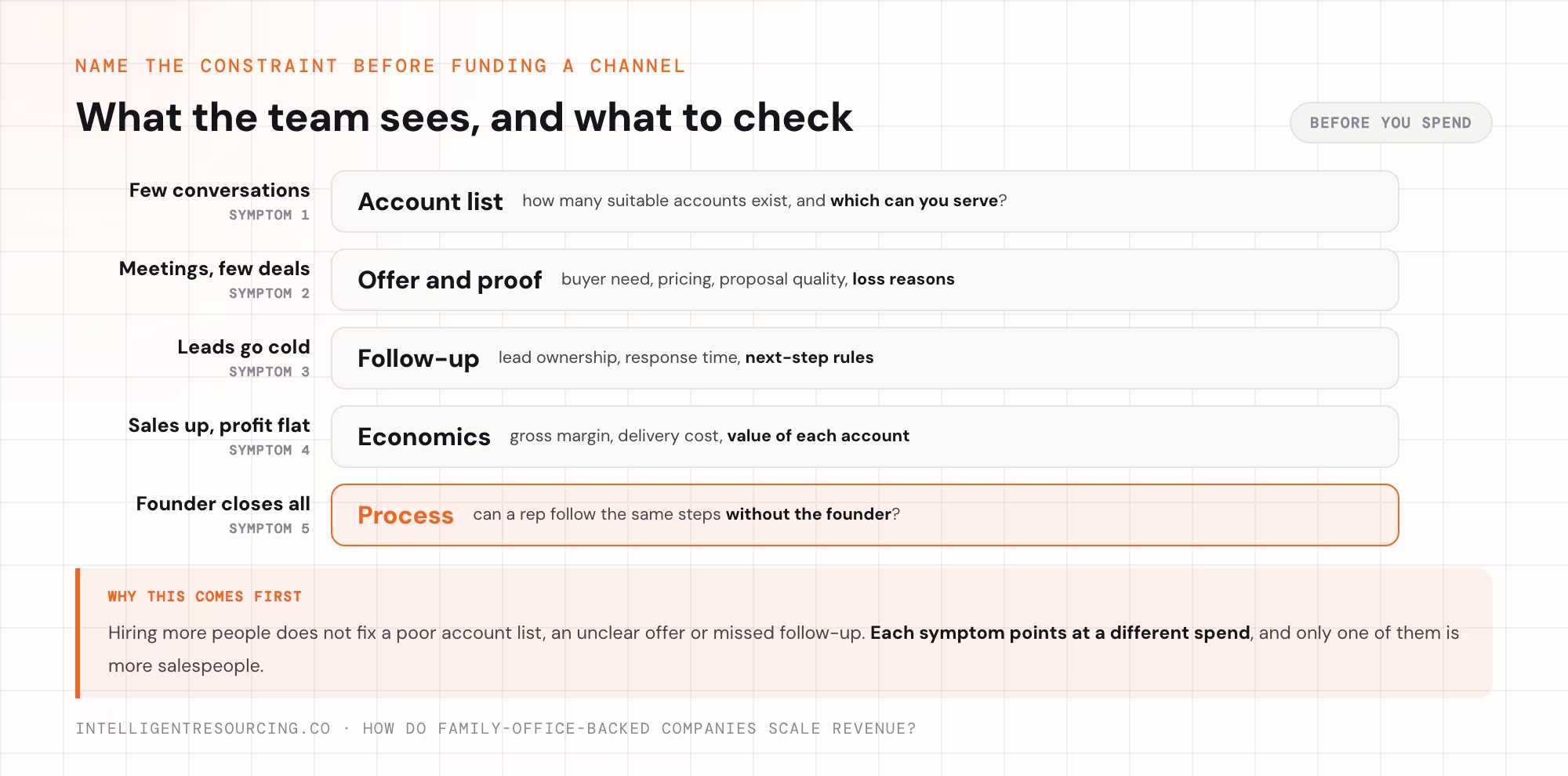
Revenue stalls when there is no repeatable way to reach new buyers. Referrals still bring orders but are hard to plan around, and hiring does not fix a poor account list, an unclear offer or missed follow-up.
Many mid-sized firms feel this now. In KPMG's 2025 mid-market pulse check, 40% of Australian mid-market leaders expected minimal growth for the rest of 2025, and 65% named cost and margin pressure their biggest concern. KPMG does not publish a sample size for that edition.
Check the gap before picking a channel.
| What the team sees | What to check before spending |
|---|---|
| Few new sales conversations | How many suitable accounts exist, and which can you serve? |
| Lots of meetings but few deals | Buyer need, pricing, proof, proposal quality, loss reasons |
| Good leads going cold | Lead ownership, response time, next-step rules |
| More sales but weak profit | Gross margin, delivery cost, value of each new account |
| Founder closes nearly every deal | Can a rep follow the same steps without the founder? |
Which Growth Opportunities Should We Test First?
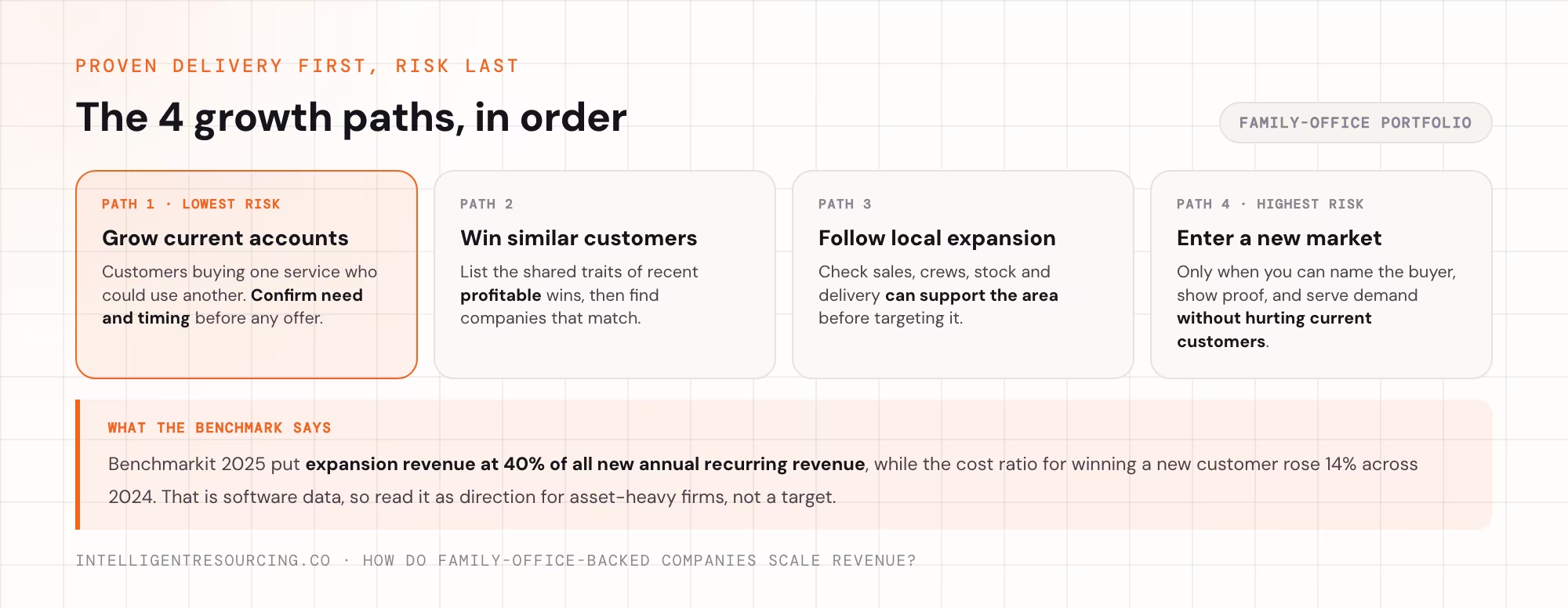
Test growth where the business already serves customers well: current accounts first, then similar buyers. Both use proven delivery and known demand. A new market comes last, adding research, proof and capacity risk before revenue.
Existing customers carry more growth than many plans assume. Benchmarkit's 2025 B2B benchmarks put expansion revenue at 40% of all new annual recurring revenue. The cost ratio for winning a new customer rose 14% across 2024. That data comes from software firms, so read the split as a direction for asset-heavy firms, not a target.
Consider 4 paths.
- Grow current accounts. Find customers buying one service who could use another. Confirm need and timing before any offer.
- Win similar customers. List the shared traits of recent profitable wins, then find companies that match.
- Follow local expansion. Check that sales, crews, stock and delivery can support a new area before targeting it.
- Enter a new market. Only when you can name the buyer, show proof and serve the demand without hurting current customers.
What Buyer Signals Matter for Asset-Heavy Companies?
For asset-heavy companies, the signals that matter are changes at a site, in a region or on a project: a new warehouse, an expansion, an approved project, a new operations role. Each is a reason to check the account, and service area and delivery capacity decide whether it fits.
| Possible signal | Why it can matter | What still needs checking |
|---|---|---|
| New warehouse or branch | New sites need stock, equipment or local service | Is it open, and does this firm buy the product? |
| Expansion into a new area | More routes can change supplier needs | Can you serve it at a fair margin? |
| Major project approval | Projects create future buying needs | Is it relevant, and near procurement? |
| New operations or procurement role | New responsibility can open a review | Does this person own the decision? |
| New contract or service line | Delivery needs change | Is the contract confirmed, the need real? |
Public data shows activity, not buyers. The Australian Bureau of Statistics reported that the seasonally adjusted value of non-residential building approved fell 44.8% in August 2026, to $5.53 billion. The trend estimate for the same series rose 2.0% that month. That gap is why a monthly swing is a prompt to check the company or the project, not a signal in itself.
How Do You Turn a Buyer Signal Into Qualified Pipeline?
Pass each buyer signal through fit, evidence and ownership checks before sales sees it. A GTM system rejects weak accounts early, matches the rest to the CRM record, and routes each to a named owner with a next step.
Finding the right owner matters because buyers rarely decide alone. Demandbase's State of the B2B Buyer Report puts 72% of B2B purchases in the hands of complex buying groups. Those groups span functions such as information technology, finance and the end users themselves.
A simple workflow for a site-based business looks like this.
- Capture the change. Source, date, and what happened at the site, region or project.
- Check company fit. Industry, size, service area and likely need. Reject what you cannot serve.
- Verify the details. Match to the existing CRM record and check for duplicates.
- Find the right owner. The operations, procurement or site role, and a verified contact route.
- Choose the action. Assign an owner and send a message that fits that account.
- Log the result. Reply, qualified opportunity, sale or rejection.
That process is the job of GTM engineering: link account evidence, data checks, decisions and next steps in the company's existing systems. The sales team still owns the buyer relationship.
Who Should Run GTM Work Inside a Family-Office-Backed Company?
The company runs GTM work, owning its customers, pricing and CRM, while the family office approves agreed capital decisions. Outside teams can build inside the company's stack, with a named internal owner for each system. Which outside firm fits depends on the job, so it helps to compare advisers by what they deliver.
Clear decision rights matter more when capital is shared. PwC's Global Family Office Deals Study 2025 found club deals made up 69% of family office investments in the first half of 2025. In a club deal, families invest alongside others, so more than one party signs off.
| Role | Decision or work owned |
|---|---|
| Family-office sponsor | Growth aim, capital limit and review points |
| Portfolio CEO | Commercial plan, trade-offs and final operating decisions |
| Sales leader | Buyer fit, sales actions and deal quality |
| Revenue operations (RevOps) or systems owner | Data fields, handoffs, checks and reporting |
| External GTM team, if needed | Agreed workflow builds and ongoing upkeep |
A GTM operating partner helps align owners and managers when the problem cuts across strategy and execution. A specialist delivery team fits better when the market is known and the gap is systems.
How Can the Company Test a GTM Bet Before Hiring More Staff?
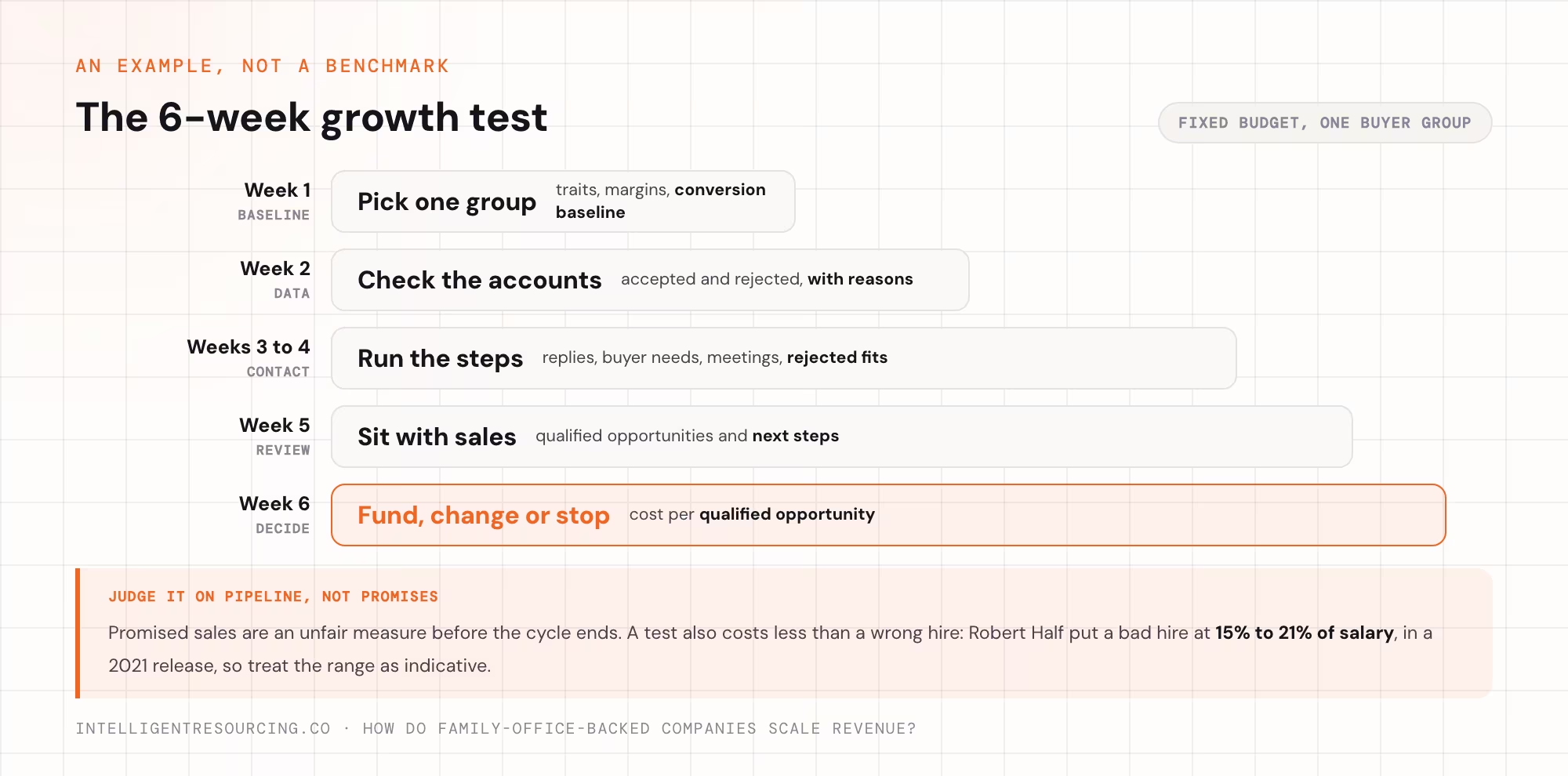
Test a single buyer group with a fixed budget, judged on qualified opportunities. Run it for a set number of weeks, keep the evidence at each stage, and end with a decision to fund, change or stop. Promised sales are an unfair measure before the cycle ends.
A test costs less than a wrong hire. Robert Half put the cost of a bad hire at 15% to 21% of that employee's salary, varying by industry and seniority. That release dates from 2021, so treat the range as indicative rather than current.
| Stage | Work | Evidence to keep |
|---|---|---|
| Week 1 | Pick one buyer group, review recent wins | Customer traits, margins, conversion baseline |
| Week 2 | Check signals, service area, account data | Accepted and rejected accounts, with reasons |
| Weeks 3 to 4 | Run approved contact and follow-up steps | Replies, buyer needs, meetings, rejected fits |
| Week 5 | Review deals with sales | Qualified opportunities and next steps |
| Week 6 | Compare results with cost | Cost per qualified opportunity, and the decision |
6 weeks is an example, not a benchmark, and long cycles need later checks for revenue. Set spend limits and fit rules from the company's own results and margins.
What Should a Family Office Ask for in a Growth Review?

Ask whether GTM work creates profitable sales opportunities. A short review with 5 lines answers that.
| Measure | Question it answers |
|---|---|
| Qualified pipeline created | How much came from real, suitable deals? |
| Opportunity progress | Are those deals moving to clear next steps? |
| Win rate and sales cycle | Do they close, and how long do they take? |
| Gross margin and capacity | Will extra sales profit without harming delivery? |
| Cost of the growth test | Does the evidence justify the spend? |
Qualification is the line to watch. Ebsta's 2025 sales qualification report drew on more than 655,000 business-to-business (B2B) opportunities worth $48 billion. It found a 50% win rate on well-qualified deals, against 8% on poorly qualified ones.
A $200,000 opportunity is pipeline; it becomes $200,000 of revenue only when it closes. Record the evidence, cost and next owner with each decision. A portfolio-wide version of this review is set out in the revenue operations charter for private equity.
When Is Signal-Led GTM the Wrong Growth Bet?
Human-led outbound should come first in three cases: one contract large enough to justify senior seller time, a category buyers do not yet know exists, or a pipeline deadline inside roughly 90 days.
All three need direct buyer conversations and sales judgement. Signal data supports account research; it does not replace the seller. Do not automate around a weak offer, margin or follow-up process.
Where tenders, panels or a few accounts drive revenue, bid work and retention can beat outbound. The Department of Finance reported small and medium businesses won 45,556 Commonwealth contracts in 2024-25, or 52.4% by number. Read that with the value share, which fell to roughly 14% as a few very large contracts took the bulk.
Do not force every holding into one channel. Choose on how the company wins work and earns profit.
How Can a Family-Office-Backed Company Put the Plan Into Practice?
Link account fit, a relevant change and a next owner in the CRM, then run a small test against the growth gap. Define what it must prove before spend rises, and name who decides to fund, change or stop.
Intelligent Resourcing builds and runs signal-led research, enrichment and sales routing inside the company's current CRM, on a managed retainer. Other partner types are compared in our roundup of GTM partners for family offices.
The constraint is rarely the idea. It is who owns the weekly work once the test starts, and whether the revenue operations underneath hold without chasing.
GTM Engineering
To see what a 6-week test would look like against your own margins and sales cycle, book a GTM strategy session with Intelligent Resourcing.
FAQs
How do family-office-backed companies grow revenue without adding a full sales team?
Start with existing customers and similar buyers, who already match what the company serves well. Test one buyer group on a fixed budget, and add headcount only when qualified opportunities, deal progress and margins show the process works.
Is GTM different for a family office and a private equity fund?
Both need profitable sales, but the owner's goals differ. A family office can favour steady cash flow, long-term value or a future sale, while a private equity fund usually works to an exit date. Confirm which leads before setting the budget.
Which growth decisions should the family office sign off, and which stay with management?
The family office signs off the growth goal, the capital limit and the review dates. Selling, pricing and account decisions stay with the company's leaders. Use each review to decide whether to fund, change or stop.
Can a family-office-backed company keep its existing CRM?
Yes. Link account checks, signals and sales tasks to the current CRM unless its limits clearly justify a change. A new platform adds cost and migration risk, and most growth tests need only clean fields, named owners and a log of results.
How quickly should a GTM test show results?
A 6-week test can show buyer fit and early pipeline. It cannot show closed sales on long cycles, so keep later checkpoints for revenue and set the length from the company's own data.