

What Does Each Model Decide, and How Do They Compare?
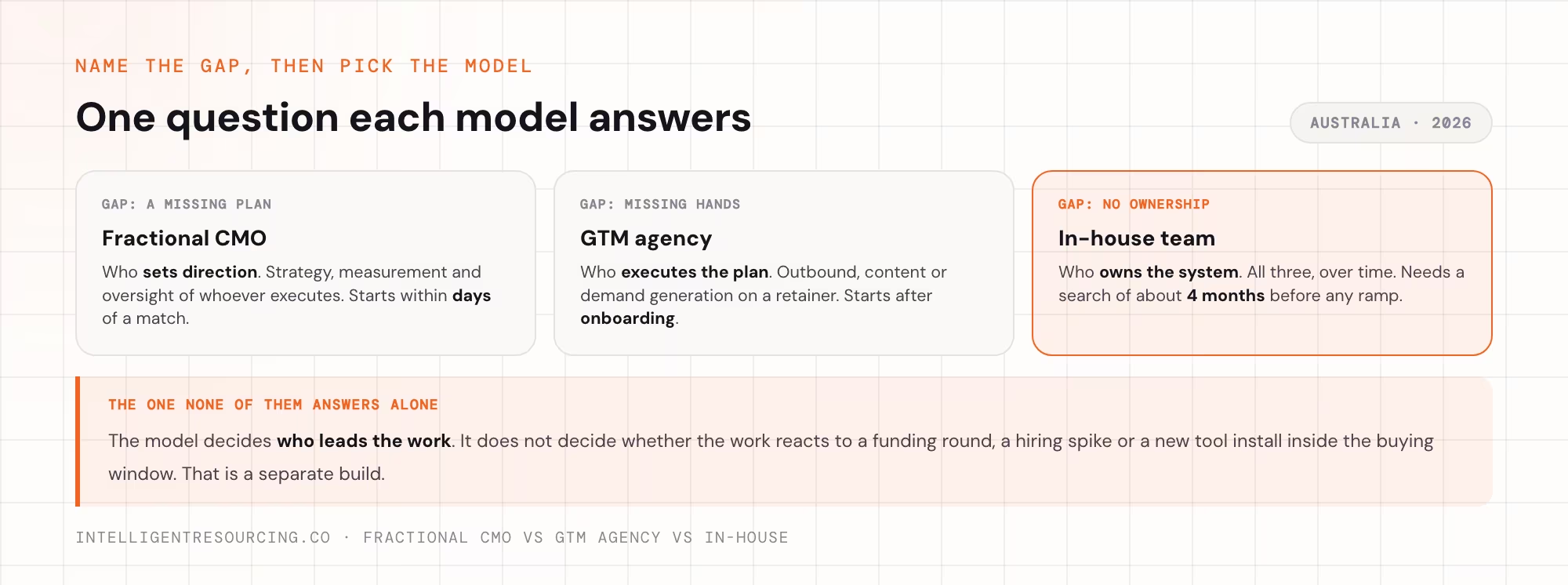
Each model answers one question: who sets direction, who executes the plan, or who owns the system. Only an in-house team eventually covers all three, and it takes the longest to build.
| If the gap is... | Start with | What it adds |
|---|---|---|
| A missing plan | Fractional CMO | Strategy, measurement and oversight of whoever executes |
| Missing hands on a working plan | GTM agency | Outbound, content or demand generation on a retainer |
| Long-term ownership of the system | In-house team | Strategy, execution and an owned system, over time |
The models also differ in how soon work begins and what stays behind.
| Factor | GTM agency | Fractional CMO | In-house team |
|---|---|---|---|
| How soon work begins | After agency onboarding | Soon after a provider match | After a search of about 4 months |
| What stays after it ends | Depends on the contract | The plan, if documented | Everything |
| Stage it suits | Proven profile, execution gap | Strategy gap, early revenue | 2 or more quarters of repeatable pipeline |
The search estimate is the roughly 4 month planning window Talentfoot gives for C-suite roles generally, not for CMO roles specifically. It is drawn from the firm's own United States placement data, and its own table shows active searches running from 12 to more than 16 weeks. Treat it as a guide.
Before you sign with any outside party, check who keeps the data and accounts when the contract ends, as set out in choosing a GTM partner after raising.
How Much Does Each Option Cost a Funded Startup?

A fractional CMO and a GTM agency cost a similar amount each month. A senior in-house leader lands at or just above the top of both ranges once on-costs are added. All figures are in Australian dollars (AUD).
- Fractional CMO: retainers run $10,000 to $18,000 a month, with day rates from $1,200 to $2,500 for smaller jobs, according to Fractionus, a fractional executive marketplace.
- GTM agency: about $8,000 to $20,000 a month for a small or medium-sized enterprise (SME), with lighter retainers from $4,000, according to what GTM engineering costs an SME.
- In-house senior leader: about $228,000 to $246,000 a year all in, or roughly $19,000 to $20,500 a month, as broken down in the in-house section below.
Compare the models on a monthly figure, not an annual one. An in-house salary is quoted per year and a retainer per month, which makes the hire look far more expensive than it is.
The gap between the models is narrower than it looks on an annual figure. An in-house leader costs roughly double a light fractional retainer, but sits close to the top of both outsourced ranges once a startup is buying 2 to 3 days of senior attention a week anyway.
When Does a Fractional CMO Make the Most Sense?
A fractional CMO suits a startup that already spends on marketing but has no senior person tying that spend to revenue. A full-time hire to close that gap is slow and expensive.
Part-time senior roles are growing. Revelio Labs found that 18 of every 1,000 new executive positions mentioned fractional work in 2024, up from 5 per 1,000 in 2018. The sharpest rise came between 2021 and 2023.
A fractional CMO sets direction and usually directs others to execute it. That is the part most often misread at signing. Buying a fractional CMO without the hands to run the plan leaves a strategy nobody executes, which is the same stall the hire was meant to fix.
For a comparison of Australian providers by engagement model, see the best fractional CMO services.
When Does a GTM Agency Make the Most Sense?
A GTM agency suits a startup with a proven profile of its best buyers and a plan that needs people to run it. Direction is already set, so the gap is capacity.
Marketers are cautious with this line of spend. In the Content Marketing Institute's 2026 research, covering 1,015 business-to-business (B2B) marketers surveyed between June and August 2025, 19% named agency and outsourcing among their top 3 areas for increased investment, against 45% for artificial intelligence (AI) tools.
The same research found 95% of B2B marketers say their organisation already uses AI-powered applications. Adoption is not the same as payback. Among those using AI for content creation, 39% reported better content performance, while 34% saw no change and 5% saw a decline.
That caution makes the ownership question more important. An agency that builds the system in your own tools leaves something behind when the contract ends. An agency that runs everything on its own stack leaves a gap the day the retainer stops.
When Should You Build the Function In-House?

Build in-house once pipeline has repeated for 2 or more quarters. At that point the company gains more from owning its account history, process and tooling than it saves by renting them.
The trade-off is cost and time.
- Base salary: an average CMO base of $182,321, from Payscale's CMO salary data covering 57 Australian profiles, updated May 2026
- On-costs: super at the Australian Taxation Office's 12% rate, plus payroll tax, workers' compensation and leave, which Fractionus puts at 25 to 35% above base
- All in: about $228,000 to $246,000 a year, before the people who run the system
- Time: a senior search of about 4 months, then months of ramp before output matches an outside team already in motion
Two caveats sit on those numbers. The Payscale figure rests on 57 self-reported Australian profiles, which is a small sample for a role this senior, so treat it as an indication rather than a benchmark. The search estimate is an average across a wide spread: Talentfoot's own table puts active C-suite searches at 12 to more than 16 weeks, and notes that some close in 6 weeks while one ran 45.
In-house is the right long-term asset, and it works best once the plan it scales has already been proven. The cost case is weaker than a headline salary suggests, because the on-costs that make a permanent hire expensive are the same ones an outsourced model never charges.
What Changes Once You Have Chosen a Model?
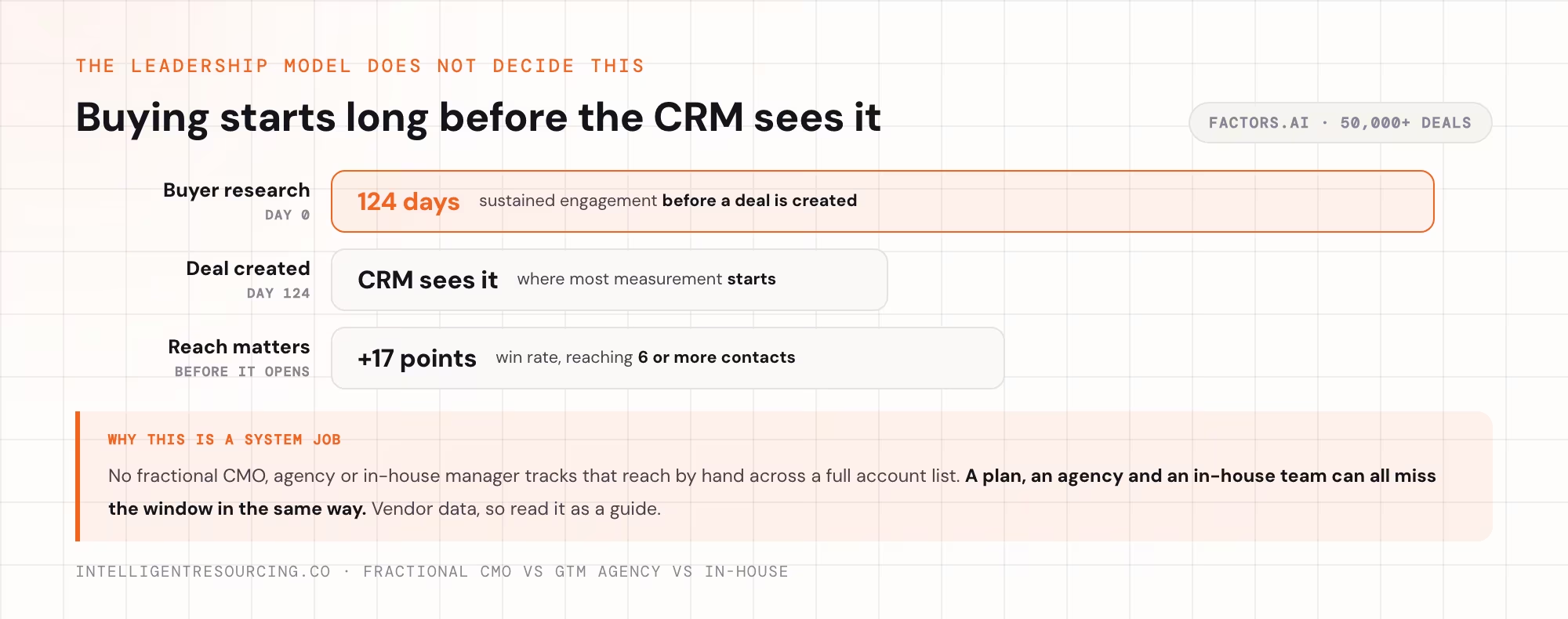
Choosing who leads the work leaves a second question open: does the work react to real buying signals? Buyer research starts about 124 days before a deal appears in the customer relationship management (CRM) system. That comes from Factors.ai's LinkedIn revenue report, which studied more than 50,000 closed deals. The data is from the vendor's own customers, so read it as a guide.
A plan, an agency and an in-house team can all miss that window in the same way. Two questions need separate answers.
- Leadership: who sets direction and executes the work
- Infrastructure: whether the system spots a funding round, a hiring spike or a new tool install and acts inside the buying window
The same report found that reaching 6 or more contacts at an account before a deal opens lifts win rates by 17 points. That is a job for the system, not the leader. No fractional CMO, agency or in-house manager tracks that reach by hand across a full account list.
The infrastructure layer is a GTM engineering job. It sits under all three leadership models.
Which Model Fits Your Stage and Budget?
The right model shifts as a startup moves through its first few quarters. The median Australian seed round was $2.5 million in 2025, says Cut Through Venture's funding report. That rarely covers all three models at once, so three situations cover most funded startups.
Pre-revenue or no proven buyer profile. Start with a fractional CMO. A wrong full-time hire costs more than a few months of senior judgement, and so does an agency executing the wrong plan.
Proven buyer profile, funded, no internal team. Start with a GTM agency. During selection, confirm the system and data stay with you when the contract ends.
2 or more quarters of repeatable pipeline. Build in-house. This is the one case where ownership beats both outsourced options on long-term cost and control.
Whichever model you pick, plan the execution layer as its own decision with Intelligent Resourcing.
GTM Engineering
Whichever model leads your go-to-market, price the system underneath it with Intelligent Resourcing so the plan runs as a working pipeline.
FAQs
Is a fractional CMO cheaper than a GTM agency?
Not reliably. Fractional CMO retainers in Australia run $10,000 to $18,000 a month, and GTM agency retainers run about $8,000 to $20,000. The ranges overlap, so scope decides which costs less.
Should a seed-stage startup use all three at once?
Rarely. Running a fractional CMO, an agency and a new hire together usually outruns a seed budget. Fill the most urgent gap first and add the next model as pipeline grows.
How fast can each model start producing results?
A fractional CMO can often start within days of a match. An agency needs a few weeks to onboard. A senior in-house leader needs a multi-month search, around 4 months by one United States estimate for C-suite roles, then several months to reach full output.
What should replace a model once it stops working?
Check the gap before switching. Changing the leadership model without fixing the real gap, whether direction, hands or infrastructure, repeats the same result.