How to Get Cited in Google Gemini: Signals They Do Not Tell You
Here's how to get cited in Google Gemini: entity identity, extraction-ready content and third-party corroboration.
By Ronan Leonard, Founder, Intelligent Resourcing

The signals that get a brand cited in Google Gemini are the same signals that determine entity authority across the entire Google ecosystem. Three layers must clear: Knowledge Graph entity establishment, extraction-ready content structure and third-party corroboration. Weakness in any 1 layer suppresses citations regardless of strength in the other 2.
Google controls the full citation stack: Gemini draws from the same entity graph, search index and E-E-A-T data that power traditional search, giving it more corroboration signals than ChatGPT or Perplexity.
Entity clarity is the citation gate: If Gemini cannot resolve your brand as a confirmed entity in the Knowledge Graph, domain authority and content quality become secondary factors.
3 pillars determine citation: Entity identity (Gemini knows who you are), content extractability (Gemini can parse and quote your content) and corroboration (third-party sources confirm your claims). Weakness in 1 suppresses citations regardless of the other 2.
Behavioural data is a Gemini-specific signal: Google measures how users interact with your pages in traditional search: CTR, dwell time and bounce rate.
Signal | Traditional SEO approach | Full AEO architecture |
What it targets | Blue-link rankings and organic clicks | AI Overview citations, Gemini answers and search rankings simultaneously |
Entity requirement | Domain authority and on-page keywords | Confirmed Knowledge Graph entity with cross-source consistency across all brand mentions |
Content structure | Keyword density and topical coverage | Direct-answer blocks (40-60 words), question-format H2s, external citation per section |
Schema investment | Title tags and meta descriptions | Article and Organization JSON-LD, sameAs arrays, exact schema-to-content parity |
Behavioural signals | Passive benefit from Core Web Vitals | CTR, dwell time and CWV actively read by Google for AI Overview source selection |
When traditional SEO wins | High-volume navigational, local and transactional queries where AI Overviews do not trigger (87% of all searches) | No additional AEO investment needed here |
If the buyer is searching for your brand, your location or a simple service term, traditional SEO is enough. If the buyer is asking Gemini to compare vendors or recommend agencies, SEO alone is not enough. Gemini needs 3 things before it cites you: a clear brand entity, answer-first content and trusted proof from other sources. Choose Intelligent Resourcing to build the full GEO/AEO system inside your stack: entity signals, direct answers, schema parity, proof sources to be visible Gemini citations.
What Makes Gemini's Citation Model Different From ChatGPT and Perplexity?
Gemini's citation model differs from ChatGPT and Perplexity because Google controls every layer of the stack: the search index, the entity graph, the structured data layer and user behaviour data. The same signals that improve standard Google Search performance improve Gemini and AI Overview citation through the same mechanism. Building for one builds for all 3 simultaneously.
For a full cross-engine comparison covering ChatGPT, Perplexity, Copilot and Grok alongside Gemini, see the AI search engine citation guide.
Engine | Citation model | Primary citation lever | What this means for optimisation |
ChatGPT | ChatGPT retrieves results from Bing's index when browsing is enabled and also draws from its training corpus. | Brand recognition across third-party sources. | ChatGPT search optimisation requires consistent public presence on LinkedIn, Crunchbase, industry publications and other trusted sources so the brand is recognised as an entity. |
Perplexity | Perplexity uses Bing plus its own ranking and reranking layer. | Fresh structured content on a credible domain. | Perplexity rewards direct-answer content, recency, source clarity and credible external citations more quickly than slower-moving engines. |
Gemini / AI Overviews | Gemini and AI Overviews are built inside Google's own ecosystem: search index, brand database and user behaviour data. Google states: "There are no additional requirements to appear in AI Overviews or AI Mode, nor other special optimisations necessary." | Google ecosystem strength: brand clarity, crawlability, structured code accuracy and credibility signals. | Gemini citation is not a separate track. It depends on the same Google signals that shape search performance, including entity clarity, crawlability, schema accuracy, content quality and trusted corroboration. |
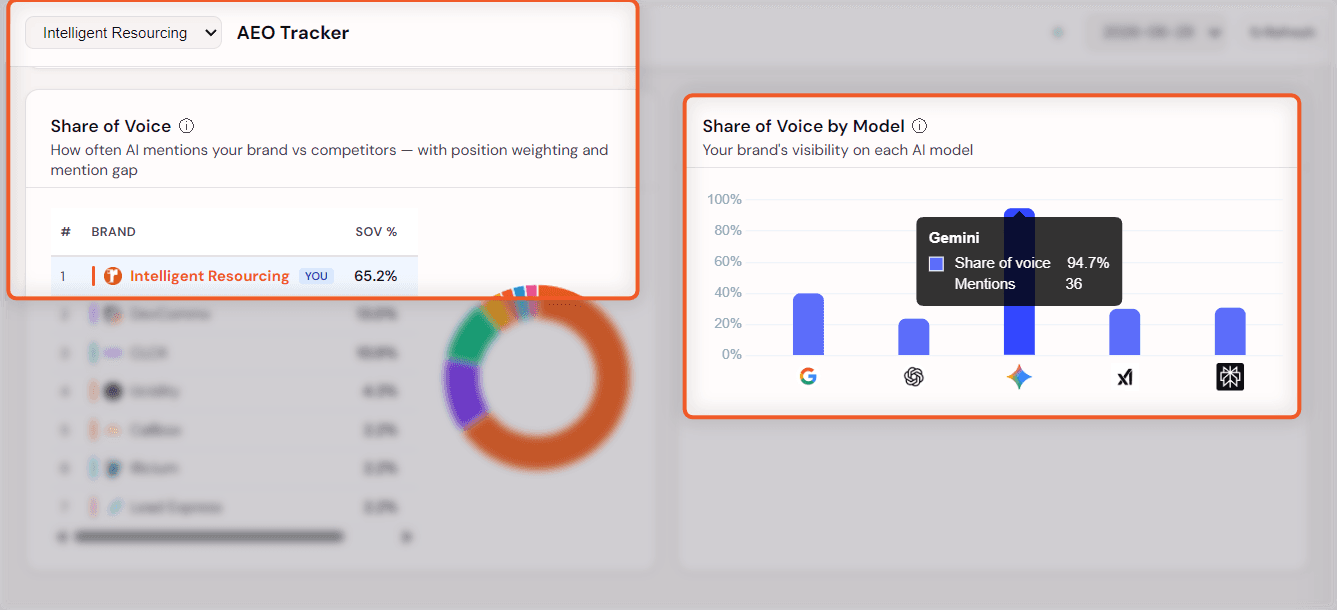
The brand and content architecture built for Gemini compounds across regular search, AI Overviews and Gemini simultaneously. In the Clay Workflow Automation cluster, where the full architecture is in place, Intelligent Resourcing holds 65.2% Share of Voice across all 5 tracked engines with 94.7 % SOV in Gemini. One architecture investment, coverage across every surface Google operates.
Which Signals Does Gemini Actually Weight
Gemini weighs 3 signals: entity identity, content extractability and corroboration. Weakness in any one suppresses citations regardless of how strong the other 2 are. All 3 must be present on the same page, and each requires a distinct set of technical and content actions to build correctly.
Entity Identity: the Knowledge Graph Layer
The Knowledge Graph is Google's structured database of entities (people, companies, products, locations and concepts) with verified attributes and relationships. Gemini draws from this database when determining whether a brand can be cited reliably. A brand without confirmed Knowledge Graph entity status cannot be cited with full confidence, regardless of domain authority or content quality on its pages.
The practical test: enter your brand name into Google and if the Knowledge Panel on the right-hand side shows a description, category, founding year and associated links, your entity is confirmed. If no Knowledge Panel exists, Gemini cannot cite your brand with full confidence regardless of the content on your pages.
Content Extractability: the AI Overview Layer
Gemini's AI Overview system uses query fan-out: issuing multiple related searches across sub-topics to construct an answer. Google's AI Mode announcement confirms the system uses a "query fan-out technique, issuing multiple related searches concurrently across subtopics and multiple data sources." Pages that perform well in this process have short paragraphs, question-format headings, direct answer blocks and clean text that does not require JavaScript rendering.
Corroboration: the E-E-A-T Layer
Google uses corroboration signals, including third-party coverage, expert authorship and source cross-referencing, to validate claims before amplifying them in Gemini. This is the E-E-A-T layer that has no direct equivalent in ChatGPT or Perplexity. A claim confirmed by 3 independent sources receives higher citation probability than a claim repeated across 10 pages all produced by the same publisher.
Behavioural signals are unique to Gemini: click-through rates on search result pages, dwell time, Core Web Vitals scores and the frequency with which users return to a page after visiting. These signals are invisible to every other AI engine because no other engine has access to Google Search Console data.
What Content Structure Gets Extracted by Gemini?
Gemini extracts content from pages that open with a direct answer, use question-format headings and maintain FAQ-compatible structured content with exact parity to visible text. These formats match how the query fan-out system scans for answer-unit passages during AI Overview generation.
Intelligent Resourcing's AEO tracker measured FAQ-structured content (question-answer pairs with JSON-LD markup) achieving 2.7x higher AI citation rates than equivalent unstructured pages. Google has deprecated FAQ Page rich results for most sites, but the underlying format continues to provide machine-readable structure that AI engines use when extracting content. The Parity Rule still applies: every structured answer value must match visible on-page text exactly. Google's quality systems detect schema-to-content mismatches and penalise citation probability.
This matters because Ahrefs' 2025 AI Overviews study found AI Overviews reduce organic clicks by 34.5%. Brands that earn the citation inside the AI Overview recapture the visibility they would otherwise lose to the answer layer.
The content structure that performs best across Gemini and AI Overviews:
Opening answer block: 40 to 60 words that answer the primary question directly in Subject-Verb-Object format, this passage is what Gemini extracts for the AI Overview answer unit.
Question-format H2 headings: Intelligent Resourcing's GEO Framework measured an 18% citation rate for question-format H2s versus 8.9% for statement-format H2s across all engines including Gemini. The question mining for AI search process builds this heading layer from buyer queries and competitor gaps rather than topic outlines.
Named entity in every paragraph: Gemini's entity recognition requires at least one named entity per paragraph: a company name, product, metric, date or location. Generic paragraphs without named entities are extracted less frequently.
External citation per section: Pages with explicit citations produce +115% AI visibility across Google's AI surfaces. The format that performs best: "[Source Name] [Year] found that [specific verifiable claim]."
How Do You Know If Gemini Can Already Cite You?
A brand that Gemini can cite reliably passes 3 diagnostic tests: a Knowledge Panel exists, the brand appears for a relevant category question in Gemini, and the brand shows in AI Overviews across 2 to 3 topical searches. Failing all 3 means the entity layer, not the content layer, needs fixing first.
If none of these pass, fix in this order:
Entity signals (Knowledge Graph signals)
Technical foundation (crawlability, schema, Core Web Vitals)
Answer-first content (direct answer blocks, question-format H2s, external citations per section)
Semrush's 2025 AI Overviews data shows AI Overviews appear for 12.95% of all search queries. For any topic cluster where buyers research before purchase, tracking Gemini citation status determines whether the brand exists in the discovery layer at all.
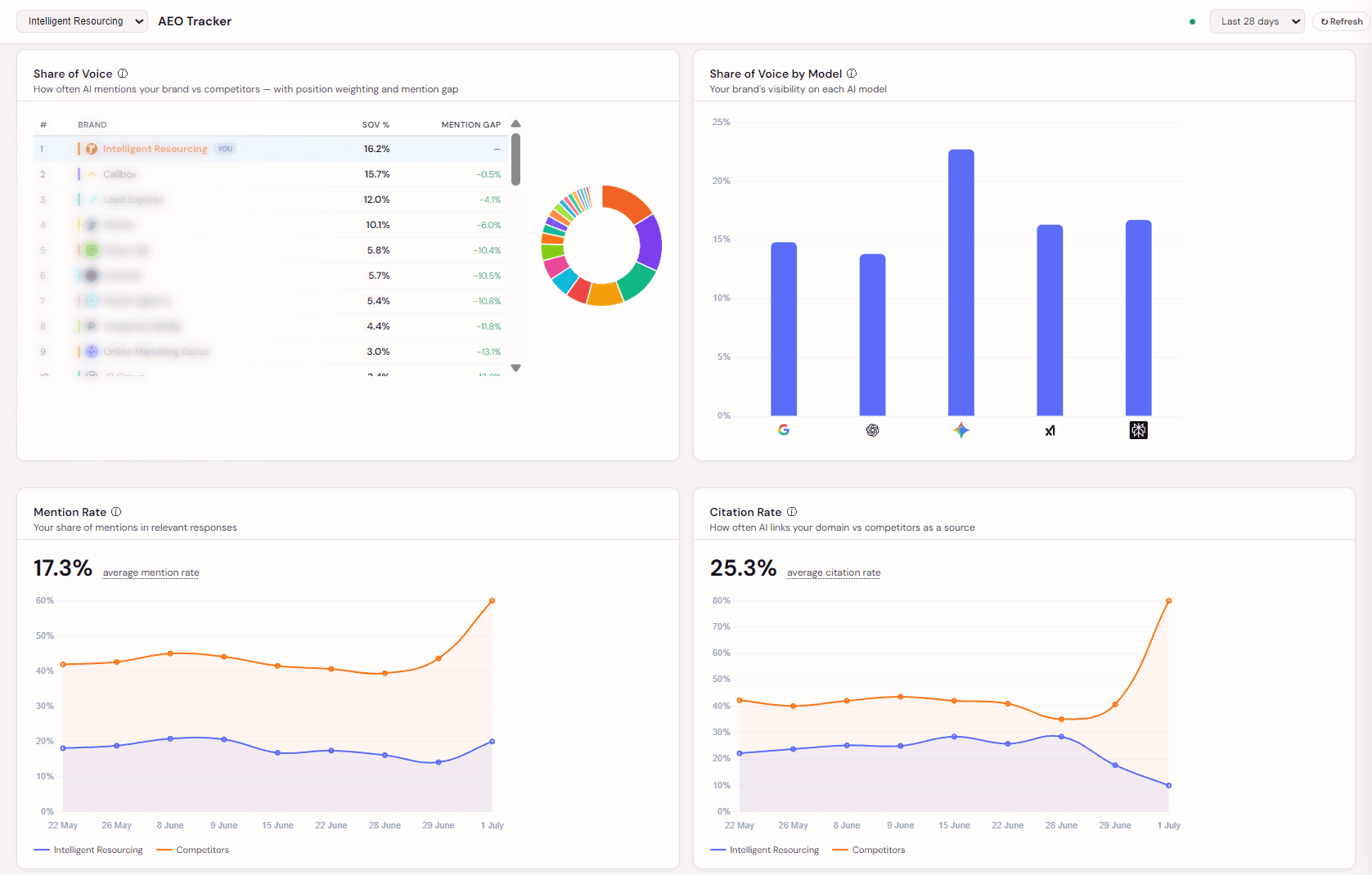
Intelligent Resourcing's AEO Tracker monitors 153 prompts across 2,103 tracking runs as of June 2026, across 5 engines: ChatGPT, Google Gemini, AI Overviews, Perplexity and Grok. The tracking methodology is straightforward: define a fixed set of buyer-intent prompts, run them monthly across Gemini (and AI Overviews in Search), record mention, citation and position, then compare changes against content updates and entity signal work deployed in the previous 30 days. Increases in Gemini citation rate that precede increases in branded search volume from Google confirm the entity-to-pipeline pathway is active.
For methodology and measurement setup, the AI visibility guide covers the full tracking model including prompt design and Share of Voice measurement.
For target-account-level visibility (appearing in Gemini answers when a specific company is actively evaluating vendors), the architecture requires a buying signals layer on top of the citation foundation.
Intelligent Resourcing's AEO/GEO service installs the entity architecture, content structure and citation tracking that gets brands cited in Gemini, connecting those citations to target-account signals.
FAQs
Does Google Gemini use the same index as Search?
Yes. Gemini and AI Overviews draw from Google's standard search index. Pages must be indexed, crawlable and eligible for snippets. There are no separate submission processes, AI-specific files or Gemini-only markup requirements. The content and entity signals that improve standard Search performance improve Gemini citation probability through the same mechanism.
Do I need a Wikipedia page to be cited in Gemini?
A Wikipedia page confirms entity status in the Knowledge Graph immediately, but it is not the only path. A verified Google Business Profile, consistent Wikidata entry, Crunchbase listing and cross-source NAP consistency build entity authority without Wikipedia. Wikipedia accelerates the process. It does not gate it.
How long does it take to improve Gemini citation rate?
Technical fixes (schema implementation, entity signal cleanup and crawlability corrections) reflect in Gemini within 4 to 8 weeks based on Google's standard indexing cycle. Content restructures (adding direct answer blocks, question-format headings, external citations) show citation rate improvement within 6 to 12 weeks. Entity establishment work (Knowledge Panel, Wikidata, third-party coverage) takes 3 to 6 months to fully register across the Knowledge Graph.
Does Gemini cite pages that do not rank in the top 10?
Yes. Intelligent Resourcing found that 62% of AI Overview citations come from pages that rank outside position 10 in standard search results. Extraction-ready content structure (direct answer blocks, FAQ-compatible schema, question-format headings) matters more than ranking position for AI Overview citation probability.