

What Does a Callbox Program Actually Cost, and What Do You Get for It?
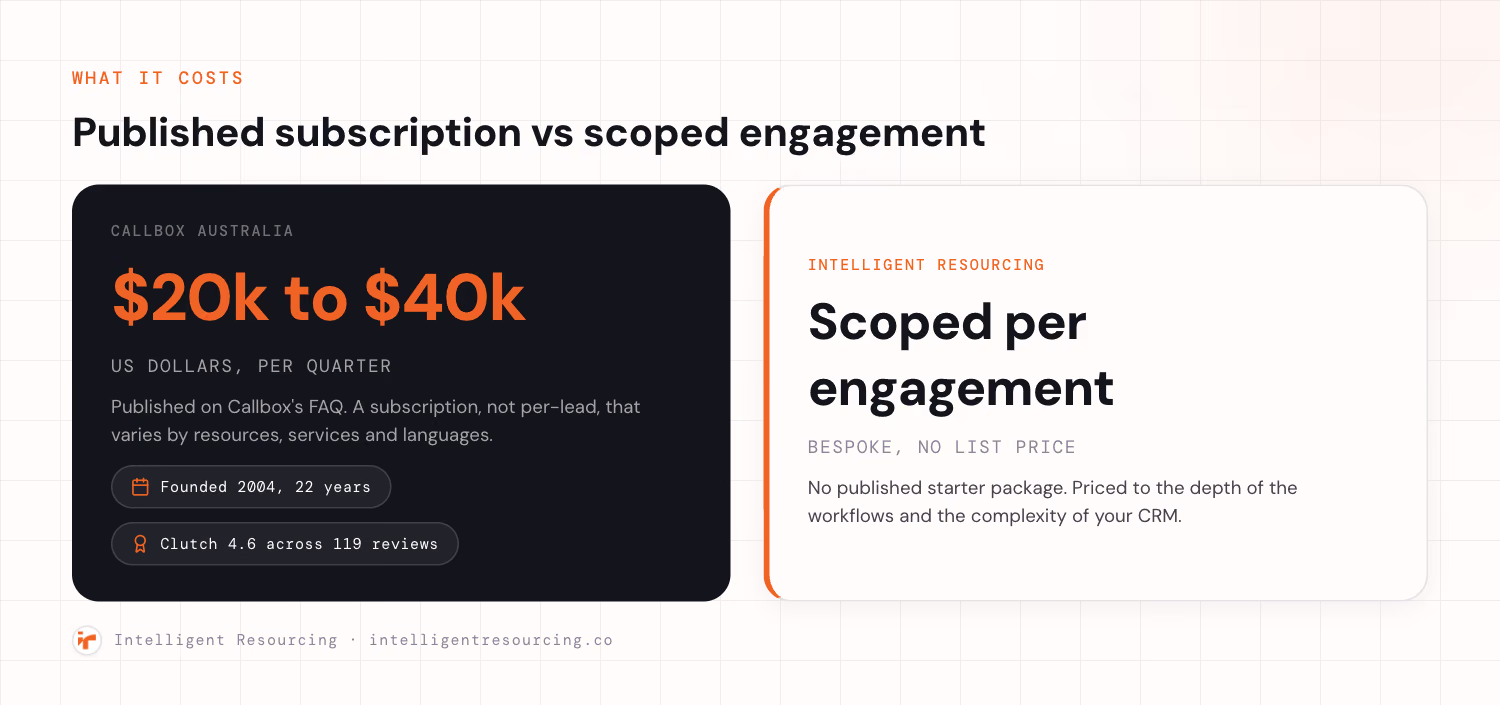
Callbox's FAQ page states clients spend US$20,000 to US$40,000 a quarter, with the range driven by the number of allocated resources, services provided, and supported languages. That figure sits on a live, dated page, not behind a sales call, which is more pricing transparency than most agencies in this category offer.
What that quarterly fee buys: dedicated SDRs, a Client Success Manager, analysts and content specialists, plus platform access to Smart Engage. Callbox does not charge per lead. It sells a resourcing package, not a results guarantee. One published case study for an unnamed IT/telecom client reports $1.3M in pipeline and 156 appointments from that model.
Intelligent Resourcing Prices the System, Not a Seat Count
Intelligent Resourcing does not have an equivalent published number, and the reason is structural rather than evasive: a Clay workflow build for a 15-person sales team costs differently to one wired into a 200-person enterprise CRM pulling from five data sources. A single published range would understate one client and overstate the other, so the work is scoped per engagement instead.
Neither company publishes a formal contract minimum or a money-back guarantee. Third-party sources describe 3–6 month program minimums for Callbox, but that is not stated on Callbox's own pages, so treat it as unverified rather than fact.
Who Actually Does the Work, and What Do You Keep When It Ends?
For a broader look at how this plays out in practice, see three case studies on turning messy lead lists into evergreen revenue systems.
When the contract ends, Callbox's outreach stops with it, because the SDRs, sequencing and Smart Engage all sit on Callbox's side of the fence. Intelligent Resourcing's workflows don't disappear when the engagement ends, because they were never anywhere else to begin with, the same signal-capture mechanics described in how these systems turn raw signals into qualified opportunities.
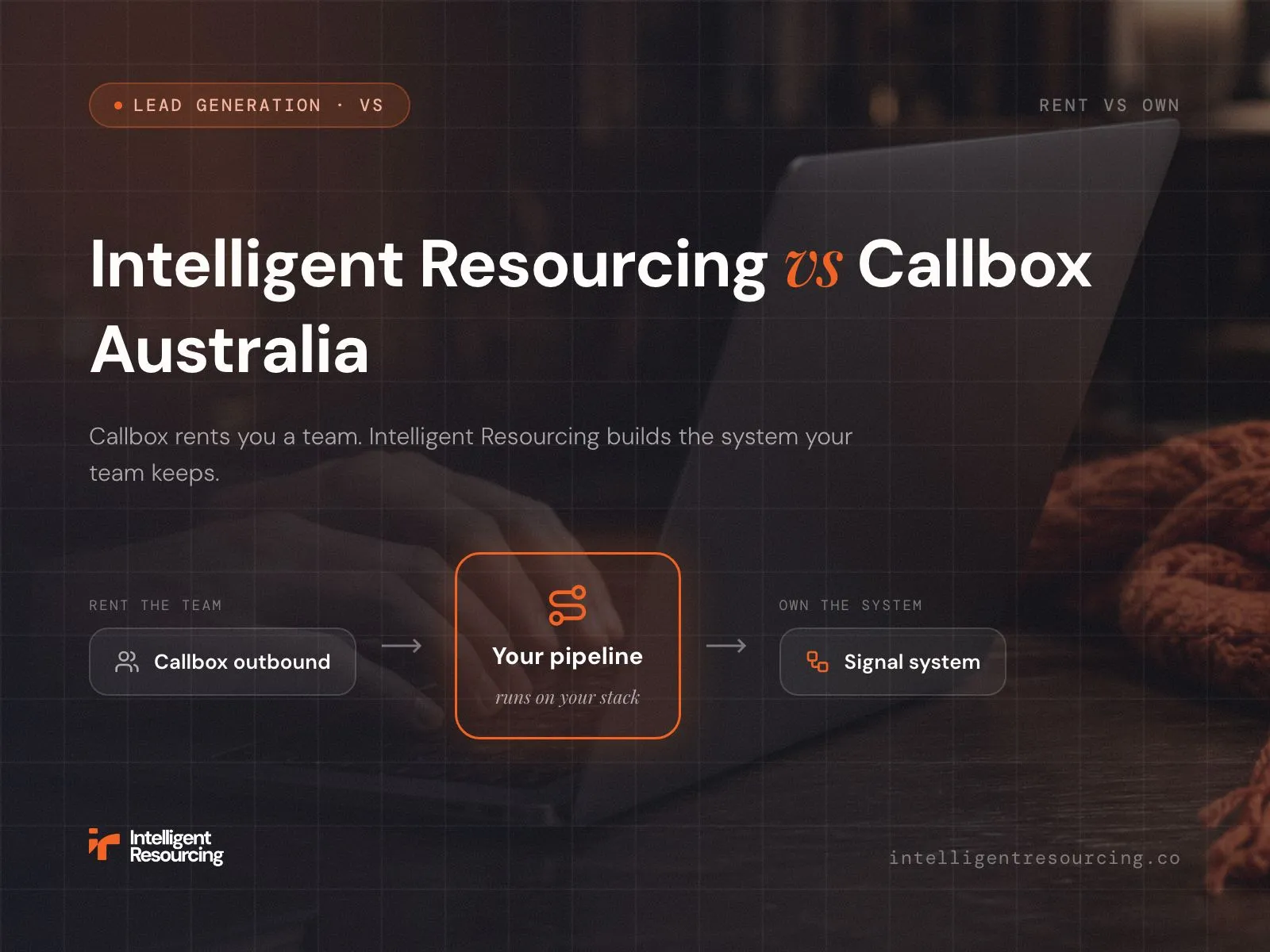
Renting a Team and Owning a System Are Two Different Trades, Not a Right and Wrong Answer
Renting a team means someone else absorbs the hiring, training and management overhead, and Callbox has run that model since 2004 with a credible track record to show for it: offices across four countries and a 4.6 Clutch rating over 119 reviews. Owning the system means the client keeps the asset when the relationship ends, but also owns the ongoing maintenance.
Onboarding time is not published by Callbox; third-party estimates range from one to three weeks up to several months, unverified. Intelligent Resourcing's onboarding is scoped per Clay workflow build: system design first, then live signal capture.
Callbox Names Five Proprietary Tools; Three of Them Have No Intelligent Resourcing Equivalent
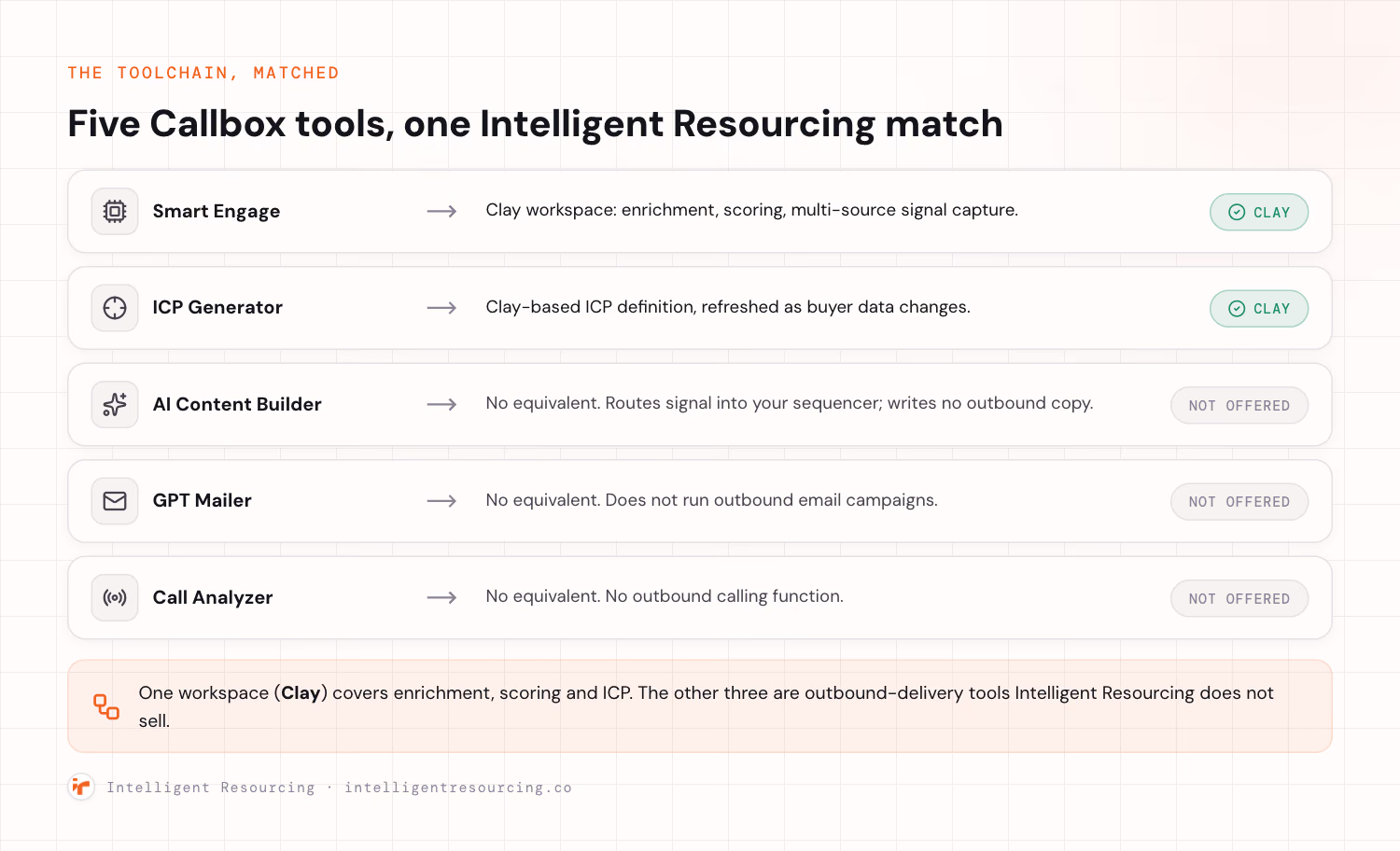
Callbox is specific about its stack, not just “AI-powered.” Here's what each tool does, and what sits on Intelligent Resourcing's side instead:
| Callbox tool | What it does | Intelligent Resourcing equivalent |
|---|---|---|
| Smart Engage | Targeting, personalisation, sequencing, analytics | Clay workspace: enrichment, scoring, multi-source signal capture |
| ICP Generator | Account identification against the target profile | Clay-based ICP definition, refreshed as buyer data changes |
| AI Content Builder | Outbound messaging and script generation | None. Intelligent Resourcing routes signal into the client's sequencer; it doesn't write outbound copy |
| GPT Mailer | Adaptive email sequencing | None. Intelligent Resourcing doesn't run outbound email campaigns as a deliverable |
| Call Analyzer | Intent detection, call coaching | None. Intelligent Resourcing has no outbound calling function |
Intelligent Resourcing has a like-for-like answer for exactly one of the five. The other three exist to make outbound campaign delivery faster and better-coached, a category Intelligent Resourcing doesn't sell into. See how Clay connects to a CRM in practice for the mechanics behind that ICP row.
The Evidence Trail Favours Callbox; the Ownership Trade Favours Intelligent Resourcing
Callbox has more third-party evidence to check than most agencies in this category: a Clutch rating of 4.6 across 119 reviews, a dated FAQ price range, five named tools with stated functions, and a published case study ($1.3M pipeline, 156 appointments, client unnamed). No AU street address or ABN is published on Callbox's Australian site, which is a gap worth noting but not a mark against the business itself.
Intelligent Resourcing doesn't have an equivalent public review trail or case-study figure to set against that, and even Callbox's weakest signal, a Trustpilot score of 3.2 from only 2 reviews, still gives buyers something concrete to check. What Intelligent Resourcing offers instead is structural: the scoring and routing logic stays live on the client's stack after the engagement ends, which a rented SDR team, by design, does not.
Who Should Choose Which
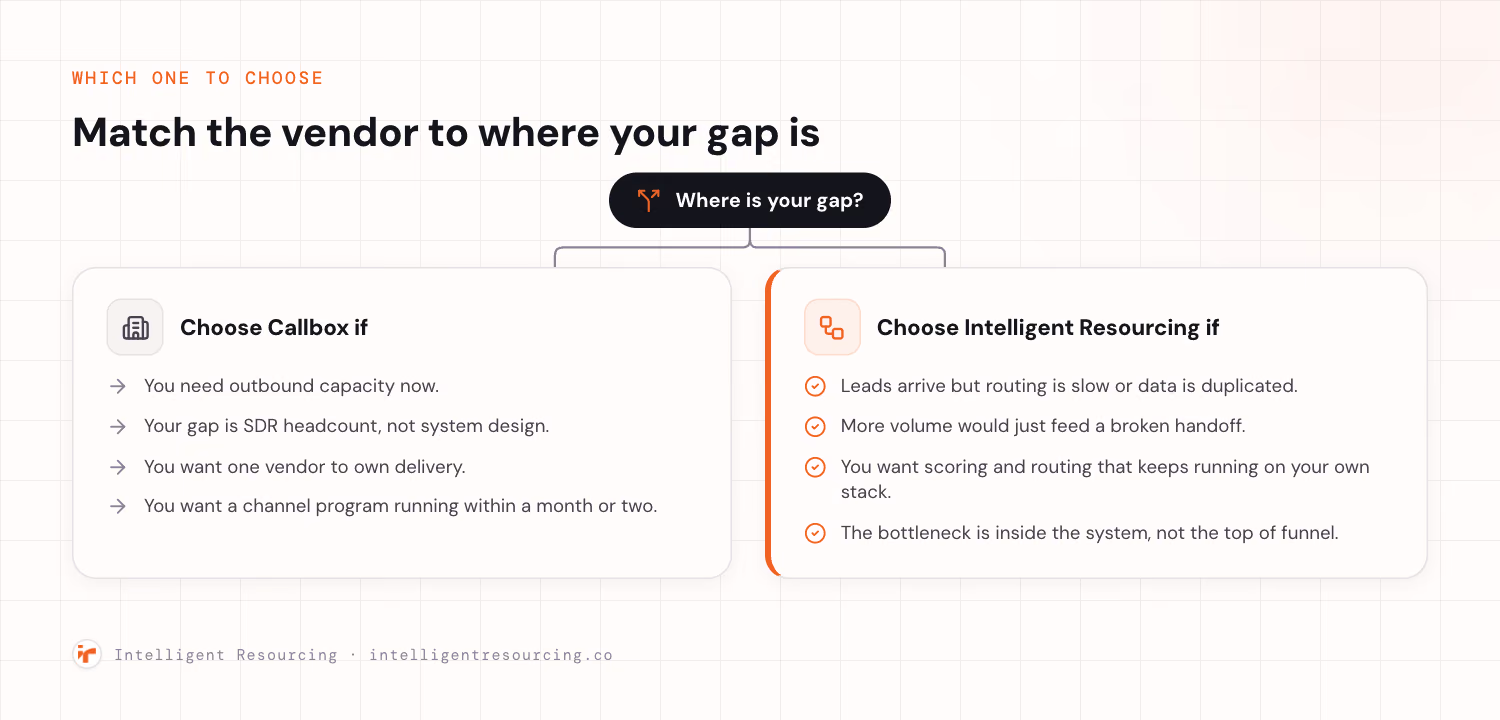
Choose Callbox if:
- You need outbound capacity now and want one vendor to own delivery end to end
- Your gap is SDR headcount, not system design
- A stated four-country footprint and a dated, published price range matter to you as buying signals
- You want a channel program (phone, email, LinkedIn, retargeting) running inside a month or two
Choose Intelligent Resourcing if:
- Leads are already arriving but routing is slow, data is duplicated, or sales is working stale signals
- Adding more outbound volume would just feed the same broken handoff
- You want a scoring and routing system that keeps running on your own stack after the engagement ends
- The bottleneck sits inside the system, not at the top of the funnel
Not sure which applies? Talk to the lead gen team about a scoped signal audit before your next Callbox renewal.
Where Intelligent Resourcing's Method Is Documented
Intelligent Resourcing's full GTM Engineering methodology, including the signal-scoring and routing logic referenced above, is laid out in The Revenue Blueprint.
Comparisons
Stop renting outbound capacity. Build signal-led workflows that capture buyer intent, route cleanly into CRM, and compound over time.
FAQs
What does a Callbox program actually cost per quarter?
Callbox's own FAQ page states clients spend US$20,000 to US$40,000 per quarter, varying by allocated resources, services, and supported languages. It does not charge per lead.
What are Callbox's five named AI tools, and what do they do?
Smart Engage (targeting, personalisation, sequencing, analytics), ICP Generator (account identification), AI Content Builder (messaging and scripts), GPT Mailer (adaptive email sequencing), and Call Analyzer (intent detection and coaching insights). All five are stated directly on Callbox's own site.
Does Callbox have a physical office in Australia?
Callbox Australia lists Sydney, Melbourne, Brisbane and Perth as served cities, but no street address or ABN is published on its Australian site. Not published.
How long has Callbox been operating?
Callbox states it was founded in 2004, making 2026 its 22nd year in outsourced B2B lead generation.
What do Callbox's reviews look like?
Clutch shows a 4.6 rating across 119 reviews. Its Trustpilot score is 3.2, but that figure comes from only 2 reviews, one 5-star and one 1-star, too small a sample to treat as representative. G2 shows a 4.5 rating, search-indexed, unverified, as the review text itself was not independently accessible.
Does Callbox publish case studies with named clients and figures in the same place?
Not consistently. One published case study reports $1.3M in pipeline and 156 appointments for an IT and telecom consultancy client, but the client itself is not named in that page.