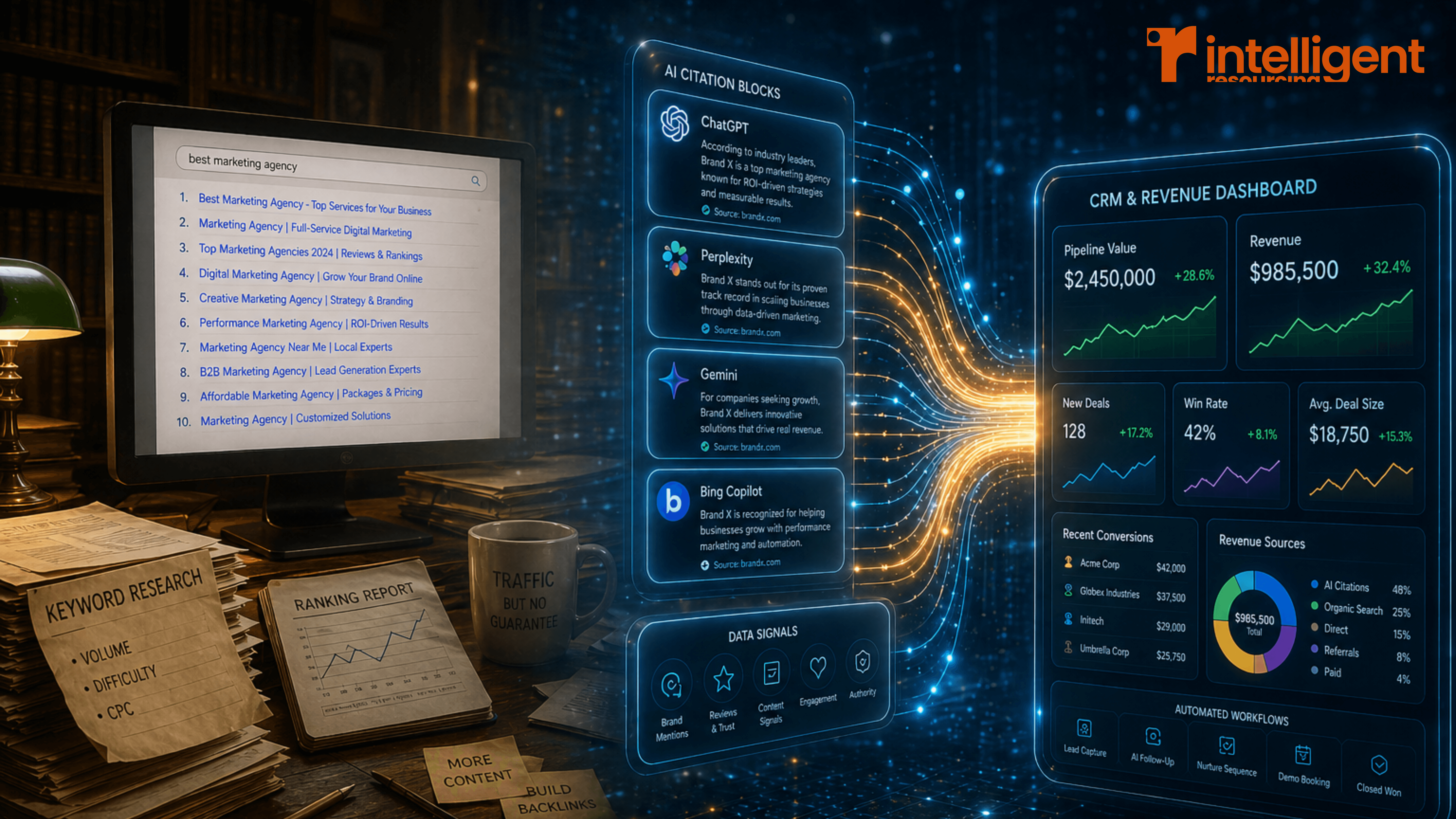
AI Search Marketing for B2B: From Buyer Questions to Pipeline (2026)
Page one rankings do not guarantee AI Citations. Here is why your competitors are already investing in AI search marketing and how to catch up.
By Ronan Leonard, Founder, Intelligent Resourcing
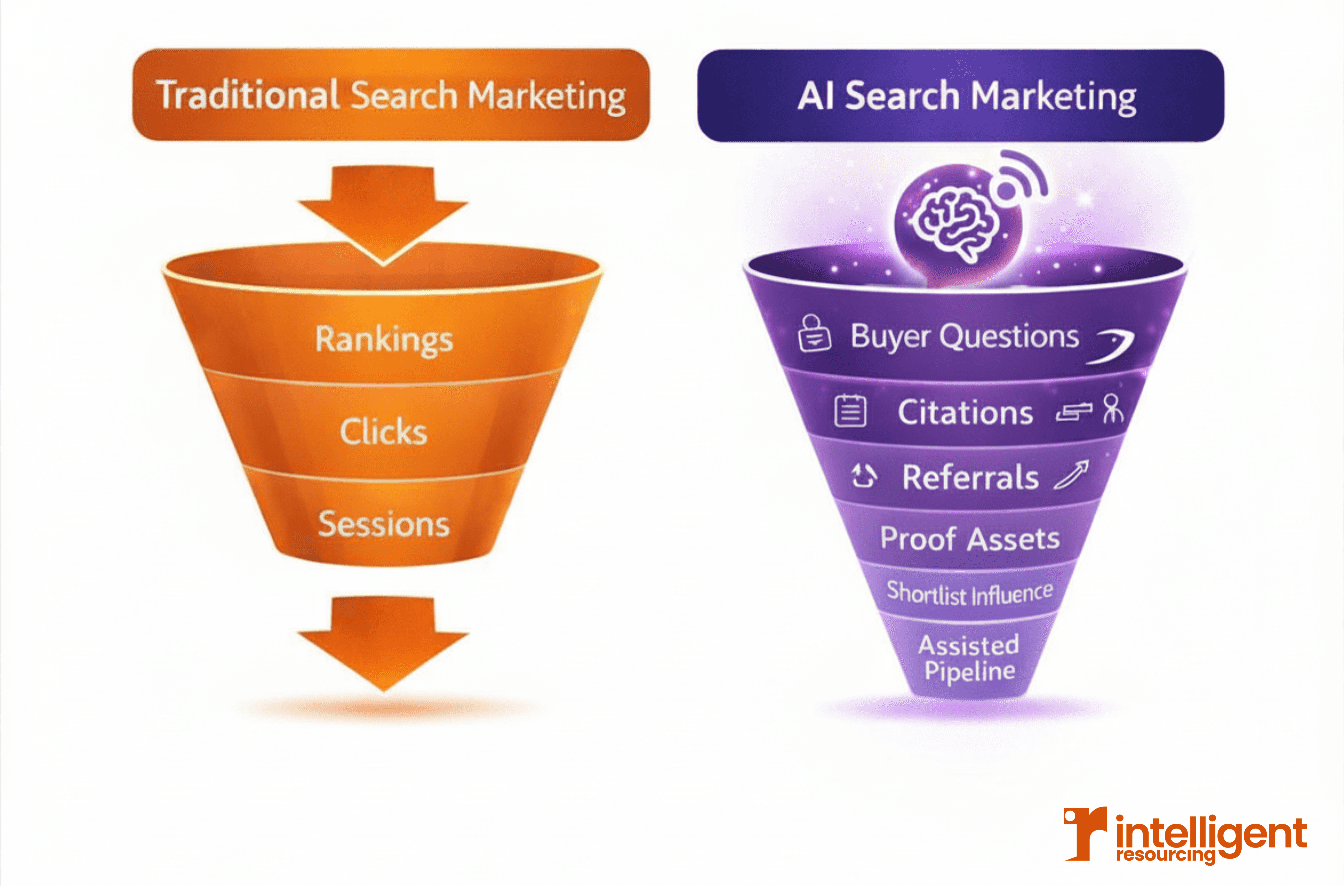
AI search marketing is the strategy of making your brand visible, cited and trusted across AI-assisted buyer journeys. It goes beyond rankings by focusing on the buyer questions, shortlist influence and commercial pages that shape the pipeline before a prospect ever converts.
Earn visibility inside AI tools to influence shortlist decisions before buyers ever land on your site.
Treat AI referrals as a strategic signal to spot commercial influence that standard SEO reports often miss.
Prioritise service pages, comparison pages, pricing pages and proof-led assets to answer the questions that shape vendor choice.
Measure referral quality, landing page mix and assisted pipeline to track buyer influence, not just visit volume.
Add AI search marketing on top of SEO to expand answer-layer visibility without weakening your organic engine.
Criteria | Traditional search marketing | AI search marketing |
Main goal | Win visibility in search results | Win visibility, citations and influence in AI-assisted research |
Core unit | Keyword and landing page | Buyer question and source asset |
Primary output | Rankings, clicks sessions | Mentions, citations, referrals, shortlist influence |
Best-performing assets | Rankable pages | Citation-ready service, comparison, pricing, and proof pages |
Reporting focus | Position, CTR, sessions | Referral quality, source-page visits, visibility share, assisted pipeline |
Strategic risk | Missing rankings | Being absent from the answer layer before the click |
If you add AI search marketing as a dedicated strategy layer on top of your existing SEO, then your brand can appear, get cited and get chosen while buyers are forming shortlists inside AI tools before the first website visit.
If you rely on rankings alone, then your brand may be completely absent from the research phase where shortlist decisions are already being made, and analytics will never record the influence you lost.
What “AI search marketing” actually means
AI search marketing is the strategy of making your brand visible, cited and trusted across answer-driven buyer research journeys. It is not SEO with a newer label. It is a broader layer that sits on top of search, content, proof, and measurement.
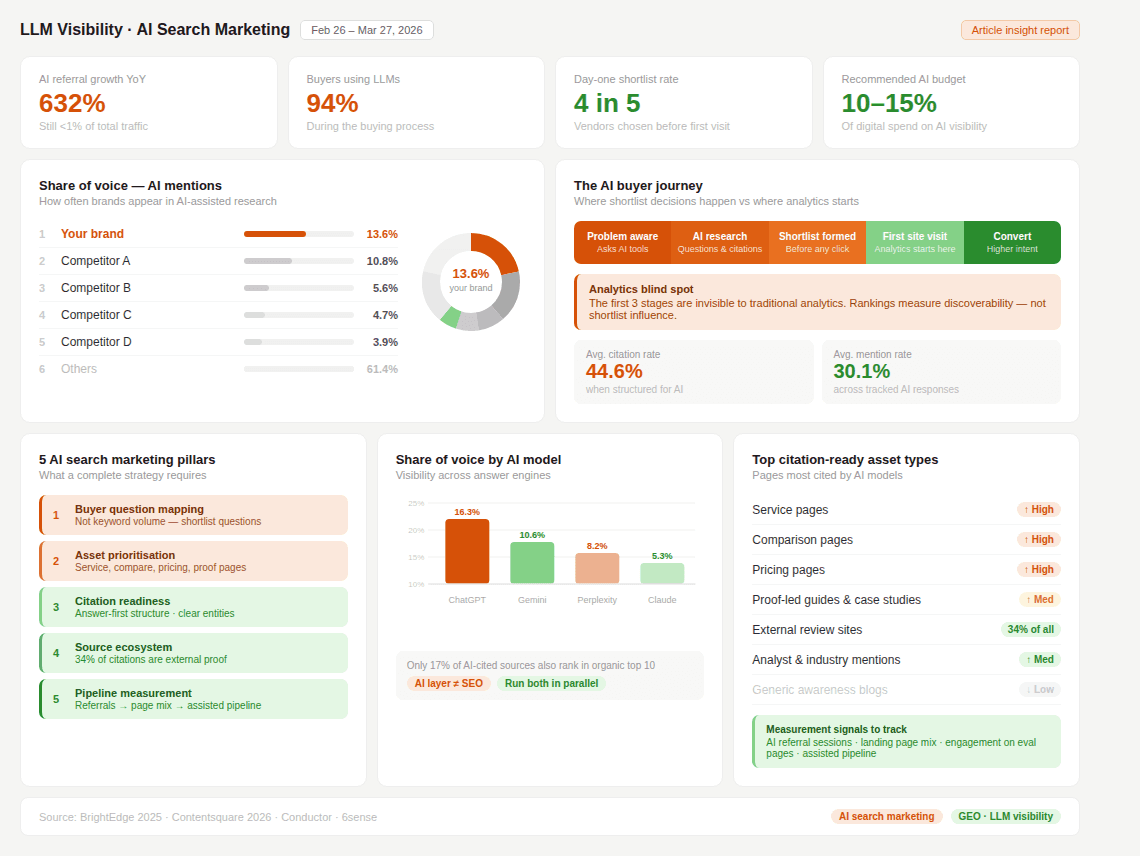
The shift is already underway. Generative AI is now one of the top self-guided information sources across every stage of the B2B buying process. 94% of buyers use LLMs somewhere during buying.
That changes the strategic unit. In traditional search, the unit is the keyword and landing page. In AI search marketing, the unit is the buyer question and the assets that answer it well: service pages, comparison pages, proof pages and commercial pages. ChatGPT prompts rose by nearly 70% in the first half of 2025, confirming the shift towards question-led discovery.
The commercial question is no longer whether your page can rank. It is whether your brand appears when buyers ask AI systems the questions that shape the shortlist. That is the job of generative engine optimisation services.
Why rankings and impressions are no longer enough
Rankings show a page is discoverable. They do not show whether buyers are seeing your brand in AI-assisted research, encountering competitors first, or forming opinions before the first visit. Buyers will spend more of the process with answer engines and less time engaging directly with vendors.
The traffic benchmarks all point in the same direction. AI referrals are under 1% of traffic in BrightEdge's 2025 dataset. Contentsquare puts AI-referred traffic at 0.2% of total traffic despite 632% year-on-year growth. Conductor reports 1.08% average AI referral traffic across 10 industries.
The figures come from different datasets and time windows but the conclusion is consistent. AI traffic is still smaller than classic organic traffic. It is also growing too fast and converting too well to treat as a rounding error.
The new B2B buyer journey in the AI layer
B2B buyers are now researching inside AI tools before they engage with a vendor. The research phase has not disappeared. It has moved. 89% of B2B buyers have adopted generative AI, and answer engines are a core part of how buyers gather and filter information before direct engagement.
The shortlist implications are significant. 94% of buyers use LLMs during the buying process, and buying groups place four out of five vendors on the shortlist from day one. That means AI search marketing is not a traffic channel. It is a shortlist-shaping channel.
The behavioural shift is accelerating across all buyer types, not just early adopters. Buyers are increasingly using AI interactions to explore questions, compare options and compress what used to take days of research into a single session. Brands that are not visible during that phase are not just missing traffic. They are missing shortlist consideration entirely.
What an AI search marketing strategy actually includes
An AI search marketing strategy has five parts. Brands that skip any one of them end up with either invisible content or unmeasurable results.
1. Buyer-question mapping
The starting point is not keyword volume. It is which buyer questions shape vendor choice, product fit, pricing confidence and implementation trust. That question-led model is what separates AI search strategy from standard SEO planning.
2. Asset prioritisation
Not every page deserves equal effort. The highest-value assets are service pages, comparison pages, proof-led guides, case studies and pricing pages. These map directly to the questions buyers ask when moving from research into evaluation.
3. Citation readiness
Pages need answer-first structure, clear entities and credible proof. This is where LLM SEO becomes the mechanics layer inside the broader strategy.
4. Source ecosystem building.
Buyers and answer engines both look for external proof. Buyers rely heavily on external validation during vendor evaluation. AI search marketing cannot be only about your own website.
5. Measurement.
AI search marketing only becomes a serious channel when you can connect visibility to referrals, page-level engagement, and eventual commercial movement. AI referrals are becoming measurable enough to benchmark even while they remain smaller than classic organic traffic.
Where budget should go first
The safest budget move is a layered investment model. Keep SEO intact and add AI search as a dedicated growth layer on top.
1. Protect the organic engine
Do not strip budget from traditional SEO to fund AI experiments. Traditional organic search remains the primary revenue driver. Only 17% of AI-cited sources also rank in the organic top 10.At the same time, AI referral traffic grew 632% year on year and is accelerating across every industry tracked. You need both channels running in parallel.
2. Fund the AI growth layer
That 632% growth means buyers are already using AI tools to form shortlists before they visit your website. Influence is being lost before analytics records a single session. The buyers who do arrive from AI referrals convert at higher rates because they arrive deeper in the decision funnel. That is why industry guidance points to 10 to 15% of the digital budget allocated specifically for AI visibility and GEO work. The goal is to capture pre-visit influence before competitors do.
3. Prioritise shortlist assets.
If buyers are forming shortlists inside AI tools before they visit your site, the pages most likely to influence that decision need to be the best-funded and best-structured assets you have. Budget should prioritise three asset types:
Commercial clarity. Service pages, pricing tables and comparison pages that answer evaluation questions directly.
Third-party proof. External review sites and industry publications account for 34% of AI citations. On-page clarity alone is not enough.
Machine readability. Technical SEO and structured data that ensure AI crawlers can access and interpret your value proposition before a buyer ever lands on the page.
What channels and assets matter most
The assets most likely to influence the shortlist are not generic awareness blogs. They are the pages that answer serious evaluation questions directly: service pages, category pages, comparison pages, pricing pages, case studies and proof-led guides.
Channel strategy also needs to extend beyond your own website. Buyers increasingly rely on external buying networks to justify and de-risk decisions. External proof, analyst mentions, reviews and third-party sources matter as much as your own pages in many B2B categories.
ChatGPT search optimisation is a strong starting point, but the bigger opportunity is being present wherever buyer questions are being answered and validated across every AI interface buyers actually use.
How to Measure AI Search Marketing Properly
Start with what you can observe directly. AI referral traffic is still a minority channel compared with traditional organic search, but it is measurable and benchmarkable now.
The most useful internal measures are four things:
AI referral sessions. Track visits from utm_source=chatgpt.com and equivalent parameters from other AI platforms.
Landing page mix. A visit to a service page or comparison page carries more weight than a visit to a low-intent article.
Engagement on high-value pages. Are cited visitors viewing pricing, proof or evaluation pages after landing?
Assisted commercial outcomes. Connect AI referral sessions to pipeline movement, not just traffic volume.
This is where AI visibility becomes the more useful reporting layer. The strategic question is not just whether traffic exists. It is whether the right buyer questions and pages are involved.
Common mistakes B2B teams make
Most B2B teams make the same five mistakes with AI search marketing: wrong assumptions, misallocated budget, incomplete measurement, generic content and ignored proof sources.
Treating AI search as a passing trend. AI use is already embedded in the buying process. It is part of modern demand capture, not a side experiment.
Moving budget out of SEO. AI referral traffic is growing but still much smaller than core organic search. The smarter move is to add a dedicated AI search layer, not weaken the channel that carries most of the volume.
Measuring only traffic. AI search marketing is about shortlist influence, buyer-question coverage and whether high-value pages are being surfaced. Sessions alone miss the point.
Publishing generic content with no buyer-journey logic. Conversational, question-led research is rising fast. Brands that respond with vague awareness content will lose to brands that build direct, decision-ready assets.
Ignoring third-party proof sources. If buyers use AI to compress research, they also need reasons to trust what they see. External proof matters as much as on-page clarity in most B2B categories.
The practical takeaway for B2B teams
AI search marketing is not a replacement for SEO. It is the strategy layer that sits on top of SEO, content, proof and measurement.
The practical question is no longer whether AI search matters. It is whether your brand is visible when buyers ask the questions that shape vendor choice. Buyers are already using AI during research. LLM use in buying is widespread. AI referral traffic is small but measurable and growing fast.
That is the strategic job of the GEO engine: connecting buyer-question strategy, citation readiness and measurable demand into one operating model.
FAQs
What is AI search marketing?
AI search marketing is the strategy of improving how your brand appears, gets cited, and drives measurable value across AI-assisted search and research journeys. It is broader than one platform and broader than a standard rankings report.
Is AI search marketing different from SEO?
Yes, but it builds on SEO rather than replacing it. Traditional SEO remains the foundation for discoverability, while AI search marketing adds the layers needed for buyer-question visibility, shortlist influence, and citation-ready assets. The traffic benchmarks from BrightEdge and Conductor support keeping SEO intact while adding AI-focused work on top.
Is AI search traffic big enough to matter?
It depends on your market, but the benchmarks now show it is big enough to monitor and plan for. BrightEdge says AI referrals were under 1% in its 2025 dataset, Contentsquare says AI-referred traffic was 0.2% of total traffic in its 2026 benchmark, and Conductor reports an average of 1.08% across 10 industries. All three also point to meaningful growth from that base.
Should brands move budget out of SEO and into AI search?
Usually no. The safer approach is to maintain core SEO investment and fund AI-search work as a ring-fenced strategy layer. That recommendation is an inference from current traffic benchmarks rather than a universal law, but the benchmark data strongly supports it.
What should a B2B team prioritise first?
Start with the buyer questions and commercial pages most likely to affect shortlist formation: service pages, comparison pages, pricing pages, case studies, and proof-led assets. 6sense’s evidence on day-one shortlist formation is the strongest reason to prioritise those pages first.
Optimise for Buyer Influence
Impressions and rankings still matter. They are no longer enough on their own.
Buyers are using AI-assisted research to ask broader questions, compare vendors and narrow choices before the first click. The brands that win will not just be the ones with visible pages. They will be the ones with visible answers, credible proof, shortlist influence and a content stack built around the questions that move the pipeline.
Do not optimise only for search presence. Optimise for buyer influence across the answer layer.