

What is the difference between AI SEO, AEO and GEO?
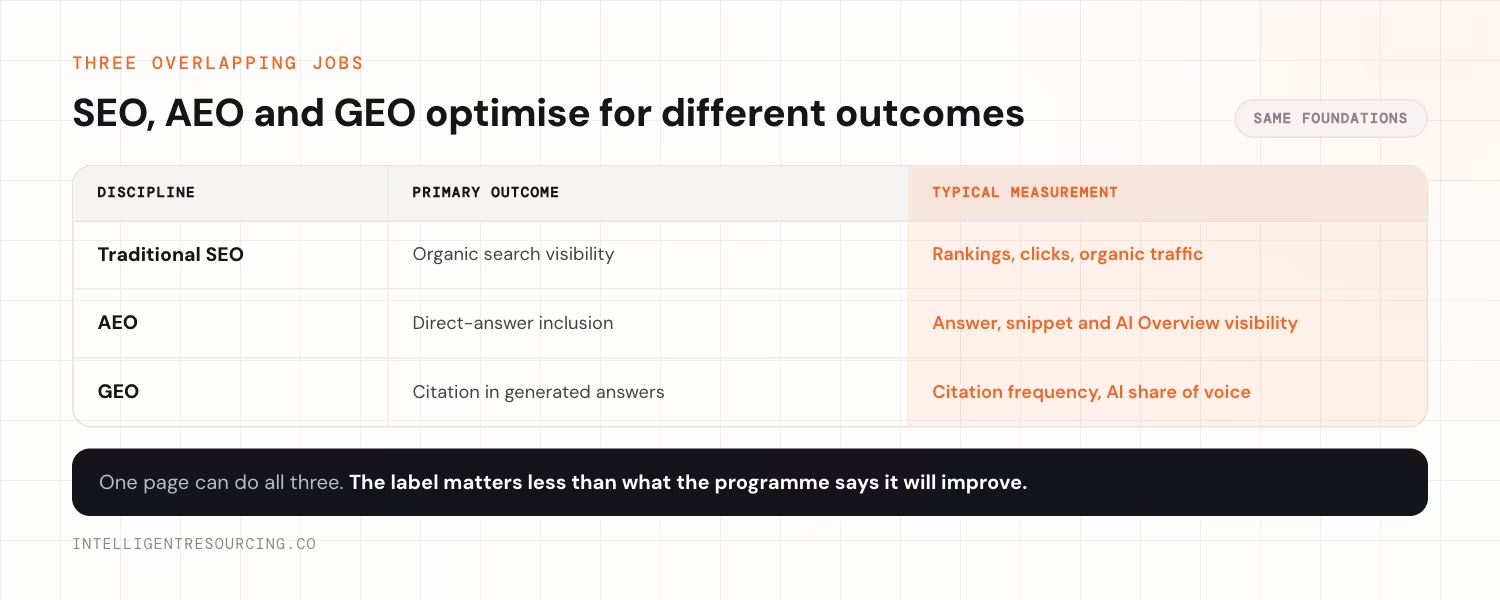
AI SEO is the broader practice of improving visibility across traditional search and AI-generated answers. Traditional SEO focuses on organic rankings, AEO focuses on being selected as the direct answer, and GEO focuses on being cited or referenced inside generated responses.
The disciplines share many foundations, but they optimise for different outcomes.
AEO: winning the direct answer
Answer engine optimisation focuses on making content easy to extract as a clear response to a specific question. It can apply across featured snippets, People Also Ask results, Google AI Overviews and other answer-led search experiences.
Typical AEO work includes:
- Direct-answer content: concise answers placed early on the page.
- Question-led structure: headings aligned with questions buyers actually ask.
- Structured data: schema that reinforces the meaning of visible page content, implemented against Google's structured data guidance.
- Supporting evidence: authoritative sources that make important claims easier to verify.
For B2B buyers this matters because answer-led search is already shaping research, as the TrustRadius figures above show. Encountering an AI answer and clicking a cited source inside it are now part of the same session.
GEO: earning citations in generated responses
Generative engine optimisation focuses on whether AI systems use your content or brand as a source when generating an answer. This includes platforms such as ChatGPT, Perplexity, Gemini, Claude and Google's generative search products.
Typical GEO work includes:
- Citation-ready content: claims and explanations that remain useful when extracted from the surrounding page.
- Entity consistency: clear descriptions of the brand, services, expertise and the relationships between them.
- Evidence architecture: original data, case studies and authoritative supporting sources.
- AI visibility tracking: measuring citation frequency and share of voice across a defined set of prompts, which is the core of our generative engine optimisation programme.
The original GEO research by Aggarwal and colleagues found that tested optimisation techniques could boost visibility in generative engine responses by up to 40%. Effectiveness varied by domain, which is why GEO should not be treated as one universal checklist.
Where AI SEO, AEO and GEO overlap
The same page can rank organically, provide a direct answer and earn an AI citation. Clear structure, technical accessibility, evidence, structured data and consistent entities can support all three outcomes.
| Discipline | Primary outcome | Typical measurement |
|---|---|---|
| Traditional SEO | Organic search visibility | Rankings, clicks, organic traffic |
| AEO | Direct-answer inclusion | Answer, snippet and AI Overview visibility |
| GEO | Citation in generated answers | Citation frequency, AI share of voice |
The terminology matters less than whether the programme defines what it is trying to improve. The broader relationship between AEO, GEO and LLMO is best understood as a set of overlapping approaches to AI visibility rather than completely separate marketing disciplines.
What do AI SEO services actually include?
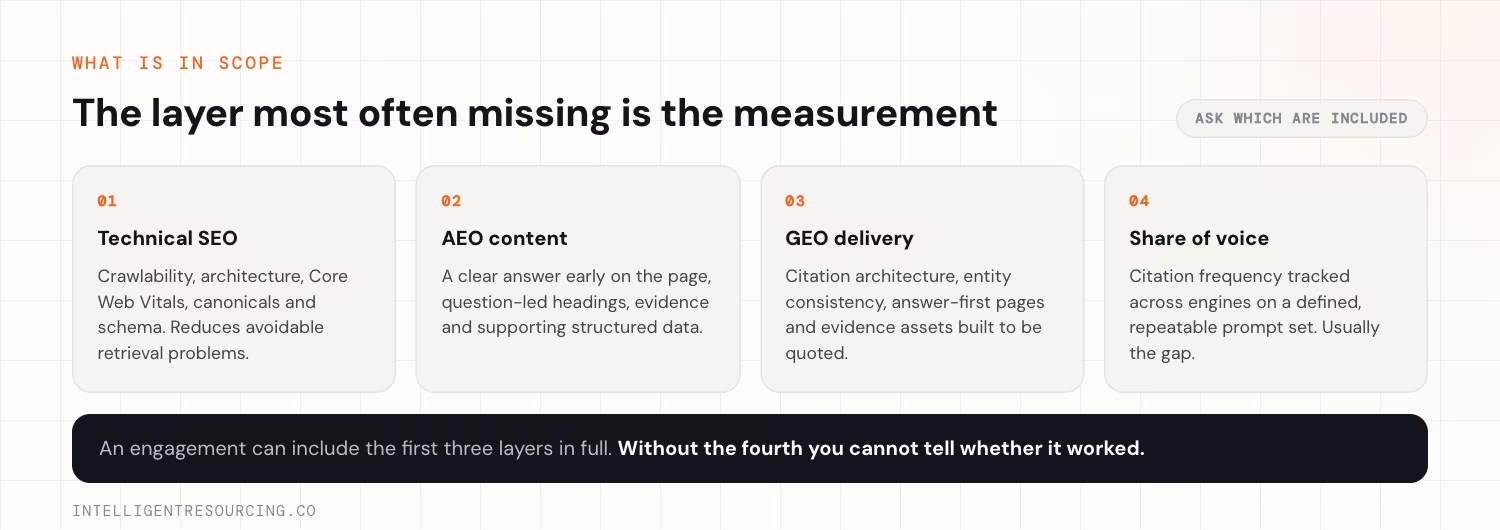
AI SEO services usually mix technical search foundations, answer-first content and AI visibility work. The exact scope differs a lot between providers. The question is not whether an agency uses the label AI SEO, AEO or GEO. It is whether the work you need is in the engagement.
Technical SEO layer
Technical SEO gives search engines and AI retrieval systems a cleaner path to the content they need to interpret.
Typical work includes:
- crawlability and indexation
- site architecture
- Core Web Vitals
- structured data
- canonicalisation
- entity clarity across priority pages
Strong technical foundations do not guarantee AI citations, but they reduce avoidable retrieval and interpretation problems.
AEO content layer
AEO content is built so an answer system can find a clear response to a specific question. A priority page opens with a short answer, then adds evidence, question-led headings and schema. The goal is not to write only for Google AI Overviews. It is to write answers that hold up across every answer-led surface.
GEO delivery layer
GEO extends that work towards measurable citation visibility.
A programme can include:
- Citation architecture: placing important claims and evidence where they are easy to identify and understand.
- Entity consistency: using clear and consistent descriptions of the brand, services and key people across owned content and structured data.
- Answer-first content: publishing pages that resolve buyer questions quickly before expanding into evidence and implications.
- Evidence assets: case studies, benchmarks, comparison pages and original data that give AI systems something specific to reference.
- AI share-of-voice tracking: monitoring citation frequency across multiple AI engines using a defined and repeatable prompt set.
The last item is the one most often missing. An engagement can include every other layer and still leave you unable to answer whether AI citation improved.
What should AI SEO services cost in Australia?
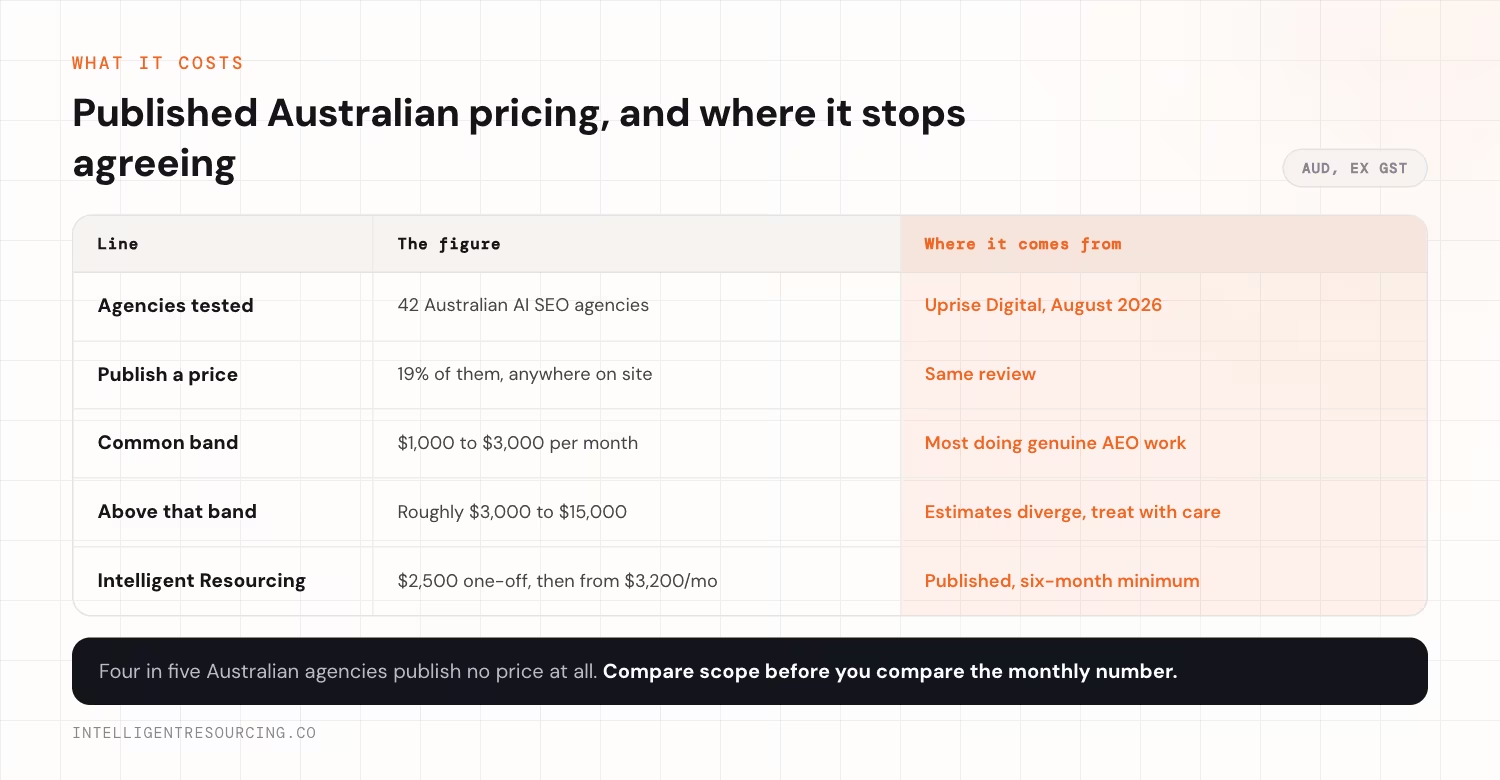
Published Australian pricing is scarce. The figures that do exist disagree above the entry level. The most useful anchor is what agencies put on their own sites.
When Uprise Digital tested 42 Australian AI SEO agencies in August 2026, only 19% published a price anywhere on their site. Of the market it could observe, it reported that most agencies doing genuine AEO work charge between AUD $1,000 and $3,000 per month, with larger engagements running higher.
Above that band the estimates diverge sharply, from roughly AUD $3,000 to $15,000 a month. It depends on who is counting and what they count. Treat any single range as one observer's read, not an industry rate. Compare scope before you compare numbers. Our breakdown of what generative engine optimisation costs per month shows why a lower monthly figure can still cost more per asset.
What drives GEO pricing higher?
Three factors account for much of the difference between a lighter AI SEO engagement and a larger GEO programme:
- Engine coverage: Monitoring more AI platforms means a larger prompt set, more repeated runs and more benchmarking.
- Content volume: More commercial questions and topic clusters require more citation-ready pages, comparisons, FAQs and supporting evidence.
- Entity complexity: Businesses operating across several services, locations, markets or named experts require more extensive entity and content architecture.
Where does Intelligent Resourcing's GEO pricing sit?
Intelligent Resourcing publishes its rates. The Strategic Blueprint is AUD $2,500 plus GST as a one-off. Ongoing delivery starts at AUD $3,200 a month plus GST for Cited Core, and AUD $3,700 for Cited Scale.
The tiers differ mainly by scope and content volume. Both include citation-engineered content, schema work and cross-engine tracking. Full package detail sits in our AEO pricing breakdown.
What questions should you ask before hiring an AI SEO agency?
Ask how the agency measures AI visibility before asking which acronym it uses. Five questions help determine whether the proposed scope matches the outcome you are buying.
1. Do you track AI share of voice?
If measured GEO performance is part of the brief, the agency should explain how it tracks citations across a defined prompt set. Ask how many runs it uses, which engines it covers, and how it compares performance over time.
A single successful screenshot is not enough to establish a trend.
2. What is your content positioning methodology?
Ask how priority pages are built for direct answers and citation. The answer should cover where claims, evidence and entities sit on the page. It should also cover how content changes when the data moves.
Vague references to quality content make it difficult to verify what GEO-specific methodology is actually included.
3. Which AI engines do you measure?
ChatGPT, Google AI experiences, Perplexity, Claude and Gemini do not return the same citations. SISTRIX's 2026 citation-drift analysis found large gaps between platforms. That makes multi-engine measurement far more useful than treating one engine as the whole picture.
4. Can you show a client result with repeated AI citation data?
Ask for a case study using a defined prompt set, multiple runs and a clear capture period. Before-and-after organic traffic alone does not prove a GEO outcome.
5. What assets and data remain after the engagement?
Clarify what happens to:
- published content
- schema
- entity documentation
- prompt benchmarks
- citation data
- reporting dashboards
- internal processes
A managed service and a build-and-transfer model can both deliver GEO work. They leave you with very different levels of dependency when it ends.
How long before AI SEO services show results?
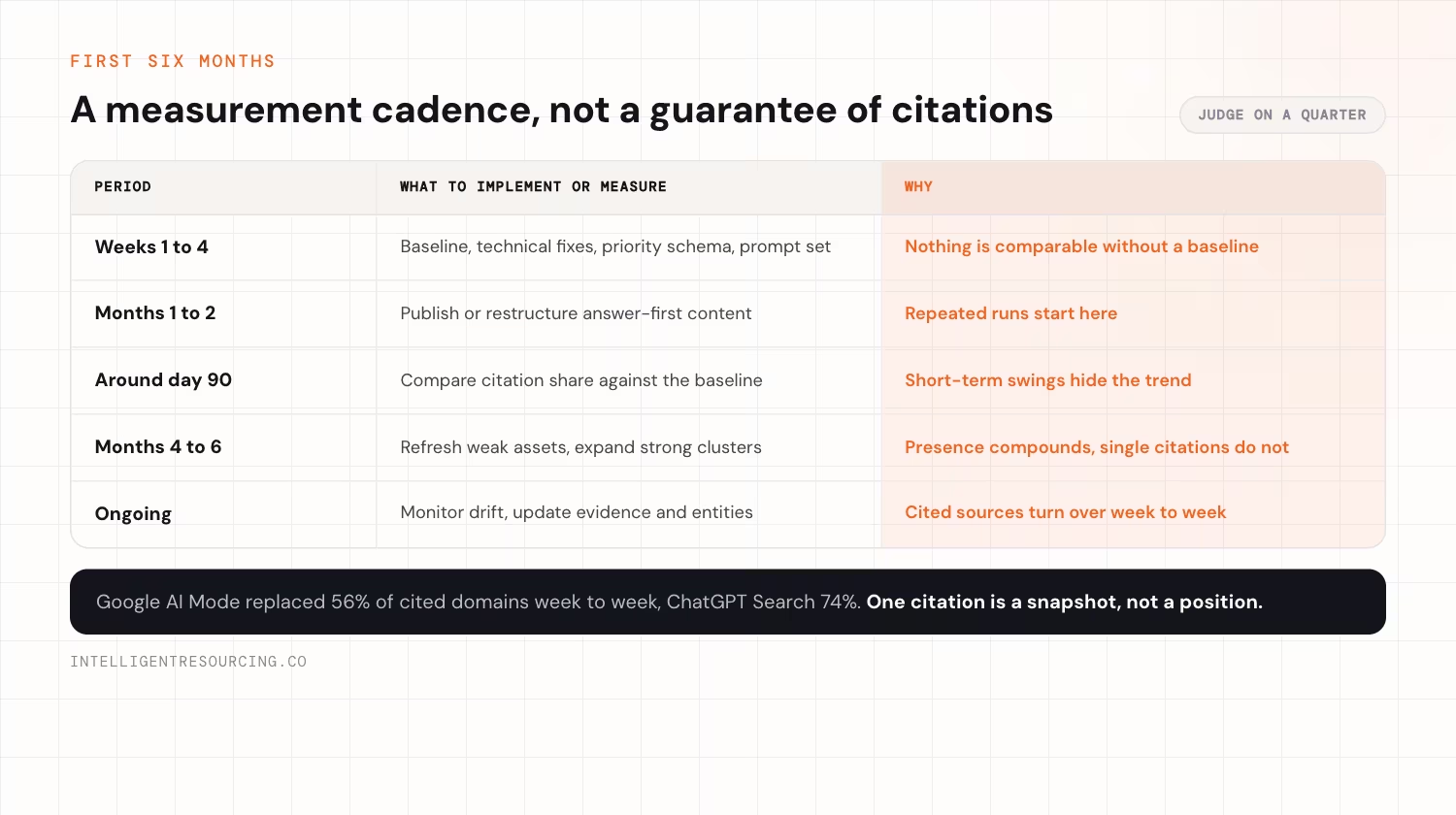
There is no reliable universal timetable for GEO results. Treat the first 90 days as a measurement window rather than a guaranteed deadline.
Some pages earn citations quickly. Others take longer, or move up and down between runs. Uprise Digital's advice is to judge an engagement on a quarter rather than a month, because short-term swings hide the trend. Keep implementation milestones separate from performance guarantees.
What should you measure during the first six months?
| Period | What to implement or measure |
|---|---|
| Weeks 1 to 4 | Establish citation baseline, fix technical issues, implement priority schema and define prompt set |
| Months 1 to 2 | Publish or restructure priority answer-first content and begin repeated measurement |
| Around Day 90 | Compare citation frequency and AI share of voice against the original baseline |
| Months 4 to 6 | Refresh weak assets, expand stronger topic clusters and continue competitor benchmarking |
| Ongoing | Monitor citation drift, update evidence and maintain accurate entity information |
This is not a guaranteed progression in citations. It is a practical measurement cadence.
Why GEO compounds differently from a single citation
The content asset base can compound, but individual AI citations are not permanent.
SISTRIX analysed 82,619 prompts across 1,548,213 snapshots between 17 December 2025 and 8 April 2026. It found heavy citation turnover week to week. Google AI Mode replaced 56% of the domains it cited from one week to the next. ChatGPT Search replaced 74%. At URL level the churn was higher again. One citation is a snapshot, not a position you hold.
The compounding value comes from a larger base of useful, structured, evidence-rich assets across the questions buyers ask. Each new page is another chance to be retrieved or cited. Repeated measurement shows whether overall presence is rising, even as individual sources change.
For GEO, the better question is not whether you were cited once. It is how often you are present across the prompts that matter, and whether that share is increasing over time.
Comparisons
Intelligent Resourcing runs a multi-engine citation audit showing where your brand appears, where competitors are cited instead, and which AI visibility gaps are worth addressing first.
FAQs
What is AI SEO?
AI SEO is the broader practice of making a site visible across traditional search and AI-generated answers. It can combine traditional SEO for rankings, AEO for direct-answer inclusion, and GEO for citations inside generated responses.
What is the difference between AEO and GEO?
AEO focuses on being selected as the direct answer across answer-led experiences such as featured snippets, AI Overviews and other generated responses. GEO focuses more specifically on being cited or referenced as a source inside generative AI answers. The work overlaps, but the primary outcome and measurement differ.
How much do AI SEO services cost in Australia?
Most Australian agencies doing real AEO work charge AUD $1,000 to $3,000 a month. That comes from an August 2026 review of 42 agencies, in which only 19% published a price at all. Above that band, estimates vary widely, from roughly AUD $3,000 to $15,000 a month. Compare what is included before you compare the monthly figure.
How do I know if an AI SEO agency is doing measurable GEO work?
Ask how it measures citations across a defined set of buyer questions. A measurable GEO programme should be able to explain its prompt set, engine coverage, repeated-run methodology and how citation frequency or AI share of voice is reported over time.
Does AI SEO replace traditional SEO?
No. Traditional SEO remains important when buyers use search engines to discover and visit websites. AI SEO adds the optimisation and measurement needed when direct answers and generative platforms also influence research. Many B2B businesses benefit from treating the two as complementary rather than choosing one exclusively.