

How has AI changed B2B prospecting in the last 24 months?
AI changed B2B prospecting between 2023 and 2025 by removing manual list research, replacing campaign-timed outreach with signal-triggered sequences, and making SDR headcount growth unnecessary for pipeline scale. Teams that made the shift monitor thousands of accounts continuously. Teams that did not are competing at a higher cost per qualified opportunity on every send.
3 changes between 2023 and 2025 made manual top-of-funnel prospecting unsustainable: large language models crossed a personalisation threshold, Clay connected intent data to CRM routing and hiring freezes across Australian mid-market revenue teams made the SDR headcount model unaffordable.
If your team still runs on the pre-2023 model, you are not operating at the same cost as a team that made the shift. You are operating at a compounding disadvantage. Closing that gap is the core of the intelligent prospecting playbook.
From manual research to automated signal detection
The role of the traditional SDR changed fundamentally between mid-2023 and mid-2025. Before that period, top-of-funnel prospecting meant building lists manually, researching accounts one by one, and sending sequences in batches. The cycle ran on a 2-to-4-week rhythm: build a list, run a sequence, wait for replies, start again.
The systems built on Clay, HubSpot, and n8n, what a GTM engineer builds into your stack, removed that rhythm entirely. A GTM engineer builds and maintains the signal detection infrastructure connecting those tools: they design the trigger logic that determines which account events fire an outreach sequence. These systems monitor thousands of target accounts continuously. When a monitored account posts a new VP of Sales role, closes a Series B, or adds a new tool to its tech stack, the system detects it immediately. Outreach fires within the same 24-hour window, before the account has engaged competing vendors working from static lists.
HubSpot's AI Trends for Marketers report found that 79% of marketers agree AI significantly reduces the time spent on manual tasks, with average savings of 1 to 2 hours per workday. In prospecting, that reclaimed time shifts from list building to signal monitoring and deal qualification. That is a fundamental change in how pipeline hours are spent.
Most teams used those reclaimed hours to send more outreach. The teams outperforming them used those hours to tighten their signal rules instead, deciding which buying events actually predict conversion, and cutting the ones that only look like intent.
What the 3 key shifts actually were
First, large language models (LLMs) crossed a capability threshold where AI-generated outreach messages were accurate enough to drive genuine replies. Personalisation based on firmographic data; company stage, recent funding, tech stack, headcount growth could be applied automatically at volume without sounding like a mail merge.
Second, Clay emerged as the signal detection layer connecting intent data, enrichment sources, and CRM platforms. Rather than managing 5 separate tools, GTM engineers built single Clay workflows. Each workflow pulls signals from LinkedIn, Apollo, and third-party sources into one enrichment pipeline, then feeds that data directly into HubSpot and SmartLead.
Third, the macroeconomic environment from 2023 to 2025 produced sustained hiring freezes in revenue functions across Australian mid-market and enterprise SaaS companies. Teams that once employed 8 SDRs found the headcount model unsustainable. AI-driven signal-based automation workflows filled the gap at a fraction of the operational cost and produced better-timed outreach in the process.
How does signal-led prospecting outperform traditional AI outreach?
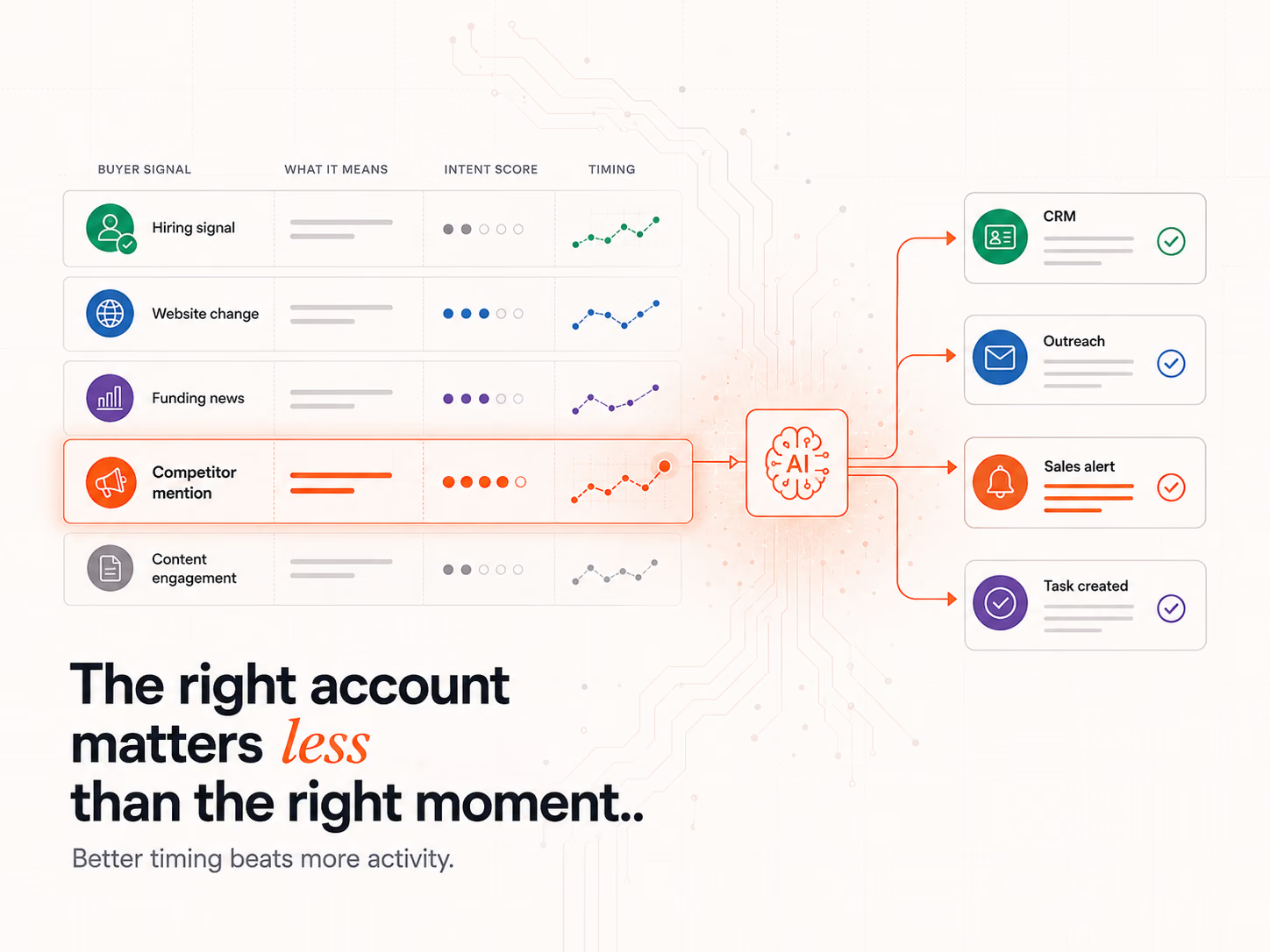
Signal-led prospecting outperforms traditional AI outreach because timing determines conversion, not volume. Clay identifies when a target account hires a new sales leader, closes a funding round, or installs Salesforce. n8n fires the outreach sequence immediately. The message reaches the decision-maker in their Verified Buying Window, before competitors running on campaign schedules have detected the same trigger.
How the signal layer works in practice
AI outreach tools improve message quality but do not determine timing. Sending a better email to an account that is not in a buying window produces the same outcome as sending a worse one.
In a signal-led system, the timing layer runs on Clay. Clay runs Enrichment Waterfalls across Apollo, LinkedIn Sales Navigator, Clearbit, and intent data sources. An Enrichment Waterfall checks each data provider in sequence, pulling the most accurate available record rather than relying on a single source that may have outdated information. Each target account records updates automatically as new signals emerge. A job change at a target account triggers an automatic re-enrichment. The updated record routes into a HubSpot workflow, then SmartLead fires an outreach sequence within hours of the signal event.
What is the result?
That combination of a confirmed signal event matched against ICP criteria and a 90-day no-contact check defines a Verified Buying Window. For most IR clients, a window opens when at least 2 trigger events appear for the same account within 30 days: a new executive hire alongside a funding announcement, or a tech stack change alongside a hiring spike. Outreach fires into that window. It does not fire outside it.
LinkedIn's 2025 ROI of AI research found that 69% of sellers using AI cut sales cycles by an average of 1 week, and 68% say AI helps them close more deals. That advantage compounds when paired with signal timing, because the message content is relevant and the account is actively evaluating options at the moment the message lands.
Most teams will read this, update their messaging templates, and keep their campaign calendar. The timing error survives the upgrade. Better messages going to accounts that are not in a buying window still do not convert. The execution improvement and the timing problem are not the same problem.
The difference between AI automation and signal-led outreach
Most platforms sold as AI prospecting tools automate the execution layer: they write emails, book meetings, and summarise research. Intelligent Resourcing, led by founder Ronan Leonard, builds the signal layer underneath them.
The distinction matters because execution without signal intelligence produces the same problem as manual outreach at scale: messages going to accounts that are not yet in-market. The volume is higher, the personalisation is better, but the core timing error remains. The prospect receives a well-written email about a problem they are not currently solving for.
Signal-led outreach solves the timing error. The system does not fire because a campaign is launched. It fires because a specific account, monitored continuously across job boards, Crunchbase, G2, and LinkedIn, has crossed a threshold that Intelligent Resourcing and the client defined as a genuine buying indicator. The outreach sequence fires because a real event just happened at that account, not because the campaign calendar says so.
For a SaaS client targeting 500 accounts, this means the CRM does not fill with leads who opened an email. It is filled with accounts that have documented signal events, scored by Clay, routed by HubSpot, and sitting in a rep's pipeline with the specific context that explains why they are in-market right now.
What is driving AI adoption in Australian B2B sales teams?
Australian B2B sales teams are adopting AI because the alternative is competing against vendors who have already automated their top-of-funnel. Banks, SaaS companies, and telecoms are building signal detection infrastructure on Clay and HubSpot. The teams that have not made that build are now slower and more expensive to operate at equivalent pipeline volume.
Local adoption across mid-market and enterprise
If you are running a sales team in Australian manufacturing, logistics, or professional services, the companies competing against you for the same accounts have already started automating their top-of-funnel. That gap is not theoretical. It is measurable in response speed, and right now it is measured in days.
Mid-market companies, which historically lagged enterprise adoption by 18 to 24 months, accelerated this cycle because offshore GTM engineering capabilities made the build accessible to companies with 50 to 300 employees.
The Microsoft Work Trend Index, which surveyed workers across 31 countries including 1,000 Australian respondents, found that 75% of workers now use AI at work, with the sharpest adoption gains in sales and marketing functions. Australian adoption is tracking this global curve, with particular emphasis on data sovereignty and consent management for B2B outreach under the Privacy Act.
A poorly defined ICP produces noise regardless of the automation layer. Clay cannot fix an absence of targeting criteria but it amplifies whatever targeting criteria it is given. When the ICP was defined first across Intelligent Resourcing's Australian SaaS engagements, Clay's signal detection removed the manual research function entirely, and pipeline quality improved within the first 60 days.
When does AI handle prospecting, and when do human reps own the outcome?
AI handles the research, enrichment, signal detection, workflow routing, CRM logging, and early-stage outreach that consume sales capacity without producing revenue. Human reps own judgement, objection handling, complex negotiations, stakeholder mapping, custom proposals, and closing. The question is not whether to split the work but it's where the split happens and who designs the handoff.
What AI handles reliably
Clay builds and maintains the target account list, pulling company data and decision-maker contacts from Apollo, LinkedIn, and Clearbit. It enriches each record continuously as new data appears. When a contact changes roles or a company raises funding, Clay updates the record without a human prompt. When a specific account crosses a buying signal threshold, it flags the account, writes the outreach message using the signal as context, and triggers the sequence in SmartLead. HubSpot routes the reply to the assigned rep. The rep receives one notification with everything needed to make a well-timed call: who the contact is, what signal fired, and why the account is in-market right now.
That sequence of monitoring continuously and acting on detected events without waiting for a human to review a dashboard is what Agentic Signal Listening means in practice. The system does not surface leads for a rep to review. It acts on what it detects, then hands the rep the context they need to close.
Gong's December 2025 State of Revenue AI report found that organisations embedding AI as a core driver of GTM strategy are 65% more likely to increase win rates, and AI-driven teams generate 77% more revenue per representative. The research was drawn from 7.1 million sales opportunities across more than 3,600 companies and a survey of more than 3,000 revenue leaders.
What human reps still do better
AI cannot interpret the political dynamics of a multi-stakeholder sale, flex its positioning in response to a novel objection, or build the trust that closes a 6-month enterprise deal. For accounts with 90-day-plus sales cycles, multiple decision-makers, and custom commercial terms, the human rep is essential.
Reps become more effective when the research, routing, and timing work is handled by the system. That is what this model is designed to do. A rep receiving a HubSpot notification that a monitored account just hired a new CFO and added Salesforce to its stack is positioned to make a call with full context. A rep spending those same hours building the account list is not.
In practice, that means opening the Clay signal dashboard at the start of each day, reviewing the accounts that crossed a threshold overnight, and making calls in the first hour rather than the fourth.
What happens to B2B teams that fall behind on AI adoption?
B2B teams that delay AI adoption in prospecting do not stay competitive at the same cost. They become slower and more expensive as competitors reduce their cost of acquisition and increase their outreach precision simultaneously. The gap compounds each quarter because signal-led systems improve as they accumulate more account data.
Slower lead engagement and higher acquisition costs
The cost of not adopting AI prospecting is measurable in 3 ways.
First, response speed: a team relying on SDRs to identify signals and qualify leads takes 2 to 7 days to act on a buying event. A signal-led system acts within 24 hours of the trigger. In competitive B2B markets where 3 to 5 vendors are reaching out to the same target account, first-mover timing determines who gets the discovery call.
Second, acquisition cost: teams without AI automation spend more on labour per qualified opportunity because the research function is not scalable. Each additional SDR adds a fixed headcount cost regardless of whether the accounts they research are in-market. A Clay-based system monitors the same accounts at no marginal cost per account added.
Third, data quality: poor CRM data now creates both revenue risk and AI-readiness risk. Validity's 2025 State of CRM Data Management report found that 37% of CRM users reported losing revenue as a direct consequence of poor data quality, and 76% said less than half of their organisation's CRM data is accurate and complete.
Manual process bottlenecks and the opportunity cost
The AI tools most teams have adopted in the last 18 months improved the quality of their outreach. They did not fix the timing. The accounts receiving better-written sequences are still not in a buying window. The cost per qualified opportunity may be lower than before, but it is not falling as fast as it should.
Salesforce's seventh annual State of Sales report found that sales reps spend 60% of their time on non-selling tasks. For a revenue team in that position, the AI layer does not simply add capacity. It restores capacity that should not have been consumed by repetitive execution in the first place.
During an engagement with a SaaS company targeting 300 mid-market accounts in financial services, Intelligent Resourcing replaced a manual outbound SDR function with a Clay-to-HubSpot-to-SmartLead signal workflow managed by a GTM engineer. Pipeline volume held steady and outreach quality improved because messages reached decision-makers when a signal confirmed the account was in-market.
How do you build an AI-ready GTM stack for signal-led prospecting?
An AI-ready GTM stack for signal-led B2B prospecting requires 4 layers: a signal detection tool, a CRM, an outreach platform, and an orchestration layer. The systems that perform best in 2026 are those where Clay, HubSpot, SmartLead, and n8n are connected by a GTM engineer who understands the commercial logic behind the signal rules, not just the technical configuration.
The core tech stack and what each tool does
A functional signal-led prospecting system runs on 4 platforms working in sequence.
Clay is the signal detection and enrichment layer. It monitors target accounts across LinkedIn, Apollo, Crunchbase, and intent data providers. When a monitored account crosses a signal threshold, specifically a new executive hire, Series B funding, or tech stack change, Clay enriches the record, scores it, and pushes it into the workflow trigger.
HubSpot receives enriched, scored accounts from Clay and routes them to the correct rep or sequence. SmartLead runs the email sequences HubSpot triggers, manages deliverability settings, and returns replies to HubSpot for rep visibility.
n8n is the orchestration layer. It connects Clay, HubSpot, and SmartLead through custom logic. If Clay flags a funding event and the account matches the ICP and the account has not been contacted in the last 90 days, n8n triggers the Series B sequence in SmartLead via HubSpot.
Teams building this stack for the first time can follow the full implementation logic in automated B2B lead generation with Clay and n8n.
That four-layer architecture is Signal-Led Growth: a system where every outreach action is triggered by a verified account signal, not a campaign schedule. A Revenue Operations Studio builds this on the client's own stack. The client owns it permanently.
Starting with a pilot: ICP definition before automation
The highest-leverage starting point for any Australian B2B company adopting AI prospecting is not the tooling. It is the ICP definition. Build the Clay workflow for one segment only. Monitor 100 to 200 target accounts. Run signal detection for 30 days before sending any outreach. Use that period to validate that the signals Clay surfaces match the accounts your sales team would actually call. Then activate the outreach layer.
A phased rollout prevents the failure mode that most AI prospecting pilots fall into: activating the system before the signal rules are validated, flooding reps with low-quality leads, and concluding that the technology does not work. For the full stack of lead generation services Intelligent Resourcing provides, the ICP definition session is the mandatory first step.
Reskilling reps for AI-supported prospecting
Reps in a signal-led environment need four skills their SDR predecessors did not: reading Clay signal dashboards to understand why an account was escalated; interpreting HubSpot workflow logic to know where it sits in the sequence; understanding the compliance implications of the signals being used; and writing follow-up messages that reference the specific trigger event.
Sales enablement for AI-assisted teams replaces the traditional pitch deck and objection handling training with workflow oversight and signal interpretation. The rep's value in this model is judgement: deciding which escalated accounts merit immediate personal outreach and which should continue through the automated sequence.
The teams that add AI outreach tools without building the signal layer are not solving their pipeline problem. They are automating the timing error. The messages are better. The accounts receiving them are still not in a buying window. And the cost per qualified opportunity keeps climbing, just faster.
The shift to signal-led prospecting is not optional for B2B teams competing at scale in 2026. The only variable is whether it happens before or after competitors have already closed the timing gap. The build takes 4 to 6 weeks. The cost of not building it compounds every quarter.
See how Intelligent Resourcing's lead generation system builds the Clay-to-HubSpot signal layer on your own stack.
Prospecting
Intelligent Resourcing's Revenue Operations Studio installs the Clay-to-HubSpot signal layer on the client's own stack. The system runs without retainer dependency and ships in 4-6 weeks.
FAQs
What is signal-led prospecting?
Signal-led prospecting uses real-time data events (job changes, funding announcements, technology installs, and hiring spikes) to identify when a specific target account has entered an active buying window and triggers outreach immediately. The system does not fire on a calendar schedule. It fires when a verified signal confirms an account is in-market.
How does Clay detect buying signals?
Clay runs Enrichment Waterfalls across multiple data providers simultaneously: Apollo, LinkedIn, Clearbit, and intent data sources. An Enrichment Waterfall checks each provider in sequence until it finds the most accurate record for that account. Clay monitors each target account for defined trigger events, updates the account record when a signal fires, scores the account against ICP criteria, and routes the enriched record into HubSpot for outreach activation.
What is the difference between AI outreach tools and signal-led outreach?
AI outreach tools automate the execution layer: they write better messages faster. Signal-led outreach adds the timing layer. It determines when to send by monitoring when a specific account has entered an active buying window. Execution without timing still produces the same error as manual outreach: contacting accounts that are not yet in-market.
Who is signal-led prospecting not suited for?
Signal-led prospecting is not suited for companies without a defined ideal customer profile, companies with fewer than 100 target accounts, or companies without internal sales capacity to act on escalated leads. The system surfaces qualified, signal-confirmed accounts. If there is no rep available to convert those accounts, the investment does not pay back.
How long does it take to build a signal-led prospecting system?
Intelligent Resourcing typically delivers a functional Clay-to-HubSpot-to-SmartLead signal workflow within 4 to 6 weeks from ICP finalisation. The first 30 days are signal validation without outreach. The outreach layer activates in week 5 or 6 once signal quality is confirmed. Pipeline from the first confirmed signal events appears within 60 to 90 days of activation.