

How This List Was Put Together
Three rules, applied before any of the five profiles were written.
- Every claim had to be checkable on the agency's own site. Anything we could not verify was cut rather than softened. That is why several profiles are shorter than the marketing behind them.
- The list is grouped by job, not ranked by quality. Each entry names the one thing it is built for, so the shortlist writes itself once you know your gap.
- Intelligent Resourcing publishes this list and appears first in it. Worth knowing as you read. Treat the order as a grouping, and check the reasoning rather than the position.
What Bushnote's AI Search Service Covers
Bushnote is a strategic and creative agency with an AI search service. Its service page names five engines: ChatGPT, Gemini, Perplexity, Google AI Overviews and Claude. It says it produces the content, structure and public evidence those engines read. For a direct comparison, read Bushnote vs Intelligent Resourcing.
Bushnote's service page lists audits, structured data, prompt testing and programmatic content, then ongoing sprints. The page's structured data adds detail the visible copy does not: AI search retainers from A$4,000 a month, an audit and roadmap within two weeks, and 30-day sprints.
Its homepage says a typical engagement across the agency starts at A$5,000 a month. Bushnote is based in Sydney, so that is AUD.
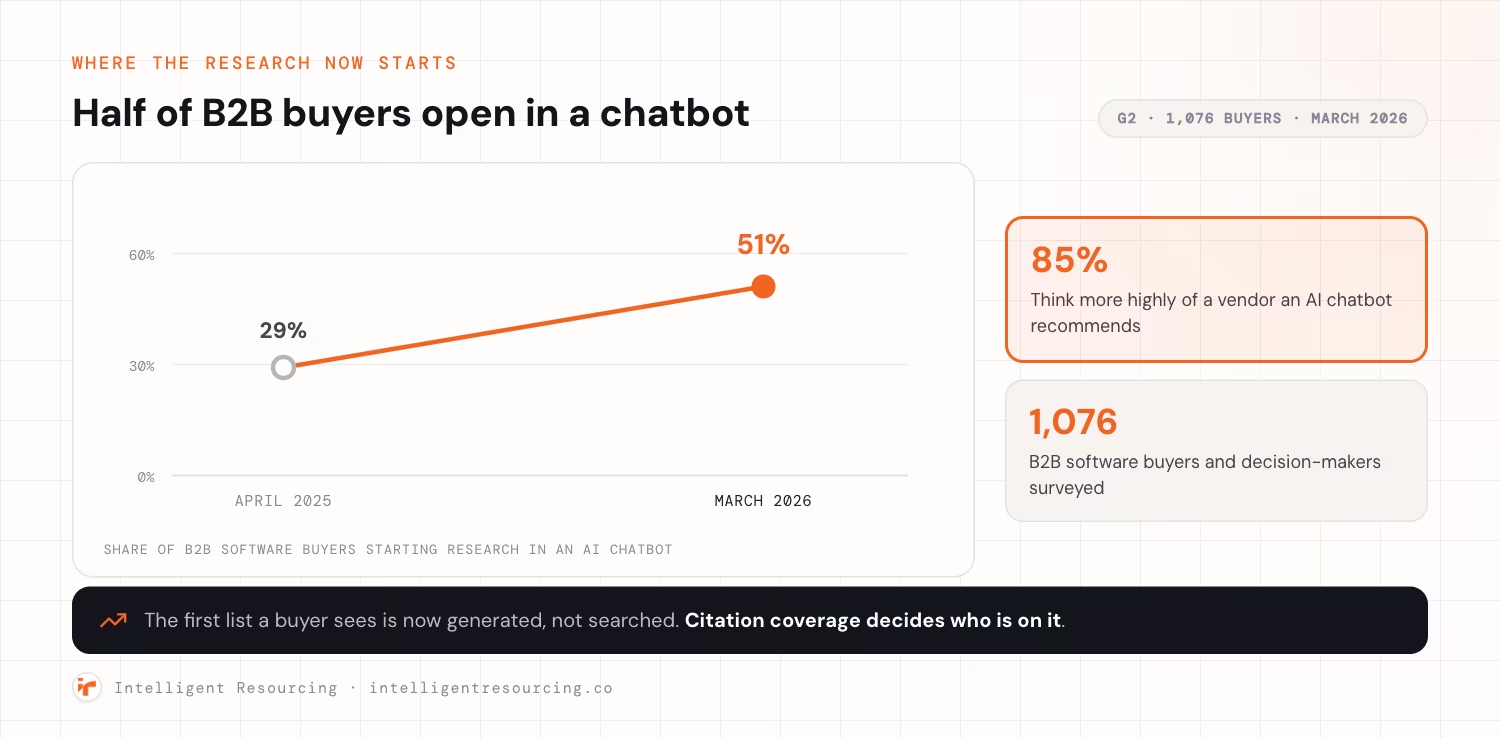
The gap to check is measurement. The service page reports share of answer by platform. It does not say whether that is broken down by topic cluster or benchmarked against a named competitor set (checked 4 November 2026). G2's March 2026 survey of 1,076 B2B software buyers found 51% now start research with an AI chatbot rather than Google. It also found 85% think more highly of a vendor an AI chatbot recommends. Share of answer shows where you appear. Share of Voice against a named set shows how much of the category you hold.
Pricing checked on 23 November 2026.
What Are the 5 Best Bushnote Alternatives for AEO and GEO in Australia?

Each of the five is grouped by the job it is built for: GEO content architecture, integrated organic and AEO, revenue-aligned GEO, AI-search-first organic growth, and editorial-led AEO. Judge them on the capabilities that decide fit:
- Share of Voice tracking across ChatGPT, Perplexity and AI Overviews
- GEO content architecture: topic cluster strategy and structured citation-building
- Off-site authority on the review sites and communities your buyers read
- Schema markup applied across the content architecture
- Australian and APAC market coverage
- Reporting tied to Share of Voice, not just citation count
- Data and asset ownership at exit
Intelligent Resourcing: best for GEO content architecture in Australia
Intelligent Resourcing is built around GEO content architecture for Australian B2B markets. The service opens with an audit: which topic clusters a brand needs to own, where citation gaps sit against competitors, and what builds Share of Voice across them.
The method spans the full answer engine optimisation layer, and Share of Voice is tracked by topic cluster against a named competitor set.
Schema markup for AI citation sits inside that architecture. Pricing is published: AUD 2,500 + GST for a one-off Strategic Blueprint, then AUD 3,200 + GST a month.
Where Intelligent Resourcing is not the right fit: this is an architecture engagement, not a fast content sprint. If you need first citations inside two to four weeks without a structural audit, a faster agency is the better start. Team size is also not published.
Omniscient Digital: best for integrated organic and AEO
Omniscient Digital runs full-stack SEO (Search Engine Optimisation) and answer engine optimisation under one engagement, so content earns rankings and citations together.
Its published case study for Convert reports 81% LLM visibility growth and a 140% citation increase in 60 days.
Omniscient Digital's homepage says full-service engagements start at A$180,000 a year (US$120,000), about A$15,000 a month (US$10,000). Its offices are all in the United States, so the source figures are US dollars.
Where Omniscient Digital is not the right fit: the A$180,000 (US$120,000) a year starting price rules it out for early-stage teams. The full-stack scope is more than a GEO-only build needs, and its site lists five offices, all in the United States.
Pricing checked on 23 November 2026. Converted to AUD at RBA rates for 20 November 2026 (US$1 = A$1.50).
Platypus SEO: best for revenue-aligned GEO
Platypus SEO describes itself as an SEO and AI search agency built for B2B SaaS. Its homepage says it works to turn organic search into a reliable source of demos, trials and revenue, and that its strongest partnerships are with vertical B2B SaaS companies and specialist firms selling into tech.
The homepage shows no pricing or minimum client size, and its visible copy gives no location. Its structured data lists Serbia as the country (checked 4 November 2026).
Where Platypus SEO is not the right fit: its homepage frames results as pipeline and revenue, and does not describe Share of Voice by topic cluster. With no published pricing, both fit and cost are scoping conversations. Ask directly about APAC coverage.
Skale: best for AI-search-first organic growth
Skale calls itself an AI-search-first organic growth agency for tech and SaaS brands. It lists generative engine optimisation, SEO strategy, content production, and link building. Its homepage carries client testimonials from G2, Maze and Wealthsimple.
The homepage shows no pricing, only a strategy call button (checked 4 November 2026).
Where Skale is not the right fit: the outreach and link-building strength is real, but the services listed on its homepage do not include cluster architecture, an entity framework or Share of Voice reporting. Category ownership would need a separate architecture engagement.
Flying Cat Marketing: best for editorial-led AEO
Flying Cat Marketing is a Los Angeles agency built around editorial quality. Its homepage reports Softr growing MRR 227% in six months through SEO (Softr case study), and Operto growing revenue from organic search 4x in twelve months.
Pricing is published on its pricing page as starting prices, in US dollars for a Los Angeles agency: a one-time A$7,500 (US$5,000) Strategy Launch, then Advisory from A$3,000 a month (US$2,000), Done-with-you from A$6,000 a month (US$4,000) or Full-service from A$10,500 a month (US$7,000). The page says scope and price are confirmed on a call.
Where Flying Cat Marketing is not the right fit: the published strength is editorial, so schema, entity work and cluster architecture need a separate technical provider. No APAC angle is advertised.
Pricing checked on 23 November 2026. Converted to AUD at RBA rates for 20 November 2026 (US$1 = A$1.50).
How Do You Measure GEO Performance After Choosing an Agency?
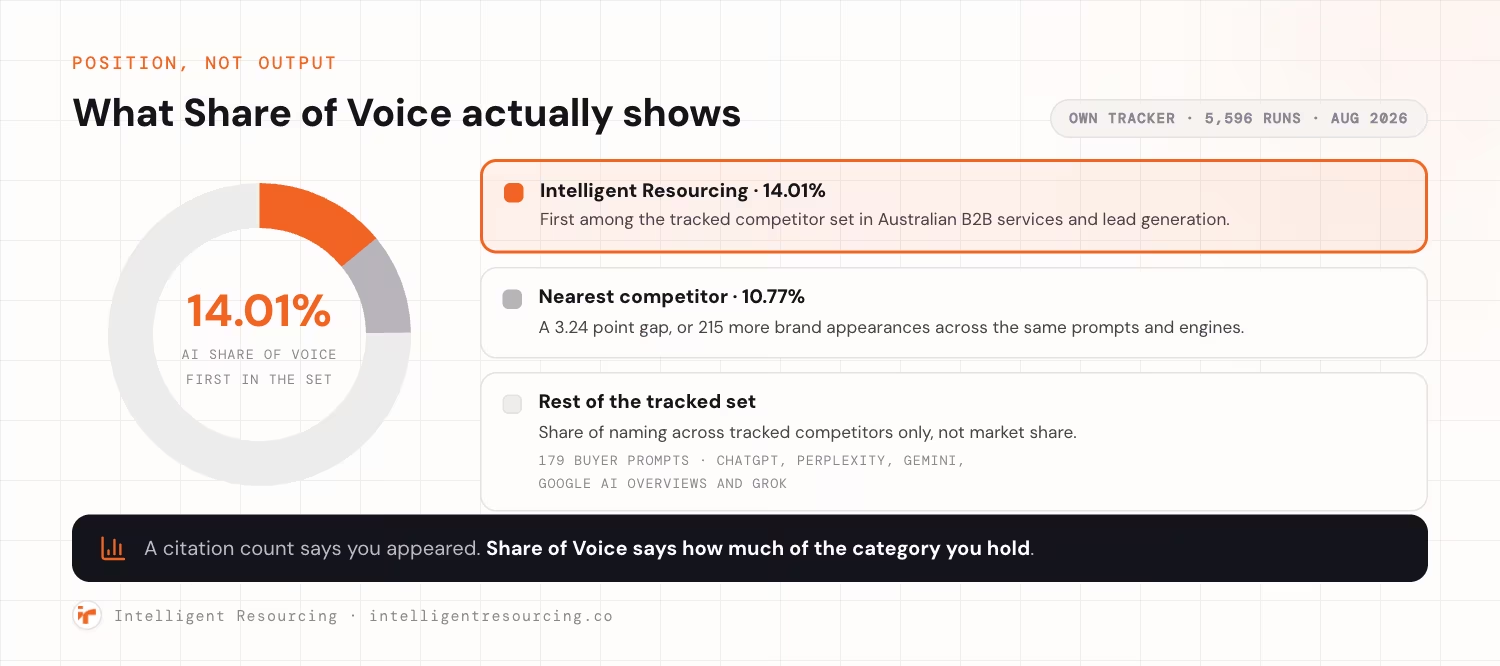
You measure GEO by tracking Share of Voice: the share of AI answers about your category that name your brand. Citation count says whether you appear. Share of Voice says how much of the category you hold, and how that moves against rivals. The gap between them is where monitoring stops being enough.
What Share of Voice tracking covers
Share of Voice maps a set of topic cluster queries, the questions buyers actually put to AI engines, then tracks what share of answers name your brand. It runs across several engines at once and benchmarks against a named competitor set on the same queries.
A citation count says your content appeared 14 times this week. Share of Voice says something else. Across Intelligent Resourcing's own tracker, running 179 buyer prompts over ChatGPT, Perplexity, Gemini, Google AI Overviews and Grok, Intelligent Resourcing holds 14.01% AI Share of Voice in the Australian B2B services and lead generation category, first among the tracked competitor set across 5,596 sample runs in August 2026. The nearest competitor holds 10.77%. That 3.24 point gap is 215 more brand appearances across the same prompts, engines and window. Share of Voice here means share of naming across the tracked set, not market share.
That is a strategic signal, not a monitoring metric. For what to check before choosing, see how to choose an AEO agency.
What to check in a GEO agency's measurement framework
When evaluating a Bushnote alternative, ask exactly how Share of Voice gets tracked:
- Which topic clusters do they track, and how were those clusters defined?
- Which AI engines does the reporting cover?
- How often does the Share of Voice report update?
- How is competitor Share of Voice benchmarked, and against which named set?
Any agency reporting only citation count is measuring output, not position. Share of Voice measures position.
Should You Hire a Specialist GEO Agency or an SEO Agency That Offers GEO?
Hire a specialist GEO agency when you already hold organic authority to build on. Hire an SEO agency that offers GEO when you start from zero. AI citation follows organic authority, so the order of investment decides the fit. Match the agency to your authority stage, not the label on its services page.
With an existing content engine, a specialist adds citation depth and Share of Voice quickly. From nothing, an SEO agency offering GEO builds the foundation first.
What Should You Ask an AEO or GEO Agency Before Hiring Them?
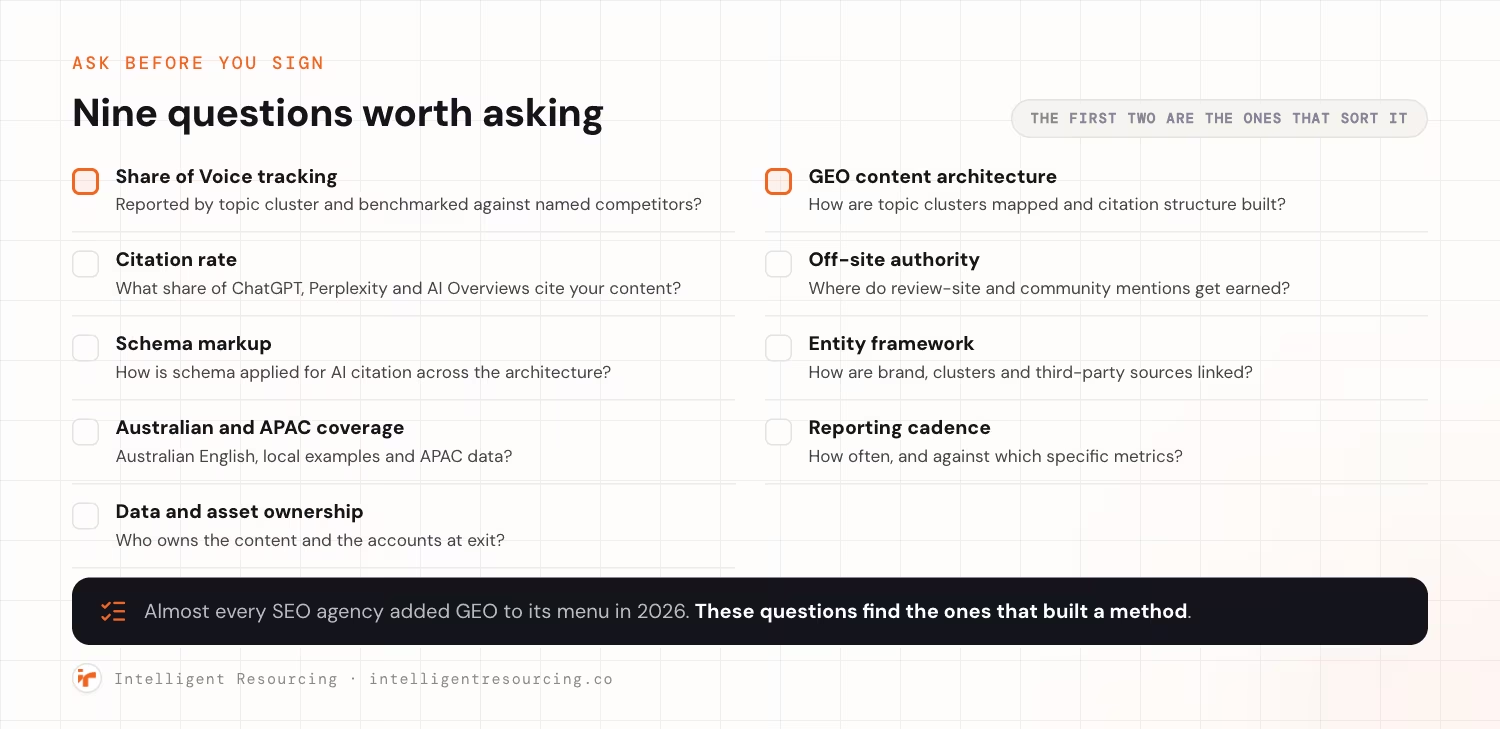
Ask for verifiable metrics before you hire. Demand Share of Voice data, citation rate across the named engines, and evidence of architecture: topic clusters, schema, entity framework. The right agency answers with method and numbers. One leading with traffic rankings is selling the wrong thing.
Work through this checklist before you sign:
- Share of Voice tracking: reported by topic cluster and benchmarked against named competitors?
- Citation rate: what share of ChatGPT, Perplexity and AI Overviews cite your content?
- GEO content architecture: how are topic clusters mapped and citation structure built?
- Off-site authority: where do you earn review-site and community mentions?
- Schema markup: how is schema applied for AI citation across the architecture?
- Entity framework: how are your brand, your clusters and third-party sources linked?
- Australian and APAC coverage: Australian English, local examples and APAC data?
- Reporting cadence: how often, and against which specific metrics?
- Data and asset ownership: who owns content and accounts at exit?
Almost every SEO agency added GEO to its menu in 2026. This checklist separates the ones that built a method from the ones that added a label. An agency that cannot answer the Share of Voice and cluster questions is running a content sprint and calling it GEO. How that sits against your existing search programme is a separate sequencing question.
Comparisons
Citation monitoring says whether you appear. Share of Voice says how much of your category you hold. Book a GEO scope assessment with Intelligent Resourcing to see where your brand sits today.
FAQs
Which AEO agency is best for B2B companies in Australia?
It depends on the gap. Intelligent Resourcing is built for Australian B2B teams needing GEO architecture and Share of Voice measurement, in Australian English with local data. For AI search run beside brand and creative work, Bushnote is a reasonable option.
What are the best Bushnote alternatives for AEO and GEO?
Intelligent Resourcing, Omniscient Digital, Platypus SEO, Skale and Flying Cat Marketing. They suit GEO content architecture, integrated organic and AEO, revenue-aligned GEO, AI-search-first organic growth, and editorial-led AEO respectively.
How much does an AEO or GEO agency cost in Australia?
Pricing varies by scope. Intelligent Resourcing publishes AUD 2,500 + GST for a one-off Blueprint, then AUD 3,200 + GST a month. Bushnote's service page data lists AI search retainers from A$4,000 a month. Omniscient Digital, a US firm, says full-service engagements start at A$180,000 a year (US$120,000), about A$15,000 a month (US$10,000). Flying Cat Marketing, based in Los Angeles, lists a one-time A$7,500 (US$5,000) Strategy Launch, then starting prices from A$3,000 a month (US$2,000). Platypus SEO and Skale show no pricing on their homepages.
How do you measure GEO results without a CRM?
Through Share of Voice, the share of AI answers naming your brand, and citation rate across the engines you care about. Both are standalone visibility metrics. Neither needs a CRM, and neither measures pipeline.