Generative Engine Optimisation: The B2B Playbook to Get Cited in AI
Get your B2B brand cited in ChatGPT, Perplexity, and Gemini. Answer-first structure, schema, real citation data inside.
By Ronan Leonard, Founder, Intelligent Resourcing

Generative engine optimisation (GEO) is a content discipline that structures passages so large language models retrieve, trust, and cite your brand inside synthesised AI answers. It extends SEO; it does not replace it. B2B teams publish answer-first passages, FAQPage and Article schema, and an llms.txt. They monitor citations across ChatGPT, Perplexity, and Gemini to win vendor-shortlist queries.
Publish answer-first passages to get each section retrieved as a standalone citation, not buried inside a long page.
Add FAQPage and Article schema to make your claims machine-readable for Gemini and Google AI Overviews.
Build off-site trust signals to clear the referring-domain authority threshold that ChatGPT Search rewards.
Track Share of Model monthly to measure your citation rate across ChatGPT, Perplexity, and Gemini.
Refresh high-intent pages every 30 days to win Perplexity's aggressive freshness bias.
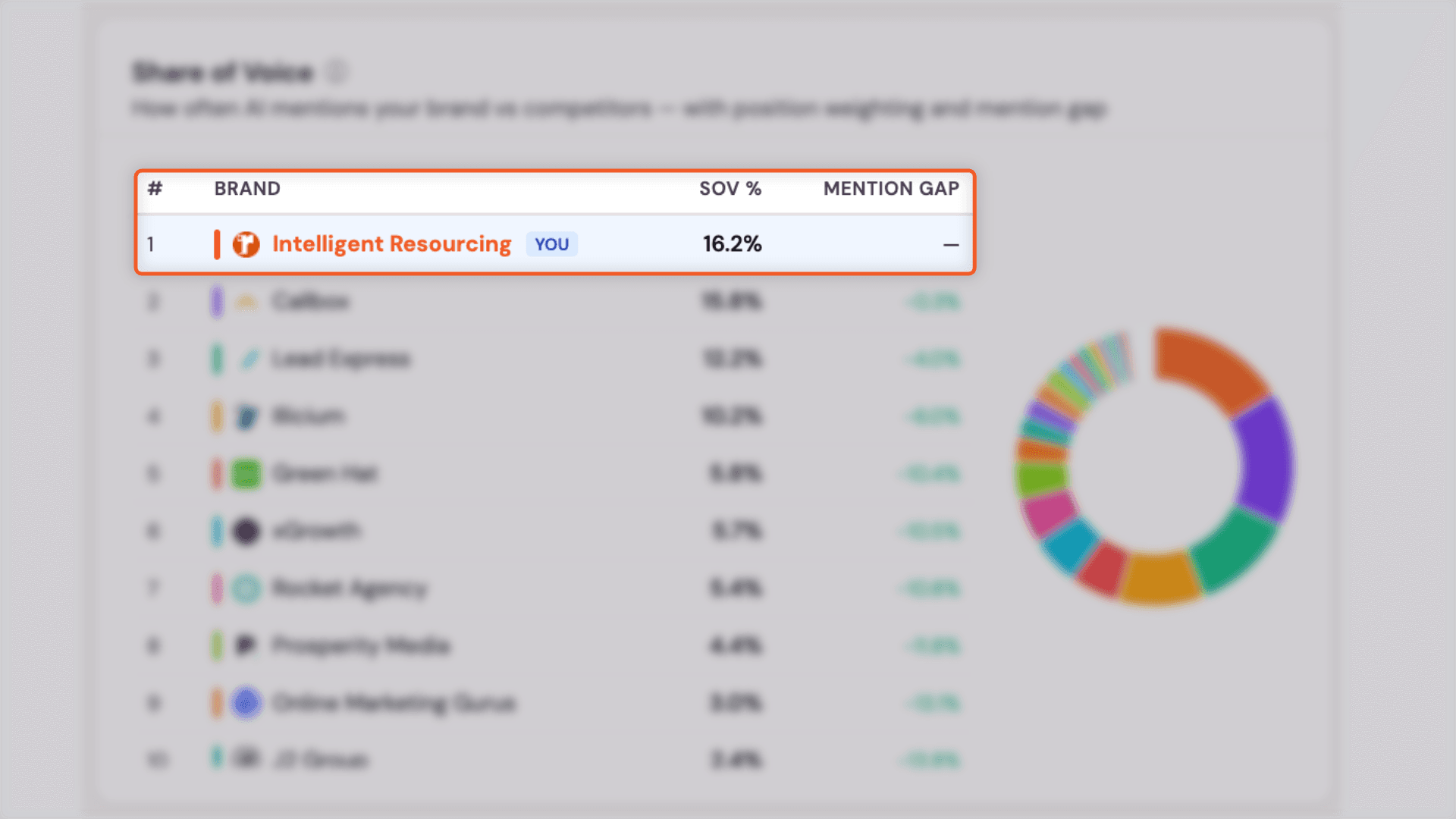
Ours proves the model works: live AEO data puts IR at #1 share of voice (16.2%) across 153 tracked prompts (source: Intelligent Resourcing AEO Tracker, live data, July 7, 2026).
Factor | Traditional SEO Only | GEO Answer-First Playbook |
Primary goal | Rank in the ten blue links | Get cited inside the synthesised AI answer |
Unit of value | The organic click | The AI citation and vendor recommendation |
Best used for | Navigational and branded queries | Research and vendor-shortlist queries |
When SEO-only is better | High-click categories with thin AI Overview coverage | Restructuring is not yet worth the effort |
GEO amplifies authority you have already earned; it does not manufacture it. Build the search foundation first, then layer answer-first structure, schema, and entity signals on top, and track the lift against a fixed prompt set. Even a category leader has to keep proving it: Intelligent Resourcing holds the #1 spot on share of voice, and the gap to #2 (Callbox) is 0.4 percentage points (source: Intelligent Resourcing AEO Tracker, live data, July 7, 2026).
Generative Engine Optimisation (GEO) vs. Search Engine Optimisation (SEO)
Generative engine optimisation structures content and entities so large language models retrieve, trust, and cite your brand inside synthesised answers. It is a systems discipline, not a single tactic. SEO, AEO, and GEO stack as complementary layers. SEO earns the ranking; answer engine optimisation wins the answer box; GEO earns citations across generative engines.
The urgency comes from buyer behaviour. Gartner projects traditional search volume will fall 25% by 2026 as buyers move to AI chatbots. Discovery is shifting into ChatGPT, Perplexity, and Gemini. Treat GEO as the next layer on your answer engine optimisation work, mapped in our AI search visibility cluster.
How is GEO different from SEO and AEO?
SEO ranks pages; AEO wins the single answer box; GEO earns citations across generative engines. The difference is the unit of retrieval. GEO retrieves passages, not pages, so every section must stand alone. A model pulls a 200 to 400 word chunk, verifies its entities, then cites it. Structure each passage as a complete answer.
This is why the skyscraper page fails for GEO. RAG retrieval does not read your 4,000 word guide top to bottom. It pulls the one passage that answers the prompt, a mechanism our LLM SEO breakdown covers in detail. Because models chunk content, a self-contained 250 word answer beats a sprawling section that needs surrounding context.
Why does GEO matter for B2B buyers now?
B2B buyers research vendors inside ChatGPT and Perplexity before they ever contact sales. The shortlist forms before a salesperson is involved. Bain found around 90% of buyers purchase from vendors already on their Day 1 list. That list is now assembled inside AI answers, not ten blue links.
The old funnel assumed buyers clicked through a results page. The AI buyer reads one synthesised answer naming three to five cited vendors. If you are absent from those citations, your win rate on that deal drops toward zero. Absence from the AI answer equals absence from the shortlist.
How Do You Get Cited in AI Search Engines in 2026?
Five signals drive AI citations. Structure beats length here; the skyscraper approach does not work.
Ship machine-readable schema to let engines parse your claims without guessing.
Open every section answer-first to get the passage retrieved as a standalone citation.
Raise named-entity density to anchor claims that models can cross-reference.
Build an off-site trust footprint to clear the authority threshold engines reward.
Refresh content monthly to win the freshness multiplier in AI answers.
Learn to structure content for AI citation first, then add schema markup for AI on every page.
What are the five signals that drive AI citations?
Structure, not word count, decides the citation.
Signal | What it does |
Machine-readable schema | Makes claims parseable |
Answer-first structure | Makes passages extractable |
Named-entity density | Makes claims verifiable |
Off-site trust | Makes the domain credible |
Content freshness | Keeps content current |
The evidence is specific. Princeton's 2024 GEO study found Quotation Addition lifted AI visibility by up to 43%, Statistics Addition by up to 33%, and citing sources by up to 28%, so evidence density beats prose length. Seer Interactive found nearly 65% of AI citations target content published within the past year, with almost 90% pulling from the last 3 years. Yext found 86% of AI citations come from brand-managed sources, with 44% from first-party sites and 42% from listings.
Off-site trust is not a minor factor in our own data either. Across the citations AI engines pull when answering our tracked B2B lead generation prompts, YouTube, Reddit, Clutch, and LinkedIn together account for more combined citations than any single brand-owned domain in the category, including ours (source: Intelligent Resourcing AEO Tracker, geo_cited_domains, live data, July 7, 2026). Schema and answer-first structure win the on-site half of the equation. Off-site presence on the platforms engines already trust wins the rest.
Princeton method | Relative visibility lift |
Cite Sources | Up to 40% |
Quotation Addition | Up to 41% |
Statistics Addition | Up to 37% |
The paper tested GPT-3.5 in 2023, so treat the figures as directional.
What results are B2B teams seeing from GEO in 2026?
GEO results show up as citation share, not just traffic. Two examples, one hypothetical restructure and one live tracker, make the pattern concrete.
Metric | 40-person AU B2B SaaS client | Intelligent Resourcing (own data) |
Baseline | Share of Model: 4% | Mention rate: 16.3% |
Result | Share of Model: 19% (90 days) | Citation rate: 25.3% %, attributed citation rate: 25.4% |
Category benchmark | Median enterprise B2B brand: 3% citation rate in relevant AI Overviews (Walker Sands, Mar 2026) | Share of voice: #1 at 16.2% ; citation frequency: #1 at 24.66% |
What moved it | Answer-first restructure, FAQPage schema, no new backlinks | 1,624 AI engine runs across 153 tracked prompts (28-day window) (source: Intelligent Resourcing AEO Tracker, geo_score, live data, July 7, 2026) |
The client moved from half the category benchmark to roughly 2.4 times it, because each rewritten passage became self-contained and independently retrievable.
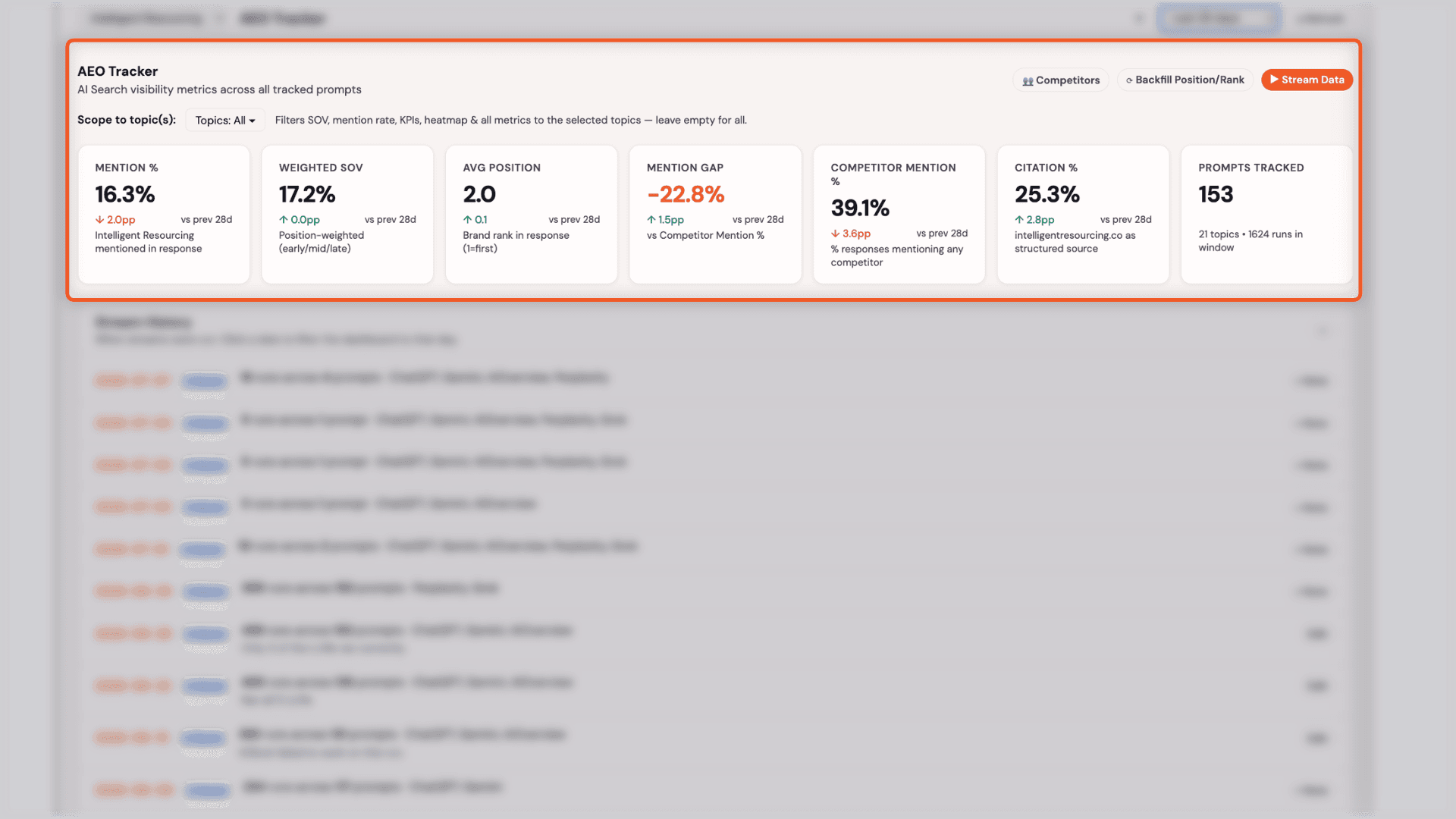
The margin at the top is thinner than the ranking suggests. The gap between Intelligent Resourcing's share of voice and the second-placed domain is 0.4 percentage points. A category leader still has to defend the position every month, not just win it once.
Which GEO Tactics Win in Perplexity, SearchGPT, and Gemini?
Citation mechanics differ by platform; one tactic does not fit all. Perplexity rewards freshness and earned media. SearchGPT rewards domain authority and web consensus. Gemini and AI Overviews reward schema-rich, brand-owned content. Match the tactic to the engine.
Platform | What it favours | B2B priority action |
Perplexity | Freshness, earned media, niche expertise | Update high-intent pages monthly; add temporal qualifiers |
SearchGPT (ChatGPT Search) | Domain authority, web consensus, Bing index | Build referring domains; ensure Bing indexation; consistent off-site profiles |
Google Gemini / AI Overviews | Schema-rich brand-owned content | Ship FAQPage/Article schema; keep grounding content server-side rendered |
Start with our guide to ChatGPT search optimisation for the ChatGPT-specific moves.
How do you optimise for Perplexity and SearchGPT?
Perplexity and SearchGPT reward different signals. Perplexity leans on freshness and third-party consensus. SearchGPT leans on domain authority and the Bing index. For Perplexity, update high-intent pages monthly and seed consensus on Reddit, G2, and Capterra. For SearchGPT, build referring domains and confirm Bing indexation.
The data supports the split. The same Seer Interactive freshness finding hits Perplexity hardest, because it carries an aggressive 30-day bias. For SearchGPT, SE Ranking found sites above 32,000 referring domains are about 3.5 times more likely to be cited by ChatGPT. Zenith AI found ChatGPT cites competitor sites 11.1 percentage points more often than Google, so consistent off-site profiles matter.
How do you optimise for Google Gemini and AI Overviews?
Gemini and AI Overviews favour schema-rich, brand-owned content. The Yext brand-managed finding shows first-party content carries the heaviest weight for Gemini.
Lead with structured data.
Render the grounding chunk server-side, because most AI crawlers do not execute JavaScript.
Ship FAQPage and Article schema that mirrors your on-page text exactly.
Add sameAs entity links to verify your brand.
Match your schema acceptedAnswer text to the visible answer word for word, because a mismatch reads as a trust failure.
Source the question set with question mining so your headings mirror the prompts buyers actually type.
How Does E-E-A-T Shape Generative Engine Optimisation?
E-E-A-T, experience, expertise, authoritativeness, and trust, is the most durable GEO lever. Experience is the one signal an AI cannot fabricate from training data. Named authorship, author schema, off-site corroboration, and proprietary data all raise citation odds. Replace "leading" and "world-class" with named outcomes, because models cite specifics. Our AI search marketing approach treats E-E-A-T as the foundation.
How do you prove Experience and Expertise to AI?
Prove experience with first-person evidence and credentialled authors. Proprietary data is the highest-value information-gain signal, because a model cannot reconstruct it from public data.
Add named author bylines with real bios.
Publish proprietary benchmarks and a named methodology.
State outcomes you observed, not claims you assert.
A practitioner view makes the point. At Intelligent Resourcing, we believe that experience is the one signal a model cannot synthesise; you either ran the test or you did not. The Princeton GEO methods reinforce this, since quotations and cited statistics carried the largest visibility gains.
This entire section is itself a live example. The citation, mention rate, and share of voice figures above come from our own AEO Tracker, re-pulled at time of writing rather than quoted from a one-off audit. A model reading this page can verify the claim is current, not archived.
What author and schema signals reinforce trust?
Author and schema signals tie your claims to verifiable entities. The failure mode is common: a schema dateModified that contradicts the visible date reads as a trust-signal failure, so engines discount the page.
Use Organization schema with sameAs links to LinkedIn and Crunchbase.
Add Article and author schema with stated credentials.
Match datePublished and dateModified to the visible dates.
Keep entity data consistent across third-party profiles.
Consistent name, role, and organisation across LinkedIn, Crunchbase, and your byline let an engine cross-reference the author as a real, verifiable person.
Agentic AI Optimisation (AAIO)
Agentic AI optimisation (AAIO) prepares your content for AI agents and machine customers that research, shortlist, and transact for buyers. It extends GEO beyond human-read answers. Machine customers reward semantic legibility, API availability, and transparent pricing over visual design. This is preparation, not hype. Gartner predicts AI agents will intermediate 90% of B2B buying and $15 trillion in spend by 2028.
What is Agentic AI Optimisation (AAIO)?
Agentic AI optimisation (AAIO) optimises content for autonomous AI agents, not human readers. GEO earns citations inside answers people read; AAIO makes your data legible to software that buys. Forrester frames these agents as machine customers that shortlist vendors on a buyer's behalf. The distinction is the reader: GEO serves a person, AAIO serves a program.
The failure mode is opacity. Gated demos and JavaScript-only pricing are invisible to agents, so a machine customer skips you and shortlists a transparent competitor. An agent cannot fill a lead form to learn your price. It parses what is server-side and structured, then moves on.
How should B2B teams prepare for machine customers?
Start with three moves. We call the result an Agent-Ready Page: a URL an agent can parse, price, and shortlist without a human in the loop.
Publish an llms.txt to declare what agents may crawl.
Expose machine-readable pricing and specs in server-side HTML.
Keep critical content out of JavaScript-only renders.
The implication for pipeline is direct. Because agents reward structure over design, the legible vendor enters the shortlist and the opaque one does not. As buying shifts toward machine customers, an Agent-Ready Page protects pipeline that never reaches a human sales conversation.
FAQs
Is GEO replacing SEO in 2026?
No. GEO does not replace SEO; it extends it. Generative engine optimisation is an answer layer built on strong search foundations. A page with no organic visibility earns few AI citations, regardless of structure. Gartner projects a 25% search-volume shift toward AI by 2026, but ranking signals still feed the models. Build SEO first, then layer GEO.
How long does generative engine optimisation take to show results?
Expect two timelines. Tactical citation lift, from schema and answer-first rewrites, typically appears within 1 to 3 months. Structural authority build, from topical clusters and author entities, takes 3 to 6 months. As of March 2026, these ranges hold for high-intent B2B pages on domains that already carry search visibility.
How do you measure if your brand is cited by AI?
Use Share of Model. Select 20 to 50 high-intent prompts. Run each across ChatGPT, Perplexity, and Gemini. Record whether your brand is cited, recommended, or absent. Citation count divided by total prompts gives your baseline. Re-test the same prompt set every 30 to 90 days to track movement after content changes. Our own tracker runs 292 prompts across five engines for this exact reason: a 20-prompt sample moves around too much month to month to act on with confidence.
Does E-E-A-T really affect AI citations?
Yes. Experience and named authorship correlate strongly with AI citation. SE Ranking found high-authority domains are cited far more often by ChatGPT. The Princeton GEO study found quotations and citations lift visibility. Experience is the one signal a model cannot fabricate, so first-person evidence and credentialled authors carry disproportionate weight.
What is the difference between GEO, AEO, and AAIO?
AEO wins the single answer box. GEO earns citations across generative engines like ChatGPT, Perplexity, and Gemini. AAIO, agentic AI optimisation, prepares your content for autonomous AI agents and machine customers that research and transact on a buyer's behalf. AEO is the box; GEO is the citation; AAIO is the agent.
Get Your B2B Brand Cited in AI Search
The shortlist now forms inside AI answers, before a buyer contacts sales. GEO puts your brand in those citations. The work is concrete: answer-first passages, FAQPage and Article schema, an llms.txt, and a Share of Model tracker across ChatGPT, Perplexity, and Gemini. It compounds existing authority, so start with pages that already rank.
We run this playbook on ourselves first. Our own AEO Tracker is the proof point in this article, not a hypothetical: #1 share of voice, #1 citation frequency, live data, re-pulled monthly. If you want your B2B brand cited in AI answers, book a call with Intelligent Resourcing to scope your GEO programme. Our answer engine optimisation service covers the full build.