


Why Is GEO Strategy a Prioritisation Problem?
A keyword list is a weak starting point for GEO. When a buyer asks an AI system a question, the system can run many related searches before it answers. Google calls this query fan-out. Its generative AI guide, last updated in July 2026, says its AI features use query fan-out to gather supporting pages.
That changes the planning problem. A team no longer works with 1 phrase and 1 results page. It works with a network of questions around a buying choice. So starting GEO means choosing which answers matter and where the brand is absent.
A broader business-to-business (B2B) GEO strategy still needs content, citation and technical layers working together. Those execution choices only become useful once the team has decided which answer opportunities deserve attention first.
What Should Determine Your GEO Roadmap?
Keyword research stays useful. GEO adds inputs because no single source shows the whole buyer decision or the full answer environment.
| Planning input | What it reveals | Role in GEO |
|---|---|---|
| Keyword research | Established search demand and category language | Validates broad topics and known demand |
| AI answer audit | Which brands, pages and sources engines use today | Finds real visibility gaps |
| Jobs-to-be-done mapping | The progress a buyer wants in a specific situation | Captures commercial questions that keyword tools miss |
| Winnability assessment | Whether you can improve the existing answer | Sets priority |
Keyword tools such as Semrush and Ahrefs show established demand. They cannot describe every situation in which a buyer investigates a market. An AI answer audit shows where your brand is missing, but not whether each gap deserves investment.
Jobs-to-be-done mapping explains why a question matters. Winnability decides whether to pursue it. Use all 4 inputs together, and let no single dataset set the roadmap.
Natural Fan-Out Changes What You Map
Natural fan-out means 1 buyer question carries many needs. The system does more work behind the scenes than the buyer sees.
Consider a B2B buyer asking ChatGPT: "Should we invest in GEO if our organic search performance is already strong?" That question covers many needs. The buyer wants to know why strong search engine optimisation (SEO) does not guarantee AI visibility.
They want to know which AI platforms their customers use. They also want to know whether current content can be adapted, how progress is measured and when a specialist is justified.
Those are separate needs that together resolve 1 commercial job. Google's guide also warns against creating a separate page for every fan-out variation to influence generative results. Google says doing so can break its scaled content abuse policy.
Map the questions, but do not turn each one into a page. The goal is decision coverage.
What Are the 5 Workstreams of a GEO Strategy?
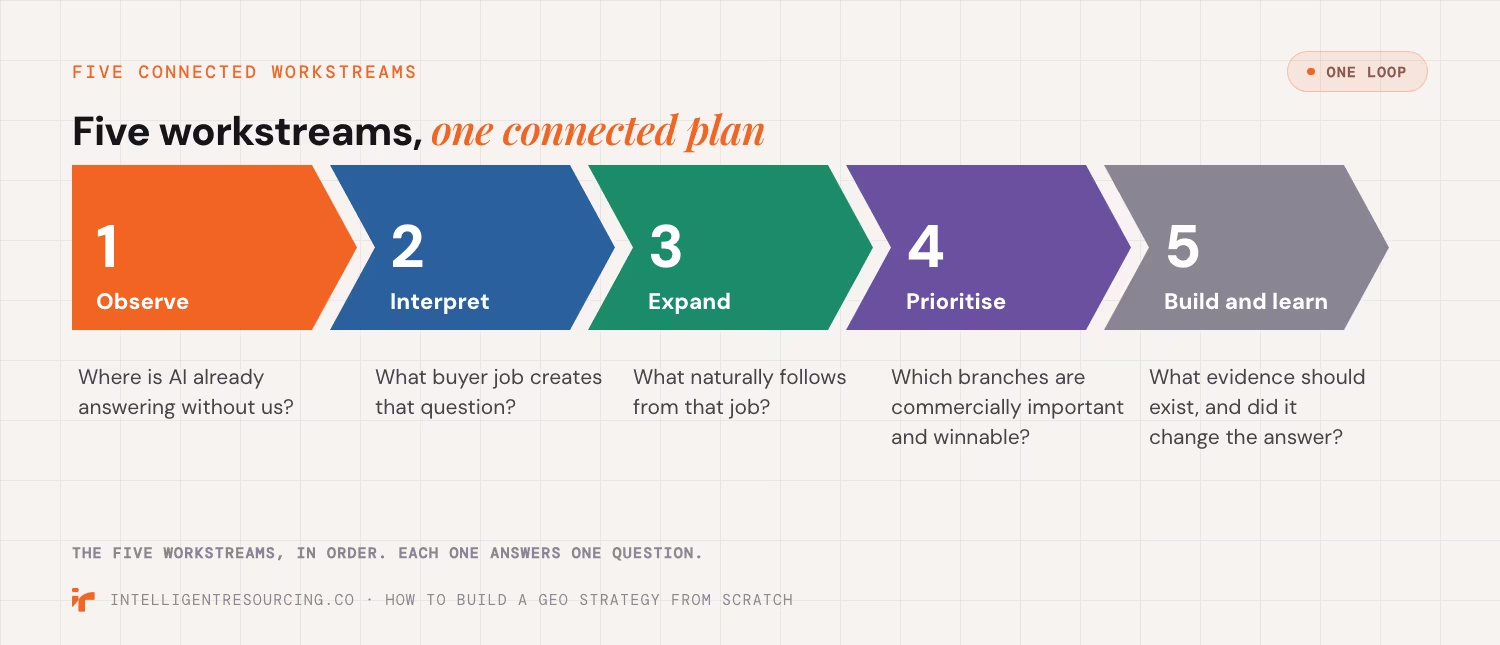
A practical GEO strategy has 5 connected workstreams. They move a team from seeing where the brand is absent to deciding which evidence to build. They also show whether it changed the answer.
| Workstream | Question it answers |
|---|---|
| Observe | Where is AI already answering without us? |
| Interpret | What buyer job creates that question? |
| Expand | What naturally follows from that job? |
| Prioritise | Which branches are commercially important and realistically winnable? |
| Build and learn | What evidence should exist, and did publishing it change the answer? |
This is a distinct start from collecting hundreds of prompts and writing content against them. You begin with the answer environment that exists today. Then you decide where your brand has a real reason to enter it.
How Do You Observe the Answers That Exclude Your Brand?
Start with the commercially relevant answers AI already gives without your brand. This is how Intelligent Resourcing starts: find questions where an answer exists and the brand is absent, then rank them by winnability.
Take a buying question such as "Which GEO agencies suit a mid-market B2B software-as-a-service (SaaS) firm?" Run it through the AI engines your buyers use. Record the companies named and the sources cited. Record the evidence in those sources and the criteria the answer uses to compare providers.
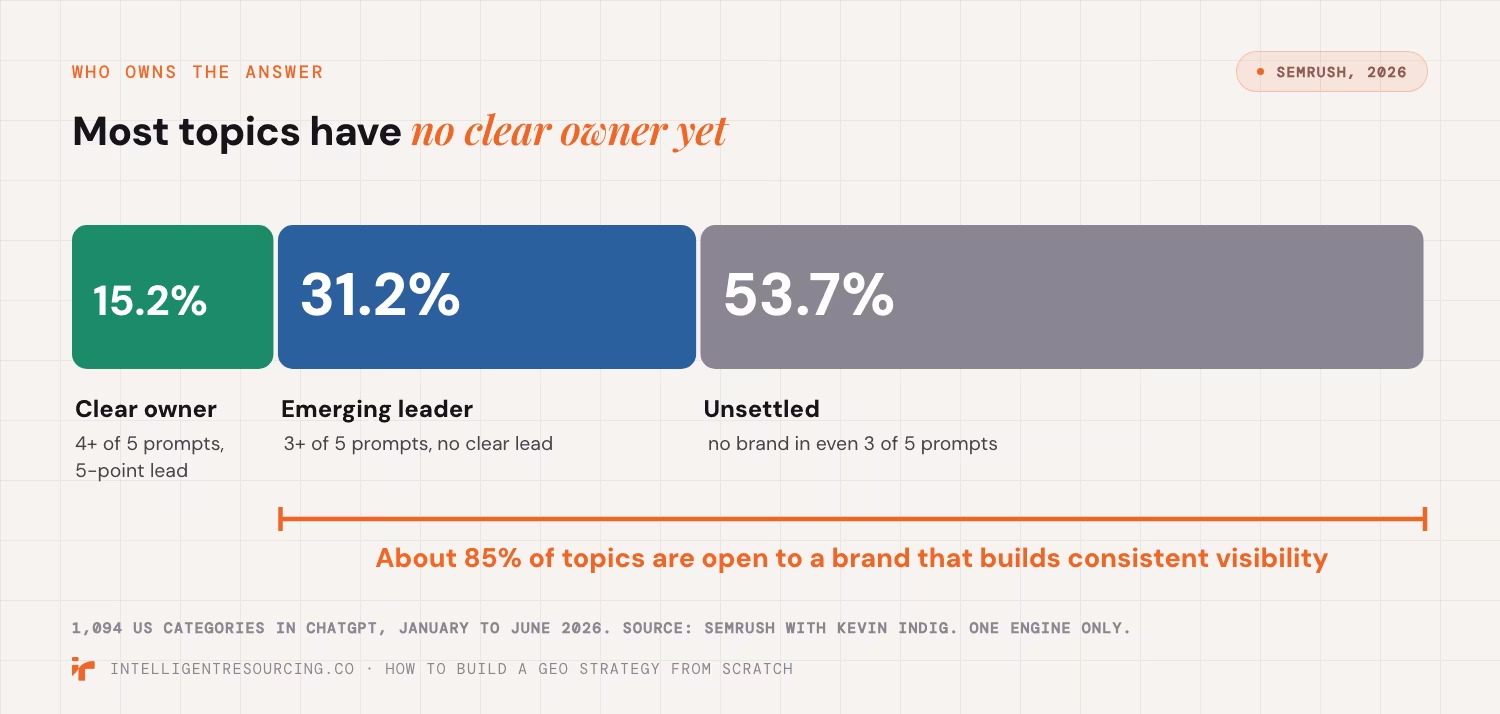
Many categories have no settled leader. The Semrush topic authority study, run with Kevin Indig, found that only 15.2% of 1,094 United States (US) categories in ChatGPT had a clear owner. Another 53.7% were unsettled. The study covers 1 engine and US categories only.
Absence, however, is only a candidate opportunity. Some questions have little commercial value. Some are already answered well. Others need evidence the brand does not yet have.
That is why a useful AI visibility and share of voice framework should sit inside the prioritisation process itself. It helps teams compare where the brand is absent, where competitors repeatedly appear and which gaps are worth acting on.
How Do You Interpret the Buyer's Job Before Trusting Keyword Scores?
B2B buying questions are often more specific than keyword databases can show. A buyer can search "GEO agency", which is clear market demand.
The real situation can read: "We rank well for our commercial keywords, but 3 rivals keep appearing when prospects ask ChatGPT for recommendations. Do we need a GEO specialist, different content or better third-party coverage?"
That question holds a starting state, a problem, options and a buying choice. In a keyword tool, its exact wording can show no volume.
Clayton Christensen and colleagues set out jobs-to-be-done theory in Harvard Business Review in 2016. It focuses on the progress a person wants to make in a given situation. Mapping that job keeps situational questions in the plan even when no volume score exists.
Compare the keyword "geo consultant" with a situational job: "Our content team can publish, but nobody owns AI citation monitoring. Do we need a consultant or should this sit with SEO?"
The keyword shows the market. The job shows why a buyer enters it now.
That distinction also changes how teams source questions. Question mining for AI search can surface the language buyers already use across sales calls, support tickets and reviews. That gives the GEO strategy a stronger input than keyword volume alone. No visible keyword volume does not mean no commercial demand.
How Do You Expand a Job Into Its Natural Fan-Out?

Once you understand the job, expand it through 6 lenses: Diagnosis → Options → Comparison → Risk → Proof → Implementation.
Suppose the job is: "Help me decide whether GEO deserves a budget alongside SEO." The diagnosis question asks why rivals appear in AI answers when the firm ranks well.
The options question compares four routes. They are improving current pages, publishing new content, earning third-party mentions and fixing technical access.
Comparison questions ask how GEO differs from the SEO work you fund today. Risk questions ask whether new content duplicates current coverage or chases questions that never influence buyers. Proof questions ask what shows commercial value. Implementation questions cover ownership, sequencing and when to review the programme.
That map beats a spreadsheet of 50 versions of "GEO strategy". Treat it as a list of questions, and decide separately which assets to publish.
Several questions can sit in 1 article. A proof question can need a case study, and a vendor-fit question can belong on a service page. Some branches need no new content at all.
Winnability Decides What Enters the Roadmap
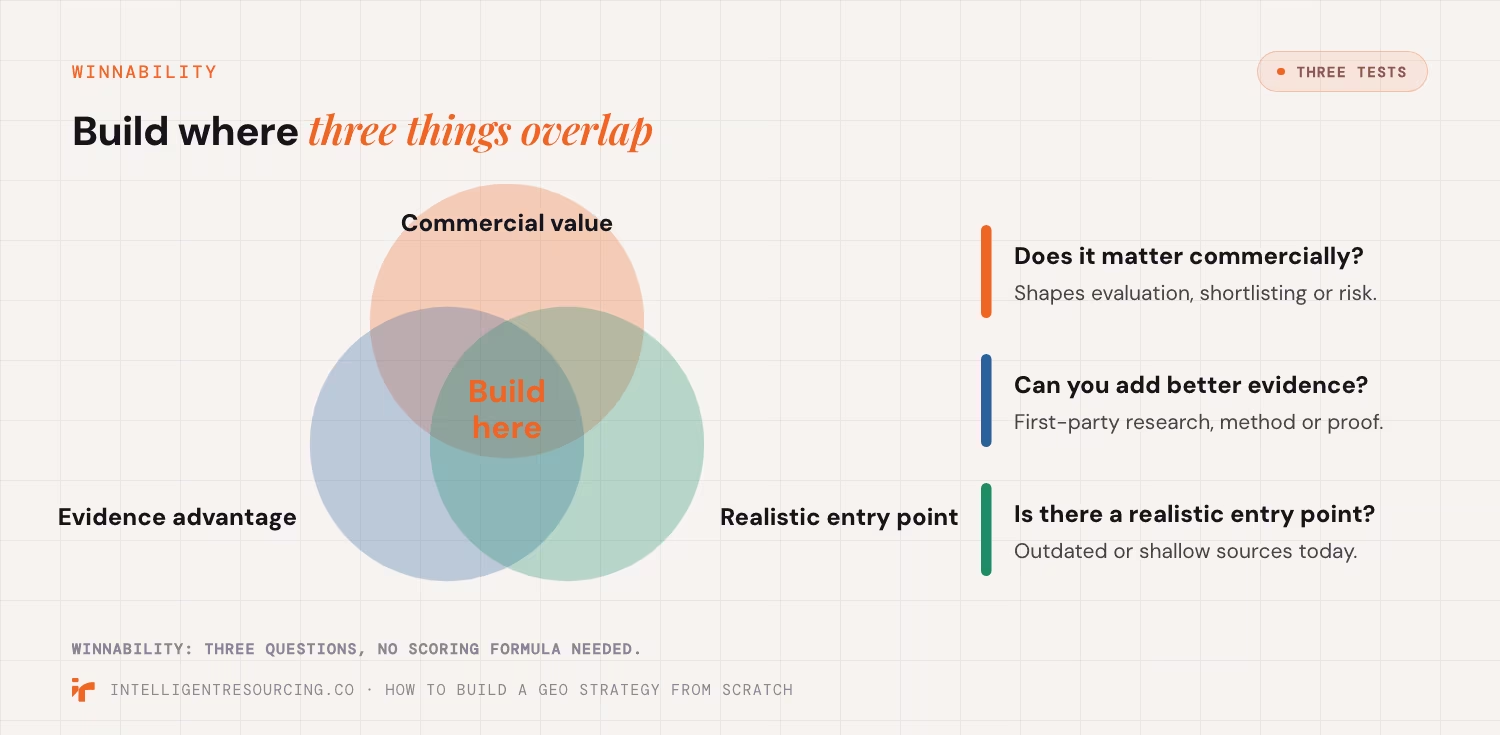
Winnability decides which questions enter the roadmap. Rank each candidate on commercial value, evidence advantage and entry point, because brand absences are not equal opportunities.
Most teams end up with too many questions. So a GEO strategy is shaped as much by what you leave out as by what you build.
Intelligent Resourcing's methodology ranks questions this way. Ask 3 questions. A 10-point scoring formula is not needed.
Does the question matter commercially?
Move a question up the queue when its answer can influence evaluation, shortlisting, risk or implementation confidence.
"What is the history of generative AI?" may attract interest. "What should a B2B firm measure before hiring a GEO agency?" sits closer to a buying choice. It can deserve priority even with lower search demand.
Can you add better evidence?
A brand needs something worth retrieving. That can be first-party research, a repeatable method or customer evidence. It can be product data, operating experience or a limit that current answers omit.
If the current answer is generic and you hold specific proof, winnability improves. If primary documentation answers it well and you add nothing new, the opportunity is weak.
Is there a realistic entry point?
Study what the answer relies on today. Are the cited pages outdated? Do they repeat the same shallow claim? Do authoritative sources define the topic but leave implementation unanswered?
A vendor answer with no clear comparison criteria is also an opening. Aim for the most consequential answer you can credibly improve. Prompt count alone is a weaker guide.
What Evidence Should Winnable Questions Produce?
Once a question clears the winnability test, decide what evidence should exist. This is where a GEO strategy becomes an evidence architecture and stops being a content calendar. Different buyer questions need distinct source types.
| Buyer needs to know | Useful asset |
|---|---|
| What does this mean? | Definitive explainer or service page |
| Which option fits us? | Comparison or decision framework |
| Does this actually work? | Case study, benchmark or original research |
| What could go wrong? | Risk, limitation or failure-mode analysis |
| How do we implement it? | Workflow, template or practical guide |
| Why should we trust this provider? | Methodology, proof, relevant experience and transparent capabilities |
GEO is often reduced to blog optimisation, which is too narrow. Take an AI answer on whether to use an external GEO partner: another generic "What is GEO?" article adds little.
A documented method, a detailed case study or an honest in-house versus external comparison can improve the answer.
The execution layer comes next. Answer-first passages, citation signals and technical access sit inside the wider system of generative engine optimisation. Do not start with a 20-page topic cluster. Decide which buyer decisions need coverage first, then build the connected pages those decisions require.
What Does This Framework Look Like for One B2B Buying Job?
Consider a firm with strong organic visibility but weak inclusion in AI recommendations. The buyer job reads: "Help me work out why rivals appear in ChatGPT recommendations when our firm does not."
A baseline review shows 3 rivals appearing again and again, backed by category guides, comparison articles and third-party mentions. The brand is absent.
The fan-out asks many things. Is this an authority problem? Are current pages unsuitable for AI retrieval?
Which engines matter most? How do third-party sources shape the shortlist? How should progress be measured?
Now apply winnability. Suppose most sources explain GEO at a high level. They give no method for diagnosing why one brand appears and another does not.
The firm holds first-party citation data, a repeatable audit process and client evidence on how source types affect visibility. That is a credible proof advantage, so the opportunity moves up the roadmap.
The right response may not be 7 new articles. It could be 1 diagnostic framework, improvements to a current service page, 1 detailed case study and stronger links between them. These 4 improvements can cover more than 7 thin pages, because each answers a distinct part of the buyer's job.
How Do You Close the Loop After Publishing?
Publishing is not the end of GEO strategy. The strategy pays off when the team learns which changes shift the answer.
Re-run the same question cluster after each change. Keep the set stable, because enough consistency has to remain to see what moved.
Visibility also swings by itself. Advanced Web Ranking's 481-site volatility study covered finance, education, health and SaaS. It found that only 49% of brands stayed visible across 3 weeks.
Engines also disagree. Kevin Indig's study of 3.7 million AI citations found that 91% of citations appeared on only 1 engine. The engines were ChatGPT, Perplexity and Google AI Overviews. Track each engine separately.
Look for movement in brand inclusion, source inclusion, answer framing, competitor presence and source type. A page can be cited to define the market, support a statistic, explain implementation or recommend a vendor. Those are distinct outcomes and need distinct readings.
The learning loop is Observe → Interpret → Prioritise → Build → Re-probe → Learn. If the answer does not change, revisit the assumption before producing more content.
The proof may not be distinctive enough. A third-party source may matter more than your own site. Or the question may never have been winnable. That feedback is what turns GEO into an evidence-led programme.
What Should the First Month of a GEO Strategy Produce?
You do not need hundreds of prompts or dozens of new pages before GEO becomes actionable. A useful first month produces 6 deliverables.
| Deliverable | What it should contain |
|---|---|
| Answer landscape | Commercially relevant questions AI already answers without the brand |
| Jobs-to-be-done (JTBD) map | The situations and decisions underneath those questions |
| Fan-out map | Diagnosis, options, comparison, risk, proof and implementation branches |
| Winnability queue | Prioritised opportunities in place of an unfiltered question list |
| Evidence roadmap | Existing pages to improve, new assets to build and proof gaps to fill |
| Baseline question set | A stable group of questions to re-run after changes |
That is enough to move from "we should do GEO" to an operating plan.
A strategy is ready for execution when the team can answer 4 questions.
Which answers do we want to enter? Why do they matter to buyers? Why does the brand deserve to contribute? What evidence must exist?
If those stay open, more content will not solve the problem.
What Is the Core Principle of GEO Strategy?
Map demand as a decision. Keyword research remains useful, but it is incomplete on its own. One buyer problem can trigger multiple searches, comparisons and follow-up questions inside a single AI interaction. Situational B2B questions can also carry real commercial intent even when the exact wording has no meaningful volume score.
The starting unit of GEO is therefore the buyer job, together with its answer gaps and winnable evidence opportunities. A list of AI questions tells you what could be asked. A strategy tells you which answers are worth pursuing and why they matter. It also shows where investment is most likely to change the brand's visibility.
Competitors may already appear in the AI answers your buyers use while your brand does not. If so, the next step is to find which of those gaps matter commercially and can realistically be won.
Book a GEO strategy call with Intelligent Resourcing to map the answer opportunities worth prioritising first.
Content Creation
To map the AI answers that leave your brand out and pick the ones worth winning, book a strategy call with Intelligent Resourcing.
FAQs
What is a GEO strategy framework?
A GEO strategy framework is a system for deciding which AI questions a brand should compete to answer. It sets what proof the brand needs and how to track progress. It comes before execution tactics such as answer structure, technical access, entity work and citation tracking.
How do you start GEO from scratch?
Start by identifying commercially relevant AI answers where your brand is absent. Find the buyer job behind each question and map the natural questions that follow. Then prioritise the opportunities where commercial relevance, credible evidence and realistic winnability overlap.
Should GEO strategy start with keyword research?
Treat keyword research as 1 input. It validates known demand and market language. Situational B2B questions can show little or no volume. Jobs-to-be-done mapping weighs the choice behind those questions so they are kept.
What is query fan-out in GEO?
Query fan-out is when a generative system creates related searches around an initial query. It does this to gather information for a broader response. For GEO teams, the idea also works as a planning model because it exposes the connected questions around 1 buyer decision.
How should GEO opportunities be prioritised?
Prioritise opportunities where 3 conditions overlap. The question influences a buyer decision, and your organisation holds credible evidence that can improve the answer. The current sources also leave a realistic entry point. High search demand alone does not make a question the best GEO target.
Does every fan-out question need its own article?
No, a fan-out map lists what a buyer needs to know to settle a job. It does not set the number of pages. Many questions can fit in 1 strong page. Others need a case study, service page, comparison, original data or no new asset.