
What Is a Citation Strategy, and Why Does It Matter in 2026?
An AI citation strategy is a plan for getting a company named or cited when buyers ask AI tools about its category. It defines which buyer questions matter. It sets which pages and outside sources support the answers. It picks which engines to monitor and how visibility will be measured over time.
Traditional content strategy starts with what to publish. A citation strategy starts with which buyer questions should name your company. Buyers can now research a category and compare providers inside an AI tool. They can clarify what they need before they visit a vendor website.
That creates a new visibility problem: a company can be absent from the buyer's research journey even when its website still ranks in traditional search.
What a citation strategy does
A citation strategy focuses on the questions that shape a buyer's choice. It maps each one to the pages, outside sources and AI engines that decide if the company is found, named or cited.
The B2B generative engine optimisation playbook explains how planning shifts from single keywords to question-led visibility in AI answers.
Why Are Fewer Searches Ending in a Website Click?
AI summaries and answer engines can answer part of a search before the user visits another site. More information now sits inside the results page or AI tool, so fewer searches end in a click.
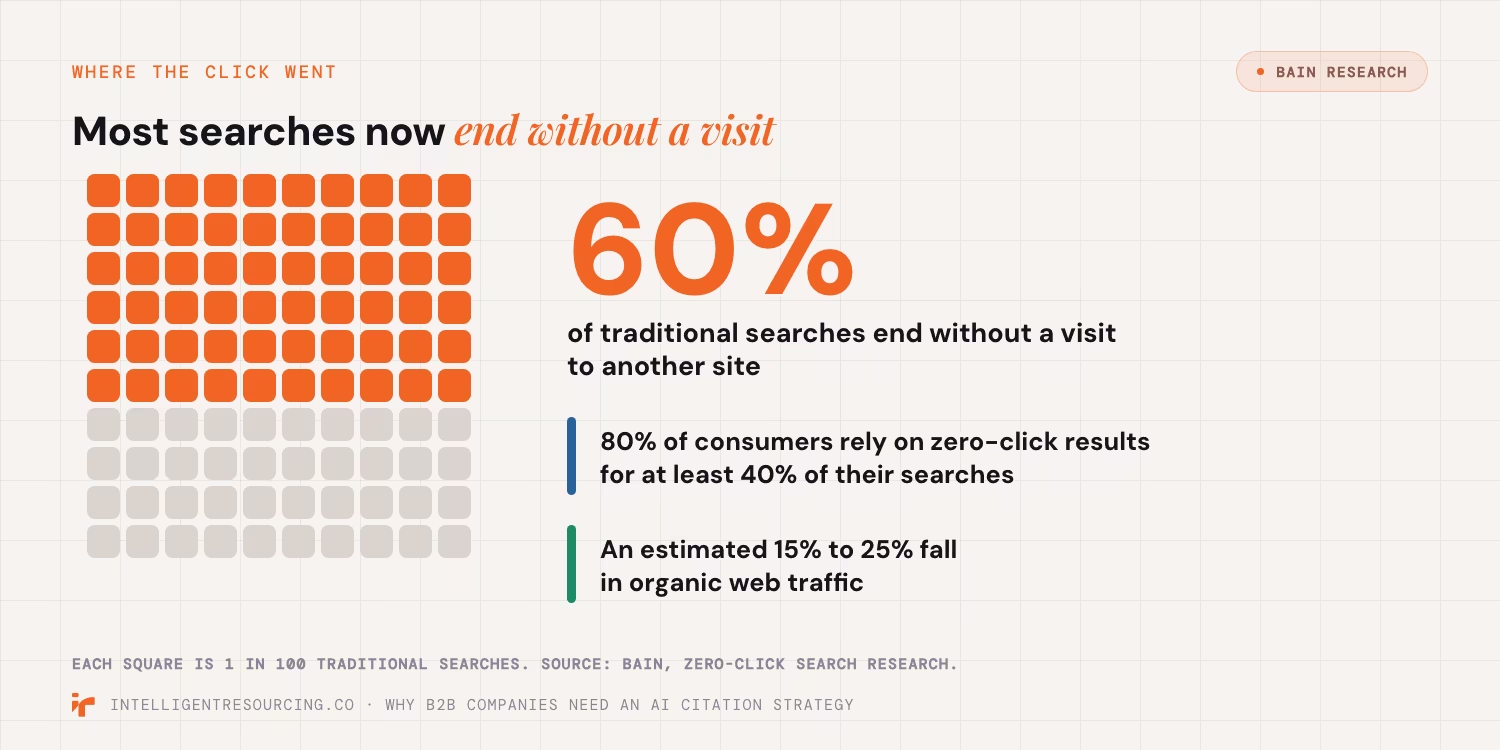
Bain's research on zero-click search found that about 80% of consumers rely on zero-click results for at least 40% of their searches. Bain estimates this can cut organic web traffic by 15% to 25%. About 60% of traditional searches end without a visit to another site.
Website sessions no longer capture the full research journey. A buyer may see your company, a competitor or a category pick inside an AI answer without visiting your site. Traffic alone cannot show whether the brand was present while the buyer was researching.
What a citation strategy changes
A citation strategy adds answer visibility to how you measure. Traffic and rankings still matter, so measure them alongside whether the company is named, cited or absent on the buyer questions that shape choice. AI search marketing for B2B is now part of the research journey. Buyers may meet a brand in an AI answer before they reach its website.
Does Being Cited Still Bring Buyers to Your Site?
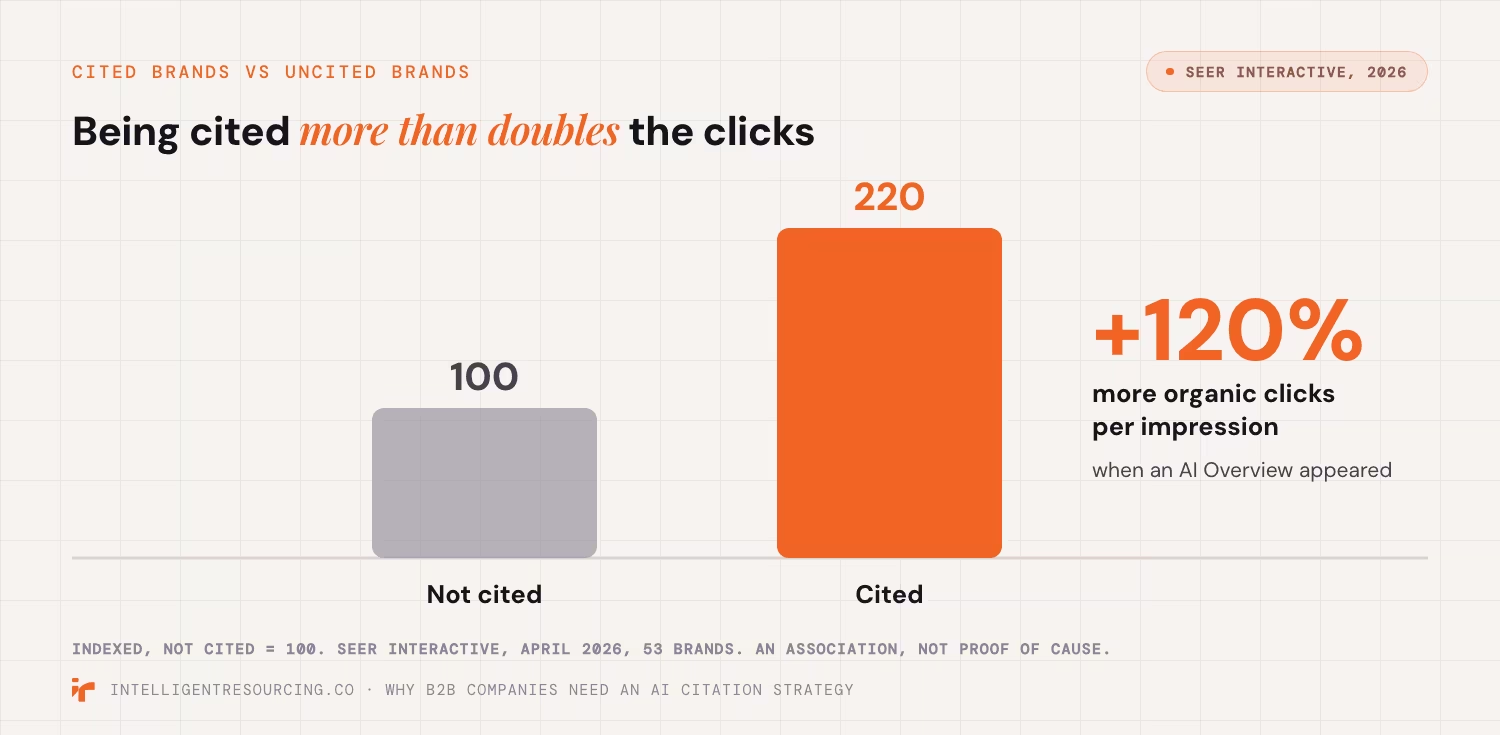
Yes, citation goes with higher click-through rates when an AI Overview appears. The evidence does not prove that citation alone causes the rise. Seer Interactive's April 2026 study analysed 53 brands, 5.47 million tracked queries and 2.43 billion organic impressions.
Across AI Overview queries, cited brands got 120% more organic clicks per impression than uncited brands. Across 2025, cited brands also had roughly two to five times the organic click-through rate.
AI Overviews can reduce the need to click. Being named in the answer still separates visible brands from those left out of the buyer's research.
What a citation strategy finds
A citation strategy shows where competitors keep appearing and why your company does not.
A company may be missing because its pages are weak or its authority signals are thin. It may lack comparison content. Or competitors are cited in AI search from stronger third-party sources.
What Does a Citation Strategy Actually Decide?
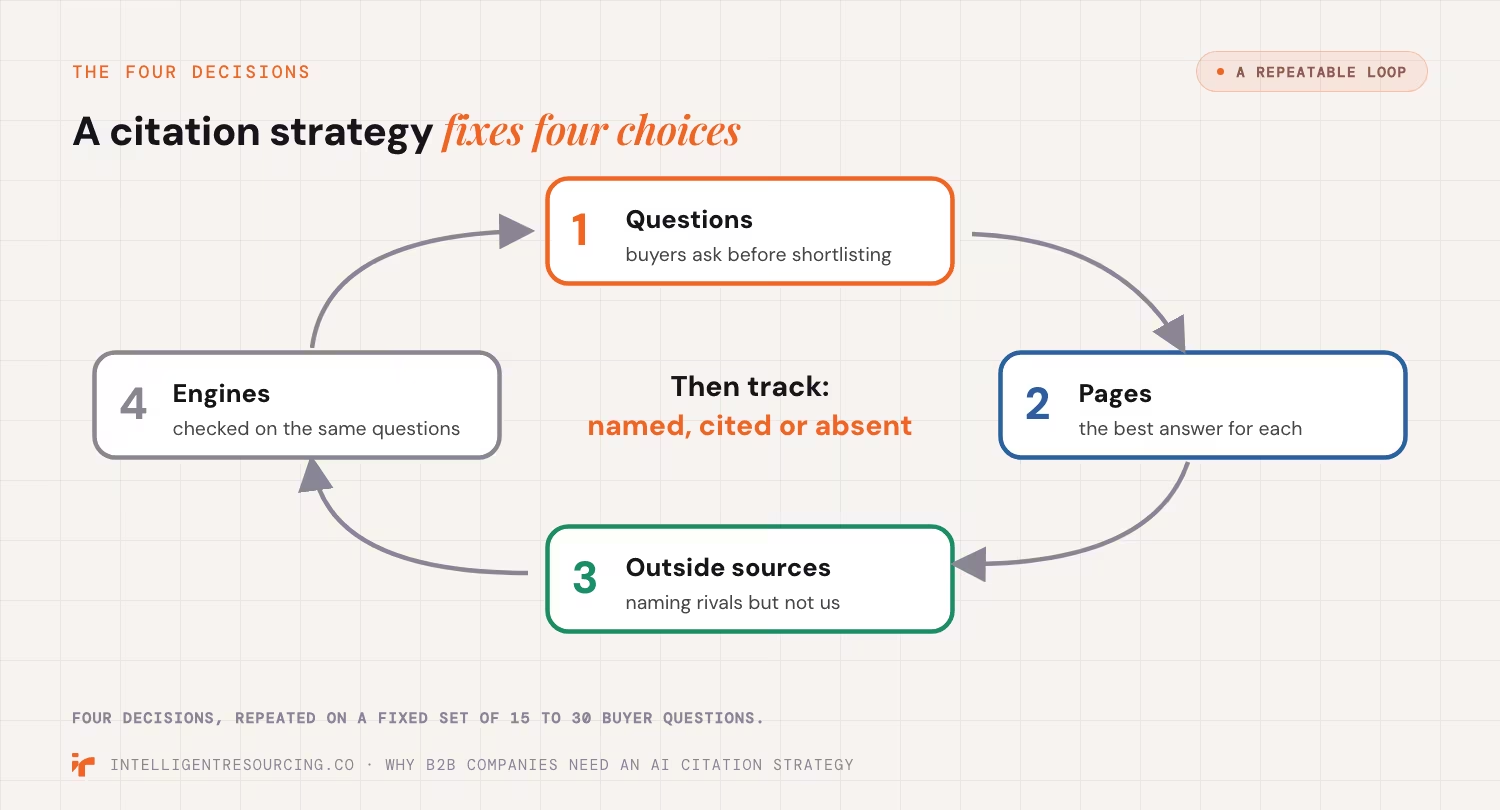
A citation strategy decides which buyer questions matter and which pages should answer them. It decides which outside sources strengthen the brand and which AI engines to monitor. Without those choices, more content does not show whether answer visibility is improving.
Google's guidance for AI search states that its generative search features use existing Search systems. They add retrieval and query fan-out to find supporting information. Google also recommends useful, original content, not separate pages for every variation of a query.
So a citation strategy is not about producing hundreds of prompt-specific pages. It is about making the right pages strong enough to answer several questions that matter to the business.
What changes for B2B companies
A single keyword can stand for many buying questions. Buyers add context such as industry, use case, needs, risk, pricing or alternatives. The strategy starts with the questions buyers actually ask. It then maps them to the pages and outside sources most likely to support the answer.
A useful citation strategy defines four things:
| Decision | Question it answers | Example output |
|---|---|---|
| 1. Questions | Which questions influence shortlists in our category? | A fixed set of 15 to 30 buyer questions |
| 2. Pages | Which page gives the strongest answer to each question? | A page map showing existing coverage and gaps |
| 3. Outside sources | Which independent sources mention competitors but not us? | A list of relevant articles, directories, reviews or industry sources |
| 4. Engines | Which AI platforms should we monitor consistently? | A defined set of engines checked against the same questions |
Intelligent Resourcing's measurement principle: track answer presence, not imaginary AI search volume.
AI platforms do not publish a reliable, complete version of Google keyword volume. That includes the questions people ask in tools such as ChatGPT. A sound measurement model fixes the question set first. It then tracks whether the company is named, cited or absent on those same questions over time.
That creates a repeatable baseline without pretending to know how many times every prompt is entered.
The process for defining that fixed set is covered in question mining for AI search. It starts with the questions buyers ask before shortlisting, not with keyword volume as the only demand signal.
Why Can't One Engine or One Campaign Cover It?
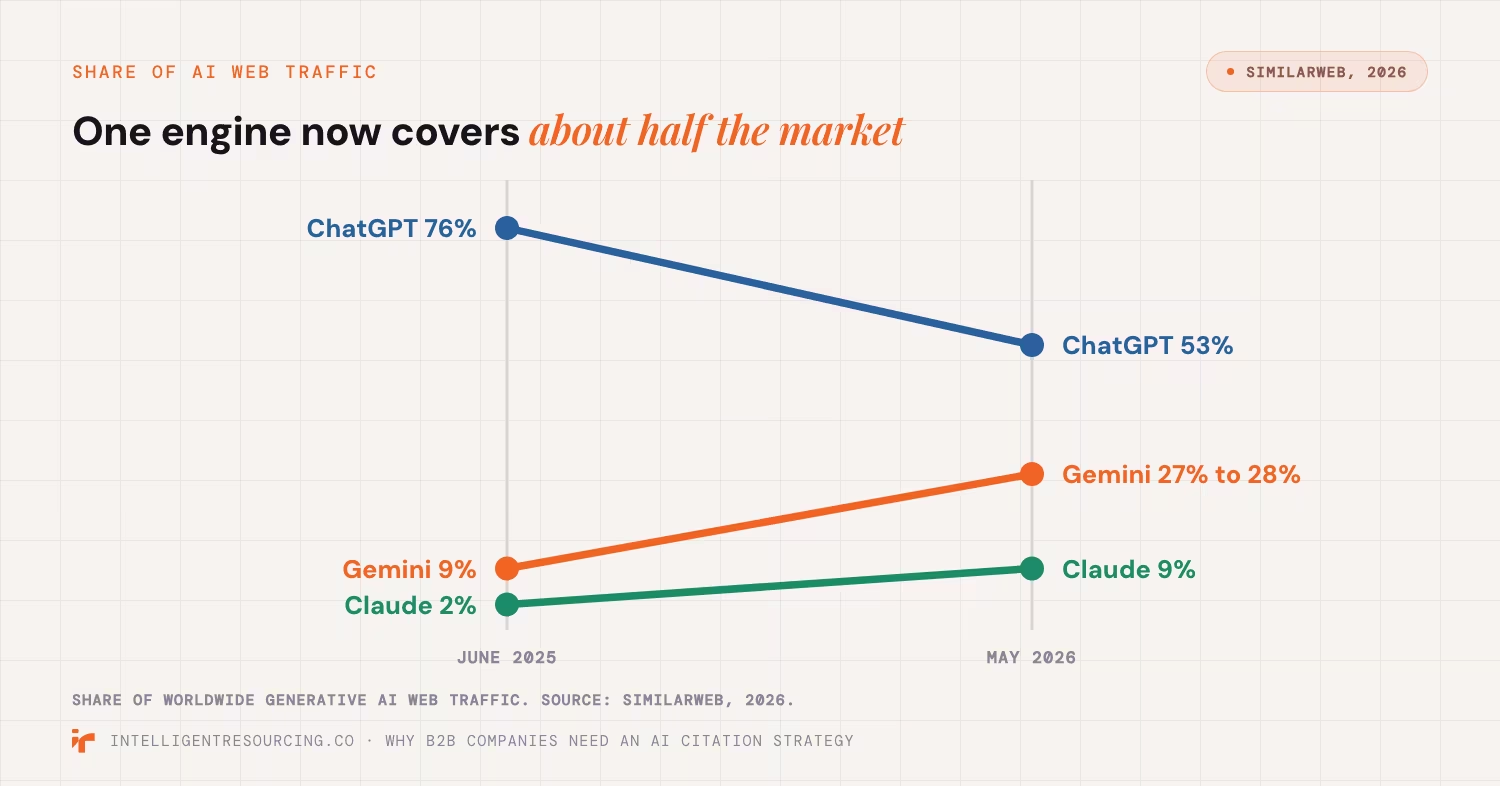
One engine cannot represent the whole AI market. One campaign cannot show whether visibility is improving. AI use is spread across several platforms. The same buyer questions need to be tested across more than one engine.
Similarweb's 2026 generative AI data shows ChatGPT's share of measured worldwide generative AI web traffic fell from about 76% in June 2025 to roughly 53% by May 2026. Gemini rose from under 9% to about 27% to 28%. Claude rose from around 2% to close to 9%.
Testing ChatGPT alone gives one view of AI visibility. A useful measurement set covers the platforms your buyers use and asks the same questions each time.
How to measure it
Most B2B companies can start with three steps:
- Define the questions. List 15 to 30 questions buyers ask before shortlisting companies in the category.
- Test the engines. Run the same questions on two or three relevant AI platforms. Record whether the company is named, cited or absent.
- Prioritise the gaps. Focus first on 5 questions where competitors appear consistently. Then check whether the missing signal sits in a page, an outside source or both.
The goal is not to appear everywhere. It is to track visibility on the questions that can shape a buyer's choice.
An answer engine optimisation baseline can be built around the same comparison. See where the company appears today, where competitors appear instead and which gaps to fix first.
Content Creation
To see which buyer questions name your competitors instead of your company, book a Strategic Blueprint audit with Intelligent Resourcing.
FAQs
What is an AI citation strategy?
An AI citation strategy is a plan for getting a company named or cited when buyers ask AI tools about its category. It defines which buyer questions to target. It sets which pages and outside sources support the answers. It also sets which AI engines to monitor and how visibility is tracked.
Why do B2B companies need a citation strategy now?
AI tools have become a mainstream research channel. Roy Morgan found 58% of Australians aged 14 and over used an AI tool in an average four weeks in early 2026. For B2B companies, the issue is whether the brand appears when buyers use those tools. They use them to research categories, providers and alternatives.
Is a citation strategy the same as search engine optimisation?
No, because search engine optimisation (SEO) focuses on visibility in search results. An AI citation strategy tracks whether the company is named or cited in generated answers. They overlap because AI search features can rely on traditional search systems, crawlable pages and quality signals. Google's 2026 guidance confirms that foundational SEO still applies to its generative AI search features.
Can you measure how often buyers ask a question in AI tools?
Not precisely, because there is no reliable public version of Google keyword volume for ChatGPT and similar tools. Nobody can see how often each question is asked. A citation strategy uses a fixed set of questions that matter to the business. It tracks whether the company is named, cited or absent over time.
Where should a B2B company start with a citation strategy?
Start with the questions buyers ask before they shortlist. Define 15 to 30 questions and test the same set across relevant AI engines. Fix first the questions where competitors keep appearing and your company does not. Then work out whether the gap sits in your own pages, outside sources or both.