

What Changes for Your Business After a Funding Round?
After a funding round, Australian B2B companies must prove that they can convert capital into pipeline before increasing headcount or paid media. Boards move their attention to deployment discipline, runway and unit economics. Teams therefore need to assign the raise to measurable targets such as pipeline created, ARR added and CAC payback improved.
Cut Through Venture's February 2026 report recorded $5.4 billion across 390 announced Australian start-up deals in 2025, up 31% year on year. The 20 largest rounds received 58% of total capital, showing that the recovery remained concentrated among a small group of companies.
AI now captures roughly 60% of all venture capital deployed in Australia. Emu Money calls this the shift from funding the idea to funding the execution. For post-funded venture capital, the message is direct: a raise no longer proves your idea won, it obliges you to build a Post-Funding Revenue Engine and show a return. The impact of post-funding on business growth comes down to one question: can you convert capital into pipeline before the runway runs out?
How Do You Turn Fresh Capital Into a Revenue System?
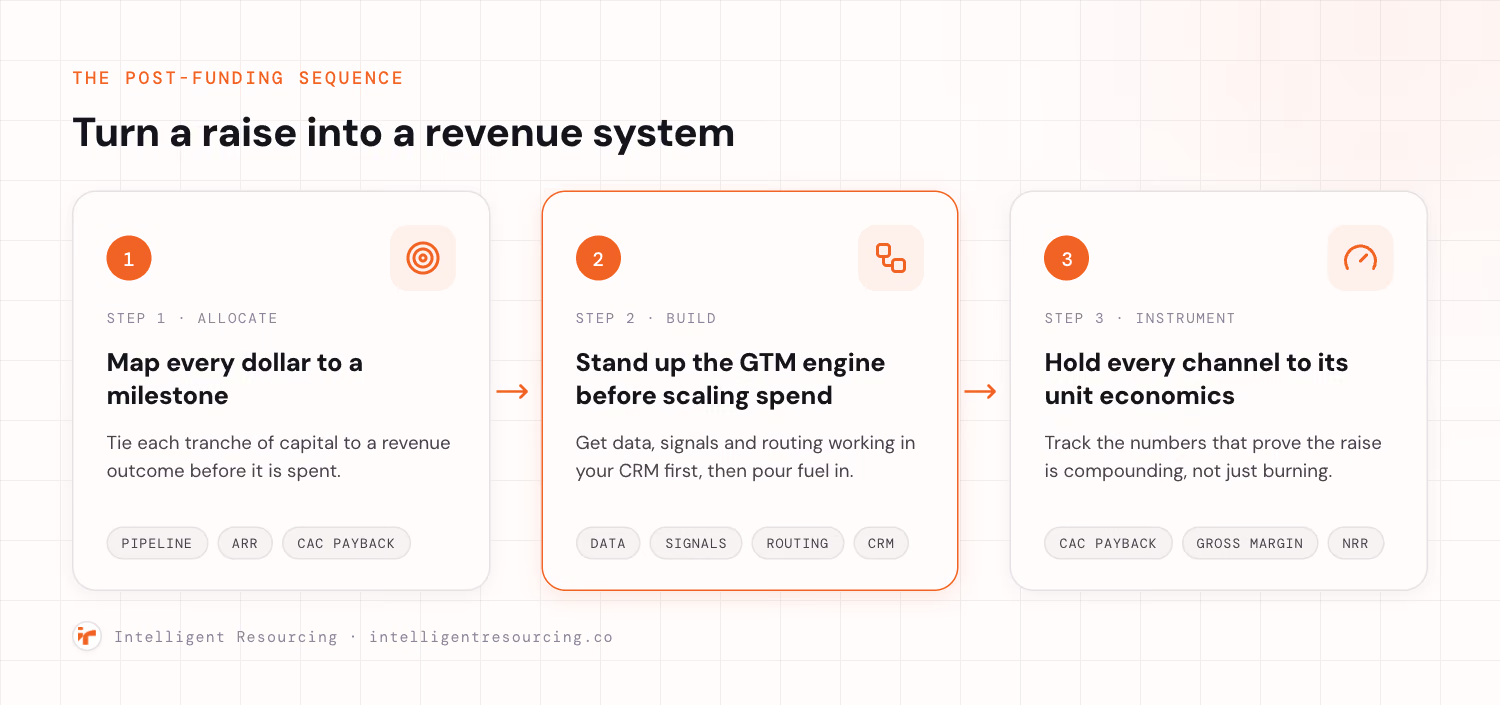
To turn fresh capital into a revenue system, map every dollar to a revenue milestone, build the go-to-market engine before you scale spend, and instrument each channel to report unit economics. This sequence converts a raise into a predictable pipeline, and it is the core of turning fresh capital into a revenue system.
- Map every dollar of the raise to a revenue milestone. Split the round into deployment buckets and give each a target: pipeline created, ARR added, or CAC payback improved. Australian Series A rounds typically run $2 million to $15 million, per Granton, and fund product, team, and customers. Attach a number to each.
- Stand up the go-to-market engine before scaling spend. Build the GTM engineering layer first: the data, workflows, and routing that move a signal to a booked meeting. Scaling spend or headcount before this inflates CAC.
- Instrument the system so every channel reports unit economics. Wire each channel to report CAC payback, gross margin, and net revenue retention. Connect lead generation services to pipeline, not to lead counts.
When we implemented a signal-based revenue engine for an Australian B2B SaaS client, CAC payback moved from 14 months to 9 months within 90 days. Comparable teams sat near 12 months, a 25% improvement against the median. Post-funded business growth strategies look like this: a system that converts capital into measurable revenue, not faster spending.
Which Post-Funding Growth Strategies Actually Compound?
Post-funding growth compounds when Australian B2B companies direct capital towards channels with measured CAC payback, gross margin and revenue retention. Teams should scale one or two proven motions before funding broader experiments. This allocation concentrates spending where the company can measure pipeline contribution, recover acquisition costs and protect the runway.
Kashcade's February 2026 analysis states that lenders are more willing to fund the execution of an existing motion once it demonstrates positive unit economics, including clear CAC payback and net revenue retention above 100%. This principle supports the use of non-dilutive capital after a channel has proved its return.
The following strategies compound because each connects capital deployment to a measurable outcome.
GTM Engineering to Automate the Revenue Engine
GTM engineering is the systems discipline that removes manual handoffs and makes the revenue engine repeatable. It is not a tactic, it is the plumbing beneath every channel, connecting tools like Clay and your CRM so a signal flows to a booked meeting without a human retyping data between steps.
Manual handoffs are where revenue engines leak, since a signal goes stale before anyone acts. GTM engineering wires the stack together: Clay enriches and scores accounts from raw signals, your CRM (HubSpot, Salesforce, or similar) holds the record and fires workflows, and a webhook connects them, so a funding signal in Clay creates a routed task automatically.
The engine behind that layer runs on signal density. Intelligent Resourcing's signal engine screens roughly 50,000 Australian news items a day down to about 50 actionable buying signals, drawn from a deduplicated universe of about 115,000 Australian companies built from four independent sources, then narrows that universe to roughly 50 net-new accounts a month, each checked against the client CRM. For site-based sectors like manufacturing or construction, a geospatial model estimates a site's annual spend from building footprint, industry benchmark and state levy before a rep ever calls.
Non-Dilutive Capital to Extend Runway
Non-dilutive capital extends the runway without giving up more equity. Instruments like R&D Tax Incentive advances, venture debt, and revenue-based finance fund proven go-to-market and smooth working-capital gaps. Among Australian post-funded investment strategies, this is the one that buys time to let a working revenue engine compound before the next raise.
Equity is the most expensive capital you will ever raise. Once a channel proves payback, funding it with debt instead of dilution protects ownership. Kashcade's 2025 data shows 31% of VCs advised portfolio companies to consider venture debt, and 49% of founders expect to consider debt in 2026. RDTI advances turn a future refund into working capital today, so each instrument funds a proven motion and you scale what works without resetting your cap table.
How to Calculate Post-Funding ROI in Australia
Post-funding ROI is the return generated per dollar of deployed capital, measured against a revenue or pipeline outcome, not activity. You calculate it by comparing incremental revenue to the capital you deployed to create it.
Post-funding ROI measures output, the revenue a deployed dollar created, tied back to pipeline or recognised revenue. Model a deployment bucket against expected ARR before you commit the capital, rather than after.
The Post-Funding ROI Formula
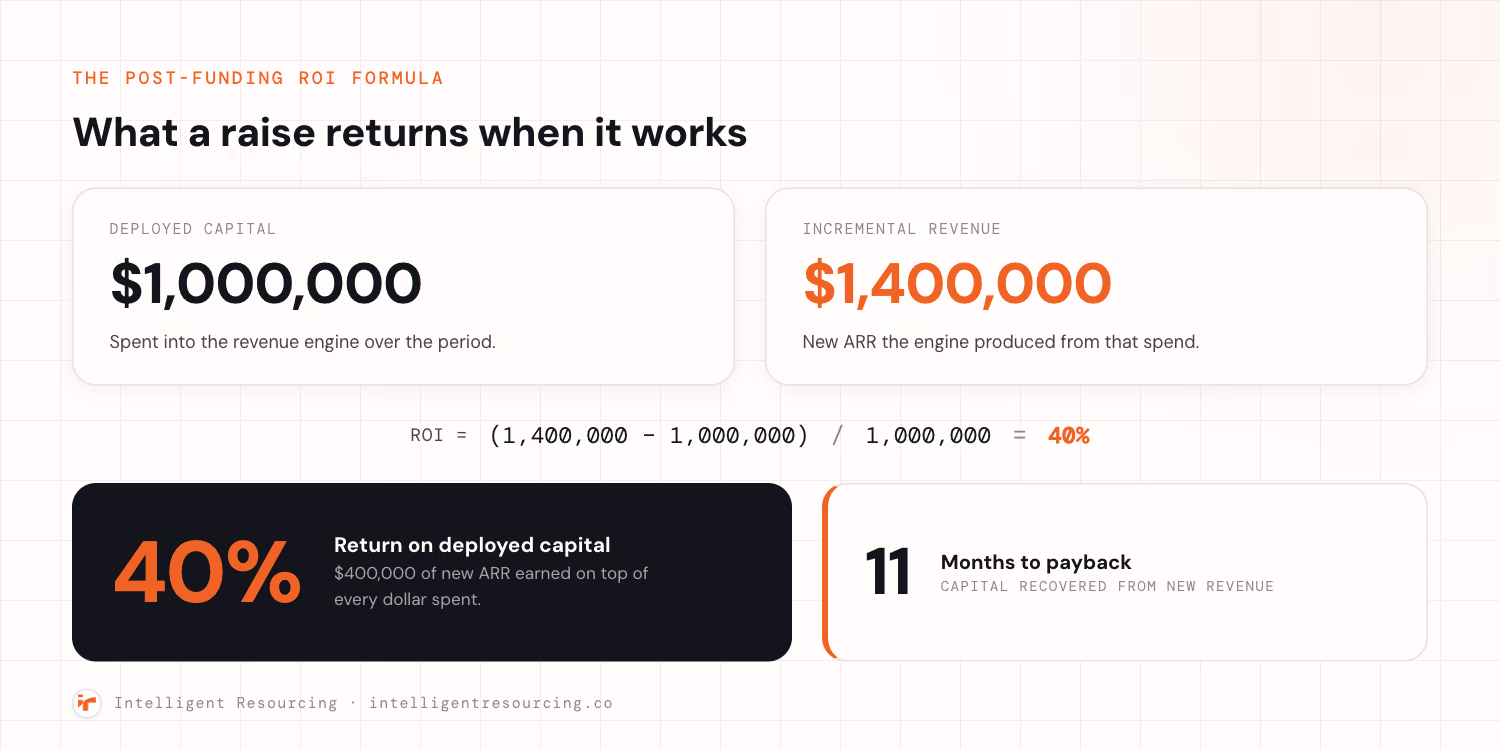
The post-funding ROI formula is simple: subtract deployed capital from the incremental revenue it created, then divide by the deployed capital. Deploy $1,000,000 and generate $1,400,000 in new ARR, and your post-funding ROI is 40%. Because the maths is stable, this formula ages well while the benchmarks around it change.
Worked example: you deploy $1,000,000 into a proven channel (deployed capital), and that spend generates $1,400,000 in new ARR (incremental revenue), because the channel showed payback before you scaled it. Subtract the capital, divide by the capital, and the result is a 40% post-funding ROI. The channel recovers its cost in 11 months, so every month after that compounds.
| Input | Definition | Worked example |
|---|---|---|
| Deployed capital | Portion of the raise allocated to growth | $1,000,000 |
| Incremental revenue | New recurring revenue attributable to that spend | $1,400,000 ARR |
| Payback period | Months to recover deployed capital | 11 months |
| Post-funding ROI | (Incremental revenue minus deployed capital) / deployed capital | 40% |
The formula does not care about the year, so it belongs in your evergreen reporting, separate from the benchmarks below.
Post-Funding ROI Benchmarks for Australian Businesses
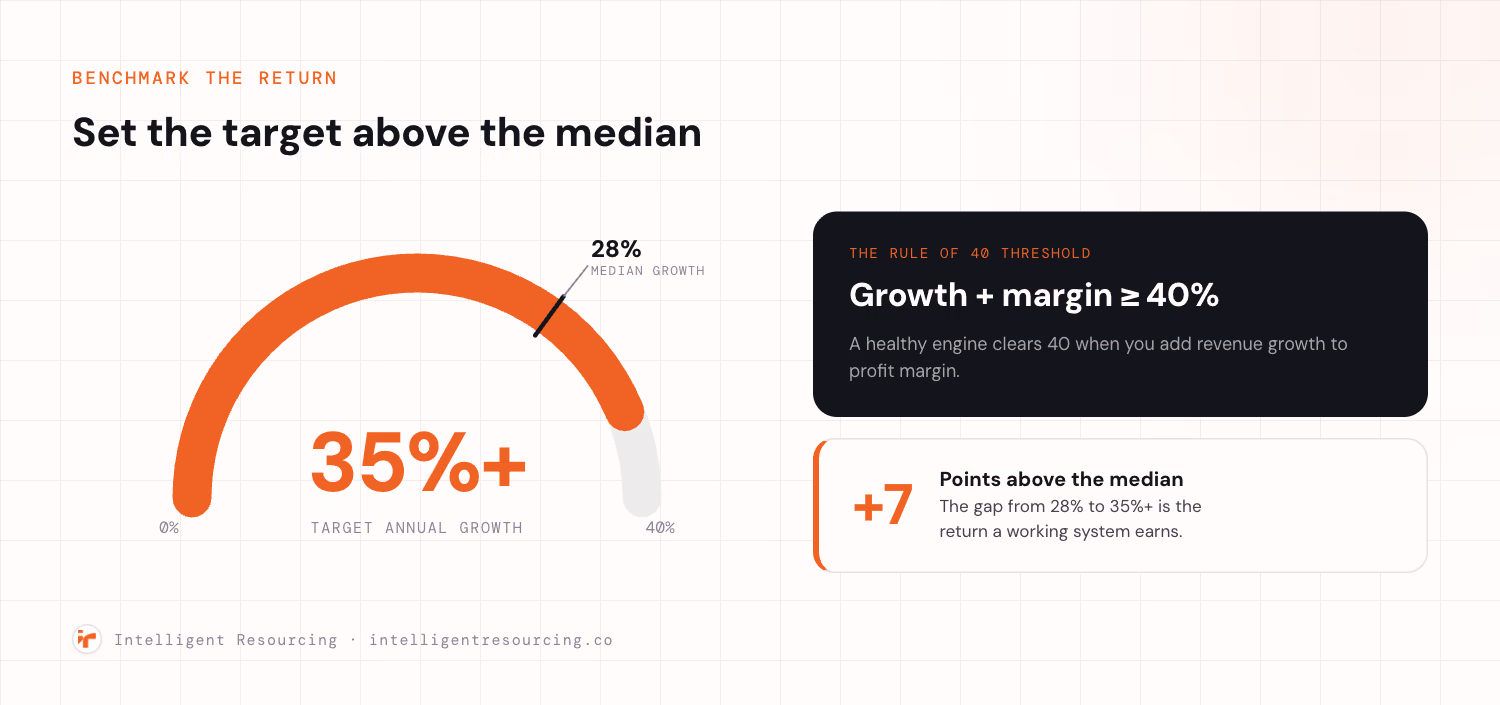
A defensible post-funding ROI benchmark in Australia anchors to the 2025 SaaS medians and the Rule of 40. As of January 2026, median annual revenue growth sits near 28%, with a sales and marketing efficiency multiple around 3x, and a systemised revenue engine should beat those medians because it deploys only into proven unit economics.
Anchor first: Kashcade's 2025 read on the State of Australian Start-up Funding puts median annual revenue growth near 28% and the sales and marketing efficiency multiple around 3x. Grant Thornton names a strong Rule of 40 score as a signal of investable growth: growth rate plus profit margin clearing 40%. Spray-and-hope deployment lands below the median because it funds unproven channels, while a systemised Post-Funding Revenue Engine deploys only into proven payback, pushing growth past the 28% median while holding CAC. Anchor at 28%, target 35% or better; that delta is the return your system earns.
Where Post-Funding Growth Plans Break
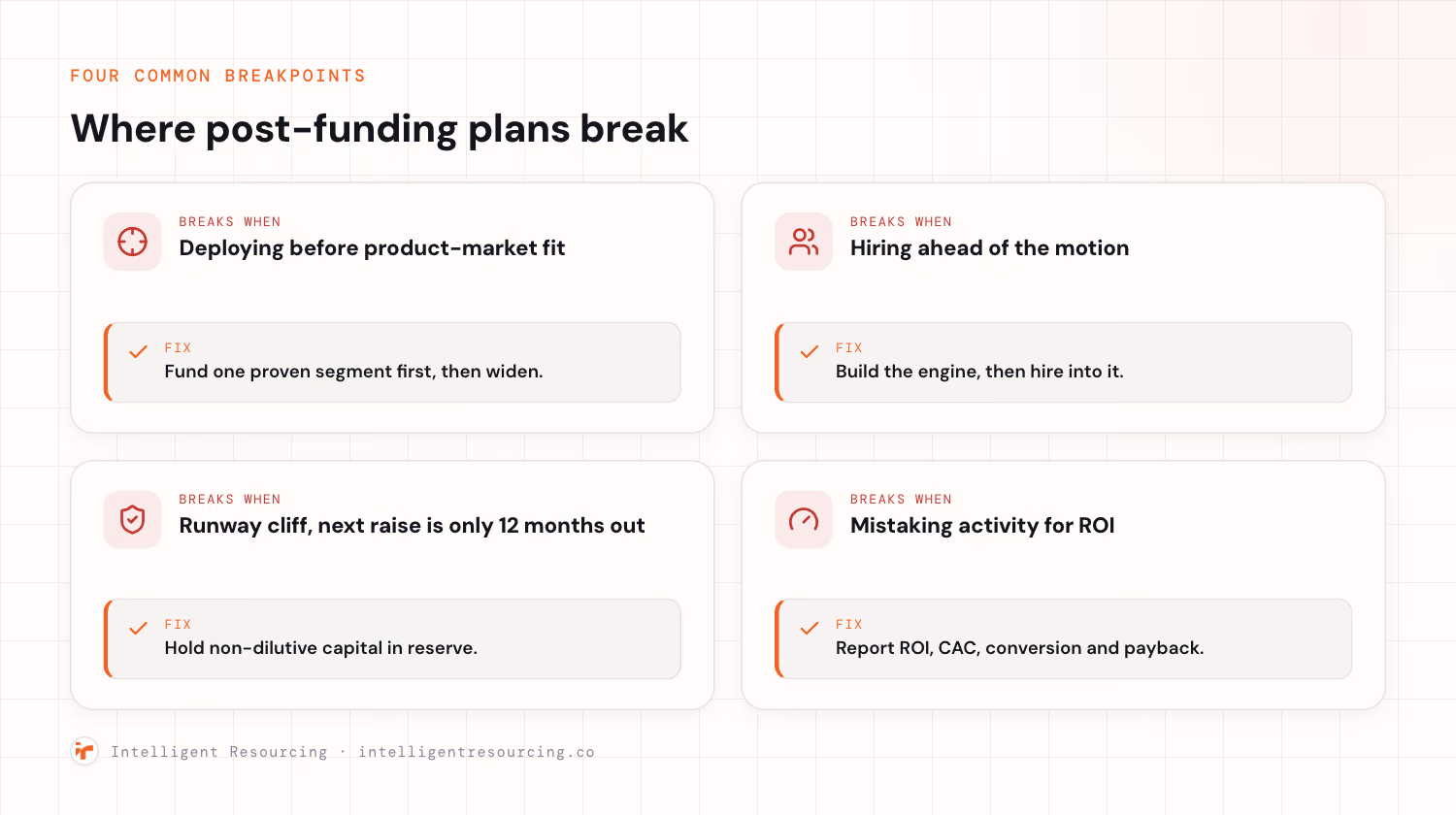
Post-funding growth plans break in predictable places. Teams deploy capital before product-market fit is proven, hire ahead of a working go-to-market motion, and mistake activity for ROI. The principle behind each fix is the same: prove the unit economics of a motion before funding it at scale, then instrument it properly.
The post-Series A growth phase is where many Australian start-up failures occur, per the Wade Institute. The raise itself is not the greatest risk. The way the capital is deployed is.
The four most common break points are:
- Deploying before product-market fit: teams spread capital across too many markets, segments or channels before proving repeatable demand. De-risk this by funding one proven segment first, then widening once conversion and retention are consistent.
- Hiring ahead of the go-to-market motion: adding sales and marketing headcount does not fix an unproven acquisition model. Build the engine first, document how it converts, then hire people into a motion that already works.
- Reaching the runway cliff: the fundraising timeline has stretched from around six months to approximately 12 months, per Kashcade 2025. Hold non-dilutive capital in reserve so the business is not forced to raise from a weak negotiating position.
- Mistaking activity for ROI: lead counts, meetings booked and campaign volume can create the appearance of momentum without improving revenue. Report post-funding ROI, customer acquisition cost, conversion and payback instead.
A constraint we see firsthand is that most teams cannot instrument more than two channels well at once. When we pushed a client beyond that point, reporting quality declined and customer acquisition cost visibility became blurred. Two well-instrumented channels therefore outperform five channels based on guesswork.
There is a genuine exception. When capital is cheap and the business is pursuing a true winner-takes-all land grab, faster and less controlled deployment may be the right decision.
Signal-based systems are not universal either. Human-led outbound can still outperform automation for high-value enterprise deals, genuinely new categories with no signal history, and businesses that need pipeline within approximately 90 days.
For most Australian B2B teams, however, runway and unit economics determine survival. Slower, leaner and better-instrumented growth usually wins.
GTM Engineering
A raise is an obligation to execute, not a licence to coast. A Post-Funding Revenue Engine converts fresh capital into a pipeline you can measure, channel by channel. Book a call with Intelligent Resourcing to design your Post-Funding Revenue Engine around your raise, channels, and runway.
FAQs
How long does it take to turn fresh funding into revenue?
Turning fresh funding into revenue typically takes 3 to 9 months, depending on your go-to-market maturity and sales-cycle length. Teams with an existing engine see pipeline in weeks; teams building from scratch take longer. Because the fundraise-to-cash timeline now runs near 12 months, per Kashcade 2025, build the revenue system before the round closes.
How much of a funding round should go to go-to-market?
There is no fixed percentage. Allocate to go-to-market in proportion to proven unit economics, not to a rule of thumb. Fund what already pays back first, then scale. If a channel returns capital in under 12 months, it earns more budget; an unproven channel earns a small test, not a large bet.
What is a good post-funding ROI benchmark in Australia?
A good post-funding ROI benchmark clears the 2025 SaaS medians and the Rule of 40. As of January 2026, aim for annual revenue growth above the 28% median and a Rule of 40 score over 40%. The benchmark only holds when you deploy into channels with proven payback.
Should post-funded businesses also use non-dilutive capital?
Yes. Post-funded businesses should use non-dilutive capital to extend runway and smooth working-capital gaps once a channel proves payback. Venture debt and R&D Tax Incentive advances are mainstreaming in Australia, per Kashcade 2025, funding proven go-to-market without further dilution so you protect equity while scaling what works.
How is post-funding growth different for SMEs versus startups?
Post-funding growth differs mainly in capital source and pace. Established SMEs often take growth capital, such as the Australian Business Growth Fund's $5 million to $15 million minority equity, to scale a proven business. Start-ups take venture capital to find and scale a repeatable model. Small business growth strategies in Australia lean on execution; venture strategies still carry discovery risk.