

What Should a Working AEO Programme Produce Within 6 Months?
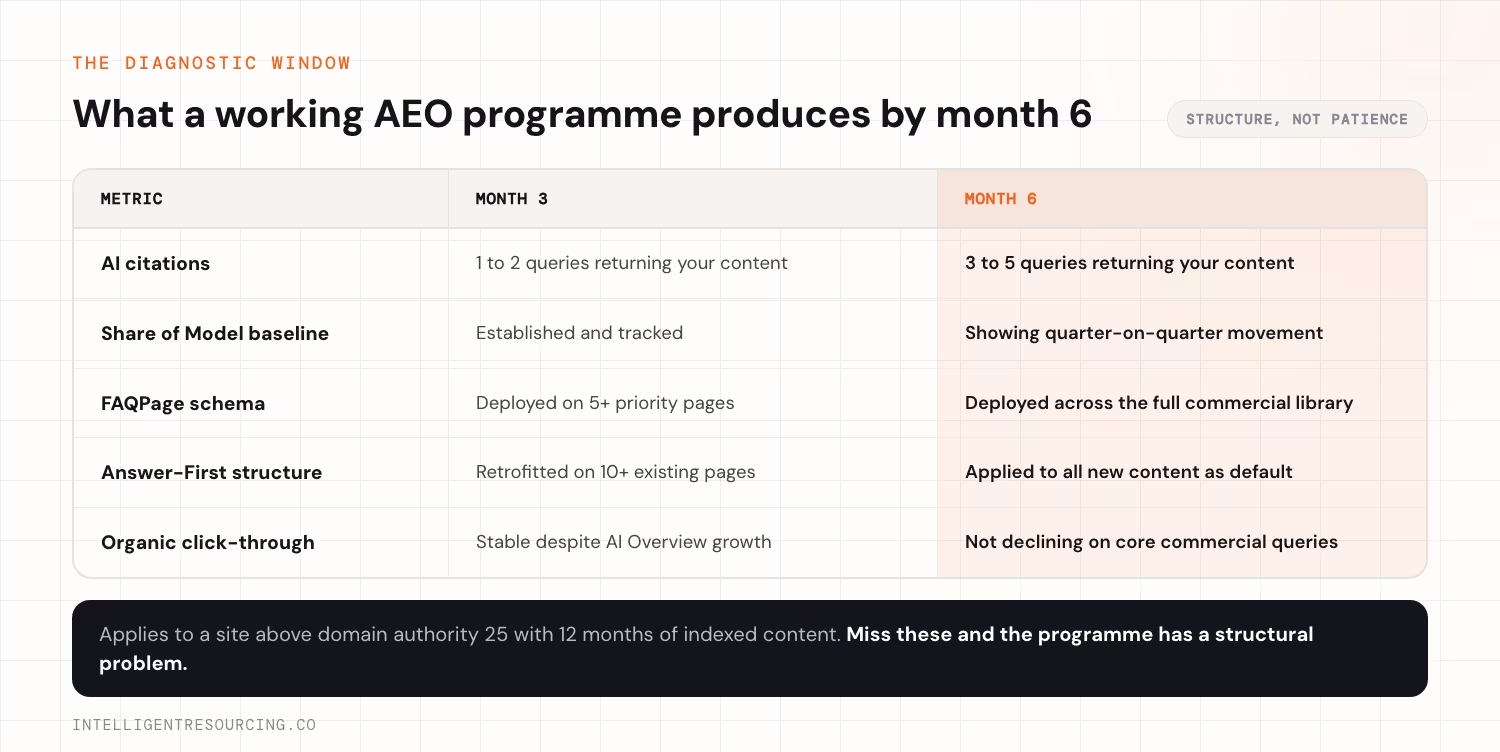
A working AEO programme produces measurable AI citations within 3 to 6 months of structural implementation. By month 6, your content should appear as a cited source in ChatGPT, Perplexity, or Google AI Overviews for at least 3 to 5 target category queries. If it does not, the programme has a structural problem, not a patience problem.
The 6-Month Output Benchmarks
| Metric | Month 3 | Month 6 |
|---|---|---|
| AI citations | 1 to 2 queries returning your content | 3 to 5 queries returning your content |
| Share of Model baseline | Established and tracked | Showing quarter-on-quarter movement |
| FAQPage schema | Deployed on 5+ priority pages | Deployed across the full commercial content library |
| Answer-First structure | Retrofitted on 10+ existing pages | Applied to all new content as default |
| Organic click-through | Stable despite AI Overview growth | Not declining on core commercial queries |
These benchmarks apply to a site with domain authority above 25 and at least 12 months of indexed content. New sites need to build the authority base before these timelines apply. BrightEdge tracking found AI Overview presence grew from roughly 30% to 48% of tracked queries in a single year, a 58% increase, making the extractable citation window real and growing. For context on what AEO requires as a foundation, the AEO, GEO and LLMO guide covers the full architecture.
What Are the Clearest Signs Your AEO Efforts Are Underperforming?
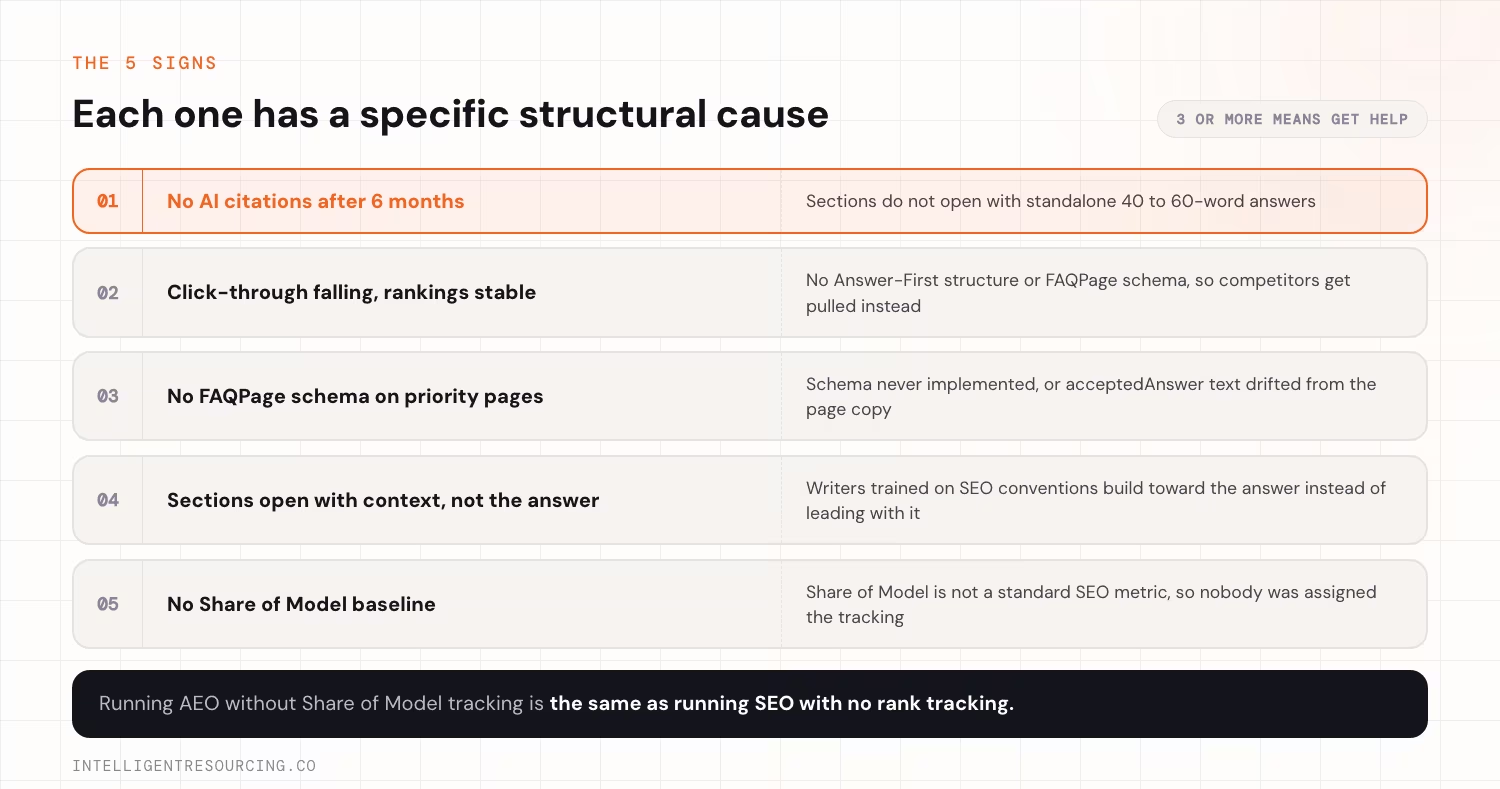
There are 5 clear signs. No AI citations after 6 months of publishing. Organic click-through declining despite stable rankings. No FAQPage schema on priority pages. Content sections that open with context rather than the answer. And no Share of Model tracking in place. Each sign has a specific structural cause and a specific fix.
Sign 1: No AI Citations After 6 Months of Indexed, Authoritative Content
Your content is live, indexed, and ranking on Google. Test your brand name and 5 to 10 category queries in ChatGPT, Perplexity, and Google AI Overviews. If you do not appear as a cited source for any of them, the content is not structurally extractable.
Structural cause: sections do not open with standalone 40 to 60-word answers. AI systems cannot pull a complete citation from a passage where the answer is buried in paragraph 3.
Sign 2: Organic Click-Through Declining Despite Stable or Improving Rankings
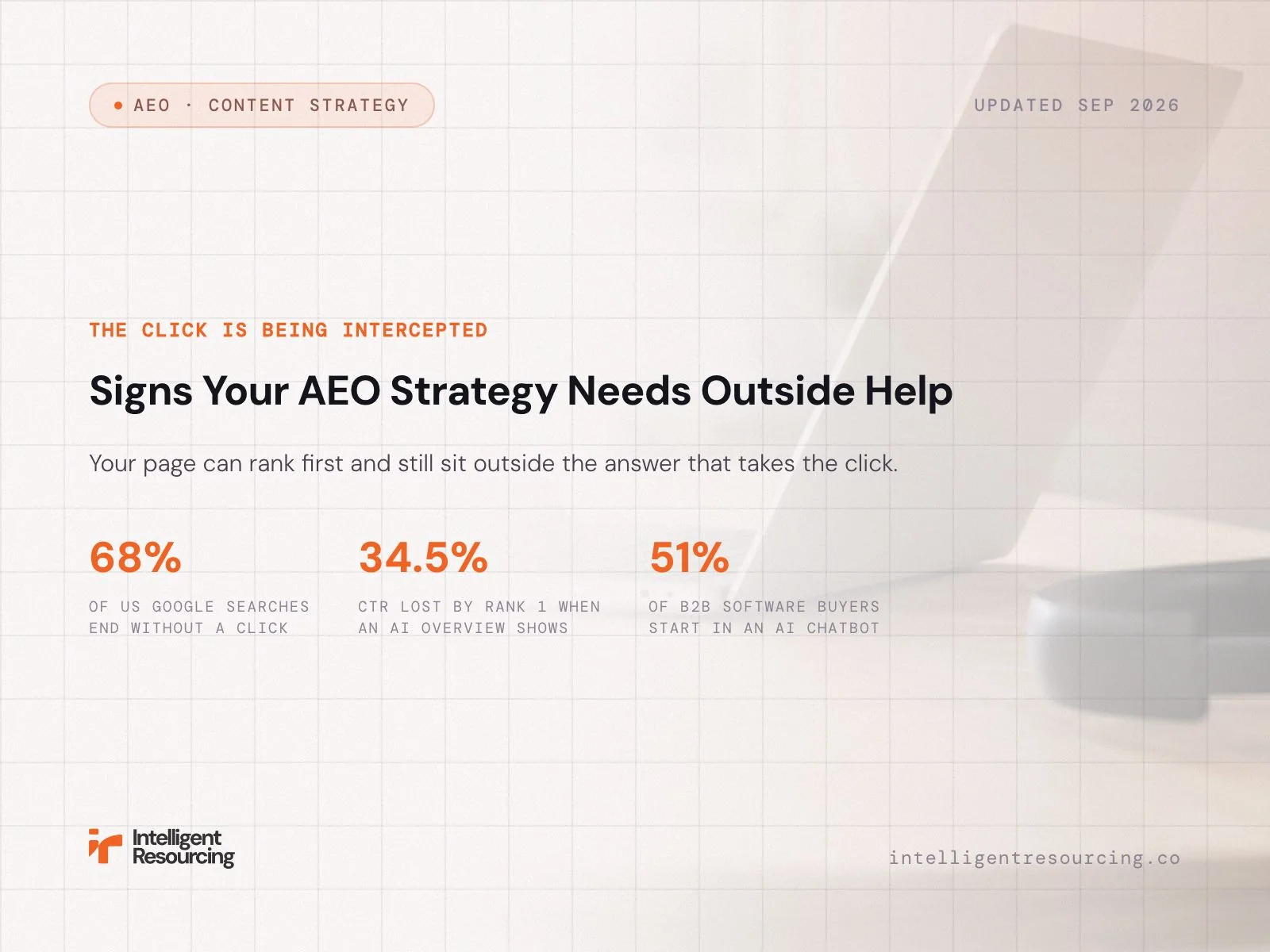
Rankings are holding but traffic is dropping. Google AI Overviews are answering queries before users click. Additional SEO investment does not close this gap. The issue is that your content ranks but is not inside the AI-generated answer that intercepts the click. Ahrefs found in 2025, across 300,000 keywords, that the top-ranking page loses roughly 34.5% of its click-through rate when a Google AI Overview is present for that query.
Structural cause: no Answer-First structure or FAQPage schema. AI systems are pulling answers from competitors whose content is structured for passage extraction.
Sign 3: No FAQPage JSON-LD Schema on Priority Pages
FAQPage schema is the machine-readable signal that tells AI systems exactly what question a page answers and what the correct answer is. Intelligent Resourcing's GEO Framework analysis found that pages with FAQPage schema and on-page answer parity consistently achieve higher AI citation rates than pages without it. SparkToro's 2026 research found that 68% of United States Google searches now end without a click, meaning the only citation surface that reaches users at zero-click is schema-structured content inside AI Overviews.
Structural cause: schema was never implemented, or it was implemented but the acceptedAnswer text does not match the on-page copy after editorial revisions (Parity Rule failure).
Sign 4: Content Sections That Open With Context Rather Than the Answer
Open any H2 section on your priority pages. If the first paragraph provides background, definitions, or caveats before reaching the answer, AI systems will not extract it as a citation. The passage independence test is binary: does the opening sentence answer the H2 question? If not, the section fails.
Structural cause: writers trained on SEO conventions build toward an answer. AEO requires the answer in the first sentence, every section, every time.
Sign 5: No Share of Model Baseline Established or Tracked
Has anyone on your team tested 20 to 50 high-intent prompts across ChatGPT, Perplexity, and Google AI Overviews and recorded the citation rates? If not, you cannot tell whether the programme is improving, stalling, or declining. Running AEO without Share of Model tracking is equivalent to running SEO with no rank tracking.
Structural cause: Share of Model is not a standard SEO metric. Most in-house teams have not built the testing and tracking process because no one assigned it.
When Does the In-House AEO Capability Gap Become Too Wide to Close Internally?
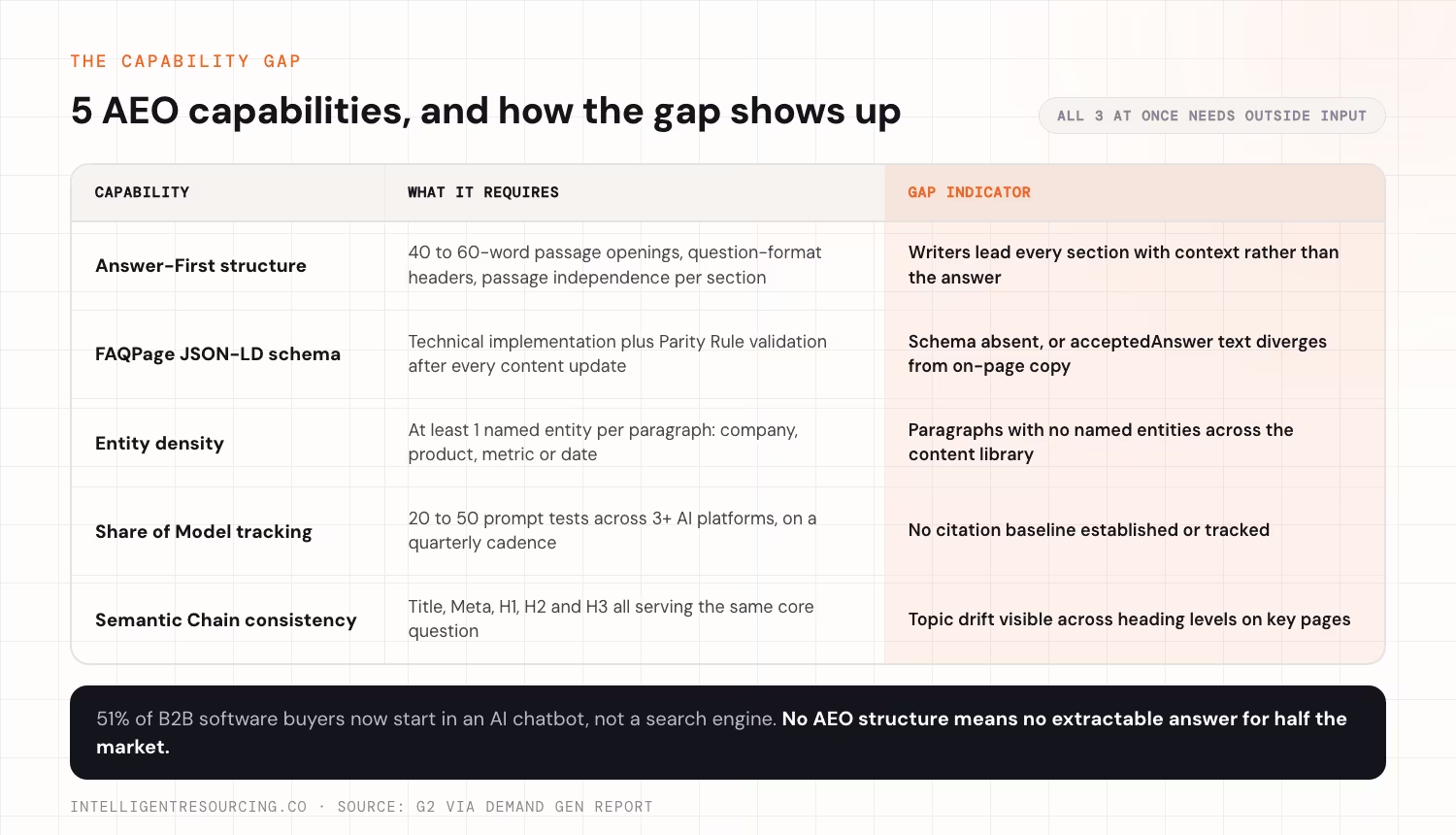
The gap becomes too wide when 3 conditions hit at once. Your team lacks Answer-First content architecture training. You have no technical resource to implement and validate FAQPage schema. And no one runs Share of Model tracking across ChatGPT, Perplexity, and Google AI Overviews. Any one gap can be trained. All 3 together require outside input.
The 5 AEO Capabilities and Their In-House Gap Indicators
| Capability | What it requires | Gap indicator |
|---|---|---|
| Answer-First content structure | 40 to 60-word passage openings, question-format headers, passage independence per section | Writers lead every section with context or background rather than the answer |
| FAQPage JSON-LD schema | Technical implementation and Parity Rule validation after every content update | Schema absent, or acceptedAnswer text diverges from on-page copy |
| Entity density | At least one named entity per paragraph (company, product, metric, date) | Paragraphs with no named entities across the content library |
| Share of Model tracking | 20 to 50 prompt tests across 3+ AI platforms, quarterly cadence | No citation baseline established or tracked |
| Semantic Chain consistency | Title, Meta, H1, H2, H3 all serving the same core question | Topic drift visible across heading levels on key pages |
G2 research, via Demand Gen Report found that 51% of B2B software buyers now begin their purchasing process in an AI chatbot rather than a traditional search engine. A content library with no AEO structure produces zero extractable answers for more than half of B2B research sessions before a vendor is ever considered.
What Does Outside AEO Expertise Provide That In-House Teams Consistently Lack?
Outside AEO expertise delivers 3 outputs in-house teams consistently lack. A structural audit of existing content against AEO citation signals. Technical FAQPage schema implementation with Parity Rule validation. And a Share of Model baseline with a tracking cadence. These are not tasks a standard SEO team picks up without specialist retraining.
Structural Content Audit Against AEO Signals
Most existing H2 sections fail the passage independence test. The section answers its question well in context, but collapses as a standalone citation because the opening paragraph is context rather than the answer. An outside audit finds this across the full content library in a single pass. It then produces a fix list ordered by commercial relevance and existing page authority.
FAQPage Schema With Parity Rule Validation
In-house teams often deploy schema that passes Google's Rich Results Test but fails the Parity Rule. The acceptedAnswer text and the on-page answer text drift apart after editorial revisions. AI systems that check schema against page content reject mismatched entries. An outside technical resource implements schema correctly, then validates parity after every content update rather than only at launch. That maintenance matters, because pages using structured data achieve a 38.5% AI citation rate compared to 32.0% for pages without it.
Share of Model Tracking From a Baseline
Intelligent Resourcing establishes Share of Model as the primary AEO success metric from day 1: 20 to 50 high-intent prompts tested across ChatGPT, Perplexity, and Google AI Overviews, recorded and retested every 30 to 90 days. In the Kynection GEO case study, Kynection reached 20.9% AI Share of Voice across 198 monitored buyer prompts on 16 June 2026, with the nearest competitor at 8.63%. On a live tracker reading dated 16 September 2026, that had moved to 23.16% across 413 monitored prompts, with the nearest competitor at 6.18%. Without a baseline, no in-house team can confirm whether structural changes are producing results or not.
How Do You Decide Between Building In-House AEO Capability and Bringing in an Agency?
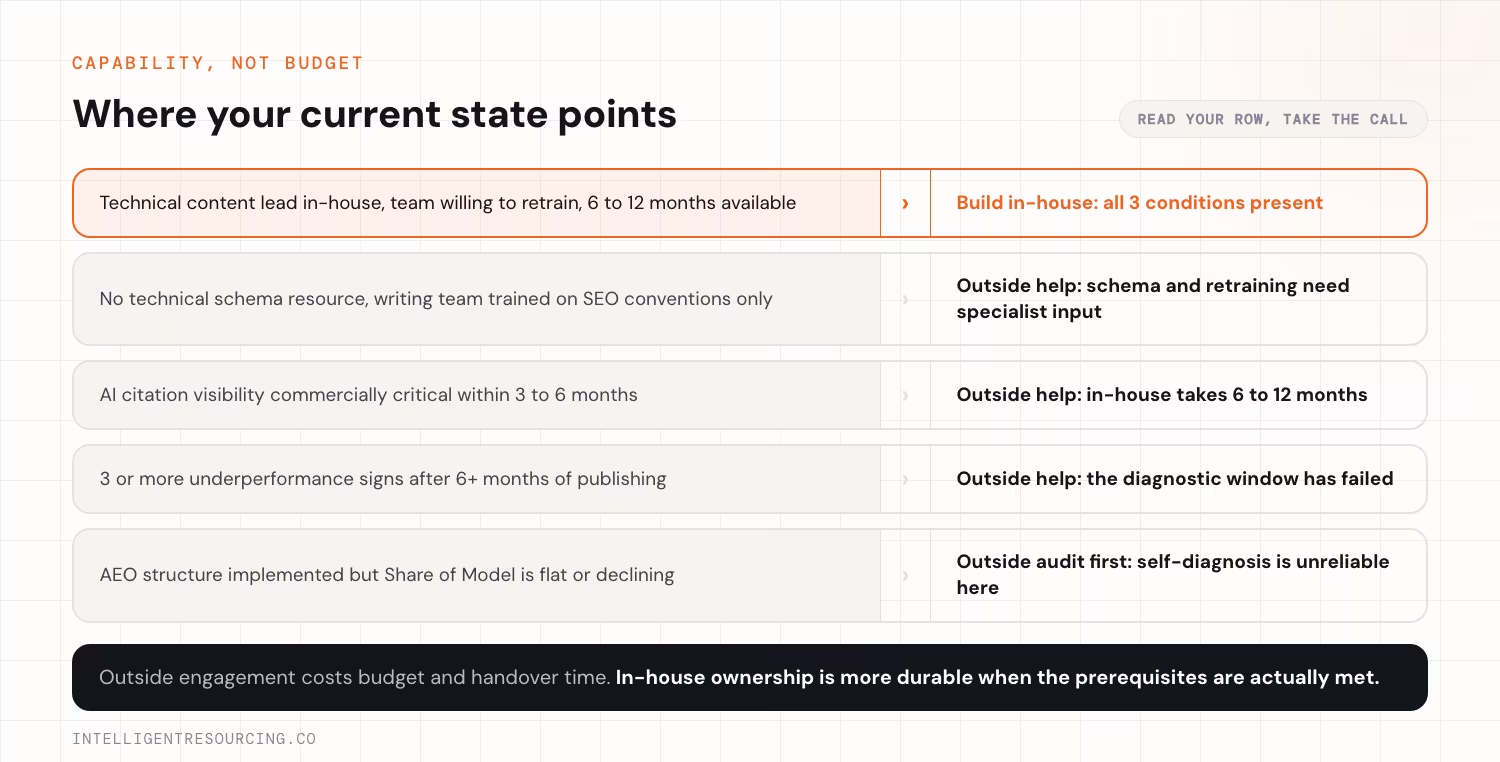
The decision is about capability, not budget. Build in-house when 3 things are true. You have a technical content lead who can implement and validate schema. Your writing practice is willing to retrain on Answer-First structure. And you have 6 to 12 months before AI citation visibility turns commercially critical. Bring in outside help when those 3 conditions are not all present.
Decision Framework
| Your current state | Right call |
|---|---|
| Technical content lead in-house, team willing to retrain, 6 to 12 months available | Build in-house: all 3 capability conditions are present |
| No technical schema resource, writing team trained on SEO conventions only | Outside help: schema implementation and Answer-First retraining require specialist input |
| AI citation visibility commercially critical within 3 to 6 months | Outside help: in-house capability takes 6 to 12 months to develop |
| 3 or more underperformance signs present after 6+ months of publishing | Outside help: programme has failed its diagnostic window, and a structural reset needs outside perspective |
| AEO structure implemented but Share of Model is flat or declining | Outside audit first: self-diagnosis at this stage is unreliable |
| When in-house is the right call | A company with a technical SEO lead who already implements structured data, a content team experienced in Answer-First frameworks or with 3 months available for retraining, and no immediate commercial pressure on AI citation visibility. Outside engagement costs budget and handover time. In-house ownership is more durable when the prerequisites are met. |
Content Creation
Intelligent Resourcing audits existing content against the GEO Framework, identifies where the structural gap sits, and delivers a prioritised fix list before any new content is commissioned. The AEO engagement starts with that audit.
FAQs
How long should I wait before deciding my AEO programme needs outside help?
6 months of indexed, authoritative content with no AI citations is the diagnostic window. Say your domain authority is above 25 to 30 and your content has been indexed for 6 or more months. If you are still absent from ChatGPT, Perplexity, and Google AI Overviews for target category queries, the programme has a structural problem. Waiting longer without changing the structure will not produce different results. AI citation systems respond to specific structural signals that either exist in the content or do not.
Can a standard SEO agency deliver AEO, or do I need a specialist?
Most SEO agencies do not deliver AEO. SEO and AEO share a content quality foundation but require different structural practices: Answer-First paragraph architecture, question-format headers, FAQPage JSON-LD schema with Parity Rule validation, entity density per paragraph, and Share of Model tracking. Before engaging any agency for AEO, ask specifically for their schema audit process, their Answer-First content methodology, and evidence of Share of Model improvement from a current or recent client. Generic content quality improvements without these structural elements will not produce AI citations.
What is the first output an outside AEO engagement should deliver?
A structural content audit: a review of existing priority pages against AEO citation signals including Answer-First structure, question-format headers, FAQPage schema, entity density, and Semantic Chain consistency. This produces a prioritised fix list before any new content is commissioned. Agencies that start with new content production before auditing existing pages are optimising the wrong layer. Existing high-authority pages, retrofitted with AEO structure, produce AI citations faster than new pages written from scratch because the authority base is already in place.
What is the difference between AEO and standard SEO in terms of team skills required?
SEO trains writers to build toward an answer. Set the context, develop the argument, then deliver the conclusion. AEO requires the opposite: the answer in the first sentence of every section, then the supporting detail. FAQPage JSON-LD schema, passage independence testing, entity density monitoring, and Share of Model tracking are not part of standard SEO training. A team strong in SEO can retrain for AEO in about 3 months. That retraining still needs a technical resource who can implement and validate schema outside the content workflow.