

Mistake 1: Strong Google Rankings Do Not Guarantee AI Recommendations
Accounting firms make an artificial intelligence (AI) visibility mistake when they treat strong Google rankings as proof that ChatGPT, Gemini or other engines recommend their practice. Organic rankings and AI-generated recommendations are related and not identical. A firm can rank for "accountant Melbourne" and still be absent when a business owner asks which accountant specialises in hospitality payroll or self-managed superannuation funds (SMSFs).
Why Doesn't ChatGPT Recommend Every Firm That Ranks Well?
AI-generated answers can draw on different sources and respond to more specific needs than a keyword search. A buyer searching Google for an accountant may want nearby businesses. Someone asking an assistant for an accountant experienced in business restructuring is stating a narrower requirement. Test questions that represent different services and client needs.
What Should Accounting Firms Do Instead?
Create a set of prospective-client questions:
- "Which accountants in Melbourne specialise in hospitality businesses?"
- "Who provides SMSF audit services in Brisbane?"
- "Which accounting firms help construction businesses manage cash flow?"
- "Who can advise a growing Australian company on Division 7A?"
- "Which accountants offer bookkeeping and business advisory services for small and medium-sized enterprises (SMEs)?"
Run them across relevant AI engines, and record whether the practice appears. Keep local Google rankings in the report, because they stay valuable for location-led enquiries. Rankings and AI answers overlap without matching, the question behind AI search engine optimisation (SEO) for accountants.
Measure actual AI recommendations, and treat Google ranking position as 1 input among several.
Mistake 2: Having Generic Accounting Service Pages
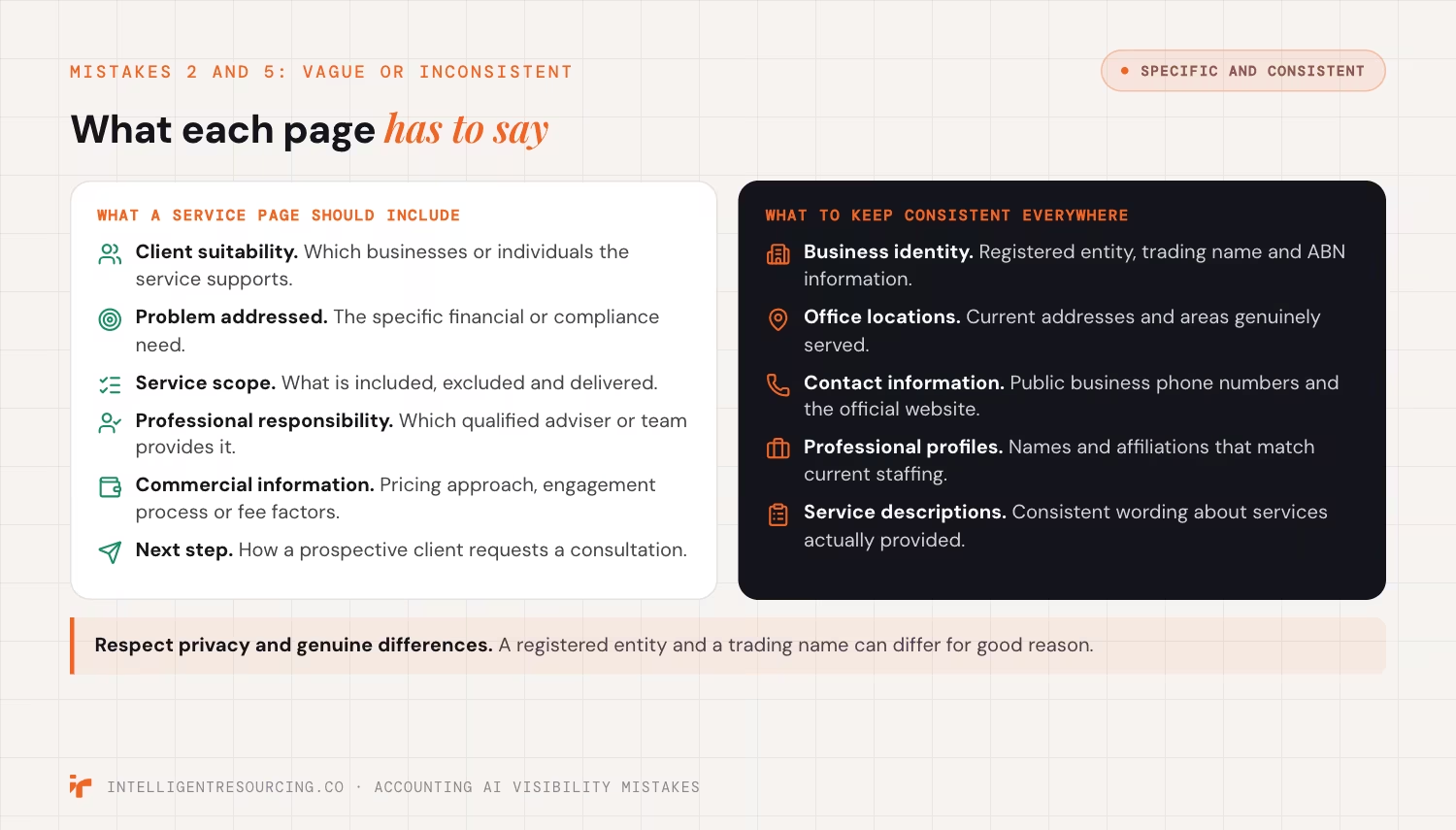
Generic service pages hurt visibility because they describe broad capabilities and leave out which clients, financial problems or circumstances the firm serves. A page that says a practice offers tax, bookkeeping, audit and advisory services gives less decision-making information than a page explaining its support for 1 specific business need.
Why Do Specific Services Need Their Own Pages?
Different enquiries need different evidence of expertise. A business owner seeking help with business activity statements (BAS) wants lodgement support, deadlines and ongoing bookkeeping arrangements. A company director researching Division 7A needs information on shareholder loans, compliance responsibilities and specialist advice. An SMSF trustee looking for an auditor needs a provider who can show the relevant audit registration. These questions are not interchangeable.
What Should a Service Page Include?
- Client suitability: Which businesses or individuals the service supports.
- Problem addressed: The specific financial or compliance need.
- Service scope: What is included, excluded and delivered.
- Professional responsibility: Which qualified adviser or team provides the service.
- Commercial information: The pricing approach, engagement process or factors affecting fees.
- Next step: How a prospective client requests a relevant consultation.
An SMSF audit page should explain the audit and identify the approved auditor, with no generic paragraph about accounting expertise in its place. Google's people-first content guidance encourages content that shows genuine expertise and satisfies the visitor's purpose. Service pages need separate checks for scope, adviser and next step, as in an accounting firm generative engine optimisation (GEO) checklist.
Replace vague descriptions with direct answers to the questions clients ask before engaging an accountant.
Mistake 3: Undated Tax Guidance Creates Risk
Undated tax content creates a credibility problem, because rules, thresholds and reporting obligations change between income years. A firm's advice may have been accurate when published and misleading when a reader applies it to a later period. Accuracy comes before visibility.
Why Do Income Years Matter in AI Search?
A buyer asking about Australian individual income tax rates may reach an article published years earlier that shows a rate that no longer applies. With no income year on the page, the reader cannot tell whether the answer is current. The Australian Taxation Office (ATO) tax time guidance lists the key changes for returns lodged at Tax Time 2026, covering the 2025 to 26 income year, which is why accounting content needs a defined time context. A current date beside an unchanged article is not enough: the figures themselves must be reviewed.
How Should Firms Maintain Tax Content?
- Identify the jurisdiction. State whether advice concerns federal tax, a state requirement or another jurisdiction.
- Specify the income year. Place the applicable year beside rates, thresholds and deadlines.
- Link to authoritative sources. Reference the ATO, legislation or the responsible regulator.
- Identify the reviewer. Name the qualified professional who approved the information.
- Record substantive updates. Note when the guidance was last reviewed or changed.
A firm writing about goods and services tax (GST) registration should explain the conditions and exceptions and avoid a universal statement that may not apply to every entity. Tax content should also say when individual circumstances need professional advice.
Treat accuracy, jurisdiction and review dates as essential parts of every financial answer.
Mistake 4: Why Must Accounting Credentials Match the Service?
Firms undermine credibility when they display qualifications and do not show who holds them, whether the registration is current or how it relates to the advertised service. A Chartered Accountant or Certified Practising Accountant designation supports professional identity, and it does not by itself authorise every regulated activity.
Which Credentials Can Buyers Verify?
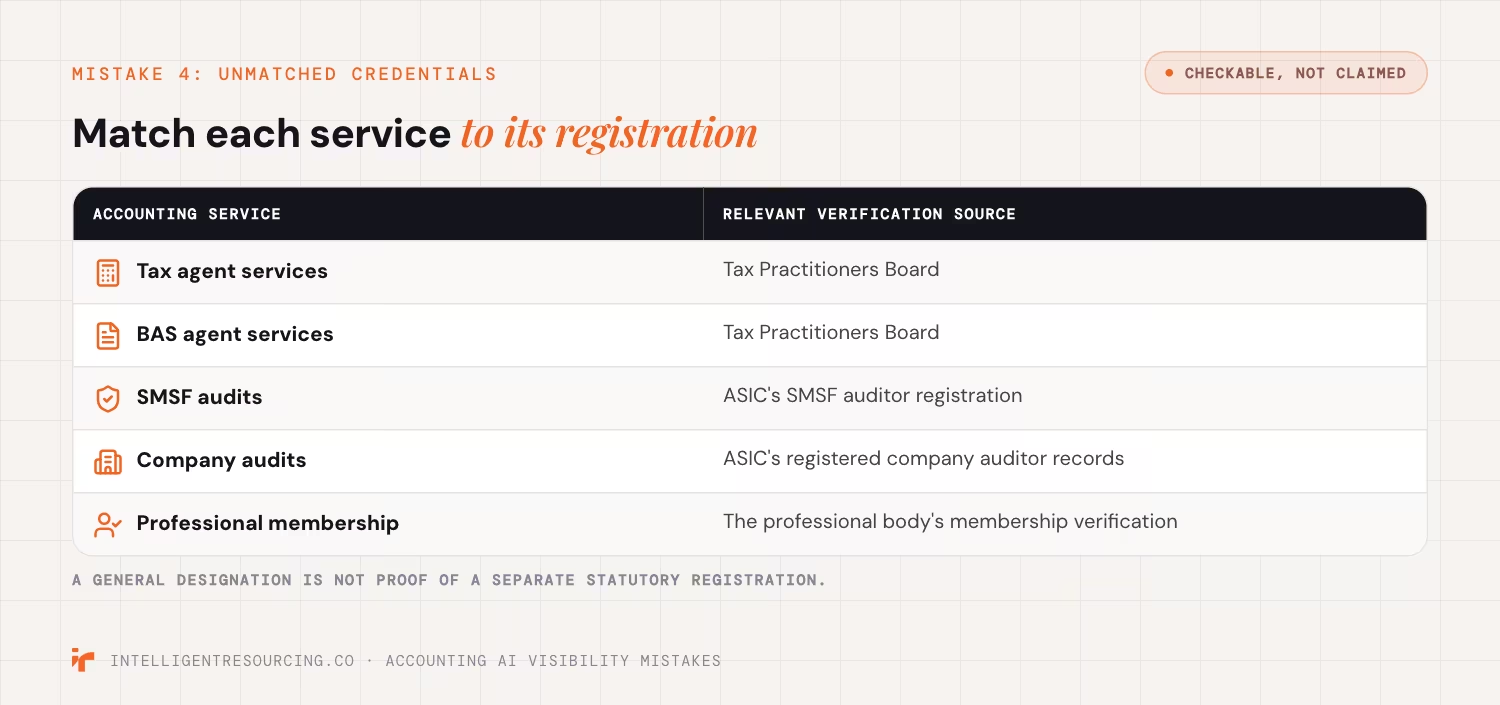
| Accounting service | Relevant verification source |
|---|---|
| Tax agent services | Tax Practitioners Board |
| BAS agent services | Tax Practitioners Board |
| SMSF audits | SMSF auditor registration with the Australian Securities and Investments Commission (ASIC) |
| Company audits | ASIC's registered company auditor records |
| Professional membership | The professional body's membership verification |
The Tax Practitioners Board (TPB) Public Register lists registration for tax and BAS agents, and ASIC explains the registration requirements for SMSF auditors. The TPB also requires its registered tax practitioner symbol to carry the practitioner's registration number and type of registration. A general designation is not proof of a separate statutory registration.
What Should a Firm Publish?
Identify the responsible adviser, their role, the relevant qualification or registration and the professional scope of the service. The information should be current and independently checkable. Avoid publishing unnecessary personal contact details: from April 2026 the TPB lets practitioners choose which contact details appear on its register, and at least 1 must remain public.
Matching each service to the right registration is the work behind accounting firm credentials in AI search.
Make relevant expertise verifiable without overstating qualifications or exposing personal information.
Mistake 5: Inconsistent Firm Information Weakens Visibility
Inconsistent firm information makes it harder for clients and search systems to reconcile a practice's identity, location and services. A business may use 1 trading name on its website, another in its Google Business Profile and an outdated address in an industry directory. Not every difference is an error, and unexplained discrepancies create uncertainty.
Why Does Business Identity Consistency Matter?
Prospective clients cross-check an accounting practice before they make contact. They compare its website, Google profile, directory listing and public business registration. The official Australian Business Number (ABN) Lookup service shows ABN status, business type and public registration information. Google explains that complete and accurate information supports local relevance in its Business Profile ranking guidance.
Public registers also change. From April 2026 the TPB Register shows only legal entity names and ASIC-registered business names, and drops unregistered trading names, so a firm's public name can differ across sources it does not control. Neither source proves that exact profile matching guarantees AI recommendations. A consistent public identity makes it easier to tell which business offers a service.
What Should Firms Check?
- Business identity: Registered entity, trading name and ABN information.
- Office locations: Current addresses and areas genuinely served.
- Contact information: Public business telephone numbers and the official website.
- Professional profiles: Names and affiliations that match current staffing.
- Service descriptions: Consistent wording about services actually provided.
Respect privacy protections and genuine differences between registered entities and trading names. A practitioner's protected residential address need not match the firm's public office address. When a partner leaves or an office moves, update the affected profiles and service pages.
Keep the firm's public identity accurate, recognisable and consistent across the sources buyers check.
Mistake 6: Unsupported Expertise Claims Create Risk
Firms create commercial and professional risk when their marketing claims exceed what they can show. Statements such as "Australia's most trusted tax experts" or "guaranteed maximum refunds" sound persuasive, need substantiation and can be misleading depending on the circumstances. AI visibility should amplify accurate professional information.
What Evidence Should Support Expertise Claims?
The Accounting Professional and Ethical Standards Board's APES 110 Code of Ethics sets fundamental principles including integrity, objectivity, professional competence and due care, confidentiality and professional behaviour. The Australian Competition and Consumer Commission's (ACCC) guidance on false or misleading claims says claims must be accurate, truthful and based on reasonable grounds. Review claims about specialist experience, client outcomes, qualifications and comparative superiority before publication.
Can Accounting Firms Publish Client Results?
Yes, when the information is accurate, authorised and lawful to disclose. Useful evidence includes an anonymised service example, a documented engagement process or an approved case study. Confidentiality comes first, and the Australian Privacy Principles govern how covered entities use and disclose personal information. Do not publish client financial information, identifiable circumstances or testimonials without authority and professional review.
Label a hypothetical example as illustrative. An advisory page can explain how a cash-flow forecasting engagement is structured without inventing a percentage improvement for a real client.
The fix: Publish evidence that is accurate, relevant and permitted for disclosure.
Mistake 7: Hiding Service Information Limits Discoverability
Firms limit discoverability when essential public service information is spread across vague pages, private onboarding packs and restricted client portals. Private documents suit confidential engagements. A prospective client should not need a login to understand what the firm offers.
What Information Should Be Public?
Public pages should answer practical questions:
- What services does the practice provide?
- Which clients or industries does each service suit?
- Who is responsible for the work?
- What is included in the engagement?
- What information must a prospective client provide?
- How are fees determined?
- What happens after an initial enquiry?
A business advisory page can describe budgeting, forecasting and management reporting services without publishing a client's financial model. An individual tax return page can explain the engagement process and general document needs without revealing client records.
Should Firms Remove PDFs and Client Portals?
No. Secure portals, engagement letters and downloadable resources still serve legitimate purposes. The mistake is assuming that restricted information can replace a clear public explanation. Keep private information protected, and present general service details in readable website text.
A firm that already publishes enough public information and earns suitable enquiries may gain little from a website rebuild. The aim is appropriate, accurate information at the point a prospective client needs it.
Keep confidential materials secure, and make the firm's public services understandable without barriers.
How Should a Firm Measure AI Visibility?
Start with a fixed set of questions that represent relevant services and client types. For each engine and question, record:
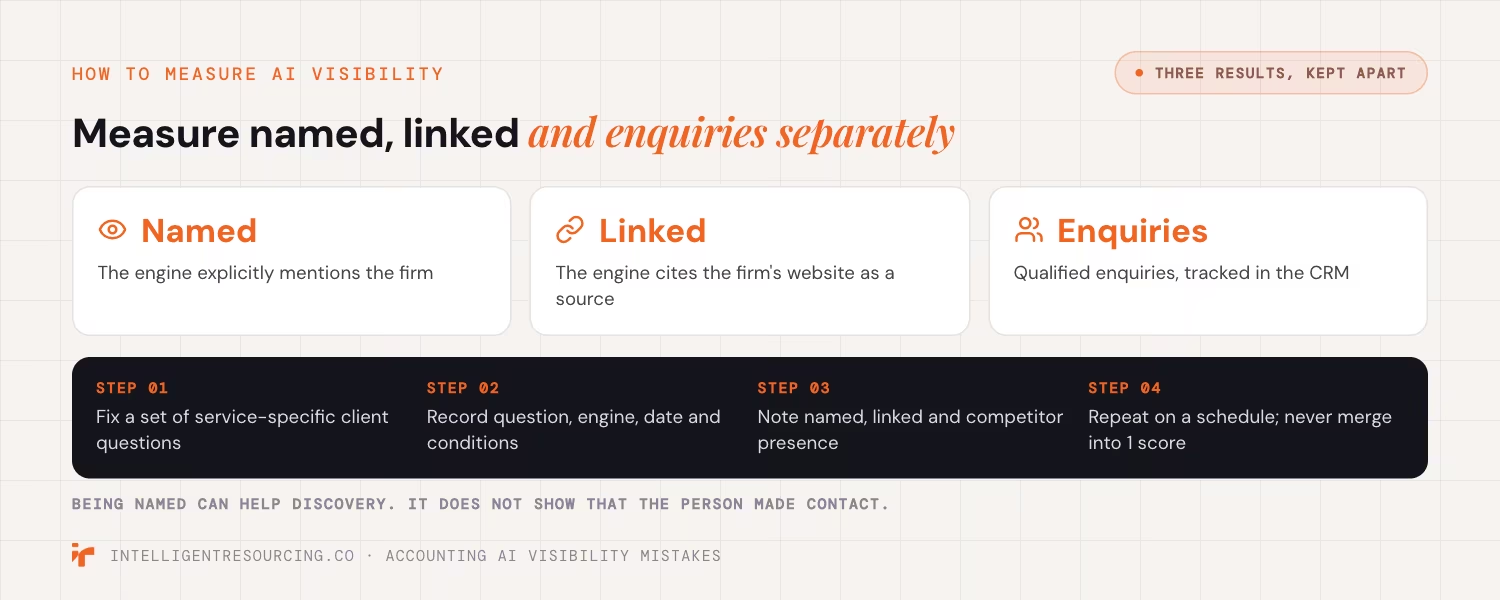
- The question tested: Exact prompt, service line and geography.
- The engine used: ChatGPT, Gemini, Perplexity or a specified Google AI surface.
- Named status: Whether the firm appeared explicitly.
- Linked status: Whether the firm's website appeared as a cited source.
- Competitor presence: Other accounting firms named.
- Date and conditions: When, where and how the test ran.
Repeat the questions, because 1 response is no reliable benchmark. Results differ across prompts, locations, engines and periods. Repeated tests separate real change from normal variation, as AI visibility changes versus noise shows.
Does Being Named by AI Guarantee More Enquiries?
No. Being named can help a prospective client discover a firm, and it does not show that the person visited the website, made contact or became a client. Track qualified enquiries separately in the customer relationship management (CRM) system. Record AI-originated referrals where possible, and ask new prospects how they found the practice. Treat self-reported discovery as a useful signal, and never as definitive attribution.
Measure named, linked and commercial outcomes separately.
Which AI Visibility Mistakes Should Accounting Firms Fix First?
Fix inaccurate professional information and accessibility problems before expanding content or investing in GEO. Then address service positioning, business identity and reporting gaps. Use this order:
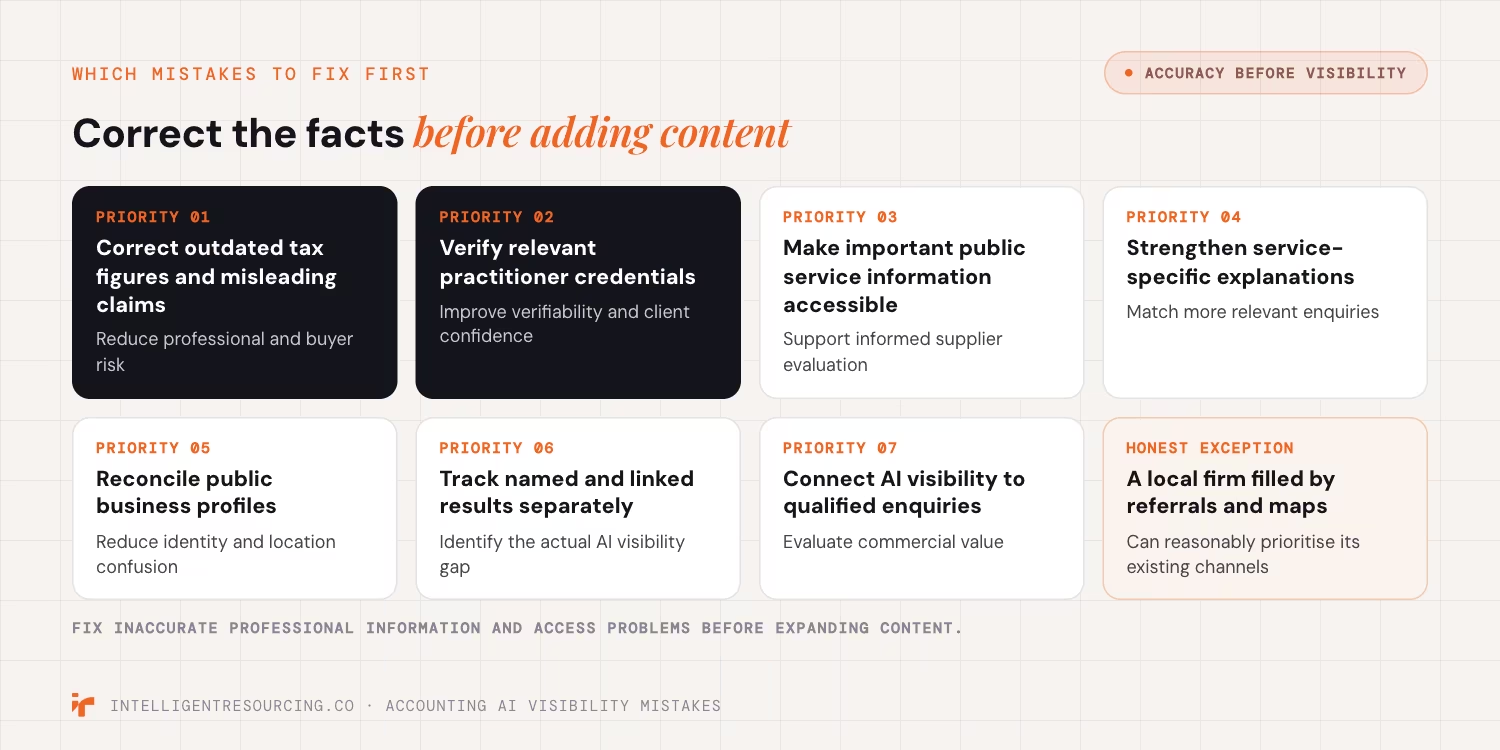
| Priority | Action | Expected benefit |
|---|---|---|
| 1 | Correct outdated tax figures and misleading claims | Reduce professional and buyer risk |
| 2 | Verify relevant practitioner credentials | Improve verifiability and client confidence |
| 3 | Make important public service information accessible | Support informed supplier evaluation |
| 4 | Strengthen service-specific explanations | Match more relevant enquiries |
| 5 | Reconcile public business profiles | Reduce identity and location confusion |
| 6 | Track named and linked results separately | Identify the actual AI visibility gap |
| 7 | Connect AI visibility to qualified enquiries | Evaluate commercial value |
An accounting practice does not need every possible AI activity. A local firm that attracts enough clients through referrals and Google Maps can reasonably prioritise its existing channels. A specialist or multi-office practice competing for broader advisory enquiries has a stronger reason to investigate AI visibility.
When Should a Firm Consider External GEO Support?
External support makes sense when the practice has confirmed AI visibility gaps and lacks the resources to diagnose and fix them. A provider can assess service-page clarity, public identity, crawlability, citation coverage and measurement. It should not approve tax advice, professional registrations or confidential client claims, and the firm's own qualified professionals keep that responsibility.
A defined assessment shows where answer engine optimisation gaps sit before any content is produced.
Content Creation
To see which client questions AI engines answer with other firms, book a Strategic Blueprint audit with Intelligent Resourcing.
FAQs
Why isn't ChatGPT recommending my accounting firm?
ChatGPT may omit a firm because its public information does not clearly match the client's question, its identity is hard to establish or competing firms offer more relevant information. One response cannot confirm the cause. Test several service-specific questions, and check named mentions and website citations separately.
How can accounting firms improve AI search visibility?
Publish clear service descriptions, keep tax information current, verify professional credentials and make relevant public information accessible. Then monitor how different engines respond to prospective-client questions. These actions support discoverability and cannot guarantee a recommendation.
Does a Google Business Profile help accounting firms appear in AI search?
An accurate Google Business Profile supports local discovery and gives public information about the firm's identity, location and services. Google says businesses with complete and accurate profile information are more likely to show up in local search results, which does not establish guaranteed inclusion in ChatGPT or other engines. Test local AI recommendations separately.
Do accounting firms need schema markup for GEO?
Structured data can describe an organisation and its content, and it does not guarantee AI citations. Put accurate visible information, service relevance and professional verification first, and use markup to support that information, never to replace it.
How often should accounting firms check their AI visibility?
Run a baseline across a fixed set of commercially relevant questions, then repeat the tests on a regular schedule. Monthly reporting works when enough observations are collected. Keep the wording, engine, market and method consistent, and investigate apparent changes before crediting a website update.
What is the difference between named and linked AI visibility?
Named visibility means an AI engine explicitly mentions the firm in its answer. Linked visibility means the engine cites the firm's website. The two can occur independently, so record each separately for every engine, and never merge them into 1 score that hides important differences.