

Mistake 1: Assuming Google Rankings Guarantee Visibility in AI Answers
Manufacturers make a mistake when they treat Google rankings as proof of artificial intelligence (AI) visibility. A product page can rank for its part number and never appear when a buyer asks ChatGPT to compare suppliers for a specific application. These are different searches, and the second one can bring new suppliers into consideration.

TREW Marketing's 2026 State of Marketing to Engineers report, a global survey by a marketing agency with GlobalSpec and Elektor, found that 69% of technical buyers use generative AI during purchasing, and rate its answers 4.7 out of 10 for trust. Of the buyers who noticed AI summaries in search, 69% read the summary and then continued to the results, and only 6% found it usually enough. Buyers are using AI to shortlist, and they still check the suppliers it names.
What Goes Wrong?
A standard search engine optimisation (SEO) report focuses on rankings, clicks and traffic. It does not show whether the manufacturer is named in AI-generated answers, or which competitors are cited. The sales team ends up with no view of AI supplier discovery.
What Should Manufacturers Do Instead?
Build a list of 15 to 20 questions that real buyers ask before requesting a quote, such as:
- "Which Australian manufacturers supply stainless steel process pumps?"
- "Best industrial valve suppliers for chemical processing"
- "Which conveyor system handles abrasive materials?"
- "Australian manufacturers of custom hydraulic cylinders"
- "Which supplier makes pumps for high-temperature applications?"
Test the questions in ChatGPT, Google AI Overviews and 1 more relevant AI engine. Record whether your company is named, your website is cited or neither appears, and keep the results separate by engine and product category.
Product information supports AI discovery only when it is complete, the core of manufacturing generative engine optimisation (GEO) strategy. Stop treating keyword rankings as your only measure of search visibility. Test the supplier questions buyers actually ask.
Mistake 2: Letting Distributors Publish Clearer Product Information Than Manufacturers
AI search can cite a distributor when its product information is clearer or easier to access than the manufacturer's own data. A distributor might publish searchable part numbers, dimensions, materials and application details on 1 page, while the manufacturer keeps the same information in a Portable Document Format (PDF) catalogue that takes several steps to reach.
What Goes Wrong?
A buyer asks which supplier provides a stainless steel valve rated for a specific pressure and temperature. The distributor's page shows the product range, technical limits and manufacturer name. The manufacturer's page says it offers high-quality industrial valves. The distributor gave the buyer more to work with.
This does not prove that an AI engine always prefers the distributor. It shows why clear product data matters.
How Do You Fix It?
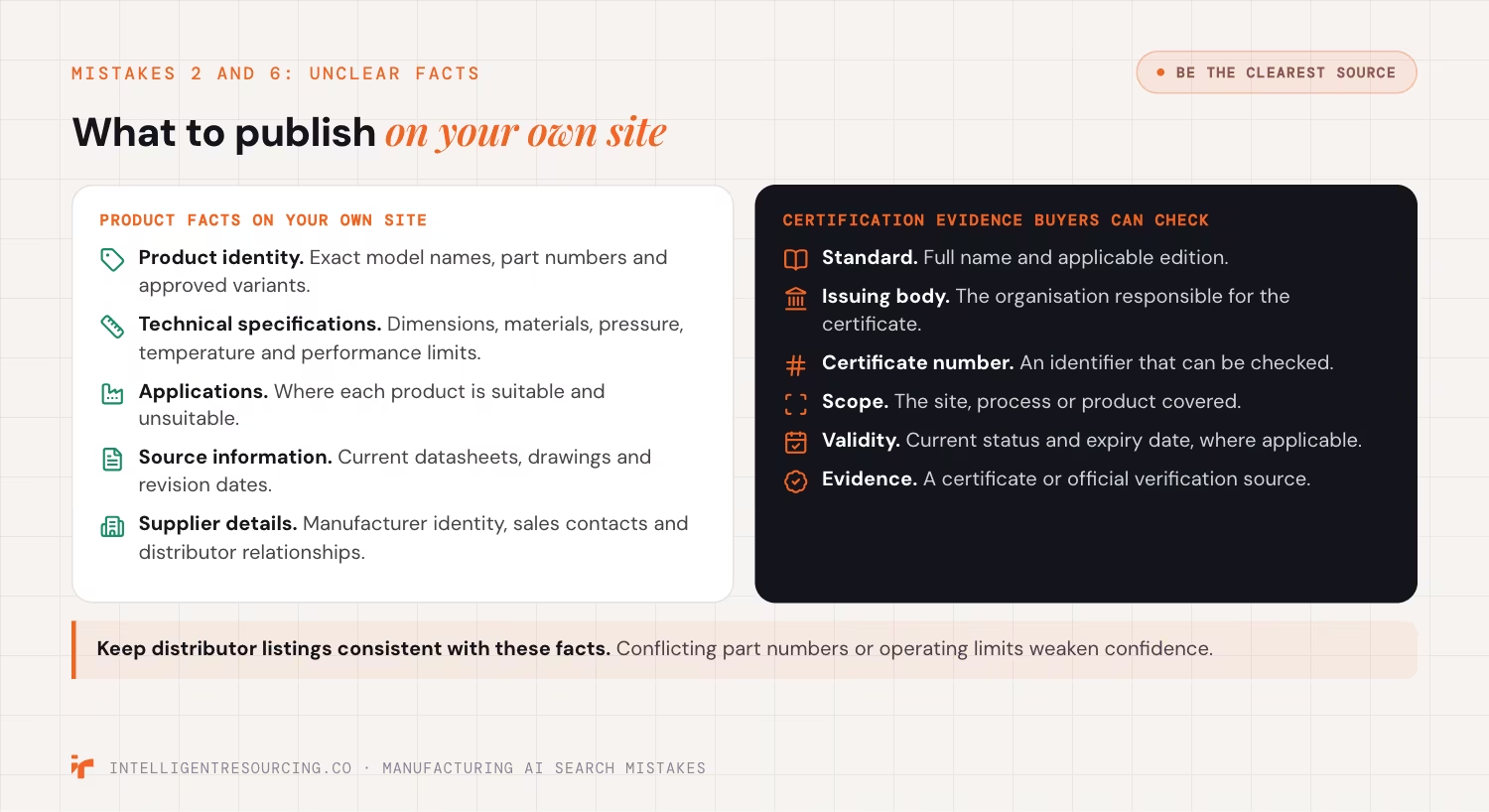
Make your website the clearest public source for your products. Start with:
- Product identity: Exact model names, part numbers and approved variants.
- Technical specifications: Dimensions, materials, pressure, temperature and performance limits.
- Applications: Where each product is suitable and unsuitable.
- Source information: Current datasheets, drawings and revision dates.
- Supplier details: Manufacturer identity, sales contacts and distributor relationships.
Check that distributors use the same approved part numbers and values, and correct an older operating limit at the source. Conflicting specifications across your own site and partner catalogues weaken confidence. Buyers who cannot find a supplier in AI answers usually hit this gap, as the work on manufacturers missing from AI search shows.
Publish complete, current product information on your own site, and keep distributor data consistent with it.
Mistake 3: Keeping Essential Product Specifications in Hard-to-Read Formats
A common industrial GEO mistake is keeping essential specifications in formats that search systems cannot reliably access or read. This often happens with scanned PDFs, locked customer portals and product configurators that load important values only after a user acts. PDFs are not automatically invisible, since search systems can index many of them. Scanned documents, poor tables and restricted pages make the information hard to extract.
What Goes Wrong?
An engineer needs the operating temperature of a specific pump. The manufacturer has published the value inside a scanned catalogue, and the product page itself shows only a model name and a download link. A buyer or search system must open another file, and if that file is hard to read, the answer goes unused.
Ahrefs' schema study cites a searchVIU test in which 5 AI systems, including ChatGPT and Google AI Mode, extracted only visible HyperText Markup Language (HTML) when fetching a page in real time, and ignored JavaScript Object Notation for Linked Data (JSON-LD). Visible page text is what these systems read.
What Should Manufacturers Do?
Put the most important specifications directly on the product page:
| Specification | Example value |
|---|---|
| Product | Example industrial pump model |
| Maximum operating pressure | 10 bar at 20°C |
| Temperature range | −20°C to 80°C |
| Material | 316 stainless steel |
| Application | Clean industrial process fluids |
Keep the complete technical datasheet available for buyers who need more detail. Use searchable text, clear table headings and a revision date, and start with the products that generate the most technical enquiries.
Crawler access, product tables, PDFs and part numbers each need a separate test, the pattern in a manufacturing GEO checklist. OpenAI's crawler documentation explains that access for ChatGPT search is controlled separately from access for model training, so review the settings that affect search discovery instead of assuming every AI crawler has the same purpose.
Make key product facts accessible in normal page text, and keep technical files as supporting documents.
Mistake 4: Publishing Generic Product Pages Without Application Guidance
Manufacturers often describe what a product is and fail to explain when a buyer should use it. A page may call a pump reliable, durable and built for demanding conditions. Those claims do not answer an engineer's question about pressure, temperature, materials or fluid compatibility.
What Goes Wrong?
An engineer asks which pump suits abrasive slurry at a given flow rate. A general product page lists features and gives no operating limits, so the engineer cannot tell whether the product is suitable. A useful application page states the conditions under which a product can be considered, and where it is not suitable.
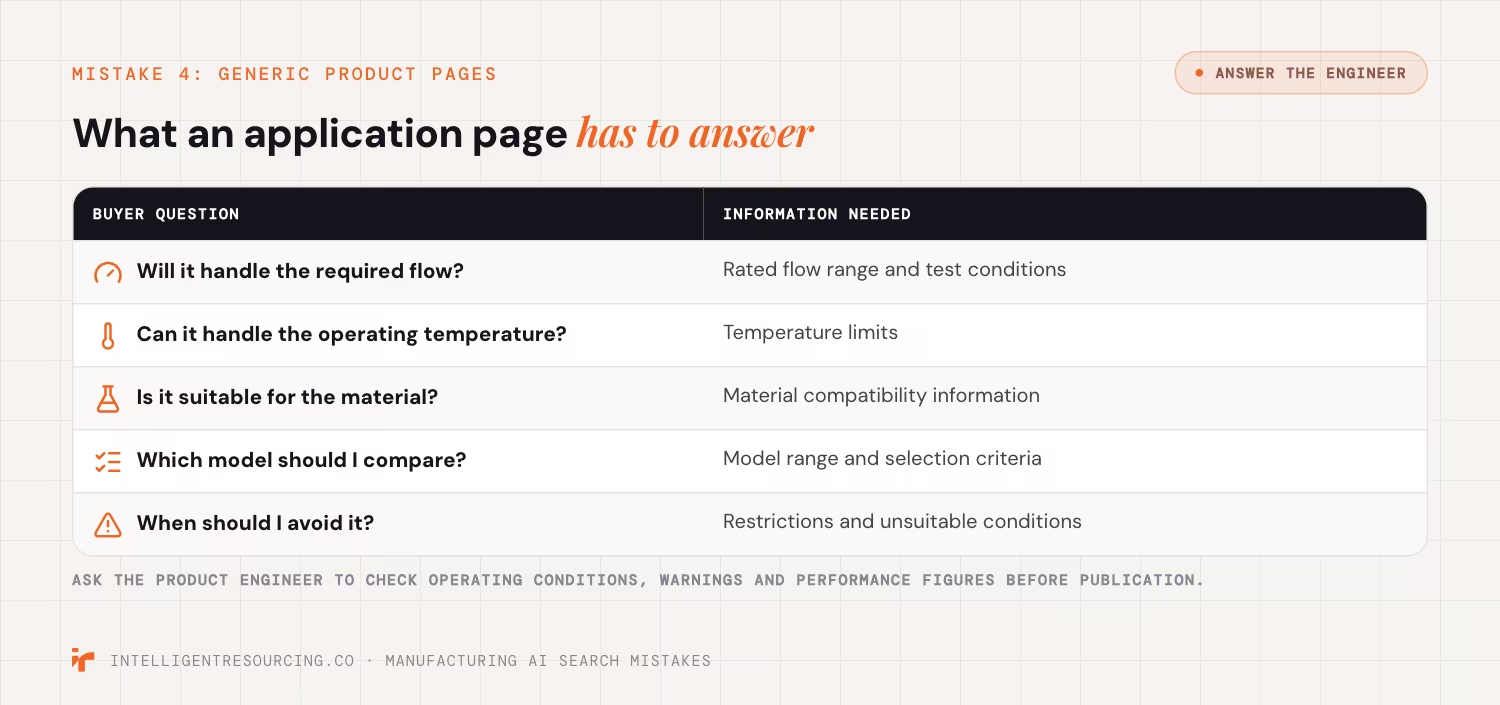
What Should an Application Page Include?
| Buyer question | Information needed |
|---|---|
| Will it handle the required flow? | Rated flow range and test conditions |
| Can it handle the operating temperature? | Temperature limits |
| Is it suitable for the material? | Material compatibility information |
| Which model should I compare? | Model range and selection criteria |
| When should I avoid it? | Restrictions and unsuitable conditions |
Do not invent technical claims to make a page more complete. Ask the product engineer to review operating conditions, warnings and performance figures before publication, especially when incorrect information could affect safety or equipment selection.
The same TREW survey found that 66% of technical buyers view vendor engineering experts as very or extremely trustworthy content authors. Name the qualified technical reviewer where appropriate, and include the review date and the evidence behind important performance claims.
Answer application questions with checked specifications, operating limits and clear restrictions.
Mistake 5: Assuming Schema Markup Guarantees AI Citations
Adding structured data does not guarantee that ChatGPT, Google AI Overviews or any other AI engine will cite a manufacturer's content. This is a costly assumption, because industrial websites often hold large catalogues, and marking up thousands of pages takes time and development work. That work can help ordinary search features, and it should not be sold as proven AI citation growth.
Should Manufacturers Stop Using Structured Data?
No. Google's guidance on AI features says no special schema is required to appear in AI Overviews or AI Mode, and recommends that structured data match the visible content. Accurate Product and Organisation markup can still support ordinary search features and clear product information, but the page must contain the real specifications. Markup on a weak page does not replace missing technical data.
For an industrial manufacturer, the better order is:
- Make the product information accessible.
- Correct missing or conflicting specifications.
- Add useful application answers.
- Implement suitable structured data.
- Test AI visibility before and after changes.
Use schema as supporting technical markup, and treat it as a shortcut to AI citations only when your own test shows it works.
Mistake 6: Publishing Certifications and Technical Claims Without Verifiable Evidence
A manufacturer can display a certification badge and give buyers no way to check it. The page names no standard, scope or issuing body. AI tools can also repeat incomplete or outdated claims, so the source information has to be accurate.
What Goes Wrong?
A page says "ISO certified manufacturer" and names no International Organization for Standardization (ISO) standard. It gives no certificate number, issue date or certification scope. A procurement manager cannot tell whether the certification covers the required site, process or product. The same problem occurs when equipment is called compliant with no named standard or conditions.
What Should Be Published?
Where relevant and authorised for public disclosure, provide:
- Standard: Full name and applicable edition.
- Issuing body: The organisation responsible for the certificate.
- Certificate number: An identifier that can be checked.
- Scope: The site, process or product covered.
- Validity: Current status and expiry date, where applicable.
- Evidence: A certificate or official verification source.
Technical compliance claims must reflect the actual certified scope. A management-system certificate does not prove an individual product meets every technical standard, and ordinary product testing is not independent certification. These distinctions matter for regulated or safety-critical applications.
Who Should Check the Claims?
The responsible engineering, quality or compliance team should approve technical and certification statements. Marketing should not decide whether equipment satisfies a formal standard. A clear approval process stops old claims from being copied across product pages and distributor listings.
Publish specific, current and verifiable technical claims, and remove badges or statements that cannot be supported.
Mistake 7: Publishing More Content Instead of Fixing Product Information
Publishing more pages will not solve missing, outdated or inconsistent product information. A manufacturer can publish dozens of articles about industrial equipment while its main product pages still lack specifications. That adds content without fixing the buyer's problem.
What Goes Wrong?
The marketing team publishes "Why Quality Equipment Matters", "The Benefits of Industrial Innovation" and "How Our Products Improve Efficiency". These topics have a place in brand marketing. They do little for a buyer asking which model meets a specific operating requirement, and a large website can still lack the pages that support supplier selection.
What Content Should Come First?
Prioritise pages based on real customer questions:
| Buyer intent | Useful content |
|---|---|
| Product selection | Model comparison and operating limits |
| Technical fit | Application and compatibility information |
| Supplier evaluation | Manufacturing capability and quality evidence |
| Commercial decision | Quotation requirements, lead times and service terms |
| Product replacement | Replacement part and compatibility guidance |
Use enquiries, quote requests and sales discussions to decide which topics matter, and ask sales and technical teams what buyers request before they decide.
An Ahrefs study of 75,000 brands found almost no relationship between the number of pages on a site and AI visibility, a correlation of about 0.19. It found stronger relationships with YouTube mentions and branded web mentions, and Ahrefs notes that correlation is not causation. Page volume alone is a poor measure of AI search success.
Improve the pages that answer real buying questions before creating more general content.
Mistake 8: Combining AI Visibility Results Into One Misleading Score
Manufacturers make a reporting mistake when they combine every AI visibility result into 1 number. A report might claim that visibility improved by 20%. That figure has limited value unless the company knows which engines, product lines and questions contributed, and it does not show that the increase produced enquiries.
What Should Manufacturers Track?
Use a fixed set of questions and record results by:
- Branded and non-branded prompts. Separate searches that include the company name from general supplier and product questions.
- Product or service line. Track pumps, valves, components, fabrication services or other product groups separately.
- AI engine. Keep ChatGPT, Gemini, Google AI Overviews and other platforms in separate views.
- Answer presence. Record whether the company is named, its website is linked, or neither appears.
- Commercial outcomes. Track identifiable AI referrals, self-reported discovery and qualified enquiries separately.
Named and linked can happen in the same answer, so record them as separate observations.
What Does a Useful Report Look Like?
| Question group | Engine | Brand named | Website linked | Competitor named |
|---|---|---|---|---|
| Industrial pump suppliers | ChatGPT | Yes | No | Yes |
| Industrial pump suppliers | Gemini | No | No | Yes |
| Industrial valve suppliers | Google AI Overviews | Yes | Yes | Yes |
Repeat the same tests at regular intervals. AI answers change between runs, so 1 result cannot show a reliable trend. Separating citations, mentions, engines and commercial signals is the structure behind AI visibility tracking.
Does More AI Visibility Mean More Requests for Quote (RFQs)?
Not necessarily. A citation shows that a page appeared as a source in an AI answer, and it does not show whether the buyer submitted a request for a quote. Connect identifiable AI visits and enquiry sources to your customer relationship management system, and record the product category, enquiry source, qualified opportunity and final outcome. Keep directly sourced enquiries separate from opportunities where AI played a supporting role.
Measure AI visibility by buyer question and engine, then track commercial results separately.
Which Manufacturing AI Search Mistakes Should You Fix First?
Fix the problems that block access or create incorrect technical information before investing in additional content. Use this order:
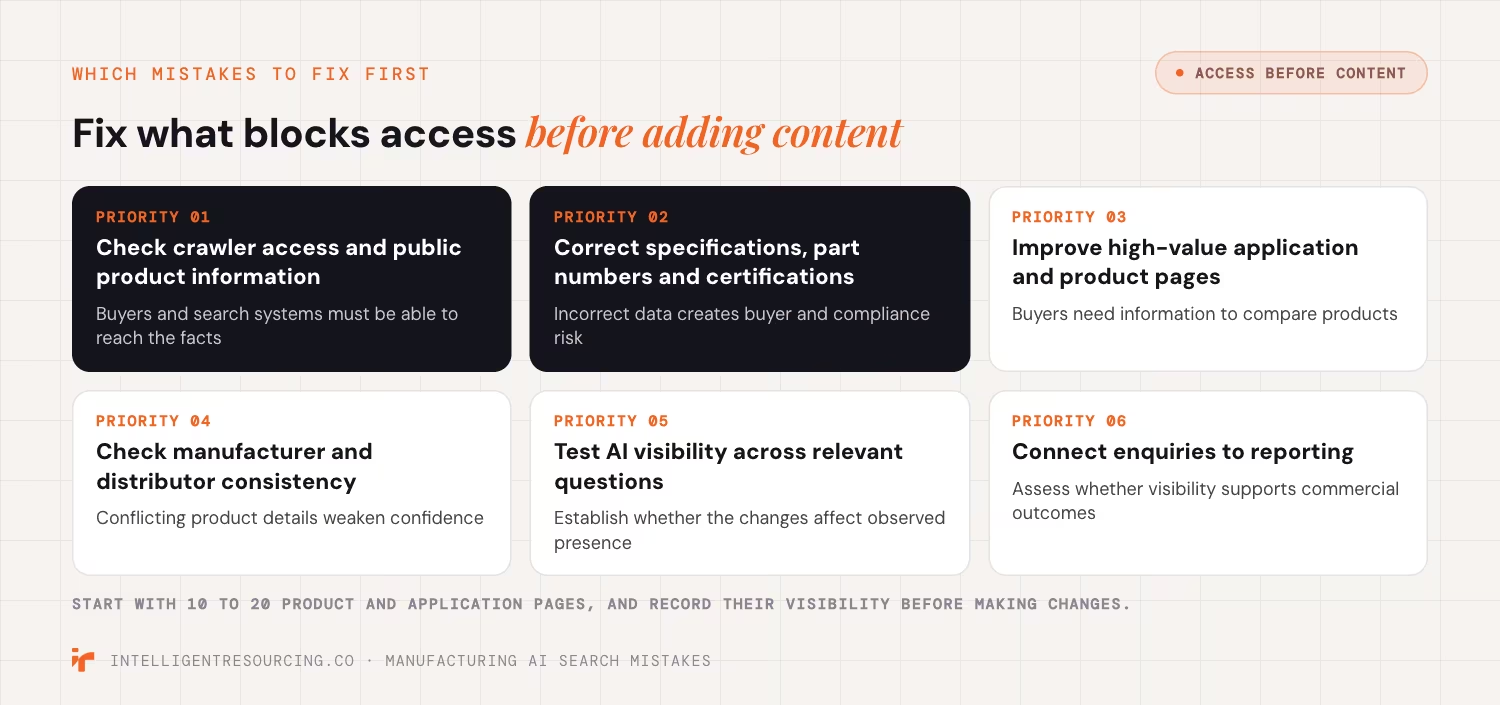
| Priority | Action | Reason |
|---|---|---|
| 1 | Check crawler access and public product information | Buyers and search systems must be able to reach the facts |
| 2 | Correct specifications, part numbers and certifications | Incorrect data creates buyer and compliance risk |
| 3 | Improve high-value application and product pages | Buyers need information to compare products |
| 4 | Check manufacturer and distributor consistency | Conflicting product details weaken confidence |
| 5 | Test AI visibility across relevant questions | Establish whether the changes affect observed presence |
| 6 | Connect enquiries to reporting | Assess whether visibility supports commercial outcomes |
Do not begin with a complete catalogue rebuild unless your website cannot display essential product details. Choose 10 to 20 product and application pages for the first review, start with the products that receive the most technical enquiries or carry the greatest value, and record their current visibility before making changes.
When Should a Manufacturer Hire a GEO Agency?
Consider external support when the company has confirmed AI visibility gaps and lacks the resources to assess them and improve the content. A GEO provider can support content audits, buyer-question research, citation monitoring and page improvements. It should not replace the manufacturer's engineering approval process, because specifications, safety limits and compliance claims must be checked by the people responsible for them.
Before signing, ask for:
- The product lines and questions included in the work.
- Which AI engines will be monitored.
- A dated starting baseline.
- The content and technical changes included.
- How progress and limitations will be reported.
- Total costs and contract terms.
Avoid providers that promise guaranteed AI citations or claim that structured data alone will solve visibility problems.
A Strategic Blueprint shows where answer engine optimisation gaps sit before any monthly work starts. It reviews observable brand presence, source links and missing coverage across AI engines. It does not promise AI recommendations or sales, and it leaves technical verification with the manufacturer.
Content Creation
To see which buyer questions AI engines answer with other suppliers, book a Strategic Blueprint audit with Intelligent Resourcing.
FAQs
What are the most common AI search mistakes manufacturers make?
Common mistakes include relying only on Google rankings, hiding specifications in PDFs, publishing generic product pages, using inconsistent part numbers and treating schema markup as a guaranteed citation tool. Manufacturers also fail to measure AI presence across specific buyer questions and engines, and so cannot see where competitors win.
Why does AI search cite distributors instead of manufacturers?
A distributor can publish clearer, more accessible product information than the manufacturer. If its pages hold exact part numbers, operating limits and application details, they are more useful to buyers and to search systems. Publish complete product information on your own site, and correct inconsistent distributor listings.
Does schema markup improve AI citations for manufacturers?
There is no confirmed general citation benefit from adding schema alone. Ahrefs' May 2026 study of 1,885 pages found no clear positive effect for ChatGPT or Google AI Mode, and a small, statistically significant decline for AI Overviews. The study was not limited to manufacturing, so treat it as general evidence and test on your own pages.
Should manufacturers remove technical PDFs?
No. Engineers still need datasheets, manuals and drawings. Keep these files, and publish key specifications in readable HTML on the product page. Make sure each PDF has searchable text, correct product identifiers and a current revision date.
How should manufacturers measure AI search visibility?
Test a fixed set of buyer questions across several AI engines, and record whether the manufacturer is named, cited or absent. Separate results by branded and non-branded prompts, product line and engine. Repeat the tests on a schedule, and track enquiries separately from visibility.
What should a manufacturing company fix first for GEO?
Start with crawler access, accurate specifications and accessible product pages. Next, improve application content and correct conflicting distributor information. Measure AI visibility before and after changes, and add more content only when it answers a specific buyer question that current pages do not address.