

Why Do Spec-Heavy Websites Need a Checklist of Their Own?
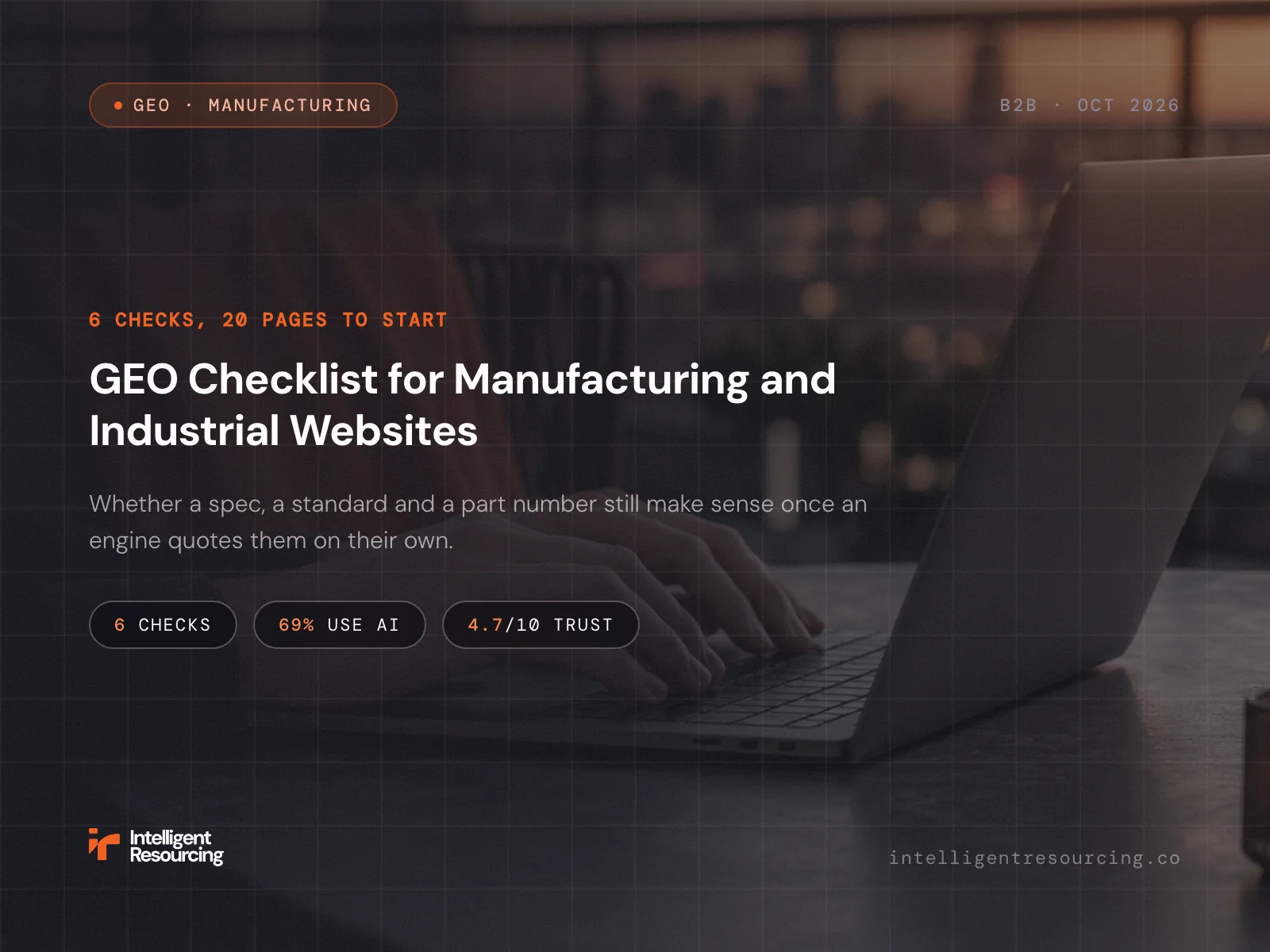
Spec-heavy websites need their own generative engine optimisation (GEO) checklist because engineers use artificial intelligence (AI) answers to build a shortlist, then check the numbers. A general audit tests whether a page can be read. An industrial audit also tests whether each value, standard and part number still makes sense when quoted on its own.
Buyers already use these tools. TREW Marketing and GlobalSpec’s 2026 State of Marketing to Engineers report asked technical buyers how they research and buy.
| Finding | Result |
|---|---|
| Technical buyers who use generative AI when they buy | 69% |
| Their trust in AI answers | 4.7 out of 10 |
| Buyers who rate vendor engineering experts as very or extremely trustworthy authors | 66% |
The gap between use and trust is your opening. When an engine quotes your exact figures, a careful engineer can check them on your own page.
Our manufacturing GEO guide explains why specs belong in HTML and which schema types to use. This checklist starts where that guide stops: the single page and the single value.
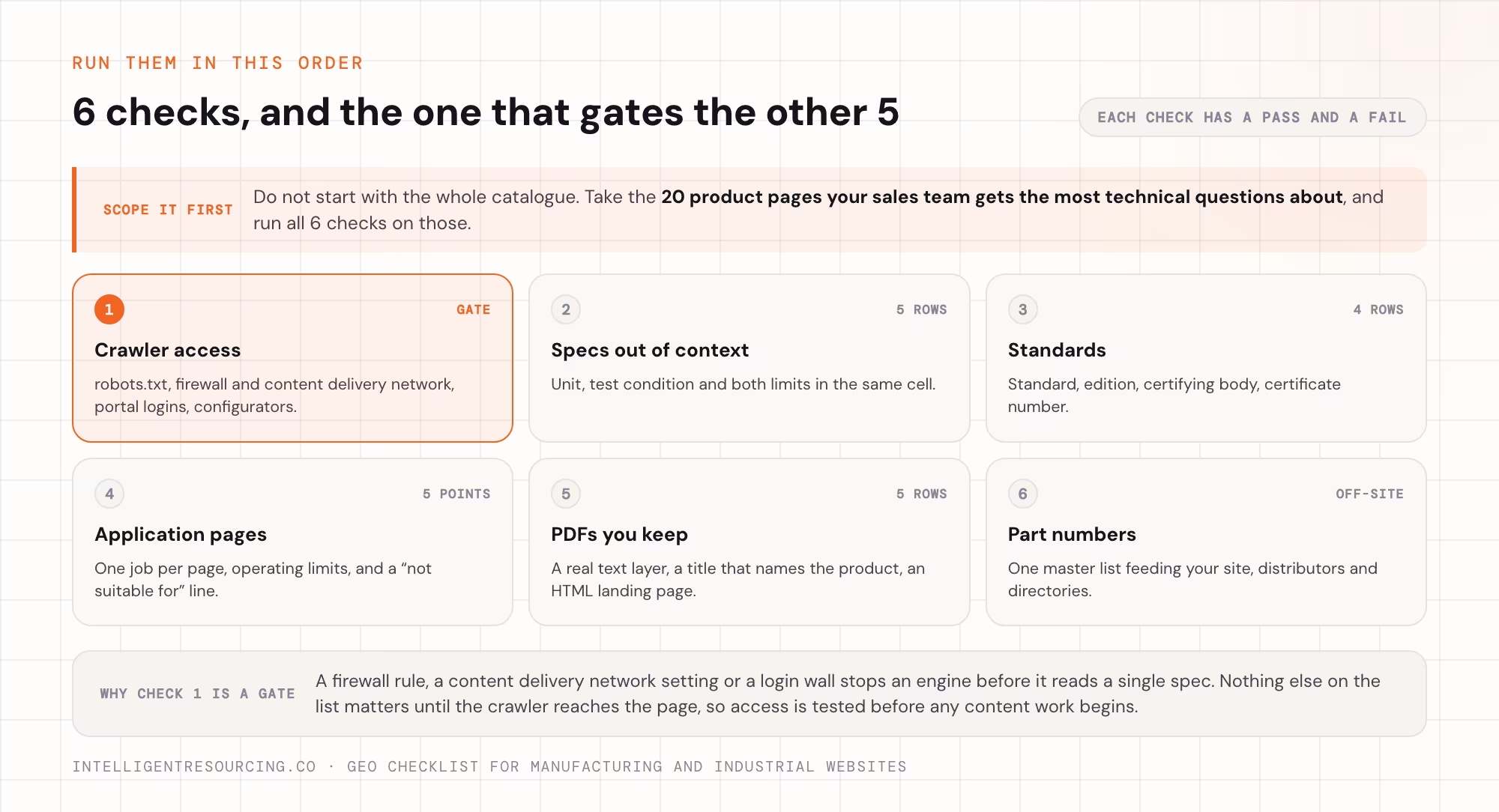
Don’t start with the whole catalogue. Pick the 20 product pages your sales team gets the most technical questions about, and run every check below on those first.
Can AI Crawlers Reach Your Product and Spec Pages?
Many industrial sites block AI crawlers without anyone deciding to. A firewall rule, a content delivery network (CDN) setting or a login wall can stop an engine before it reads a single spec. Check access first, because nothing else on this list matters if the crawler never reaches the page.
Crawler rules don’t always say what site owners mean. The Data Provenance Initiative’s audit of 14,000 web domains found inconsistencies between what sites said in their terms of service and what their robots.txt files allowed. Check what your files actually say.
| Check | Pass | Fail |
|---|---|---|
| robots.txt | Crawlers such as GPTBot, OAI-SearchBot and PerplexityBot can open product folders | A blanket block, or a rule copied from an old template |
| Firewall and CDN | Bot settings reviewed in the last 12 months | Defaults never checked |
| Datasheet library | Spec pages open without a login | Specs sit inside a customer or distributor portal |
| Product configurator | Key values appear in the page source | Values load only after a buyer picks options |
For the configurator check, open the page source and search for a key value. If it’s missing there, a crawler that doesn’t run scripts never sees it. Our robots.txt and llms.txt guide shows how to open the right paths to each crawler.
Does Every Specification Make Sense Out of Context?
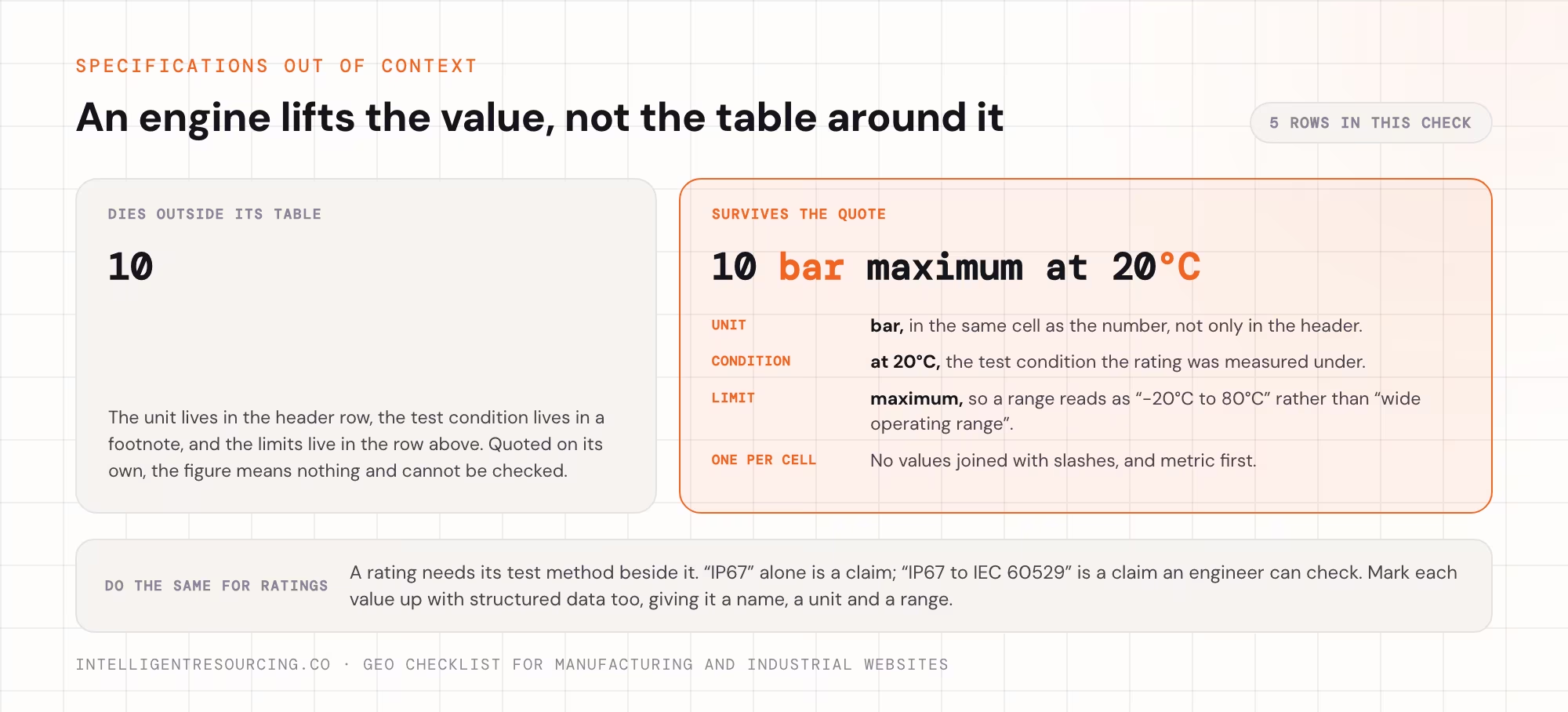
A spec makes sense on its own when the unit, test conditions and limits sit right beside the number. AI engines lift single values from pages. A bare "10" means nothing once it leaves its table, but "10 bar maximum at 20°C" is a figure an engineer can quote, check and trust.
| Check | Pass | Fail |
|---|---|---|
| Units | The unit sits in every cell, such as "6 mm" | Units appear only in the header row |
| Conditions | The test method sits beside the rating, such as "IP67 to IEC 60529" | A rating with no test method |
| Ranges | Both limits written out, such as "-20°C to 80°C" | "Wide operating range" |
| One value per cell | One figure in each cell | Several values joined with slashes |
| Unit system | Metric first, imperial in brackets if buyers need it | Systems mixed across pages |
Research points the same way. A 2025 study comparing AI search with Google advises engineering content for machine scannability and justification. A unit and a test condition do both jobs for a spec. Mark up each value with structured data too, giving it a name, a unit and a range.
Clean values also decide who gets cited. Our guide to why manufacturers go missing from AI search shows how distributors with tidier tables get named instead of the maker.
Can an AI Engine Verify Your Standards and Certifications?
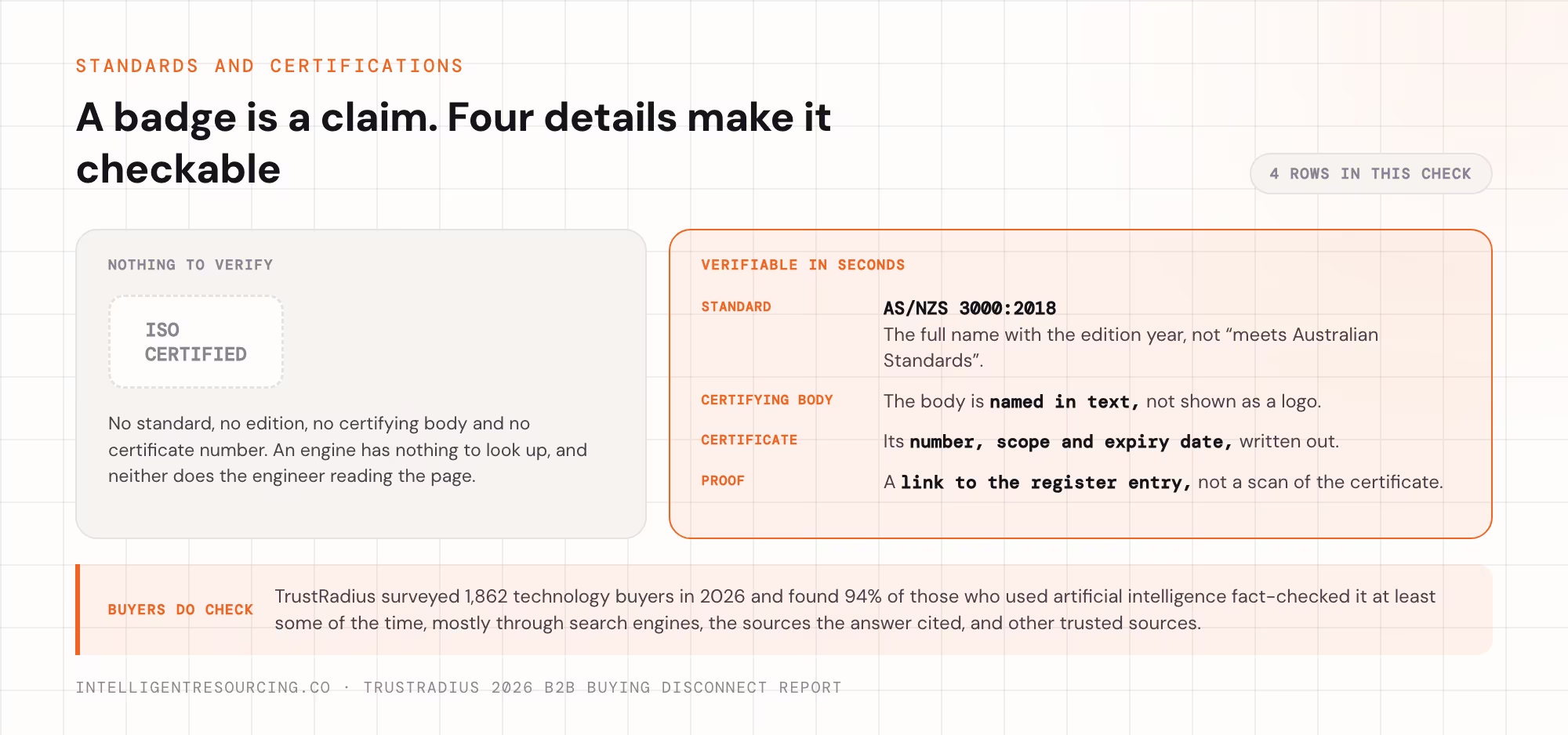
An engine can check a certification claim only when the page gives 4 details: the standard, its edition, the certifying body and the certificate number. "ISO certified" on a badge gives it none of these. Write each claim so a buyer, or a model, can find it in a public register and confirm it.
Buyers do check. TrustRadius’s 2026 survey of 1,862 technology buyers found 94% of those who used AI fact-checked what it told them at least some of the time. The top 3 resources they used were search engines, clicking through to the sources the AI cited, and other trusted sources.
Those buyers were software buyers, but engineers check at least as hard. A certificate number linked to a public register gives them something to confirm in seconds.
| Check | Pass | Fail |
|---|---|---|
| Standard | Full name with the year, such as AS/NZS 3000:2018 | "Meets Australian Standards" |
| Certifying body | The body is named | A logo with no name |
| Certificate | Number, scope and expiry date shown | A badge with no details |
| Proof | A link to the register entry | A certificate shown only as an image |
Building these details into every product template is a core part of generative engine optimisation work.
Do Your Application Pages Answer "Which One for This Job"?
Application pages answer "which one for this job" when they state the operating limits, what the product suits and what it doesn’t suit. Engineers rarely ask an AI engine for a part number. They ask which product handles a given load, chemical or temperature, and plain answers get used.
So build each application page around the questions an engineer asks. A question about a pump for abrasive slurry breaks into parts like these:
| Sub-question | What the page needs |
|---|---|
| What flow rate does it handle? | An operating limits table |
| Which wear materials suit slurry? | A materials compatibility table |
| Which seals will last? | Seal options with a "not suitable for" line |
A page that answers each part directly gives the engine more to work with. Each application page should carry:
- A title naming the job, such as "Pumps for abrasive slurry", with one page per application.
- Operating limits in a table, covering pressure, temperature, flow and how long it can run.
- A compatibility table for materials, fluids or the parts it connects to.
- A plain "not suitable for" line, which answers the question a careful engineer asks next.
- A named engineer as author, with their role, since vendor engineers are the authors technical buyers trust most.
Mapping these questions across a whole product range is the core of our content service built for AI answers.
Will the PDFs You Keep Still Be Readable?
The PDFs you keep stay readable when they have a real text layer, a clear title and an HTML page that introduces them. Key values belong in HTML, but full datasheets, manuals and drawings will stay as PDFs. Check each one so an engine pulls out its text instead of finding a picture of a page.
Reading PDFs is harder for machines than it looks. A 2024 study of 10 PDF reading tools found every tool struggled with scientific and patent documents. A scanned page with no text layer is worse, because there’s no text to pull out at all.
Test each file in 3 steps:
- Open the PDF in any reader.
- Search inside it for a part number.
- If the search finds nothing, the file has no text an engine can read.
| Check | Pass | Fail |
|---|---|---|
| Text layer | Text can be selected and searched | A scanned image of each page |
| Document title | The title property names the product | "Microsoft Word - Document1" |
| File name | pump-ps200-datasheet.pdf | scan_0043.pdf |
| Landing page | An HTML page lists the key values and links the PDF | A bare download link |
| Version | Revision number and date on page 1 | No date anywhere |
Do Your Part Numbers Match on Every Site That Lists Them?
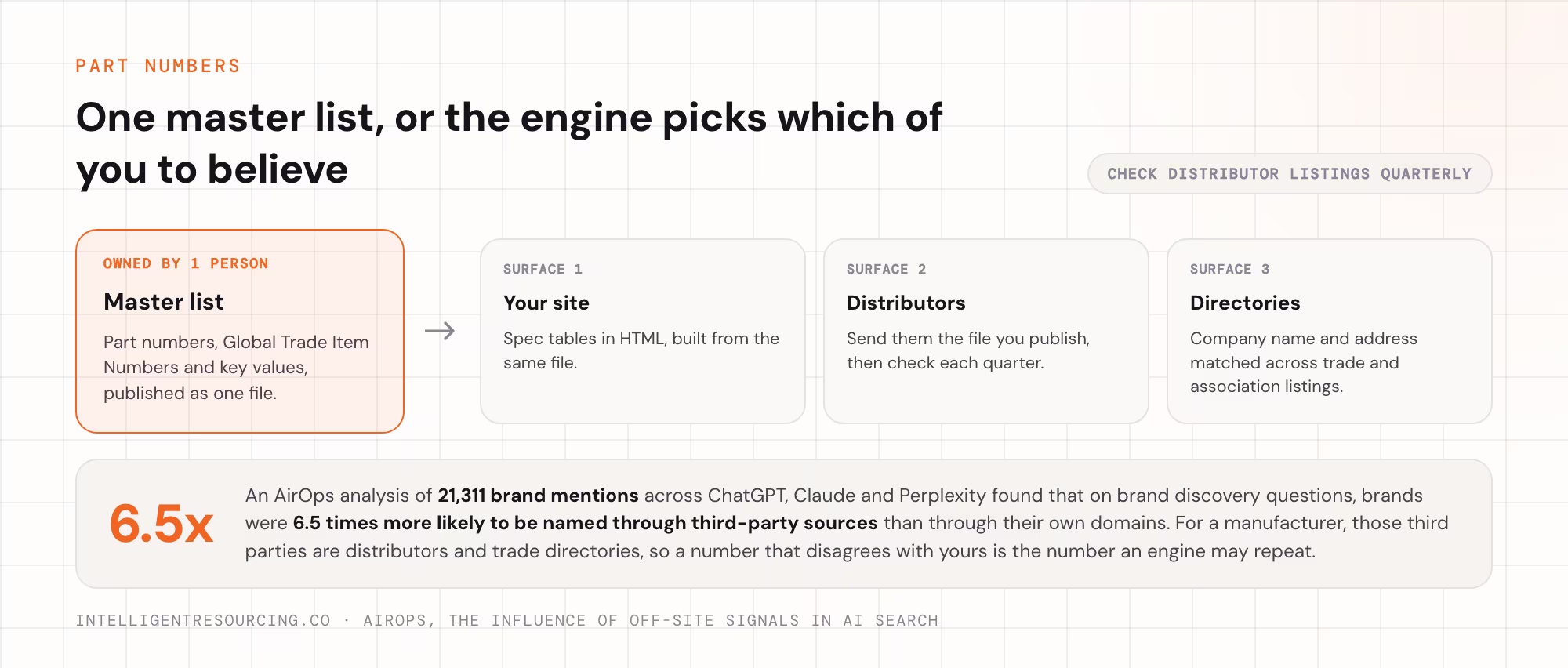
Part numbers match when 1 master list feeds your site, your distributors and your directory listings. An engine that finds 2 numbers, or 2 values, for the same product can’t tell which is right. It picks the version it trusts more, or it leaves the product out.
Other sites carry much of the weight. An AirOps study of 21,311 brand mentions found that on brand discovery questions, brands were 6.5 times more likely to be named through third-party sources than through their own domains. For a manufacturer, those third parties include distributors and trade directories.
Keep those listings in line with your own:
- Keep 1 master list of part numbers, Global Trade Item Numbers (GTINs) and key values, owned by 1 person.
- Send distributors the file you publish, then check their listings each quarter.
- Never reuse a retired part number for a new product.
- Match your company name and address across trade directories and association listings.
Content Creation
We’ll go through them with you, page by page. The findings are yours to keep, whether we end up working together or not.
FAQs
What does a GEO checklist for manufacturing and industrial websites cover?
It’s a page-by-page test of whether AI engines can find, read and check a manufacturer’s product specs. It covers crawler access, units and conditions, standards, application pages, PDFs and part numbers. Each check has a clear pass and fail, so a web team can work through it without a rebuild.
How do you test whether a PDF datasheet is readable to AI?
Open the PDF and search inside it for a part number. If the search finds nothing, the file is a scanned image with no text to pull out. Then check the document title names the product and an HTML page links to the file.
How should units and tolerances be written for AI search?
Put the unit in the same cell as every value, and state the test condition beside it. Write ranges with both limits, such as -20°C to 80°C, and use one value per cell. A figure written this way still makes sense when an engine quotes it alone.
Does an "ISO certified" badge help with AI citations?
A badge on its own gives an engine nothing to check. Name the standard and its edition, the certifying body, the certificate number and its scope. A buyer, or an engine, can only confirm a claim that names the body that issued it.
Which product pages should a manufacturer check first?
Start with the 20 product pages your sales team gets the most technical questions about. TREW Marketing found 69% of technical buyers use generative AI when buying, so those questions now reach AI engines too. Fix those pages first, then extend the checklist across the range.