

What Makes B2B SEO Campaigns Successful in Australia?
Successful B2B SEO campaigns in Australia target the questions a buying committee asks. They build technical foundations that both search engines and AI crawlers can read, and measure pipeline influence, not just rankings. Keyword volume alone predicts none of these outcomes.
SEO remains the most used B2B marketing channel. HubSpot's 2026 State of Marketing report found website, blog, and SEO is used by 48.4% of B2B marketers, ahead of email at 39.3% and organic social at 38.6%. That measures what marketers use, not where buyers look. Responsive's 2025 study of 350 B2B buyers found nearly two-thirds use generative AI as much as or more than search when researching vendors. A campaign needs to cover both.
A campaign built around that reality covers three layers:
- Demand mapping. Keywords sorted by buying-committee role and research stage, not by search volume alone.
- Technical health. Fast, crawlable, properly indexed pages, checked against both Google Search Console and a log-file crawl for AI bots. How AI engines evaluate technical content covers what they look for.
- Content built to answer, not just rank. Pages that open with a direct answer a reader or an AI engine can lift on its own.

Most underperforming campaigns skip the first layer. The difference shows up in results:
| Approach | Typical outcome |
|---|---|
| Keyword volume targeting | Traffic that rarely matches any buying-committee role |
| Content mapped to buyer role and research stage | Higher conversion, because each page answers the question that visitor actually had |
Pages built this way sit inside a broader content strategy programme. They are not one-off posts chasing a keyword.
How Is B2B SEO Different from B2C SEO?
B2B SEO targets a buying committee researching over months, while B2C SEO targets one person deciding in minutes. That difference changes keyword choice, content depth, and what counts as a converting visit. A B2B sale needs more proof before anyone signs off.
B2B purchases involve several stakeholders, and the number scales with company size. A 2026 Belkins analysis of 1,871 ideal customer profile submissions found sellers list an average of 4.6 decision-maker titles per deal at small businesses, 5.6 at mid-market and 6.0 at enterprise. Enterprise committees add gatekeepers such as legal, procurement and IT security. A single landing page cannot answer a technical evaluator, a budget holder, and an end user at once.

| Factor | B2B SEO | B2C SEO |
|---|---|---|
| Decision-maker count | Multiple roles, often 4 to 6 titles | Usually one person |
| Search volume per term | Lower, more specific | Higher, more general |
| Content depth needed | Technical detail, proof, comparison | Simpler, faster to the purchase |
| Typical research window | Weeks to months | Minutes to days |
| Conversion to track | Qualified pipeline, not just a form fill | Direct purchase or lead |
Content built for B2B needs a separate page per role in that committee. A technical evaluator wants integration detail and proof. A budget holder wants cost and risk. Serving both with one generic page loses a share of the committee before they reach a sales conversation.
Structuring that content helps an AI engine tell the roles apart. That is the specific job answer engine optimisation does.
What Does AI Search Change for a B2B SEO Campaign?
AI search adds a second reader to a B2B SEO campaign and leaves the first in place. Google's crawler and AI crawlers both need pages that are fast, crawlable and structured, so the SEO foundation stays and a few AI-specific checks go on top.
AI referral traffic is still small. Ahrefs reported AI chatbots sent 3.5 million visitors in March 2026 across the 74,752 websites tracked by chatgpt-vs-google.com, about 0.28% of total web traffic in that sample. Small does not mean irrelevant. B2B buyers making a considered purchase are the audience most likely to ask an AI assistant a specific question.
Three checks cover most of what a campaign team can change:
- Schema that mirrors the page. FAQPage and Article markup should match the visible text exactly.
- Entity clarity. Name the organisation, the service and the author the same way on every page.
- Server-rendered answers. In a Vercel and MERJ study, none of the major AI crawlers tested rendered JavaScript, so the answer needs to sit in the raw hypertext markup language (HTML).

Why ranking and citation have separated is covered in moving SEO budget to AI work. The signals that predict a citation are in what actually predicts an AI citation.
Which SEO Basics Still Apply for B2B Buyers?
Nearly all of them. Crawlability, site structure and helpful, people-first content remain the foundation Google's SEO Starter Guide recommends. AI search hasn't changed that foundation. A campaign that skips these basics struggles in both classic rankings and AI answers.
The basics worth checking before anything more advanced:
- Crawlable and indexed pages. Confirm every commercial page is reachable and free of an accidental noindex tag. Check that it appears in Search Console's index coverage report.
- Fast, mobile-first pages. Google uses the mobile version of a page for indexing and ranking. Load time and layout stability matter on a phone, not just a desktop.
- Content written for the reader first. Pages built to satisfy a search intent, not to hit a keyword quota, perform better on both classic rankings and AI citation.
- Clean internal linking. Related pages linked by topic help both readers and crawlers understand how a site connects.
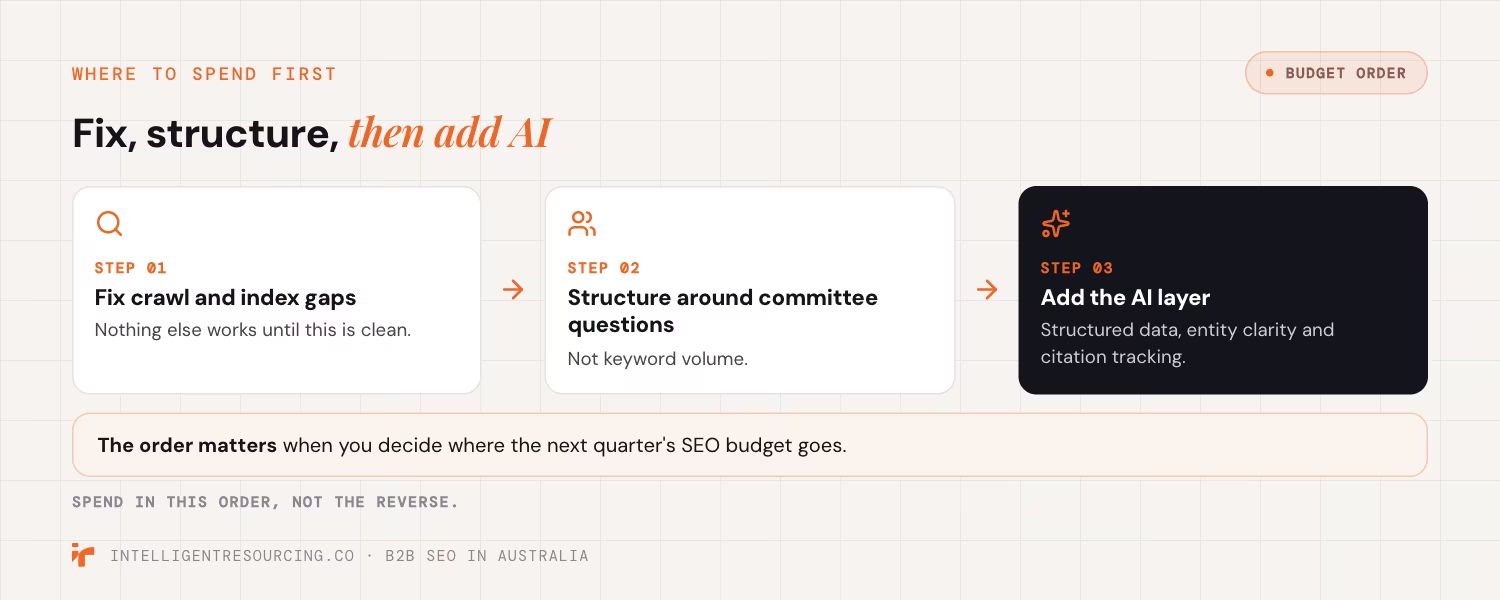
For an Australian B2B team weighing where to spend the next quarter's SEO budget, the order matters:
- Fix any crawlability or indexing gap. Nothing else works until this is clean.
- Structure content around buyer-committee questions, not keyword volume.
- Add the AI-specific layer: structured data, entity clarity, and citation tracking.
Ahrefs' technical SEO guide makes the same point: well-structured, crawlable pages help AI systems find, understand and surface a site's content.
Knowing which of these basics a site is actually missing beats guessing.
Book a free AI citation audit of your site.
Content Creation
A free audit shows where your pages stand on crawlability, structure and AI citation, so you fix the right gap first.
FAQs
What makes B2B SEO campaigns successful in Australia?
Successful campaigns target buying-committee questions at each research stage, keep pages technically clean for both Google and AI crawlers, and measure pipeline influence rather than rankings alone. Keyword volume by itself predicts none of these outcomes.
How is B2B SEO different from B2C SEO?
B2B SEO serves a buying committee researching over weeks or months, often 4 to 6 decision-maker titles. B2C SEO serves one person deciding quickly. B2B content needs more depth, more proof, and a separate page per role in the purchase.
Does SEO still fuel AI search visibility?
Yes. SEO still supplies the crawlability, structure, and authority an AI engine draws on before it cites a source. AI referral traffic stays a small share of total traffic today, but it is growing, and the two channels increasingly need separate tracking.
How long does a B2B SEO campaign in Australia take to show results?
Early ranking movement in B2B SEO typically shows within three to six months for specific, lower-competition terms, though competitive commercial terms can take 12 months or more. Turning that into a qualified pipeline takes longer again, because B2B research cycles run for weeks or months before a buying committee decides.