
What Ranking Factors Matter Most for LLM SEO?
The strongest evidence clusters around accessibility, search visibility, query relevance and extractability, rather than any single new AI ranking signal.
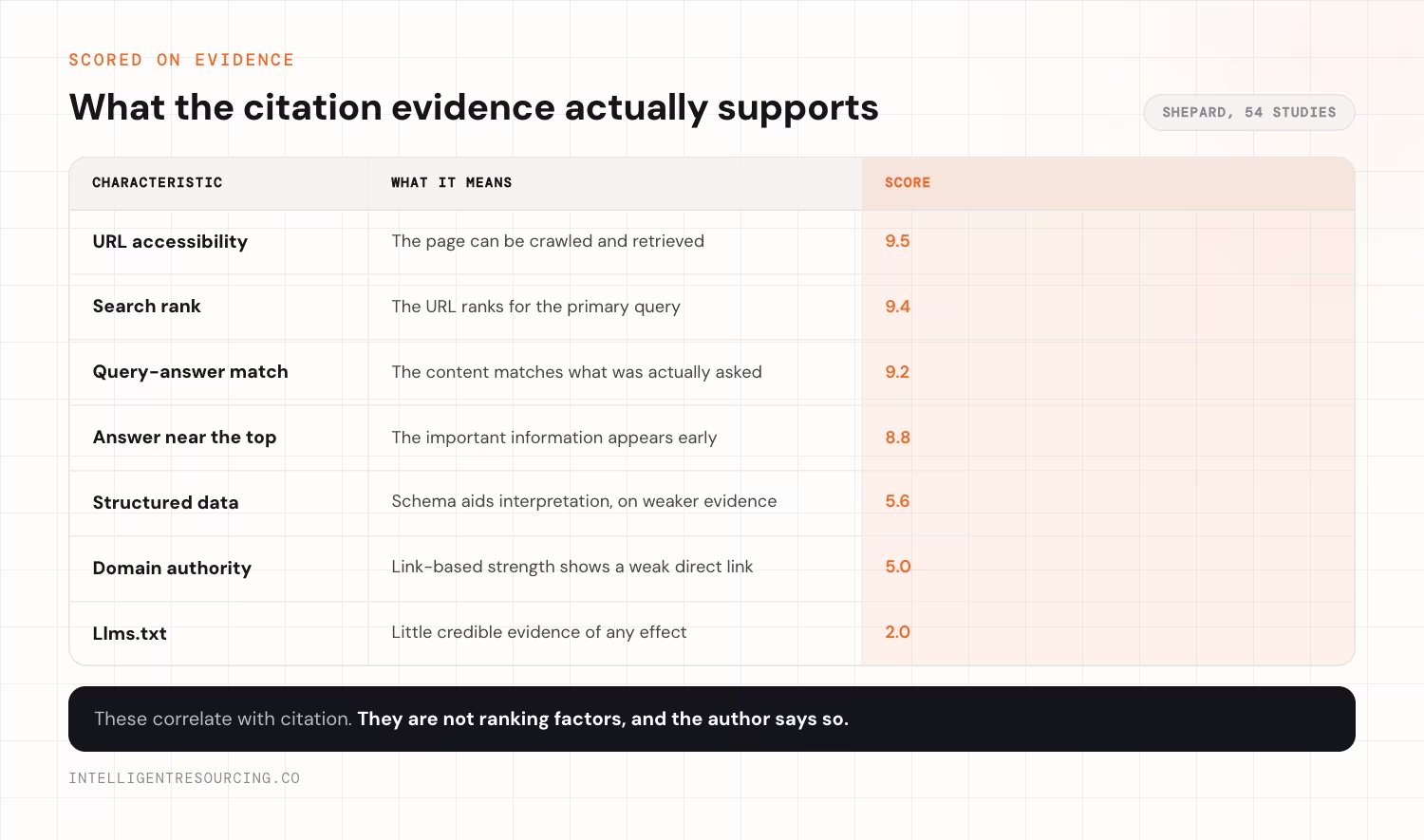
Cyrus Shepard reviewed AI citation experiments, studies and patents over two years and narrowed them to the 54 most useful, scoring each candidate factor on repeatability, strength of evidence and official platform support. He is explicit that these are not ranking factors in the classical sense, and that correlation is not causation.
| Citation characteristic | Score | What it means |
|---|---|---|
| URL accessibility | 9.5 | The page can be crawled and retrieved |
| Search rank | 9.4 | The URL ranks for the primary query |
| Fan-out rank | 9.3 | The URL ranks for the sub-queries generated during retrieval |
| Query-answer match | 9.2 | The content matches what was actually asked |
| Intent-format match | 9.0 | The page format fits the kind of answer needed |
| Topic cluster ranking | 8.9 | The site is visible across related queries |
| Answer near the top | 8.8 | The important information appears early |
| AI-ready structure | 8.6 | Content is organised for extraction |
| Factually specific | 8.3 | Claims carry explicit, checkable detail |
| Structured data | 5.6 | Schema aids interpretation, on weaker evidence |
| Domain authority | 5.0 | Link-based domain strength shows a weak direct link |
| Llms.txt | 2.0 | Little credible evidence of any citation effect |
Read the table as two stages rather than a list. The top half is about retrieval eligibility: can the system find, reach and judge the page relevant? The rest is about selection: once retrieved, does the passage answer the question clearly enough to quote and attribute? Traditional search work carries most of the first stage. Answer engineering carries the second.
Our LLM SEO checklist covers how to test the accessibility gate on your own pages, since it is the one that silently voids the rest.
Does Publishing More Content Improve AI Citation Odds?
More pages help only when they answer questions the site does not already cover.
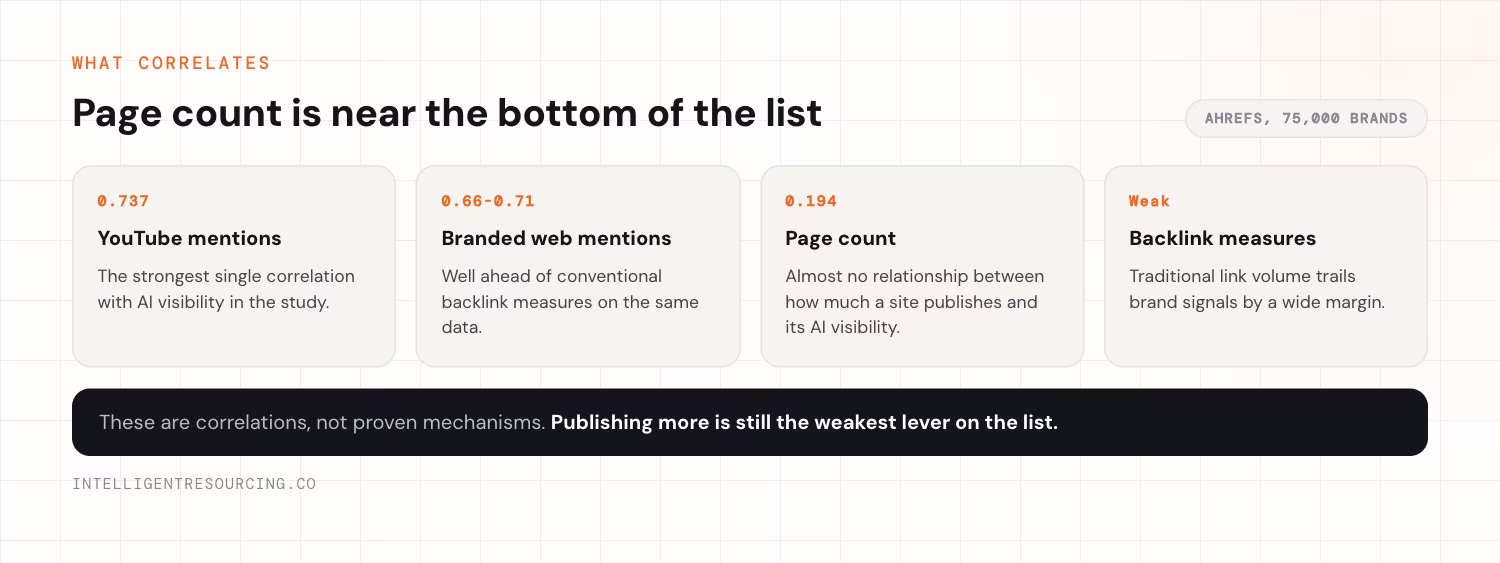
Ahrefs' study of 75,000 brands found almost no relationship between the number of pages on a site and AI visibility, at a correlation of roughly 0.194. For comparison, branded web mentions in the same study ran between 0.66 and 0.71, and YouTube mentions reached 0.737.
The useful question is not how many pages to publish. It is which valuable buyer questions currently have no strong answer on the site.
Coverage still matters, and format matters with it. BuzzStream analysed four million citations across roughly 4,000 prompts over a week in January 2026 and found blog and content pages took 53.46% of citations, ahead of news at 14.09% and social at 8.71%. It also found the type of prompt changed which formats got selected.
So the practical position is:
- New coverage helps when it closes a real prompt gap.
- Generic coverage does not raise citation odds on its own.
- Format has to match intent, because comparison, informational and brand questions pull from different source types.
- Every page needs a job in the buyer-question set, not another keyword variation.
Structure-first does not mean publish less. It means earn the right to scale by solving retrieval first.
Does Schema Help You Get Cited?
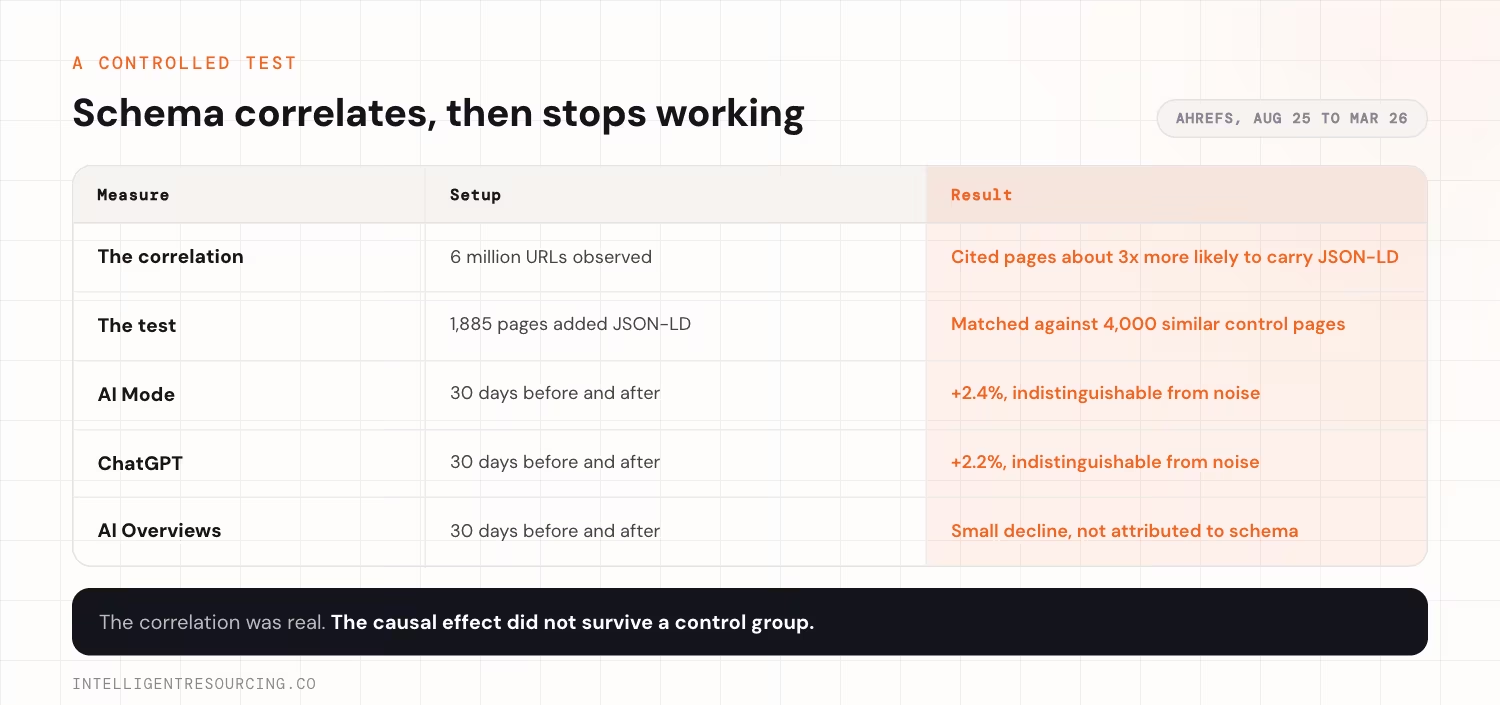
Not on its own, and this is the clearest result in the whole category.
The belief has a real basis. Across six million URLs, pages cited by AI were about three times more likely to carry JSON-LD. That looks decisive until you ask whether schema caused it or simply travelled with better content and stronger links.
Ahrefs tested exactly that. It tracked 1,885 pages that added JSON-LD between August 2025 and March 2026, matched them against 4,000 control pages with similar prior citation levels, and compared the 30 days before and after. No platform showed a meaningful increase. AI Mode moved 2.4% and ChatGPT 2.2%, both indistinguishable from noise. AI Overviews showed a small decline the researchers would not attribute to schema.
The correlation was real. The causal effect was not there.
That does not make schema useless. It makes it the wrong lever to pull for citations. Schema earns its place reinforcing what the visible content already says:
- Organisation identity, so it is clear which company the page represents.
- Service relationships, connecting what is offered to who offers it.
- Author identity, making expertise easier to attribute.
- Entity consistency, so naming variations resolve to one entity.
- Publishing signals, clarifying when content was written or updated.
If an important fact exists only inside JSON-LD, it is not doing the job you think it is. Put it in the visible page.
Where Do Backlinks and Brand Signals Fit?
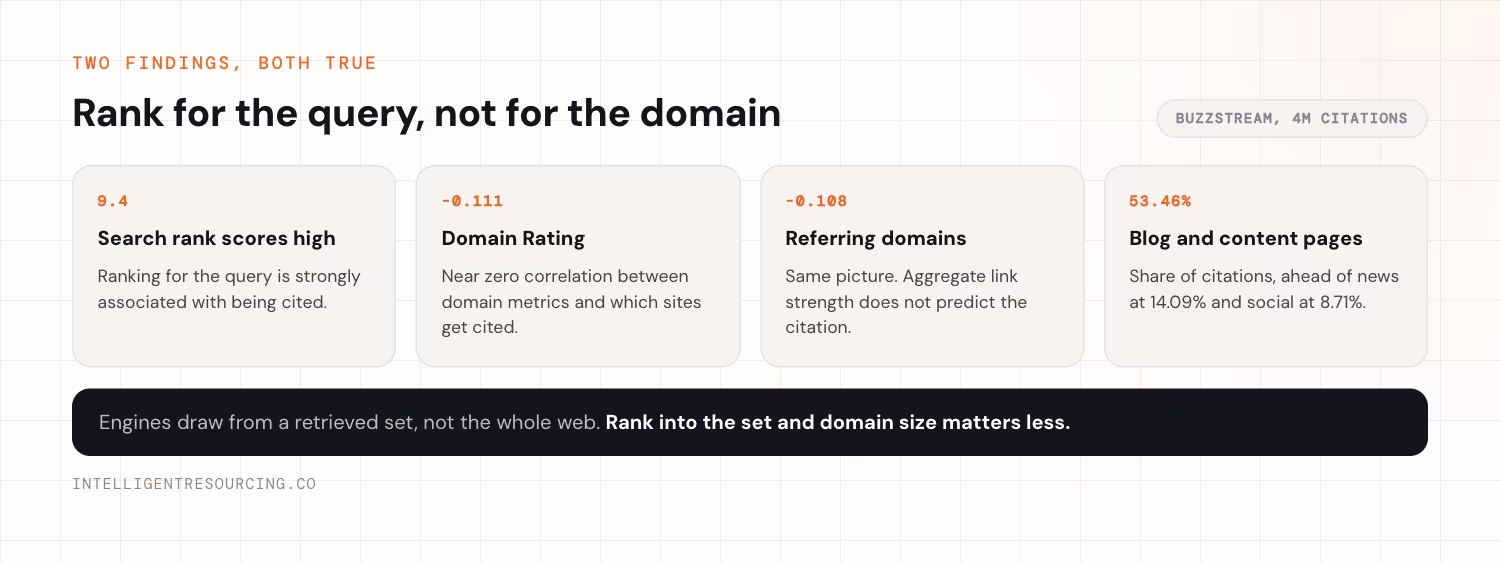
Backlinks still matter, but domain-level link metrics are a poor proxy for citation performance.
The two findings that look contradictory are not. Shepard scores search rank at 9.4, a strong relationship between ranking for a query and being cited. BuzzStream found essentially no correlation between the sites cited and their domain metrics: Domain Rating at minus 0.111, referring domains at minus 0.108, organic traffic at minus 0.089.
Both hold, because they measure different things. A page can rank well for one specific query without sitting on the biggest backlink profile in the category. BuzzStream's own reading is that engines do not draw from the whole web, they draw from a retrieved set built around query variations. Rank into that set and the domain's aggregate authority matters less.
Brand signals behave differently again. In the Ahrefs correlation study, branded mentions and branded anchor text outperformed conventional link measures by a wide margin. That is correlational, not proof of mechanism, but it points somewhere practical: a brand that appears across relevant publications, discussions and video gives an engine more corroborating context than one whose presence sits entirely on its own domain.
Our analysis of what backlinks do for AI citation sets out the working model: authority helps a page reach the candidate pool, and answer quality decides what happens next.
Why Does Answer-First Structure Matter?
Because position inside the page changes the odds.
Kevin Indig analysed 1.2 million AI answers and 18,012 verified citations, reported by Search Engine Land, and found 44.2% of citations came from the first 30% of page content. Later content still gets cited. It is just cited less.
A section that survives extraction usually runs in this order:
- Answer first, in one or two sentences.
- Evidence next, with the figure, study or observation behind it.
- Mechanism after that, explaining why it holds and where it stops.
- Comparison in a table or list when several variables are in play.
- Nuance last, so exceptions do not blunt the opening answer.
A heading that asks "Does schema help AI citations?" followed by "Not on its own" beats three paragraphs of background before the point. Our guide to structuring content for AI citation covers the mechanism in more depth.
What Should You Prioritise?
In this order.
- Make priority pages retrievable. Accessible, present in the rendered HTML, not blocked.
- Build around the exact buyer question. A heading that names a question sets up an answer. A category label does not.
- Match format to intent. A comparison question needs a table. A process question needs steps.
- Put the answer before the explanation. The citable claim goes directly under the question.
- Make claims specific. "Branded mentions correlate with AI visibility at 0.664" is reusable. "Brand awareness seems important" is not.
- Add pages only for real gaps. If a suitable page exists, restructuring it usually beats publishing an overlapping one.
- Build third-party corroboration. Coverage, mentions and comparison pages that sit outside your own domain.
Then measure across repeated runs rather than one reading, which is the subject of our guide to citation velocity.
What Does This Look Like in Practice?
A programme built on mapped prompts and structured answers rather than a content quota.
Intelligent Resourcing's Kynection case study reports 23.6% AI share of voice in August 2026, first in its monitored category, with Procore second at 6.8%. That reading came from 1,459 brand mentions across 4,775 tracked runs and 373 tracked prompts. A fresh read of the same tracker on 8 September 2026 puts Kynection at 23.16% across 412 prompts and 10,111 runs, still first, with Procore at 6.18%. Different window, same shape.
Both are dated samples on a defined prompt set, not a guaranteed outcome on any query. What produced them was prompt mapping, content built for specific questions, structured direct answers and repeated measurement rather than a one-off audit. Our generative engine optimisation service runs on the same sequence.
Content Creation
Most of what gets sold as LLM SEO sits at the weak end of the evidence. Page volume correlates at 0.194 and schema did not move citations in a controlled test. Book a GEO diagnostic call with Intelligent Resourcing to see which buyer questions you are already losing.
FAQs
Does publishing more content improve AI citation odds?
Only when the new pages close real coverage gaps. Ahrefs found page count correlates with AI visibility at roughly 0.194 across 75,000 brands. Content becomes valuable when it gives the brand a credible answer to an important buyer question that no existing page covers.
Does schema help you get cited?
Not on its own. Ahrefs tracked 1,885 pages that added JSON-LD against 4,000 matched controls and found no meaningful citation increase on any platform. Cited pages do carry more schema, but that correlation disappears once other signals are held constant. Use schema for entity clarity, not as a citation lever.
Do backlinks still matter for LLM SEO?
Yes, but link count alone predicts little. Ranking for the query is strongly associated with being cited, while domain-level metrics show near-zero or slightly negative correlation with which sites get cited. Authority helps a page get considered. The answer decides the rest.
Do brand mentions matter more than backlinks?
They correlate more strongly. In Ahrefs' 75,000-brand study, branded web mentions ran between 0.66 and 0.71 against AI visibility, well ahead of conventional link measures. That is a correlation rather than a proven mechanism, but it supports treating third-party coverage as part of the work.
Should LLM SEO be structure-first or volume-first?
Structure first, then scale against verified prompt gaps. Improve retrieval, answer placement and evidence on pages that already exist. Create new pages when an important buyer question has no suitable answer anywhere on the site.