
How Does the Starting Point of B2B Research Change?
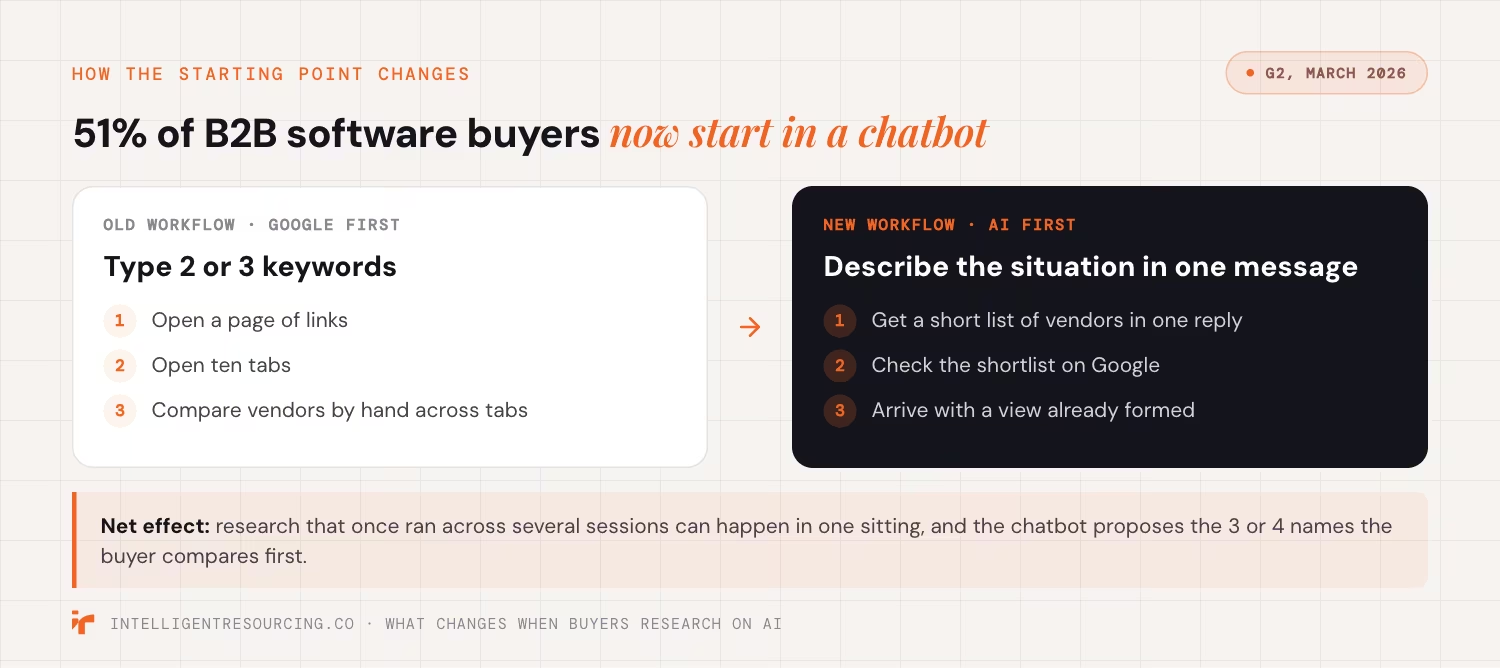
A buyer used to type two or three keywords into Google and open a page of links. Now many open a chatbot and describe their situation in one message. G2's 2026 AI search report, a March 2026 survey of 1,076 business-to-business (B2B) software decision-makers, found 51% start research in an artificial intelligence (AI) chatbot more often than Google. G2's 2025 Buyer Behavior Report put the same figure at 29%.
What that looks like in practice:
- Old workflow: type 2 or 3 keywords, open ten links, compare vendors by hand across tabs.
- New workflow: describe the situation in one message, get a short list of vendors in one reply.
- Net effect: research that once ran across several sessions can now happen in one sitting, and the chatbot proposes the 3 or 4 names the buyer compares first.
The tactics that earn a citation once this shift lands are covered in our B2B generative engine optimisation playbook.
What Does an AI Chatbot Weigh That Google Doesn't?

Google's ranking rewards a page that matches the query and earns links from other sites. An AI answer leans harder on what independent sources say about a vendor. A 2025 University of Toronto study compared AI search engines with Google and found the AI engines favoured earned, third-party sources over brand-owned and social content, while Google's mix was more balanced.
| What's weighed | Google rewards | An AI chatbot rewards |
|---|---|---|
| Content signal | Match with the query | Named entities, specific figures and use-case detail |
| Authority signal | Links from other sites | Independent coverage, reviews and third-party mentions |
| What it produces | A ranked page | A passage it can repeat in its own words |
A page can rank well on Google and still be left out of an AI answer when no independent source backs up its claims. Our breakdown of how a live AI search runs shows where in the process that filtering happens.
What Gets Removed From the Buyer's Research Process?
Buyers used to open five tabs and compare each vendor's claims by hand. Much of that cross-checking now happens inside the chatbot session. Semrush's 2026 survey of 519 United States B2B professionals who use AI at work found 41% start with AI and then validate the answer through search. Semrush sells search and AI visibility software, so treat it as vendor research.
- What's compressed: the open-ended browsing between a buyer's first search and their first real comparison.
- What stays: verification. The buyer still checks the answer, starting from a summary someone else assembled.
- What changes for a vendor: the first touchpoint is an AI summary the vendor does not write. Becoming a source that summary draws on is the job of a generative engine optimisation programme.
What Does a Pre-Briefed Buyer Know Before They Contact You?
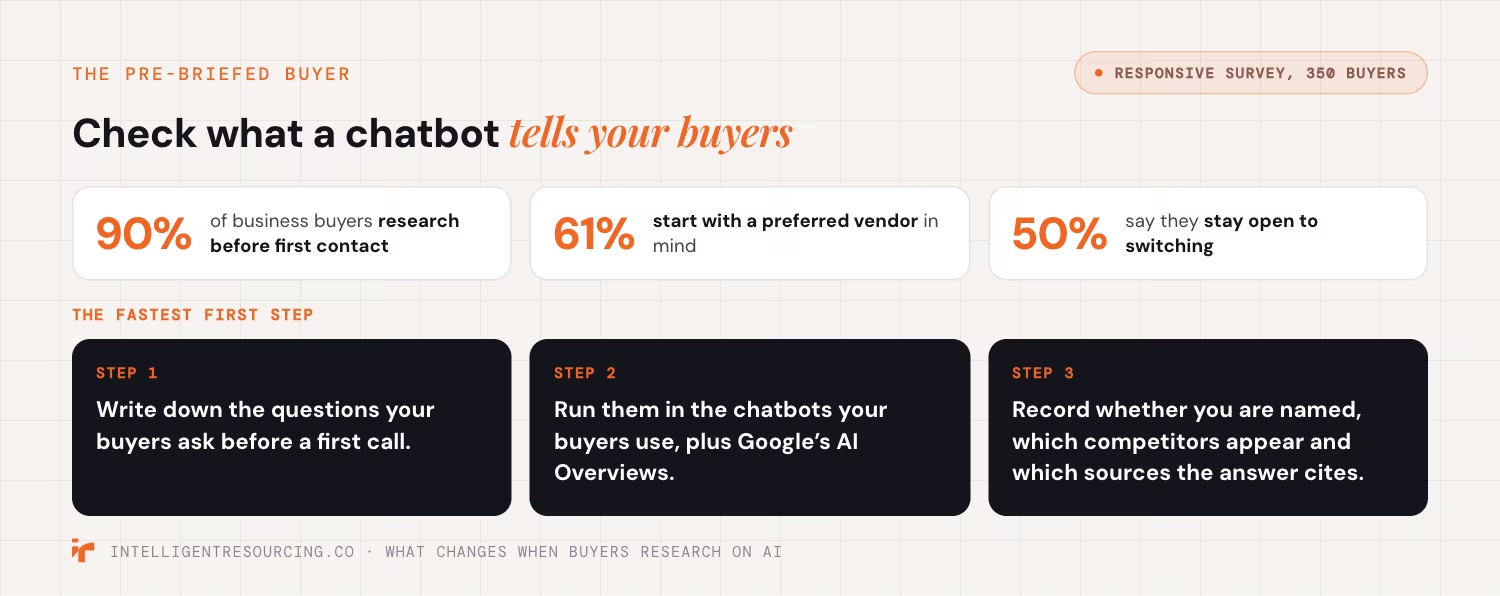
A buyer can reach a sales call already holding an AI-formed view of your strengths, your gaps and two or three competitors you never raised. Digital Commerce 360 reported Responsive's buyer survey, which found 90% of 350 business buyers research before first contact, and 61% start with a preferred vendor in mind. Half said they stay open to switching. Responsive sells proposal software, and every respondent worked at an organisation that issues at least 10 requests for proposal a year.
- The shortlist can still move. A preferred vendor is a starting point, and new information from a chatbot can shift it without the vendor knowing.
- The opening question changes. A rep can no longer assume the buyer is working from the vendor's own framing of the category.
- A better opener: ask what the buyer's research already told them, then correct it or build on it.
Where Does Google Still Fit Once AI Answers the First Question?

Google now does more checking than discovering. A buyer who wants to confirm a chatbot's answer searches the vendor's name, reads reviews and opens the site. On queries where Google shows its own AI Overview, Seer Interactive's 2026 study found organic click-through rate rose from 1.3% in December 2025 to 2.4% in February 2026.
| Organic clicks per 1 million impressions, informational queries, 2025 | Clicks |
|---|---|
| No AI Overview shown | about 33,500 |
| AI Overview shown, brand cited in it | about 20,700 |
| AI Overview shown, brand not cited | about 9,400 |
Seer tracked 53 brands and calls the data directional; higher-authority brands are also more likely to be cited, so read it as an association. On a page with an AI Overview, the cited brand still takes more than twice the clicks of the brand left out. Our guide to building an AI citation strategy covers how to measure that.
How Can You Check What a Chatbot Tells Your Buyers?
Keep the Google-ranking work, and add a check on the answers buyers read before they search. Earning an AI citation takes answer-first pages, named entities and claims other sources can confirm.
The fastest first step:
- Write down the questions your buyers ask before a first call.
- Run them in the chatbots your buyers use, plus Google's AI Overviews.
- Record whether your business is named, which competitors appear and which sources the answer cites.
Find out whether your business is one of the names an AI chatbot returns for your category. Scope an AI visibility audit through our answer engine optimisation service.
Content Creation
Find out whether your business is one of the names an AI chatbot returns for your category. Scope an AI visibility audit with Intelligent Resourcing.
FAQs
Is Google search declining for B2B buyers, or changing role?
Its role is changing. More buyers start in an AI chatbot, then use Google to check specific claims and look up the vendors the chatbot named. Most B2B buyers still use a search engine somewhere in their research.
Where do AI chatbots get the information they use to describe vendors?
Mostly from independent sources: press coverage, review sites, analyst and comparison pages, and forums. A vendor's own site is one input among many. Claims that other sources repeat are easier for a chatbot to state with confidence.
What should a sales rep ask a buyer who researched in a chatbot?
Ask what the research already told them and which other vendors came up. Then correct anything outdated and build on what is accurate. This saves the buyer from hearing a pitch that repeats what they already read.
What should a B2B marketing team measure instead of keyword rankings?
Track whether your business is named when an AI chatbot answers the questions your buyers ask. Measure it across the engines your buyers use, alongside rankings. Citation frequency shows whether you reach the shortlist before the first site visit.
When does a Google-first research process still make sense?
It still makes sense in formal procurement, where buyers need a comparison they can defend in a review. It also fits very new categories, where few independent sources exist for a chatbot to draw on.